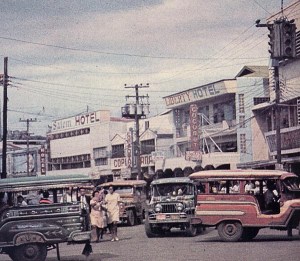
Everyone aboard every Navy ship that cruised between California and Vietnam in the late 1960s knew about liberty in Olongapo, Republic of the Philippines. The city stood just outside the main gate of the U. S. Naval base at Subic Bay, a regular port of call for Western Pacific (WESTPAC) ships.
Old salts called the town “hell” and promised Seaman Recruits coming on board the carrier USS Ranger out of bootcamp that anyone leaving the main gate of the base on liberty would be corrupted immediately by booze, drugs, girls, gambling and crime. They called the drainage ditch separating the base’s main gate from the town “the shit river,” though I saw it as the River Styx.
I crossed the shit river multiple times and found the world there to be everything the old salts described. As a former Eagle Scout, it crossed my mind on more than one occasion, “if only my Scout master could see me now.” Our Scout troop was sponsored by a church, so the Scout master was the least of my worries when I thought of how the deacons, elders and Sunday school teachers should they ever see a photo taken on Magsaysay Drive.
As a writer in training, I saw Magsaysay Drive and the Galaxy Bar and the touts and the constant ruckus in the streets as “research.” But I doubt my Scout master would have understood, or anybody else I knew, for that matter. Luckily, webcams and cell phones hadn’t been invented yet. There was no Facebook either in 1968. This meant that no pictures of me crossing the shit river appeared anywhere–and since a lot of time has gone by since then, I doubt they ever will.
Everyone who might know the Eagle Scout and paperboy who went to hell and then put his research into a novel called Garden of Heaven is long gone by now. So, I think I can safely post this excerpt without word getting back to the old neighborhood.
Excerpt from Garden of Heaven:
Standing on the bridge over the Shit River listening to the half-naked children in flimsy boats below shouting for a handful of centavos, the city in his face was—with more pride than apology—very much a city with its tattered underwear showing. If Magellan only knew what was here now. If Dad only knew David was here now.
Night was settling down over the hazy first lights of the bars and hourly rate hotels along Magsaysay Drive and the razor-sharp edges of Kalaklan Ridge like an old whore.
David dropped several 25-centavo coins over the railing, heard an explosion of whitewater, heard the laughter and the shouting, ‘Salamat, Joe, Salamat.’
He crossed Perimeter Road, ignored the hopeful greetings of the money changers behind their well-caged windows, then dodged a badly mixed throng of sailors, girls and honking multi-coloured jeepneys that swelled out into the Gordon Avenue intersection. He cut across the street, smiling, waiving at imagined friends in the distance, and moved with the deliberate intent of a man who had crossed this street hundreds of times.
‘Casual alertness, that’s the key to surviving Olongapo’s jungle of thieves, gangs, girls, high-strung Marines, bored Shore Patrol and Hard Hats, and drunk boatswain’s mates and snipes,’ Lowell had said.
“Hey Joe, cold beer cold beer cold beer, nice girls.”
Touts were everywhere below the slapdash smorgasbord of disheveled signs and awnings, leaning telephone polls, and the rag-tag assortment of buildings with upper floors stacked up in odd strata.
Assorted conversations flew past, barely audible in the close heat… ‘Hintayin mo aki,’ …‘Magandang amaga, Carlo, kumusta ang bagong sanggol?’… ‘Hey Joe’… ‘Tao po! Tao po!’… ‘Hoy, tulungan mo akong magdiskarga sa trak na ito, pwede ba?’… ‘Good food here, Joe!’… ‘Galing akong Maynila. Nasaan ang Zambales Bank?’… ‘Balut, Balut!’… ‘Tayo na’t kumuha ng makakain’ ‘Magandang ideya, handa na ako sa napunan’… ‘Nagustuhan mo ba ang bago kong kamera?’
The sign for the Galaxy Bar was plainer than most. An unadorned interior stairway led to the second-floor club, a large room strewn with tables occupied by sailors, many with girls whose eyes caught the low light like predators or gods. David didn’t see anyone he knew. He had a small envelope in his back pocket for Maria.
Two girls who had bathed in perfume and spackled their faces with makeup were leaning against the bar watching a waitress organise a tray full of San Miguel beer bottles.
“Maria, tingnan mo itong malambing na lalaki.”
“Lamayo ka sa kanya, Adelaide.”
Assuming he’d actually heard her name in those quick Tagalog comments, Maria was the one wearing a red dress, thrusting herself forward to him as he approached, posing her sweet curves, allowing her long hair to seductively frame her face, smiling as though they were friends with a history. He could almost see himself in the high gloss of her lipstick.
Copyright (c) 2010 by Malcolm R. Campbell
USS Ranger (CVA-61)
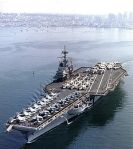
The USS Ranger has been decommissioned. The USS Ranger Foundation is working diligently to convert the aircraft carrier into a museum on the Columbia Driver near Portland, Oregon. The effort requires multiple phases, the next being a comprehensive environmental site analysis of the propose mooring location.
The Foundation is seeking donations to help pay for its on-going work. If you would like to contribute to the $15 million dollar fund raising project to bring a historic ship to Oregon as a museum, please click on the link above. Once you’re there, you’ll find some handy PayPal buttons.


 Malcolm's Round Table