Book Review: ‘Evenings on Dark Island’

Evenings on Dark IslandEvenings on Dark Island by Rhett Devane
My rating: 5 of 5 stars

What do the rich and famous, a Florida swamp, an expensive upscale spa, a rat-faced dog, state-of-the-art galas, NASCAR, pot, an inner garden of rare hybrid plants and vampires have in common?

The standard answer is nothing.

But in Evenings on Dark Island authors Rhett DeVane and Larry Rock have turned the highly improbable into a hilarious and tastefully bloody neck biter that’s quite something.

Vincent Bedsloe, who has party planning in blood that’s not altogether his, is the flamboyant, details-oriented master of an exclusive spa set in the middle of an isolated Florida island where the rich and spoiled come to be drained of their income–and perhaps a bit more–while they are ramped up into an ecstatic level of health and fitness.

Bedsloe, who ponders over the emotions of his guests–emotions he no longer has–often retreats into an inner sanctum where he watches old movies and gets his kicks by debunking the silly vampire lore flowing out of Hollywood like blood from a burst artery.

Vincent is a kind-hearted vampire who cares about his human guests. Even his NASCAR-crazed, white trash vampire mechanic Jimmy Rob has an occasional redeeming thought: “He led her to the far, shadowy corner of the bar, behind a thick hedge. Kissed her again. Nibbled her neck. Bit down and drank until he felt her knees buckle. He pulled back abruptly. No need to kill the gal. She’d had a hard enough life.”

The only somewhat normal person in the book is DEA agent Reanita Geneva Register who has been inserted into the mix by the Feds at great expense to prove the obscure island is a haven for drug smugglers. Posing as a rich heiress, Register not only feels naked without her gun but a little nonplussed by her ability to enjoy the island’s pleasures.

The tight-lipped Dark Island staff are notoriously loyal to their employer and, with the annual Blue Blood Ball benefit for the American Hemophiliac Association fast approaching, much too busy to be easily questioned about the strange boats passing in the night.

The authors advertise Evenings on Dark Island as a fang-in-tooth spoof of the vampire genre. And what a spoof it is. This book is not only inventive and well crafted, but it’s filled with the kinds of one-liners and puns that will even wake the undead.

The plot, characters and setting work to perfection without blood, gore and body counts. While the spa at Dark Island may not be the transfusion you need for your physical health and well being in real life, DeVane’s and Rock’s collaboration has a high-clotting factor as well as the kinds of hijinks that will have you laughing all the way to the blood bank.

View all my reviews

Malcolm R. Campbell , who would never dream of writing about vampires, is the author of Jock Stewart and the Missing Sea of Fire, a novel that satirizes the blood suckers in government and the newspaper business.

Review: John Atkinson’s ‘Timekeeper II’

Timekeeper IITimekeeper II by John Atkinson
My rating: 5 of 5 stars

In John Atkinson’s 2008 novel Timekeeper, Johnnyboy leaves his dysfunctional Virginia home at fourteen after his father “Bugdaddy” beat him again. In Oklahoma, Chief calls him “Timekeeper” and sends him on a vision quest to find himself. He does, but he is not yet whole.

At the beginning of Timekeeper II, scheduled for a September 21, 2010 release from il Piccolo editions, Atkinson writes, “I went to the Sacred Mountain in the flesh, but didn’t see it clearly until I returned in a ghost world dream.” Timekeeper II isn’t a clock-time, linear novel. It’s a dreamtime novel where all the dualities that haunted Johnnyboy must be brought into harmony in order for Timekeeper to face the world and himself as a fully integrated person.

The dualities arise in Timekeeper’s mind like opposing armies: a humiliated, illiterate man in a world where the ability to read is not only mandatory, but presumed; a man of mixed white and Native American parentage who is unaccepted and foreign in both worlds; a seeker on the path who left home to find himself while leaving his mother and first spiritual teacher Morning Song behind to face the wrath of an abusive father who once said, “Don’t turn Indian on me, boy! I’ll kill you dead in your tracks.”

Timekeeper II is a rare treat, a window that opens and re-opens into a dreamer’s world where events and personages from the world of form and the world of spirit mix and interact and sometimes contradict each other. Neither Chief nor the illusive and powerful Round Woman will give Timekeeper clear and definitive self-help lessons. Instead, he must take on the role of a shaman and enter the ghost world and find spirits who will help him heal himself.

Once again, John Atkinson has conjured up a gritty, highly original story where reality itself turns in upon itself and carries both his protagonist and his readers through the fires of transformation into a world where all conflicts disappear. Timekeeper II is highly recommended for all adventurous readers.

View all my reviews >>

Malcolm R. Campbell is the author of “Garden of Heaven,” “The Sun Singer” and “Jock Stewart and the Missing Sea of Fire.”

Book Review: ‘We Hear the Dead’

Rap twice for “yes.” Rap once for “no.”

If spirits weren’t talking through raps, taps and other assorted sounds in the darkened rooms, how were the girls doing it? Some said Maggie and Kate Fox were frauds when they first claimed to hear the dead in Hydesville, New York in 1848.

Perhaps Maggie, the protagonist, had a gift for counseling and perhaps her more adventurous sister Kate truly had the evolving abilities of a medium, even though the whole thing began as a prank. Their mother believed more than they believed. Their older sister Leah saw that if “spirit circles” were properly presented, there was money to be made.

Welcome to the world presented in living color through the well-focused lens of Dianne K. Salerni’s very readable novel “We Hear the Dead.”

While the dashing military hero and Arctic explorer Elisha Kent Kane, who had his eyes on Maggie, did not believe the rapping came from the spirit world, many of the rich and famous did. The Fox sisters, who were born on the wrong side of the tracks, became sought after by high society. One of the strong points of this novel is the dynamic interplay between historical and fictional characters in believable settings as the sisters travel and attract press attention and large audiences.

Before you begin reading “We Hear the Dead,” you will know that the story is true. As you read, you’ll quickly discover that the Salerni’s wonderful historical novel not only brings the Fox sisters to life, but the dead with whom they spoke as well.

“We Hear the Dead” is real because Salerni knows how to weave solid research and meaningful historical details into a novel that begins with two confessions, moves on to the haunting, and remains strong and vital throughout.

Malcolm R. Campbell is the author of “Garden of Heaven,” “The Sun Singer” and “Jock Stewart and the Missing Sea of Fire.”

I had high hopes for literary monkeys

“Remember the old adage about how an infinite number of monkeys typing on an infinite number of typewriters will eventually type something beautiful? Well, the Internet disproves that.” — Kurt Vonnegut

I’ve had high hopes a monkey or two would make it onto the New York Times bestseller list. Figuratively speaking, these hopes have been realized many times over.

But literally, literary monkeys have been a disappointment, though the odds (I thought) were good that sooner or later, out of all the gibberish and all the jammed keyboards, a monkey would finally type: “Call me Ishmael” or “Lolita, light of my life, fire of my loins.”

Some say that the opening line to Finnegan’s Wake would have been better if a monkey had co-authored the book with James Joyce, starting with: “riverrun, past Eve and Adam’s, from swerve of shore to bend of bay, brings us by a commodius vicus of recirculation back to Howth Castle and Environs.”

As far as I know, there aren’t currently any Federally funded monkey typing and literature experiments even though finding out once and for all whether an infinite number of monkeys typing on an infinite number of typewriters will eventually type something beautiful is a typical usage of tax dollars.

I mean no disrespect to monkeys: there’s nothing better than a barrel if them for a lot of laughs, and I’m talking about higher quality laughs than I’m hearing on most ABC network sitcoms which, quite possibly, may have been scripted by monkeys to a greater extent than we know.

Monkeys get a lot of bad press, bless their hearts, for you seldom hear anyone say that something or other is more fun than a barrel of laughing hyenas or that an infinite number of wharf rats typing at an infinite number of typewriters will ultimately write a novel that begins “Once upon a time and a very good time it was there was a moocow coming down along the road and this moocow that was coming down along the road met a nicens little boy named baby tuckoo.”

Most wharf rats are looking for something better than the lowly life of a writer: Congressman, for example, or IRS agent.

Most logical people think that monkeys will never amount to anything, but that if they did, they would find their true calling in show business rather than the writing business. Hollywood has proven to us that this is true since an above average number of celebs either claim to be monkeys’ uncles or act like them.

“I wish either my father or my mother, or indeed both of them, as they were in duty both equally bound to it, had minded what they were about when they begot me; had they duly considered how much depended upon what they were then doing.” Such thoughts have occurred to many people, especially to Hollywood agents, Congressmen and IRS operatives because, when it comes down to it, even if a monkey had accidentally typed it, it’s not a monkey sentiment.

Of course, to some, Tristram Shandy might have been a better book had it been improved with either monkey business or rat droppings. My theory has always been that no self-respecting money will type everything it can just because it can, meaning that some of the worst possible fiction has yet to be created.

Thousands and thousands of monkeys are sensible enough not to ape everything a human under the pressures of riches and deadlines might type on a single typewriter in a single day. That’s my theory, anyway, and I’m sticking to it.

–Malcolm, author of “Jock Stewart and the Missing Sea of Fire,” a satirical thriller that pokes fun at the real or imagined monkeys in government and newsgathering.

Pied Type Doesn’t Have a Flaky Crust

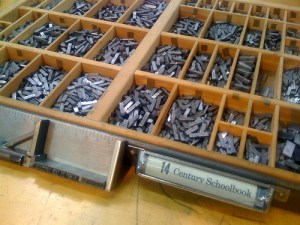
Job Case Photo by Heather on Flickr
The title of this post comes from my novel “Jock Stewart and the Missing Sea of Fire.” For better or worse, it’s a play on words. In this case, “pied” has nothing to do with the apple and cherry pies grandma used to make.

The term “pied type” refers to handset type that’s been dropped on the floor, scattering in a mess.

Handset type was stored by font in a California Job Case, a removable drawer in a cabinet. The letters were arranged in the case in order of their frequency of use. Printers created words, one letter at a time in a composing stick–a small hand-held tray which the typesetter viewed upside down. (The Linotype did this automatically, one line at a time–quite a time savings)

When the typesetter finished a column or part of a column, he tied the type tightly together with string and then transferred it to a form to be mounted on the press. If he dropped it, he said he had pied his type. “Pi” or “Pie” type refers to mixed up stuff whether it’s a dropped block of type or pieces of the wrong font mixed up in a job case.

Handset type was still prevalent enough in the late 1960s that my journalism course work included a printing class in which we were all trained to set type this way. Years later, I would still find some printers–especially those doing formal invitations on small platen presses–to be setting type in a stick and letting lose with a lot of profanity whenever the type got pied.

Malcolm

Have Fun and Lose Weight

Riding in Christmas Parade
The feds won’t let me promise you anything, but let’s just say that anyone reading my comedy/thriller novel Jock Stewart and the Missing Sea of Fire might just laugh their butt off.

Now, for some people, that’s going to be a hell of a lot of weight lost in only 220 pages for only $11.86! The price is lower on Kindle.

So, it’s win/lose for everyone.

Really Brief Excerpt

Jock’s dear old daddy always said, “Jock, take my word for it. Sloppy people are all going to hell.” He also said, “If a man smells like a whore house, he’s going to hell.” Smith had two strikes against him today and it wasn’t even noon yet.

“What did Lucinda Trail have to say?” asked Jock while Smith was licking his plate like an all day sucker.

Smith almost dropped the plate.

“Are your people following me around?”

Jock shrugged. “That, plus you’re wearing her perfume.”


It was an honor being among the local authors serving as grand marshals in this year’s Christmas parade in Jefferson, Georgia. The theme was “A Storybook Christmas.” Each of the authors tossed handfuls of candy to the kids along the 40-minute route. I’m shown here in the photograph with my wife, Lesa.

Malcolm

Congratulations Diana Gabaldon

EchoCoverUSAWhile I’ve only met author Diana Gabaldon once, I feel like I’ve known her for years. During the past twenty years, I’ve been a member of the CompuServe Books and Writers forum where many people (including myself) have come and gone as newer venues like Twitter, MySpace and Facebook competed for our time. But during this entire time, Diana has not only been a faithful member of the forum, but a mentor to us as well.

She has posted her novels in progress for discussion. She has read our work (including my novel “The Sun Singer”) in progress and offered encouragement and suggestions. She has always been there with gracious and and detailed answers to our questions about writing, publishing, agents, research and anything else remotely related to reading and writing good books.

DianaGabaldonSo, it pleases me no end to see that the latest novel in her Outlander Series is sitting at #2 on the New York Times bestseller list. If this weren’t another Dan Brown mega year, “Echo in the Bone” would be sitting at #1.

Beginning with “Outlander” in 1998, six novels in the series lead up to “Echo in the Bone.” And for those of us who have been avid readers, we understand that this novel isn’t the last one about Jamie and Claire and their wonderful saga through time and through history.

Malcolm

When Did the Realization “I Am an Author” Hit?

Author Pat Bertram (“More Deaths Than One” and “A Spark of Heavenly Fire”) wrote a post with this same title today. She’s been assisting her publisher, Second Wind, with projects while working on pre-publication publicity for “Daughter Am I” and on edits for “Light Bringer.” So today, the realization it: She feels like an author.

I left a comment on her post, saying that I felt more like a writer when I worked as a corporate communications director and a technical writer than I do now. Partly, that was because my work produced an income that made a difference to my family’s financial well being. Now, I can’t say that. On some days, I feel like writing is a very expensive hobby and I look at Pat Conroy who’s two years younger than I with another bestselling novel and I think, “there’s an author.” Most authors, though, remain obscure.

Many traditionally published books sell a thousand copies or less; most self-published books sell a hundred copies or less. The income produced is less than publicity costs. Hence, it becomes easy to say writing is a hobby–like having aquariums all over the house, a dozen stamp albums in the den, or a huge model train layout in the basement–because it uses up income while producing many interesting hours rather than paying the rent.

Yes, I am an author. Yes, I enjoy writing, planning novels, doing reviews, posting here on this web log, researching new project ideas, and keeping up with the profession. Yet, the reality of being an author is so much different than I expected when I looked ahead to my career when I was in high school. And, I think it’s probably a lot different than the public believes as well. For the public, if they’ve heard of you, you’re and author. If they haven’t, you’re not. The public is very blunt about whether one is or isn’t what he claims to be.

It comes down to self-satisfaction, then, being happy with what one is doing and feeling that the output, however obscure, is also what he is supposed to be doing. We all hope our books reach readers who will enjoy them and who might also derive value from them. But we’re seldom omniscient enough to know when and where that happens.

But we keep writing because–in our warped imagination–there’s no better way for us to spend our lives.

Malcolm

To view my “Wonderful Books” FriendFeed posts, click on the icon below.

Subscribe to me on FriendFeed

Book Note: ‘Across Time’ by Linda Kay Silva

Across Time Across Time by Linda Kay Silva

My rating: 4 of 5 stars
A beautifully written book with a teenage protagonist who gets her life back together by helping others who live 2000 years in the past.

Author Linda Kay Silva has created believable characters and an imaginative plot in a book filled with deep wisdom.

View all my reviews >>

“Across Time” was published by Spinsters Ink in 2008. Protagonist Jessie Ferguson and some of the other primary characters also appear in Silva’s “Second Time Around” published in July.

Malcolm

A Good Day for a Smile

Nora Roberts sells 21 books every minute. When you go to her website, you’ll find all of her titles are available in an Excel spreadsheet. 160 of her books have been New York Times bestsellers. After all these years and all these books, I wonder if she still feels a sense of excitement and adventure on the day each new novel is listed on Amazon. On each book’s official release date, does she sit back in an easy chair, smile and enjoy the experience?

SeaCoverMy second novel, Jock Stewart and the Missing Sea of Fire, was listed there yesterday. Exhausted from non-stop proofreading, I didn’t notice the listing until late in the evening and the book’s description hadn’t appeared yet. It’s there now and yes, it does make me smile–partly because it’s there, partly because my Jock Stewart character is so off the wall, I can’t help but be amused at the antics he gets away with while following truth, journalism and the evil-doers who stole the mayor’s racehorse and killed his publisher’s girl friend.

Writing is an adventure that unfolds in the quiet of an author’s den. My den’s a mess and I have no clue where anything is. I’m the hermit of a room lined with books, some by Ms. Roberts and dozens of other authors whose work has also contributed to my on-going education. It’s nice, though, to step outside the solitude once in a while and see what’s going on in the world past my horizon of books. Seeing one’s book listed on Amazon is a perfect excuse.

I have a smile on my face today. When you read the book, I hope you will, too.