Written ten years ago and still getting visitors

When I posted Heave Out and Trice Up in 2010, I thought it would get five or ten readers and then fade away. Apparently, it’s never going away, often getting more readers that current posts. I don’t know if today’s aircaft carriers and other ships still broadcast via the public address system (1MC) the ringing of the ship’s bell and a string of daily events like heave out and trice up. When I reported aboard the USS Ranger (CVA-61) for duty in 1968, I had no idea what I was supposed to do with heave out and trice up.

What are the dimensions of navy ship bunks? - QuoraBasically, it meant wake up and secure your hammock of rack (bunk). Mama taught us to make our beds every morning. We forgot this wisdom when we went away to college. Suffice it to say, when you join the military, you start doing it again.

Our berthing areas and racks looked like those in this photo. As you can see, there’s not a lot of room. I don’t even want to know what the accommodations on a submarine looked like.

Every part of the navy has its own set of slang and technical phrases. On a carrier, it wasn’t possible to know all of it, for when the air wing was aboard, the ship carried about 5,000 people in multile disciplines and divisions. Needless to say, the most humorous and profane slang never got broadcast over the 1MC, like “bent shitcan” (disreputable sailor) and “buddy fucker” (a sailor who can’t be trusted because s/he sells out his/her friends.

Most professions have their inscrutable slang and jargon, but I suspect the military takes the cake with a slew of words that has evolved over the years, with special categories for each war. The Vietman war (Disneyland Far East) had its own collection of especially graphic stuff, most of it incomprehensible to those of us aboard the big ships. It’s amazing how quickly a new recruit starts using a vocabulary that mama don’t allow.

Malcolm

The slang alone would probably ban this book from most school systems.

At Sea by [Malcolm R. Campbell]Na

That Navy Slang Gets More Hits Than Almost Anything Else

ussrangerunrepOur of this blog’s 60,000 page views, a surprisingly high number of people are searching for navy slang. My three-year-old post “Heave out and Trice Up” still gets dozens of hits a week. And just to think, I wrote it for kicks.

I was working on my novel The Sailor. Needless to say, that novel has a lot of navy slang in it. I got to wondering: “Do non-sailors know what any of this stuff means?” There are dozens of sites about navy slang, some of which allow people to post questions. Apparently the words “heave out and trice up” are asked about more often than anything else.

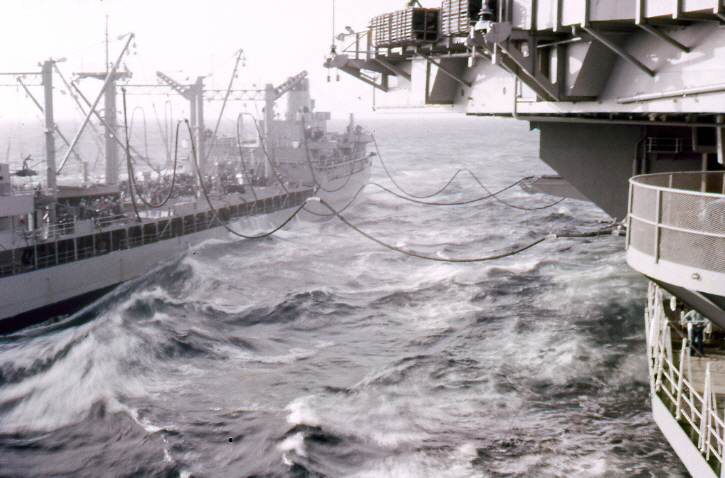
As the Vietnam War fades into memory, I can understand why there would be fewer people asking about Hanoi Hannah, the “Tokyo Rose” of her day. And, as cigarette smoking becomes less pervasive in our culture, fewer people are asking what it means when a ship’s 1-MC public address system informs the crew that “the smoking lamp is lighted.” In fact, the interior spaces of ships are now being declared “smoke free.” Of course, the smoking lamp is out while loading ammunition or fuel during an unrep (Underway Replenishment as shown in the photo.)

But “heave out and trice up”? I’ll give you a clue: it has nothing to do with getting seasick, an event that’s much more likely on a can (no, not the head, but a destroyer) than an aircraft carrier during heavy weather. Part of the problem with the phrase is the word “trice.” We don’t use that word around the office much these days. It’s a sailor’s term, meaning to tie up or secure something, as in a sail or a bunk.

After seeing old pirate movies as kids, we went around shouting “avast,” which means to stop doing what you’re doing–such as trying to get away. When pirates shouted “avast” to a merchant ship they wanted to board, they expect the captain of the hapless boat to heave to, meaning to bring the ship to a stop.”

Wikipedia has an alphabetized glossary of navy slang. If you’re about to join the navy, buy a sailboat, be hired on to a cruise ship, or play pirate games with the kids, this glossary is much easier than searching through old books for jargon until 0-dark-thirty.

As we said in Navy bootcamp, those attending class were expected to take a good set of notes in order to past the tests. If you can’t past the tests, much less figure out what’s going on aboard ship, you’re pretty much considered a bent shitcan whether you’re assigned to a can or a birdfarm.

My heave out and trice up post has received more hits than any other post, except one: a book review of Raymond Khoury’s “The Last Templar.”   Go figure.

Malcolm

thesailorcoverMalcolm R. Campbell is the author of “The Sailor,” a Vietnam-era novel about life on board an aircraft carrier.

Visit me on Facebook.