Unlike real potpourri, this post won’t make you sneeze. If it does, please consult a psychologist or, possibly, a conjure woman.
 Since I grew up in Florida, I see the Florida Panther as “Florida’s Buffalo.” They used to be found throughout the Southeast. When my family moved to Florida in 1950, they were still roaming throughout the Florida Panhandle. Now, those that remain are confined (mostly) to a refuge in South Florida just north of Alligator Alley. In the old days, there was a bounty on them for about the same reasons there’s often a bounty on wolves–a threat to livestock. Now, development is the primary threat to the Panther. You can become a member of the Friends of the Florida Panther for $25. I’m happy to say I have seen one. Magnificent! Sadly, it was in an outdoor zoo.
 I hope most people take a moment or so to think about Veterans Day. I like this poster from 2018 because it brings back the ambiance of the time when the holiday was created as Armistice Day in 1938, before expanding into Veterans Day in 1954. I called it Armistice Day for years because that was its name when I was a kid. I know this is “flip,” but we kept saying “Armistice Day” and “Boulder Dam” instead of “Hoover Dam” for the same reason that many of us still refer to aluminum foil as “tin foil.” The name doesn’t matter as much as an acknowledgment that we owe a lot to those who came home.
-
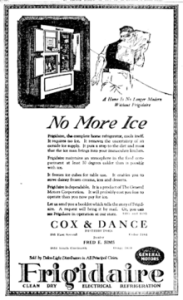
1922 Ad As was thinking over the old names that got engraved in stone, I realized that many of my friends (and sometimes me, horrors) still refer to the refrigerator as the “ice box.” Yes, we called our Frigidaire the ice box when were were kids because ice boxes were still common. My parents bought our Frigidaire when the brand was still made by General Motors and, it was still running many decades later (outlasting my parents). Now, like the word “cellophane,” often used to refer to any clear wrap, many people call their refrigerator a Fridge even though it’s not a Frigidaire. It’s rather like calling any facial tissue a “Kleenex.” We always use Kleenex so we’re in the clear when we refer to our tissues and “Kleenex.”
 As I continue re-reading Holy Blood, Holy Grail, I wonder how many of the “hoaxes” (or unproven speculations) in the book and Dan Brown’s subsequent novel are really hoaxes and how many are coverups for organizations that really exist. (Nothing to see here, that’s all been faked.) For example, the Priory of Sion (which some say was the parent of the Knights Templar and which others say was founded in 1956 and made to appear older than it was), probably wasn’t the nasty child of the Vatican as portrayed in The Da Vinci Code. Well, fooey. But unlike the real or imagined Priory, I do think the evidence suggesting Mary Magdalen probably was Jesus’ wife is correct. Margaret Starbird’s The Woman with the Alabaster Jar is for me, the most definitive on that point.
–Malcolm
 Called “The Penitent Magdalene,” (or “Magdalen with the Smoking Flame”) the painting is one of several with that name by French artist Georges de La Tour done in 1640. In the Disney film, Ariel is shown looking at the painting, most especially the candle, as she tries to figure out the nature of fire–not something she would know about under the sea. Was Disney, for reasons unknown, comparing the red-haired Ariel with the red-haired Mary Magdalen?
 Malcolm's Round Table