This is one of my favourite words for magic. I like it because it’s old and it’s a Scots word. The English say “cantrip” and use the word to refer to ‘scam.”
 The English need to get their minds right about this.
My ancestry is Scots, with a strong dash of Irish from my mother’s side of the family. That means I was born with an affinity for cantraip whether it was the spell of a witch or the mischief out of the faerie world.
In The Life of Robert Burns, which you can find in Project Guttenberg, he says: “I owed much to an old woman (Jenny Wilson) who resided in the family, remarkable for her credulity and superstition. She had, I suppose, the largest collection in the country of tales and songs, concerning devils, ghosts, fairies, brownies, witches, warlocks, spunkies, kelpies, elf-candles, dead-lights, wraiths, apparitions, cantraips, giants, enchanted towers, dragons, and other trumpery. This cultivated the latent seeds of poesie; but had so strong an effect upon my imagination that to this hour, in my nocturnal rambles, I sometimes keep a look-out on suspicious places.”
I grew up reading Bobby Burns’s lowland Scots poems and perhaps that influenced me as much as my DNA to always be seeking a fair bit o’ cantraip in every dark wood and every dark woman.
Truth be told, I expect that the many worlds interpretation of quantum mechanics and panpsychism will ultimately explain many things that are best-considered cantraip at present. Quantum physics is science and panpsychism is superstition (or so some say), but they have a lot more in common than the followers of either viewpoint are willing to acknowledge yet. I’m enchanted by both–call it a Scots Irish thing.
Cantraip is never sleight of hand, the kind of “magic” you see during most magic shows on TV or conventions. I did like Erin Morgenstern’s novel The Night Circus wherein the magicians were using real magic while pretending it was sleight of hand. Whenever I see purported sleights of hand, I wonder, “hmm, is that real magic or practices misdirection?”
Sleight of hand, it seems, is much easier for audiences to believe in. Audiences want to be fooled, and they are. The great sucess of Penn and Teller is evidence of that. If you saw Tony Randal in the 1964 movie 7 Faces of Dr. Lao, you may remember that the audience was far more excited over the splashy sleight of hand than Merlin’s real magic.
You fools, I thought.
The world might be better if we could buy faerie dust at Walmart. We need a wee bit o’ cantraip to give us hope, make us smile, and prove that Washington’s politicians don’t know everything.
 Long-time students of magic claimed that most of the information in the book had been around for a long time, but that Byrne had repackaged the information in a new way for today’s audience. In a way, she did for our time what James Allen did for his time with the publication in 1903 of his now-famous book
  I appreciate everyone who grabbed up a free copy of my Kindle short story “Waking Plain.” There used to be a TV bit called “Fractured Fairy Tales;” I suspect I got brainwashed by that so that I take sweet old stories and turn them upside down.
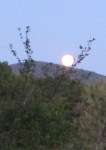 Coping with the aches and pains of yard work, my wife was awake at dawn when the moon was setting and captured this picture.
 Participants in mental improvement courses, such as The Silva Method and others that lean toward the development of intuition, often begin exercises by being asked to imagine something. The intent of this is to focus and connect the relaxed mind on, say, a person or a place, and then allow one’s attention to to take over and begin providing impressions, visual or otherwise, about what is really happening (outside the scope of what we could possibly have known already).
 Personally, I think we can produce “magical results” without the need of rituals, candles, wands, athames, Tarot cards, and other paraphernalia. The power is within us, not the equipment. If the equipment, crutches as I view them, helps, then there is not need to avoid it. We all use what facilitates our intentions.
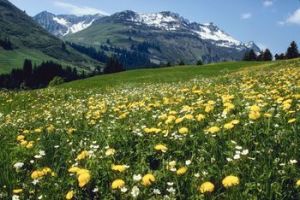 This place can be either real or imagined. Many people choose places associated with quiet and beauty–a mountain meadow, a shimmering pool,a moonlit lake, or even an easy chair in a room filled with books and perhaps a stone fireplace. The idea here, is that over time, you will be able to imagine/visualize this setting as a place of peace and serenity.
 Malcolm's Round Table