Let’s get this out of the way first: I’m older than most of you.
Bookwise, this means that I grew up reading hardbacks and paperbacks and still prefer them to Nooks, Kindles, and whatever else people use to read off the screen.
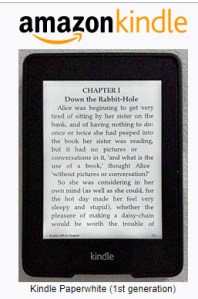 As 2018 ended, I tallied up the number of copies sold for Conjure Woman’s Cat, Eulalie and Washerwoman, and Lena. (Actually, my publisher did this.) Anyhow, what continues to surprise me is that for all of these books, the paperback editions represent a very small percentage of total sales.
I have Kindle for PC, so I do read books off the screen. However, I spend the entire day looking at a screen, so the last thing I want to do when I relax with an interesting book at the end of the day is read it off the screen. I buy paperbacks when I can and hardbacks when I can’t wait for the paperback edition to come out. Every night before I go to sleep, I prop up in bed with a calico cat named Katy, a paperback book (currently, Tom Clancy’s Dark Zone) and a comfy pillow. The ambiance would be totally spoilt with a Kindle or a Nook.
Yet, even though I’m older than most of you, I don’t feel that out of touch. I have this blog, a Facebook account, and can be found on Twitter. So, I’m not a 1950s person trying to navigate the new millennium. That means, I thought more people would be reading paperback and hardbacks because those are real books. Yes, I know, they cost more, but you really never own the books, do you? They’re saved on Amazon and you’re just accessing them.
 If Amazon were to crash and burn, which might not be a bad thing, all of my physical books would still be on the shelves in my office the next day. I have no clue where all my Kindle copies would be. I suspect the answer is “nowhere.”
Plus, if you have a cat next to you in bed, that cat doesn’t want to compete with a Kindle, a tablet, or any other kind of electronics because those cat ears pick up the sounds from the unit, including the demons hard-coded in the software, and they’re (those sounds) not soporific in spite of my white noise machine that covers up the outside world.
So, my advice–not that you’ve listened in the past–is keep the cat, keep the pillow, and ditch the e-book. Yes, I know, there will be a period of withdrawal as you wean yourself from movies and books watched/read off of cell phones. But once you succeed, you’ll feel better about yourself and your reading habits. Seriously, you don’t want to be hooked into the Internet like just another computer, do you?
The other day, I saw an article bemoaning the fact that nobody fixes stuff anymore when it breaks. They just replace it. So, what happens to your Nook or Kindle when it breaks? You throw it in the trash since recycling centers seldom take electronics. Bad for the Earth, right? When a physical book “breaks,” we can either throw it in the fireplace (which somehow seems wrong) or we can throw it out with the sure and certain knowledge it’s biodegradable.
The bottom line is this: Kindles and Nooks have zero reading ambiance when you’re propped up in bed with your calico cat, but worse yet, they’re not Earth-friendly. Personally, I hope the Earth stays around for a while, so I read paperbacks and hardbacks and see that as part of my bit for humanity. No, it’s not the same as discovering a cure for cancer or a cost-effective way of getting all the plastic out of the oceans, but it’s a step in the right direction.
 Malcolm R. Campbell is the author of three folk magic novels set in the Florida Panhandle during the Jim Crow Era in which a conjure woman named Eulalie and a cat named Lena fight the evils of the day

 Sale dates: 10/28/16 through 10/31/16
 What’s more likely for novelists is writing about a wonderful character or an exciting event in novel manuscript that never gels as a whole. Perhaps we write the entire novel, but see that it doesn’t quite work. Unlike the couplet that comes out of the blue without a poem to go with it, the pure gold scenes in unfinished or unsubmitted novels might not have originally caught our attention when we viewed them as part of a larger work.
 I’m thinking of this idea because I have some older books that are out of print that include a few scenes I happen to like a lot. Fixing them up was a lot more fun than I expected. Characters I liked when I wrote the original, suddenly emerged more fully formed in the revision. If they were evil, they became really evil in the short story. Or, if they were funny, they turned into first class hoots.

 P.S. The St. Louis ghost in this short story is real. To learn more about Patience Worth,
 Malcolm's Round Table