Growing Up With Hurricanes

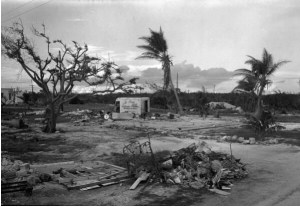
Debris from Donna – Florida Memory Photo

I lived in Florida during the years from the first grade through college in Tallahassee which saw very few up-close storms of note, though we did worry about hurricane Donna in 1960. Since then, the state has been hit quite a few times by major storms, primarily in the peninsula on tracks similar to Ian’s.

As a child, I was always somewhat stunned when newscasters said that slight changes in the storm’s path meant we were safe even though it was (apparently) okay if a town fifty miles away was wiped out.

We didn’t have the kind of reporting available today, so we were never quite sure where the hurricane was when we went to bed at night. Now, until the power goes out we have live pictures showing a hurricane’ track and impact, being out of touch in the 1960s was a far cry from watching the Weather Channel today and seeing Jim Cantore standing in the storm and getting knocked down by a branch.

Nights were the worst time for storms since we never knew where they were or which way they were headed. Now we can log on and learn that the storm is on our street heading for our house.

When hurricanes hit Florida these days, I feel sorry for the people who are impacted by the winds and storm surges. When I was a kid, there was a certain excitement when hurricanes were near. As I’ve grown older, that excitement has morphed into worry and dread. While I live in north Georgia and don’t have much to worry about, having family and friends in central Florida anchors me to the real-life impact of storms. I’m just too old to find any excitement in it.
Malcolm

Ground Zero In Florida: Labor Day 1935

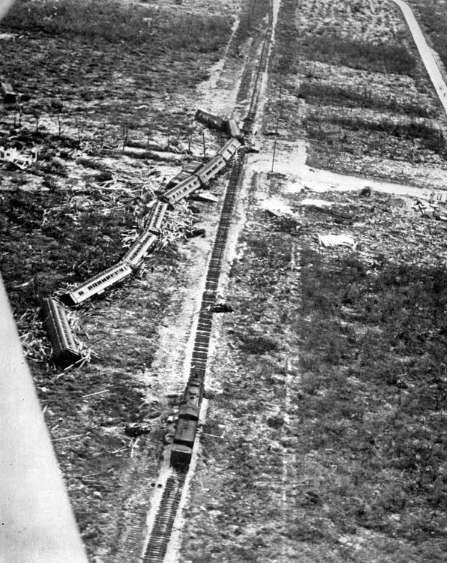
Rescue train blown off tracks.

When I was in grade school in Florida in the 1950s, the parents and grandparents of my fellow students compared every tropical storm and hurricane to The Labor Day Hurricane of 1935.

While the cat 5 hurricane is still listed as the worst hurricane (in terms of intensity) to hit Florida, it’s seldom mentioned by forecasters and reporters now in spite of its sustained winds of 185 miles per hour and gusts at 200 mph. Its landfall pressure was 892 mbar, followed by Camille at 900 mbar in 1969 and Karina at 920 mbar in 2005.

I guess it happened so long ago, it’s no longer real to us.

The fatalities, at 405 were, however, far short of the deadliest hurricanes: Galveston in 1900 (8,000 dead), Lake Okeechobee in 1928 (2,500 dead), and Katrina in 2005 (1,200 dead). The worst hurricane to hit Florida when  I was growing up there was Donna, a cat 5, which got more than our attention in 1960 with 160 mph winds.

I doubt that most people driving the overseas highway to Key West these days know that between 1912 and 1935 Henry Flagler’s extension to the Florida East Coast Railway traveled 128 miles past the end of the Florida peninsula to Key West. All that ended in 1935 when the tracks were destroyed and never rebuilt.

As hurricane Irma approaches, I can’t help but think back to the stories our elders told us when I was a kid, long before the Weather Channel and 24/7 news channels gave us minute to minute reports of the hurricanes’ locations. “Yep,” they said, “you should have been here in 1935.”

Heck, I don’t want to be there now even though the storm seems to be headed toward us here in North West Georgia.

–Malcolm