Glacier Park…it’s why we live here…what we LOVE here… “Celebrate it in style.”
The evening will be elegant…the setting – spectacular. But leave your heels at home and your hat on your head…THIS is a party for people who LOVE the outdoors! The Backpacker’s Ball is our one and only, most magnificent celebration of the year!
Join us at the historic Green Valley Ranch at the edge of Glacier National Park, where the beauty is borrowed from the land we live in – the real-life murals made by mountains in our own backyard.
Wear your dancing shoes, so you won’t be stuck in your chair when the Ashley Creek Ramblers take the stage. You’ll have to fight your feet NOT to dance to this toe-tapping, must-move music.
Come hungry…because you won’t soon find another feast like this. Locally harvested specialties are the menu’s mainstays as a nod to our nation’s heritage. Wonderful wines complement the array.
Get swept up in the excitement of our Live Auction, or quietly acquire some amazing items in our Silent Auction. You’ll find everything from one-of-a-kind artisan creations to once-in-a-lifetime adventures. This is just a small part of our evening, so the focus is on having fun!
The Backpacker’s Ball is our once-a-year rally to raise needed funds so that we can continue to share this precious place with nature lovers from around the world.
The Glacier National Park Conservancy assures the Glacier National Park experience by providing support for preservation, education, and research through philanthropy and outreach.
–
If I lived closer, I’d be there. Click on the graphic for the Conservancy’s page with additional information.
St. Mary Campground Closed due to standing and running water, and debris from Wild Creek and other run-off water. There were approximately 10 campers at the St. Mary Campground last night, and all left this morning on their own, prior to campground closure.
Access to the Kintla Lake area closed at the head of Big Prairie – 7 miles north of the Polebridge Entrance in the North Fork District of the park. Travel in the North Fork area of Glacier National Park is not advised at this time. There is standing water in several areas.
Red Eagle Lake Trailhead, near the 1913 Historic Ranger Station near St. Mary is closed.
Sand bags were deployed in the administrative area of St. Mary on the east side of Glacier National Park, responding to rising/flooding Divide Creek.
Pre-evacuation planning underway for the St. Mary area of National Park Service administrative and housing areas (approx. 30-40 people), and for the Many Glacier Hotel area. No evacuations have been initiated at this time!
No work is being conducted on plowing the Going-to-the-Sun Road at this time. Crews moved plowing equipment to lower locations yesterday as snow began to fall and more snow was predicted.
NPS employees are at Sperry Chalet conducting seasonal preparation activities and report 14-16 inches of snow since Tuesday morning. It was snowing again this morning at Sperry Chalet. Photos attached! Sperry Chalet is located on the west side of the park, near the Continental Divide.
Park personnel continue to monitor and access the situation across the park, making preparations in the event of any evacuations and staging equipment to respond as needed. Park personnel are in regular communication with the National Weather Service. All visitors are encouraged to use caution during this time of increased moisture.
from NPS Glacier National Park, as of June 16:
WEST GLACIER, MONT. – Snow conditions, cool weather, and debris from snow slides are challenging some spring opening operations for trails, facilities and roads in Glacier National Park. Snow accumulations in the park are above average this year and spring snowmelt has varied at different locations.
Numerous trails in Glacier National Park are still snow-covered. Park staff report damage to trails and backcountry campsites due to snow slides and large amounts of avalanche debris. The Ptarmigan Falls Bridge and Twin Falls Bridge have been removed due to winter damage and hazardous conditions. Temporary bridges are expected to be installed by early July. The Iceberg Lake Trail is closed to stock use until permanent repairs to the Ptarmigan Falls B ridge are complete. Permanent repair work on both bridges is anticipated to begin this fall.
Extensive avalanche debris has impacted the Trout Lake Trail. Hikers are not encouraged to use this trail, or it is recommended that hikers have route-finding skills to traverse the debris.
Trails may traverse steep and sometimes icy snowfields and hikers are strongly advised to have the appropriate equipment and skills to navigate such areas, or perhaps visit those areas once conditions improve. Please visit the park’s website for current trail status at http://www.nps.gov/glac/planyourvisit/trailstatusreports.htm. Please report any hazardous or unusual trail or backcounty conditions by calling the park at 406-888-7800.
Frozen and damaged sewer and water lines caused some delays in seasonal opening activities for utilities park-wide. Rising Sun and the Swiftcurrent cabin areas experienced damaged water lines. The Apgar and Lake McDonald areas experienced issues with frozen sewer lines, and some broken water lines. The Cutbank, Many Glacier and Two Medicine Campgrounds experienced delayed openings due to abundant snow accumulation and slow snow melt.
A snow slide in the Alps area of the Going-to-the-Sun Road, about five miles west of Logan Pass, wiped out about 20-30 feet of rock wall along the road. Several new slide paths across the road have been encountered this spring, including the need for extensive snow and debris cleanup.
Snow removal operations on the Going-to-the-Sun Road continue with road crews working near the Big Drift and Lunch Creek areas east of Logan Pass. Above average snow accumulation and cool June temperatures have provided challenges for snow removal operations. The snow depth at the Big Drift is estimated to be about 80 feet, larger than recent years. Once the snow is removed, a thick layer of ice on the road is anticipated.
In addition to snow removal, road crews are working to install over 400 removable guard rails, sweep the road of rock debris, and clear snow from Logan Pass Visitor Center facilities including sidewalks and trails. Park road crew employees have begun working overtime in an effort to accomplish snow removal goals in a safe and timely manner, as well as other park employees assisting in the hand work to remove snow around facilities.
Currently, visitors can drive about 16 miles from the West Entrance to Avalanche on the west side of the park, and one mile from the St. Mary Entrance to the foot of St. Mary Lake on the east side. It is anticipated that there will be vehicle access to the Jackson Glacier Overlook area on the east side of the Going-to-the-Sun Road by this weekend, but it is dependent on weather conditions. Vehicle access to Logan Pass, and beyond Avalanche on the west side of park, is unknown at this time.
Hiker-biker access is currently available from Avalanche to the Loop on the west side, and from St. Mary to Rising Sun on the east side. For current hiker-biker access and park road status, visit http://home.nps.gov/applications/glac/roadstatus/roadstatus.cfm. For additional questions about Glacier National Park, visit www.nps.gov/glac or call 406-888-7800.
WEST GLACIER, MONT. – Public comments are encouraged on a recently completed environmental assessment for a proposed fish passage barrier downstream of Akokala Lake in the North Fork District of Glacier National Park. Comments are due by July 7, 2014. The Akokala Creek Fish Passage Barrier Environmental Assessment is available at http://parkplanning.nps.gov/AkokalaFishBarrier. (Click on document list to read.)
Akokala Lake is one of the last bull trout supporting lakes on the west side of the park and is at risk of invasion by non-native lake trout, which are known to have severe detrimental effects on native fish populations. The drainage is also susceptible to invasion by rainbow trout and possibly brook trout. Monitoring and genetic testing show hybridization between westslope cutthroat and rainbow trout has already begun to occur in Akokala Creek. Brook trout can out-compete westslope cutthroat trout and hybridize with bull trout.
The environmental assessment analyzes two alternatives: 1) Alternative A-No Action, and 2) Alternative B-Construct a fish passage barrier on Akokala Creek. The preferred alternative is to construct a fish passage barrier (Alternative B). A fish passage barrier would prevent additional non-native fish from accessing Akokala Lake and the upper Akokala drainage, and reduce or eliminate further expansion of westslope cutthroat-rainbow trout hybridization. By protecting the drainage against non-native invasive fish, this project would also help safeguard important habitat refugia for native fish confronting the stressors of climate change.
The environmental assessment, as well as additional information is available at http://parkplanning.nps.gov/AkokalaFishBarrier. Public comments can be made directly through this website, or written comments may be mailed to Superintendent, Glacier National Park, Attn: Akokala Fish Barrier EA, PO Box 128, West Glacier, Montana 59936.
–
Personally, I support the fish barrier due to the risk to native specifies from non-native species.
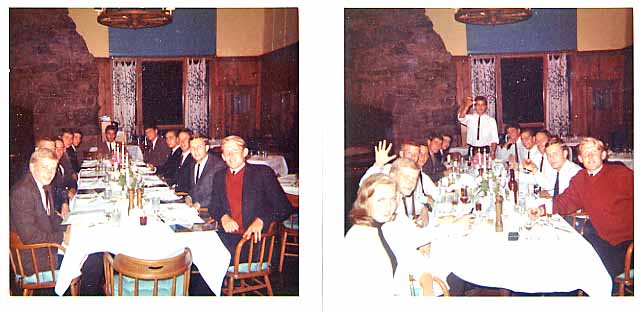
If so, can you find yourself in either of these snapshots of the bellmen banquet in August of 1964 in the Many Glacier Hotel dining room?
I remember we all ordered the most expensive meals on the menu. A friend of the bellmen who owned a well-known Chicago restaurant at the time, ordered multiple bottles of wine and had them delivered to our table.
Maybe it was the wine, or the number of years that have gone by or the fact that we had two sets of twins in the bellmen group that year, but I cannot ID the people in these pictures any more. Oh, well, I do know that I’m the third person back on the left side of the table and that my room mate Marc Miller is the nearest person on the right side of the table.
Malcolm R. Campbell is the author of three novels partially set in Glacier National Park: “The Sun Singer,” “Sarabande,” and “Mountain Song.” Click on my name at the end of the post to see my Amazon author’s page.
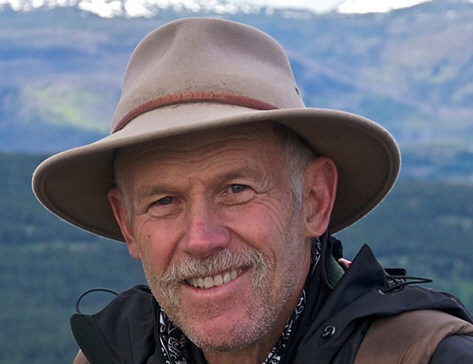
Author and wilderness lover, Howie Wolke will talk about the ongoing loss of wilderness, both in the big outdoors and within the human animal. He will relate the erosion of the wilderness idea to the spreading disease of Wilderness Amnesia.
Wolke is a ‘wild preservative,’ to borrow the term from the late Edward Abbey, advocating for the designation and protection of real wilderness in the United States. He is past president and current vice president of the national conservation group Wilderness Watch. He also cofounded Big Wild Advocates, Montanans for Gallatin Wilderness, the original Wyoming Wilderness Association and the original wilderness-focused Earth First. Following his passion, Wolke has made his living as a wilderness guide and outfitter for the last 36 years.
A new National Park Service report shows that approximately 2.2 million visitors to Glacier National Park in 2012 spent $172 million in communities near the park. That spending supported 2,754 jobs in the local area.
“We are honored and proud to welcome visitors from across the country and around the world to Glacier National Park,” said Park Superintendent Jeff Mow. “Glacier is a special place and many times visitors travel to Montana specifically to visit Glacier, and are introduced to the many other wonderful amenities that Montana, and Northwest Montana have to offer.”
National park tourism is a significant driver in the national economy – returning $10 for every $1 invested in the National Park Service. National park tourism is a large factor in the local economy as well. Mow said, “We are fortunate at Glacier National Park to be greatly supported by our partners, neighbors and local communities. We appreciate this partnership and support, and believe the presence of the park helps sustain local communities.”
The peer-reviewed visitor spending analysis was conducted by U.S. Geological Survey economists Catherine Cullinane Thomas and Christopher Huber and Lynne Koontz for the National Park Service. The report shows $14.7 billion of direct spending by 283 million park visitors in communities within 60 miles of a national park. This spending supported 243,000 jobs nationally, with 201,000 jobs found in these gateway communities, and had a cumulative benefit to the United States’ economy of $26.75 billion.
According to the report, most visitor spending supports jobs in restaurants, grocery and convenience stores (39 percent), hotels, motels and bed-and-breakfast locations (27 percent), and other amusement and recreation (20 percent).
To learn more about national parks in Montana and how the National Park Service works with Montana communities to help preserve local history, conserve the environment, and provide
outdoor recreation, visit http://www.nps.gov/state/mt.
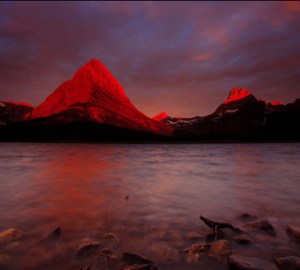
Alpine Glow at Many Glacier Hotel. Notice that true alpine glow is being pushed out by the direct light. – photo by Jeff Pang
Lucky short-term tourists and almost all long-term visitors to Glacier National Park learn about the beauty of alpine glow (called alpenglow in many parts of the world). While some mistake sunlight on the mountains at sunrise and sunset as alpine glow, true alpine glow occurs only when the sun is below the horizon. It comes from light that’s reflected by snow, water or ice particles in the atmosphere. There is often a red or purple hue within the glow.
One of my three jobs at Many Glacier Hotel in the park’s Swiftcurrent Valley required me to be on duty by 5 a.m. several days a week. When I walked over the rise that separated the hotel from the dorm, I checked my watch to make sure I wasn’t late because the hotel manager, Ian B. Tippet was always there before dawn. Since he was there, he firmly believed everyone else should be there.
Grinnell Point and Heavy Shield Mountain across Swiftcurrent Lake from the hotel – photo by Joe Dsilva
While the light in the manager’s office near the lobby attracted my attention first, those mornings when alpine glow bathed the peaks and turned glaciers and snow patches into shimmering light sources, my early hours job gave me a gift most employees and guests slept through.
When I saw Ian Tippet at the park this fall, we joked when he said, “we always began promptly at 5 a.m., a beautiful time to be awake.” I agreed, but didn’t mention that I looked at his office window before breathing in the sky.
I always wanted to see the alpine glow on Mt. Everest, or even in the Alps where the term originated. However, the mountains of Glacier made many early mornings worth losing sleep over.
Chief Mountain: Home of the Thunderbird – Physical, Historical, and Spiritual Perspectives, by Dave Shea, Thomas Printing, 2010, Second Edition, 42pp, photographs, maps, charts
Backcountry ranger, wildlife biologist and botanist Dave Shea worked in Glacier National Park for almost four decades, spending many years at the Belly River Ranger station in the shadow of Chief Mountain. Shea writes that those who have seen that shadow in the valley in March and September call it “the sacred shadow.”
This tightly written, encyclopedic book shows that Shea has come to understand the rock, natural forces, legends and people behind that shadow very well. Without a doubt, Chief Mountain (Nináistuko) is the one of the most distinctive, visible and photographed peaks in Montana.
While Glacier specialists and friends of the park will have seen most of the geological information in the first part of the volume elsewhere, the book is an able summary of Chief’s setting within the Rocky Mountain Front as well as its importance and current status as a sacred site to the Blackfeet Nation. In addition to the spectacular cover photo by B. Riley McClelland, the author’s photographs are a beautiful addition to the book.
From the Publisher
For 36 years, Dave Shea prowled Glacier Park’s wilds as a backcountry ranger, patrolling trails, managing wildlife, leading search and rescue efforts. And for 11 of those years, he and his wife, Genevieve, lived, quite literally, in the shadow of Montana’s most sacred mountain. And so it’s appropriate, perhaps, that when Dave Shea set out to put the peak on the page, he did so in what could be described, in terms of size, as a booklet, but in scope is most decidedly a full-blown book.
Reviewer’s Comments
“It’s clear Chief has become a character in Shea’s life, a fully animated wonder complete with presence and with moods and with attitude,” writes Michael Jamison in the Missoulian. “In a cave, near the summit, lives Thunderbird and the Thunder-Maker Pipe. The Wind Spirit resides here, as does Old Man Napi. The Sacred Shadow reaches far into the backbone, and each spring and autumn darkens other peaks with the outline of the Chief.”
Shea, described by the Missolian as “one of Glacier Park’s last old-school patrol rangers – a man competent and comfortable and completely content in the backcountry,” is also the author of the NPS field checklists “Mammals of Glacier National Park” and “Birds of Glacier National Park.”
Malcolm R. Campbell, a seasonal employee at Many Glacier Hotel in the park in 1960s, is the author of contemporary fantasy novels including “The Seeker.” “The Seeker” is partially set in Glacier during the historic flood of 1964.
People often say they need time to recuperate from their vacations before going back to work. Yeah, my knees and ankles hurt after walking miles and miles between airport gates in order to travel from Georgia to Montana and back. But really, it’s mental relaxation I’m needing. (My brain doesn’t have a automatic transmission, so I have to manually shift from vacation mode to work mode.)
Oh, so we can’t get meals delivered to our table without going to a grocery store first?
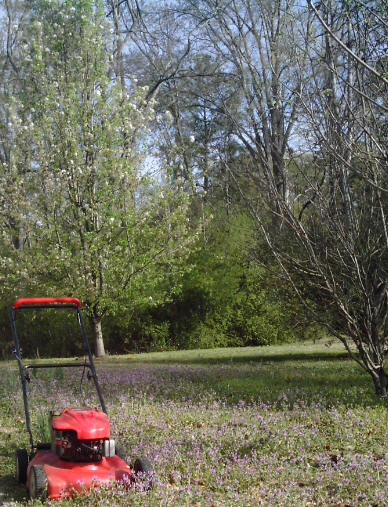
Oh, are you telling me there’s no yard crew keeping the flowers happy and the grass green and well-mowed like there was at Glacier Park Lodge?
But, without missing a beat, the credit card bill arrived a few moments after we got home. Naturally, there was nothing in the mail from Hollywood telling me they want to pay me 100 grand to make The Seeker into a blockbuster movie. But the credit card people didn’t waste any time telling me it’s time to fill their collection plate.
As a contemporary fantasy author, I try to keep reality to a minimum, but so far, I haven’t found the right magic formula for limiting the amount of reality in real life.
Oh, so those prescription meds don’t jump into the bottles automatically unless I call them in first and then drive down to the pharmacy and pick them up?
There’s a plus side to work mode reality. Even though work mode includes chores, it’s cheaper than vacation mode. And really, work mode food is gentler on our digestive systems.
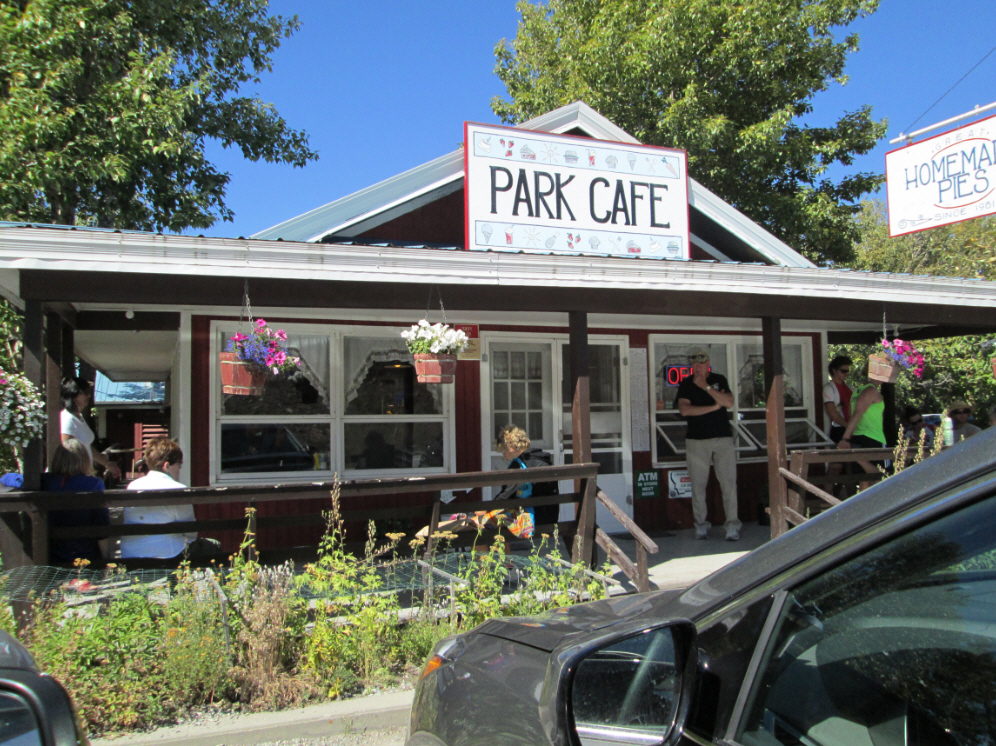
I’m glad we could catch a few Montana meals at the Park Cafe, Bison Creek Ranch, Luna’s, and the Whistle Stop cafe because the chefs at both Many Glacier Hotel and Glacier Park Lodge have a preoccupation with overly spicy food. Can’t you put a few plain dinners on the menu to give our stomachs a break?
Since I’m writing this post instead of working, you can tell I’m not completely out of vacation mode. Shifting gears is a work in progress.
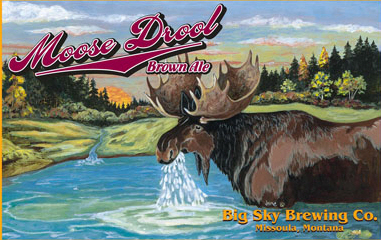
The closest my wife and I came to a moose during a ten-day trip to Glacier National Park with my brother Barry and his wife Mary was an ice cold can of Moose Drool brown ale. For the most part, the critters were absent.
We discussed photo shopping this picture and saying, “Hey, guys, we saw this moose in Lake Josephine, but frankly the scenery doesn’t look much like Lake Josephine.
We did see several grizzly bears, ground squirrels, a coyote, a flash of brown that was purportedly a wolverine, and an osprey.
We were assured by the bartender at Many Glacier Hotel that Moose Drool isn’t made with actual drool. Most of the drool during the vacation was caused by various renditions of huckleberries: huckleberry water, huckleberry ice cream, huckleberry margarita, and huckleberry pie.
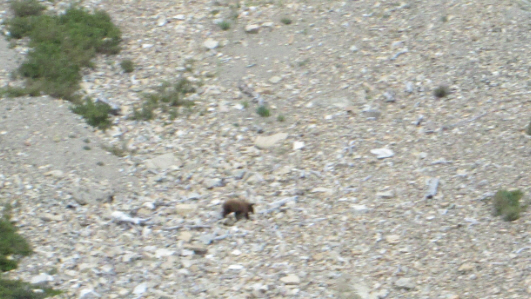
Grizzly bear near Many Glacier – Photo by Barry Campbell
One of the grizzly bears was on the talus high above the road between Many Glacier and Babb. We saw it several times and began to wonder if the National Park Service was paying it in huckleberries to pose there for tourists.
Seeing the cars and buses stopped for this bear–with everyone pointing–reminded me of similar scenes with black bears in the Smoky Mountains.
In spite of the lack of wildlife, we had a good trip. Well, we could have done without the cold rain and the hail storm we got into on during a hike near Hidden Falls. So far, four of my novels are partially set in Glacier. With another novel on the drawing board, it was nice to see many of the settings I plan to use.
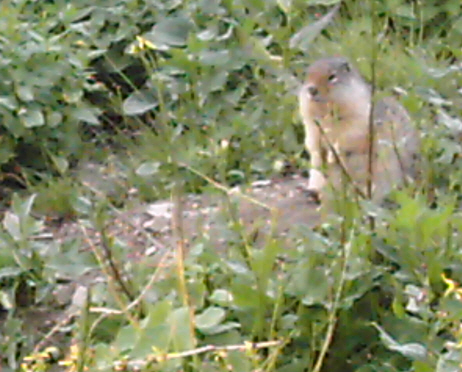
Ground Squirrel at Logan Pass – Photo by Lesa Campbell
I have a lot of location choices. Plenty of places for action, battles, people sneaking up on other people, and the other kinds of things that happen in contemporary fantasy novels.
Coming soon, The Betrayed, the third novel in my “Garden of Heaven” series named after a Glacier Park Valley near Hidden Falls.
Next year, Aeon will complete the trilogy that includes The Sun Singer and Sarabande, both of which are partly set in Glacier Park’s Swiftcurrent Valley.
So far, I haven’t thought of a way to include Moose Drool in one of my books other than to suggest that an ice cold glass of it goes very well with the stories.
 The evening will be elegant…the setting – spectacular. But leave your heels at home and your hat on your head…THIS is a party for people who LOVE the outdoors! The Backpacker’s Ball is our one and only, most magnificent celebration of the year!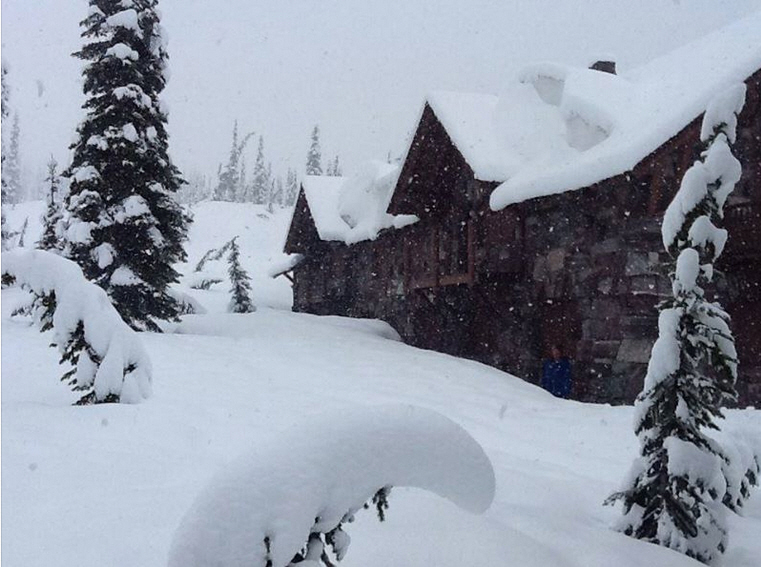





 Malcolm's Round Table