During Glacier National Park’s 2010 centennial, I wrote quite a few posts about the history, personalities, facilities and environment of Montana’s shining mountains for this weblog. Now, Vanilla Heart Publishing has compiled a selection of those posts into a free PDF e-book that you can download from PayLoadz.
Highlights of the 49-page e-book
Fast Facts and Photographs
All Aboard for Glacier National Park
Glacier by the Grace of God and the Great Northern
Mountains and Rock
Remembering James Willard Schultz
Glacier’s Long-Ago Mining Town
Remembering George Bird Grinnell
Those Historic Red Tour Buses
Kinnikinnick
Glacier’s First Ranger
Heavens Peak Fire Lookout
Mary Roberts Rinehart
The Scenery Behind My Stories
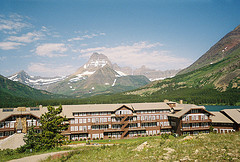
While working as a bellman at a Glacier Park hotel, I fell in love with the park. I’ve been back several times, but it’s too far from northeast Georgia for easy commuting. I returned in my imagination, though, while setting three novels in the park: The Sun Singer (contemporary fantasy, 2004), Garden of Heaven: an Odyssey (magical realism, 2010) and Sarabande (contemporary fantasy, 2011). If you’ve visited Many Glacier Hotel on the east side of the park, you’ll recognize many of the settings in all three books from Swiftcurrent Lake to Grinnell Glacier
I hope you will enjoy Celebrate Glacier National Park and the scenery behind my stories with a bit of the history of how Glacier came to be and who took part in developing it as both a park and a playground. Of course, you need to do more than read about “backbone of the world” in northwestern Montana.
How about a trip? You’ll need to stay for a couple of days so you have time to see both sides of the park, experience Going-to-the-Sun Road, hike to Sperry or Grinnell Glacier, take a launch trip on Lake McDonald, Swiftcurrent Lake or Lake Josephine, and ride in one of those ancient red buses with the top down so you can enjoy the mountain air.
Looking at the pamphlet shown here, I can say that I have no idea how and when I got it, who scribbled on the cover, or even why the handy little pocket guide published in 1956 didn’t get buried in one of the numerous boxes of packrat stuff in the garage or attic.
Today, of course, a writer can Google just about anything. If he’s persistent, he can sort through all the hobby sites and find information he can count on. While writing my 2010 novel Garden of Heaven: an Odyssey, I needed a handy reference to Florida’s trees. And there it was: right on my shelf less then six feet from my desk.
Published by the Florida Board of Forestry since 1925, I’m guessing I stole or borrowed or received this pocket guide while I was in the Boy Scouts in North Florida. The guide contrains black and white drawings of leaves, acorns and cones along with a descriptive text for each tree. This makes it easy for a hiker or a Boy Scout in Tate’s Hell Forest, the Apalachicola National Forest, or the swamps and estuaries along the Gulf Coast to identify what he’s looking at.
I grew up around Baldcypress, Chinkapin, Tupelo, Sweetbay Magnolia, Sassafras, Cabbage Palmetto, and Swamp Cottonwood trees. So, one would think I’d be a walking encyclopedia about their common attributes, the quick kinds of details a writer needs when he writes a sentence such as “David stood beneath the ______ leaves of the ____-foot tall Swamp Popular.” But no, I’ve been away from Florida too long to remember even the simplest details.
If only I had a photographic memory!
I include a lot of detail in my novels about mountains, trees, lakes and wildlife. That helps anchor the magic and fantasy in the story while making the location settings three dimensional. There’s a risk, though. If you make a mistake, somebody’s going to write you a letter or focus his review on the fact that while the hero of the novel was in a gun battle fighting for his life beneath a Chinkapin Oak, you forgot to mention that the three- to seven-inch leaves are toothed or that the trees are between fifty and eighty feet tall. Nice to have a quick reference book!
When it came down to quick reference materials, I found it much faster to grab this old pamphlet off the shelf than to search online. Sorry, Google, but I rather enjoy being a packrat and every once in a while I can actually justify it.
As the author of two contemporary fantasies and one magical realism novel, I enjoy blurring the line between the real settings in my novels and the stuff I make up.
Real settings provide a foundation for the magic of my imagination whether they’re well-known locations such as Glacier National Park or personal locations such as the house my parents owned in Eugene, Oregon when I was in kindergarten.
However, the trickster in me wants the reader to always be in doubt where reality begins and ends. When people tell ghost stories around a camp fire, the stories often begin with: “Many years ago in these very woods on a summer night just like this one, a monster watched a patrol of Boy Scouts cooking their evening meal.”
Suddenly, everyone around the camp fire starts hearing strange noises in woods—perhaps it’s just the wind, or perhaps it isn’t. When I set my contemporary fantasy novels Sarabande (2011) and The Sun Singer(2004) in Glacier Park, I not only had a lot of photographs and reference materials helping me make my descriptions accurate, but also the benefit of knowing that many of my readers will have been there or seen pictures or TV programs about the area. (I also had my memories of hiking a good many trails in the park.)
So, is there magic at Many Glacier Hotel in Swiftcurrent Valley? Maybe yes, maybe no.
Garden of Heaven
InGarden of Heaven: an Odyssey (2010), I used well known locations in Glacier National Park such as Chief Mountain and Many Glacier Hotel. For my own personal amusement, I also used the starter-house my parents owned on Alder Street in Eugene. While I barely remember the house, I do have pictures of it. My readers, of course, don’t know anything about an obscure street in Eugene, but they have heard of the town. That’s why I used the name in this stream-of-consciousness, vision quest sequence in the novel:
My mother at the house in Eugene
He woke up in the centre of the prairie where the land lay like a calm sea and the black mountains were small in the west. On his mind there was a predominant thought, ‘I am east of the sun and west of the moon,’ and though that was true, for it was sometime past noon, the thought was on his mind in a strange déjà vu way, pulling him he knew not where. His memory danced like a frail aspen leaf in the north wind until he was carried southwest by south on more or less a straight course past the grey ice of Api-natósi, the north fork of the Flathead, the Kootenai National Forest, the Bitterroots, south of Couer d’Alene Lake, the boiling confluence of the Columbia and Snake, the Cascades, to Eugene and Alder Street, to the little buff-coloured house with the blue roof and white picket fence and a snowman to the left of the driveway, and then inside to a room bluer than the roof where an inviolate circle of light from the lone lamp encompassed mother and child, she in a chair reading aloud from an old tan book of stories, he sleepy-eyed beneath covers hearing about trolls, witches, winds that talked, a castle, and a prince, the stuff that dreams and futures are made of before seasons matter and life hardens the soul.
In a vision quest, the real and the unreal are often tangled up. I always want the reader to wonder which is which. In this passage, most readers will recognize the real places such as the Snake River and the Cascades even if they’ve never been to the area. I added “Alder Street” just for me because I’m a spinner of tall tales that are occasionally true.
E-Book only $5.99“Garden of Heaven: an Odyssey” is the story of a man’s spiritual journey through the mountains of Pakistan, the swamps of North Florida, the beaches of Hawaii, the waters of the South China Sea and the ivy-covered halls of an Illinois college as he attempts to sort out the shattered puzzle of his life.
In this excerpt, David Ward’s significant other, a woman well-practiced in the old Huna magic of Hawai’i, is ready to discuss the clues, if any, she found in his journals about who has been trying to kill him.
David sits on a fence post, a comfortable, familiar spot, and looks across the creek to the house. The creek is the same; the house has shrunk with time. Too perfectly symmetrical when it was new, the structure’s roofline, doors and walls have aged randomly and grown more natural into the place.
Complacent while Siobhan keeps the Komondor puppy inside, the remaining Dominique chickens peck at the hard path between the kitchen door and the clothes line. The path turns west into a gravel road that leads to an old house lying down in weeds and ruin where his grandparents lived until one became too frail and the other became too psychotic to be left alone, where they said that his mother was born on a cold January night in 1914, where lies and truths were sown and bore hybrid fruit.
Along the road between the houses, grey sheds linked by fences lean into the earth. Dry and empty, like old nooks and crannies and secret places, they were always the first full focus of spring–humid and rich as sea fog, dripping with the juices of birth and new life. Jayee’s timing was as precise as nature allowed. Today he would be moving the last of the lambs from the jugs to the bunch pen if he was on schedule, or the first of them if nature wasn’t.
From this vantage point, David sees the pros and cons of dreams; he views his visions from the other side, and—remembering everything that has happened between then and now and then and now and then and now—must decide how much of history is too broke to fix. Siobhan refuses to tell him who tried to kill him and why because he’s not ready to hear it, much less re-live it; Sikimí will take them back to the scene of the crime soon enough.
She steps out the back door carrying old notebooks, an envelope labeled remnants, and grandmother’s blue-on-white eight-pointed star quilt. The door slams, stirring memories. She smiles and her pony tail dances when she nods at the circle of box elders where she heads at a brisk walk.
In her khaki cargo shorts and light blue sleeveless crew shirt, she radiates a well-toned athletic health that sings of perfectly managed energy conceived in Aries fire and transformed into infinite zest down through her well-developed shoulders and sun-browned legs. Siobhan is Wind’s daughter. Grandmother would love her for that alone. It’s a matter of breath control, he thinks. When Siobhan is open to the world, she inhales those she meets into her presence, pulling them in with her smoky eyes and the fluid caresses of her hands. At such times, she drags out the first syllable of her name in a shhhhhhhhhh of light breezes. David heard that endearing shhhhhhhhhh when she ran into him like a pro-football lineman on the day they met. When Siobhan is closed to the world, she exhales those she meets outward beyond the reach of her hands. At such times, when there is no still escape from her eyes, she clips off the first syllable of her name into a harsh shh that shushes even the most determined people into quiet.
She flips the quilt out into an even rectangle and sits in the centre of it surrounded by Blue Horses and Silver Bears, knowing Katoya stood on that very spot in the tall bluebunch wheatgrass 33 years ago and told him the secret of the universe before they watched the stars rise into the sky. When he stops at the northern boundary of the eight-pointed starry night lying across the grass, Siobhan looks up from an open composition book as though she’s surprised, but pleased, to see him there.
–I’ve finished reading almost all your journals.
As he takes off his boots, he’s enveloped by the scent of her lavender bath soap. He shrugs. What is there to say? He feels naked in spite of her smile which is so unwaveringly natural it seems to be borne up out of the grass.
–You know almost everything, then, and you’re free to run for the hills, he says.
Siobhan frowns and looks at him with her eyebrows raised about as high as she can get them. She waves an older Blue Horse in his face.
–Talk like that chased Anne Hill away, didn’t it?
–It seemed a logical thing to say at the time.
–How logical does it seem now? she asks.
He sits next to her and studies her face while she watches the noisy water of the creek bunching up at the base of the limestone bedrock.
–Hell, I was looking for reassurance.
She turned toward him now and her breath was warm and sweet on his face.
–No need and you know it, she says and kisses him. When he starts to speak, to say some inane self-deprecating thing, she kisses him again. Shhhhhhhhhh, she whispers, Anne is Anne, Siobhan is Siobhan, and you and I are the yin and the yang fitting precisely together.
She hugs him, wrapping him snugly in lavender.
–I see what you mean, he tells her. This hug could easily lead to more, much more, but I think you have things to say.
We can’t see the word odyssey without thinking of the epic Greek poem attributed to Homer that begins (in Robert Fagles’ translation):
Sing to me of the man, Muse, the man of twists and turns
driven time and again off course, once he had plundered
the hallowed heights of Troy.
Indeed, the word stems from Odysseus’ trip, meaning a long and wandering physical or spiritual quest with multiple adventures and changes of fortune.
My novel Garden of Heaven is subtitled “an Odyssey” because protagonist David Ward ends up in many places with many people before returning to the Montana ranch where he grew up.
The novel has multiple locations: Glacier National Park, the Florida Panhandle, Chicago, Hawai’i, the Philippines, the Netherlands, central Illinois, Pakistan, and the Gulf of Tonkin. In each place, new problems and adventures occur.
But there are some common themes. One is his first lover’s relentless quest for revenge which is caused by a problem of which David is unaware. Another is David’s spiritual journey which begins on a vision quest in Glacier National Park and then haunts and inspires him from one end of his odyssey to the other. And, like Homer’s Odysseus, David also has a way with words, though it remains to be seen whether this is more of a blessing than a curse.
Untangling the lies and truths strewn throughout his journey will take David quite a few years. In the process, he will serve aboard an aircraft carrier, climb one of the most difficult mountains in the world, work as a professor at a small college, and consort with horses, eagles and ravens. Garden of Heaven is not one adventure, it’s many. And, as in “real life,” David’s good fortune often looks like bad fortune, and vice versa.
–
Garden of Heaven is available as an e-book from OmniLit for $5.99.
For more information about Garden of Heaven, see my August 3, 2010 interview on BookBuzzr.
Use your imagination and you can fly with crows. Since you won’t be able to speak to unimaginative people about such things, your magic flights can be transformed into poems and scenes in novels.
David looked the crow in the eye while concentrating on the drum beat of his of his own heart until the apartment slipped away and he found himself flying, one crow among many, across the clear sky of the lower world, watching the city with brown eyes as it slid southward into the morning and disappeared.
Wind, the Creator’s breath, we found it sweet and held it as tentatively as flight required with effortless, almost lazy, caresses of our wings. The city before us, north along our route, did not exist until we manifested it out of dream and then perceived our creation, now then, West Wood Street coming out of nothing, then returning, the same, now then Eldorado and the railroad tracks followed by Central and King healthy with people wrapped against the cold, hurrying after their morning tasks unaware they owed their lives to crows, more common and libeled than alchemy’s prima materia, yet mothers of gold in all its forms, then Marietta and Orchid and Packard, less jammed with cars where the city centre held less sway, soon, then Division and the IC tracks until, in the slim distance we gave birth, were birthing without effort or preoccupation with means, a White Rolls Royce Corniche crossing the intersection with Shafer, the top was down and
Eve’s hair was flapping like a crow’s wing, and as we descended, I could just hear the whisper of the car’s 6¾ litre V-8 engine when she passed a ploughed field, reached forward, and made the call.
The harsh ring of the phone tore me out of the air; I hit hallway floor next to the Chippendale claw-and-ball candlestand on the 4th ring. Somewhere between the field and the apartment, reality twisted inside out and expected Siobhan to be calling from the police station.
–I’m here, Cat.
–No, David, it’s Eve. I’m glad you’re up.
–I couldn’t sleep, he said, disoriented and heavy.
–Sweet Jesus, all these birds in my face.
–Perhaps they’re looking for fallen corn in that field to your left.
–You did this?
–Don’t be silly. Nobody controls crows.
–Copyright (c) 2010 by Malcolm R. Campbell; excerpted from Garden of Heaven, a novel in progress.
Píta, the Golden Eagle, leaned forward into Wind’s gentle breath and came to him on soft wings. David looked up to the outstretched legs uncomprehending like a lamb, tagged, docked, weaned and newly out of the pen into greened up spring. When the talons closed around his head, he saw pain and brighter light, then a sudden upward thrust of great wings pulled him free of the world.
Safe beneath the shadow of those wings, vision came to him as a pure chaos of cloud, as talons dangling above his head as from a mirror, as glimpses of earth. He was almost air. He heard elk mating, stones disturbed on high ridges beneath his feet, water clear and cold. The sky carried snow’s scent.
Manna flung back to heaven, he was limp and drugged by height and claws, his hands and arms flapped uselessly beside him, slightly feathered and somewhat wing. Blood trickled into his eyes and mouth.
He spat salt, choked and felt himself bank southward.
He blinked until his eyes were clear and there lay the world, horizons shattered and clarified out to uncommon distances. He saw the unseen.
He saw the Mokakínsi, the backbone of the earth, and its seven points of power from the crown of the continent running south shone like suns.
He saw Grandmother standing upon a great wall of rock above Apinákui-Píta, the falls of Morning Eagle, facing east, her arms raised to the sky.
He saw lives unfolding along great rivers that emptied into one ocean and in this land where substantial water is a treasure, the rivers flowed as liquid gold.
He saw ignorant men desecrating Mother Earth.
He saw old men telling stories, the smoke of pipes and camp fires rising to the sun.
He saw the far sides of clouds.
He saw the elements dancing naked as secret lovers.
He saw tomorrow and the day after.
He saw lambs waiting to be born.
He saw the seasons change beneath his feet in a spinning blur of white, then green, then the a rainbow resolving to gold, around and around, with sparkling lights and stirring music and bobbing horses, with laughter and tears.
He saw with absolute clarity that an absolute clarity of objects was a crafted illusion, there were no defined edges, no chasms between viewer and viewed, no spaces between here and there, no times between here and now.
The universe spoke, was speaking with Píta’s voice keeeee his vision clearing keeeee over a clarified world keeeee where he merged with his horizons. Lost in limitless light, he was an ocean of stars, a deep flowing tide of emotion, a flooding river of thought, wave after wave of energy, keeeee keeeee keeeee, heard the light coalesce and there the photons were named Mokakínsi, were named Grandmother, were named this person and that person, were named river, were named smoke rising, were named sun, were named cloud, were named lambs, were named autumn, were named God.
Copyright (c) 2010 by Malcolm R. Campbell, excerpted from “Garden of Heaven,” a work in progress.
COMING SOON
An interview with Smoky Trudeau, author of “Observations of an Earth Mage.”
 During Glacier National Park’s 2010 centennial, I wrote quite a few posts about the history, personalities, facilities and environment of Montana’s shining mountains for this weblog. Now, Vanilla Heart Publishing has compiled a selection of those posts into a free PDF e-book that you can download from PayLoadz.
 Those Historic Red Tour Buses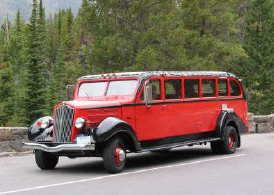
 for easy commuting. I returned in my imagination, though, while setting three novels in the park: The Sun Singer (contemporary fantasy, 2004), Garden of Heaven: an Odyssey (magical realism, 2010) and Sarabande (contemporary fantasy, 2011). If you’ve visited Many Glacier Hotel on the east side of the park, you’ll recognize many of the settings in all three books from Swiftcurrent Lake to Grinnell Glacier





 Píta, the Golden Eagle, leaned forward into Wind’s gentle breath and came to him on soft wings. David looked up to the outstretched legs uncomprehending like a lamb, tagged, docked, weaned and newly out of the pen into greened up spring. When the talons closed around his head, he saw pain and brighter light, then a sudden upward thrust of great wings pulled him free of the world.
  Malcolm's Round Table