Common Forest Trees of Florida – How being a packrat saves time

Looking at the pamphlet shown here, I can say that I have no idea how and when I got it, who scribbled on the cover, or even why the handy little pocket guide published in 1956 didn’t get buried in one of the numerous boxes of packrat stuff in the garage or attic.

Today, of course, a writer can Google just about anything. If he’s persistent, he can sort through all the hobby sites and find information he can count on. While writing my 2010 novel Garden of Heaven: an Odyssey, I needed a handy reference to Florida’s trees. And there it was: right on my shelf less then six feet from my desk.

Published by the Florida Board of Forestry since 1925, I’m guessing I stole or borrowed or received this pocket guide while I was in the Boy Scouts in North Florida. The guide contrains black and white drawings of leaves, acorns and cones along with a descriptive text for each tree. This makes it easy for a hiker or a Boy Scout in Tate’s Hell Forest, the Apalachicola National Forest, or the swamps and estuaries along the Gulf Coast to identify what he’s looking at.

I grew up around Baldcypress, Chinkapin, Tupelo, Sweetbay Magnolia, Sassafras, Cabbage Palmetto, and Swamp Cottonwood trees. So, one would think I’d be a walking encyclopedia about their common attributes, the quick  kinds of details a writer needs when he writes a sentence such as “David stood beneath the ______ leaves of the ____-foot tall Swamp Popular.” But  no, I’ve been away from Florida too long to remember even the simplest details.

If only I had a photographic memory!

I include a lot of detail in my novels about mountains, trees, lakes and wildlife. That helps anchor the magic and fantasy in the story while making the location settings three dimensional. There’s a risk, though. If you make a mistake, somebody’s going to write you a letter or focus his review on the fact that while the hero of the novel was in a gun battle fighting for his life beneath a Chinkapin Oak, you forgot to mention that the three- to seven-inch leaves are toothed or that the trees are between fifty and eighty feet tall. Nice to have a quick reference book!

When it came down to quick reference materials, I found it much faster to grab this old pamphlet off the shelf than to search online. Sorry, Google, but I rather enjoy being a packrat and every once in a while I can actually justify it.

Malcolm

Blue Highways at Night

“Beware thoughts that come in the night. They aren’t turned properly; they come in askew, free of sense and restriction, deriving from the most remote of sources.” — William Least Heat-Moon in “Blue Highways: a Journey into America.”

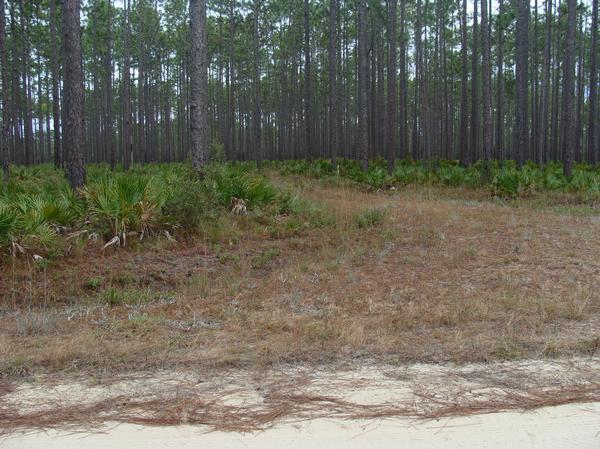
Forest Service Road - Wikipedia Photo

In the early 1960s when gasoline was 31 cents a gallon, my decrepit 1954 Chevrolet knew every unpaved national forest road in Florida between Tallahassee, St. Marks, Woodville, Sopchoppy, Carrabelle, Sumatra and Chattahoochee. Almost nightly, I drove late into the night and all the graveyard shift fry cooks and waitresses knew my name.

The car at night was a sanctuary and such guidance as I received from the universe was both welcome and askew.

In the early 1970s when gasoline as 35 cents a gallon, my 1970 Kaiser Jeep knew the secondary roads across northern Illinois and southern Wisconsin from Waukegan to Fox Lake to Lake Geneva to Kenosha. I’d take the doors off and make the Jeep’s noisy, nighttime world into a place of meditation where the best of wisdom was free of sense and restriction.

Sweet Highway

Montana Plains - Wikipedia Photo

In time, the Jeep also learned the beauty of the empty daylight highways that led through Minnesota and North Dakota to the Rocky Mountains following the route of the old Great Northern Railway. The “sweet highway,” as author Linda Niemann once called it, was the best route to the most remote sources my mind sought out in those days.

I have always understood why some people like repetitive factory jobs, sitting in the right-hand seat of a freight locomotive, or sailing for days with no sight of land. The widgets passing by on the line, the sound of steel wheels on steel rails, and the rhythmic movement of a boat in mid-ocean are the perfect mantras for unlimited thought.

For a young writer trying either to hide from the world or to find his place in it, unlimted thought behind the wheel of a Bellaire or a CJ5 was perfect escape and therapy. Quite literally, driving saved my life and most of my sanity while giving me a first look at the plots and themes of the novels I would one day write.

The Jeep and I in 1975

Driving blue highways at night isn’t for everyone, and thank goodness, because it was the roads would be too crowded to be of any value. The real world expects those who enter the workplace to have the validation that comes from a high school diploma and a college degree. There’s value in a formal education.

The Cost of a Good Education

Yet, I learned more about myself and about writing on Forest Road 13 in Florida and Heart Butte Road in Montana than I did in high school or college. Today, when I compare the tuition costs with the gasoline prices nearing $4 per gallon, I can’t help but wonder if Blue Highways at Night are still a better value.

Malcolm

You can download a free copy of my satirical (fake) news stories “Jock Talks Satirical News” in multiple e-book formats at Smashwords.

Also available at Smashwords and Kindle for only 99 cents, are Jock Talks Strange People, Jock Talks Politics, and Jock Talks Outlandish Happenings.

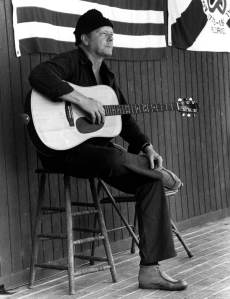
The Father of Florida Folk

McLean in 1965 - Courtesy Florida State Archives
The sun was not shining,
The mist it was thick;
“Oh Lordy!” Tate holler’d,
“I’m lost up the crick.”
–Will McLean, “Tate’s Hell” in “Florida Sand”

Will McLean (1919-1990) wrote 3,700 songs and was often called the “Father of Florida Folk.” If you grew up in North Florida during the 1950s and 1960s and liked folk music, you knew the music of Will McLean. He sang about the swamps and piney woods, capturing forever in his music the land that he loved.

I thought of Will McLean and his 1964 collection of songs called “Florida Sand” when I set major scenes of my novel Garden of Heaven: an Odyssey in Tate’s Hell Swamp in the Florida panhandle. I couldn’t resist having my characters stop by an old store in nearby Sumatra, where McLean stopped from time to time, and hear a few lines from his ballad about a man named Tate who was stalked by a panther in that swamp over a century ago.

In The Other Florida, Gloria Jahoda of Tallahassee, wrote, “Will McLean, who grew up near Sumatra…is a folksinger in the truest sense of the word, for he has taken the legends of his childhood and woven them into music.”

This, I think, was the greatest strength of his songs. He sang of the land we knew and of the the people and stories we grew up with..Gopher John…Acre-Foot Johnson…Osceola.

McLean’s soul was a hawk, he said, and I believe him. In addition to his music, McLean is remembered and honored through the yearly Will McLean Music Festival. Held this month at Brooksville, Florida, the festival celebrated its twenty-second year.

Unfortunately, “Florida Sand” is out of print. However, you can now find its songs compiled within “The Songs and Stories of Will McLean.” McLean’s songs are available on CD from the Will McLean Foundation.

Folksinger Pete Seeger once said of Will, “His songs will be sung as long as there is a Florida.” I hope he’s right about that.

Malcolm R. Campbell is the author of “Jock Stewart amd the Missing Sea of Fire,” “The Sun Singer,” and “Garden of Heaven: an Odyssey.”

Book Review: ‘Evenings on Dark Island’

Evenings on Dark IslandEvenings on Dark Island by Rhett Devane
My rating: 5 of 5 stars

What do the rich and famous, a Florida swamp, an expensive upscale spa, a rat-faced dog, state-of-the-art galas, NASCAR, pot, an inner garden of rare hybrid plants and vampires have in common?

The standard answer is nothing.

But in Evenings on Dark Island authors Rhett DeVane and Larry Rock have turned the highly improbable into a hilarious and tastefully bloody neck biter that’s quite something.

Vincent Bedsloe, who has party planning in blood that’s not altogether his, is the flamboyant, details-oriented master of an exclusive spa set in the middle of an isolated Florida island where the rich and spoiled come to be drained of their income–and perhaps a bit more–while they are ramped up into an ecstatic level of health and fitness.

Bedsloe, who ponders over the emotions of his guests–emotions he no longer has–often retreats into an inner sanctum where he watches old movies and gets his kicks by debunking the silly vampire lore flowing out of Hollywood like blood from a burst artery.

Vincent is a kind-hearted vampire who cares about his human guests. Even his NASCAR-crazed, white trash vampire mechanic Jimmy Rob has an occasional redeeming thought: “He led her to the far, shadowy corner of the bar, behind a thick hedge. Kissed her again. Nibbled her neck. Bit down and drank until he felt her knees buckle. He pulled back abruptly. No need to kill the gal. She’d had a hard enough life.”

The only somewhat normal person in the book is DEA agent Reanita Geneva Register who has been inserted into the mix by the Feds at great expense to prove the obscure island is a haven for drug smugglers. Posing as a rich heiress, Register not only feels naked without her gun but a little nonplussed by her ability to enjoy the island’s pleasures.

The tight-lipped Dark Island staff are notoriously loyal to their employer and, with the annual Blue Blood Ball benefit for the American Hemophiliac Association fast approaching, much too busy to be easily questioned about the strange boats passing in the night.

The authors advertise Evenings on Dark Island as a fang-in-tooth spoof of the vampire genre. And what a spoof it is. This book is not only inventive and well crafted, but it’s filled with the kinds of one-liners and puns that will even wake the undead.

The plot, characters and setting work to perfection without blood, gore and body counts. While the spa at Dark Island may not be the transfusion you need for your physical health and well being in real life, DeVane’s and Rock’s collaboration has a high-clotting factor as well as the kinds of hijinks that will have you laughing all the way to the blood bank.

View all my reviews

Malcolm R. Campbell , who would never dream of writing about vampires, is the author of Jock Stewart and the Missing Sea of Fire, a novel that satirizes the blood suckers in government and the newspaper business.