Mercedes Wore Black, by Andrea Brunais, Southern Yellow Pine Publishing (June 14, 2014), 291pp.
I’m enjoying this smartly written political thriller set in Florida where I grew up. As a former college publications adviser from a “journalist family,” I see immediately that Andrea Brunais knows the world of reporting and gets it right, especially in the domains of murder, political intrigue and the often-losing out Florida environment.
From the Publisher
Florida Politics. The only thing predictable is the unpredictability. When Janis is fired from her job at the newspaper, she focuses on the causes that matter to her. The environment and the economy. That embroils her in the 2014 election.
When her good friend Mercedes encounters danger and is brutally murdered, Janis begins to investigate. She finds herself in a political maelstrom of big money, lottery, and interests with opposing goals. Will she be able to find the crux of the problem—and Mercedes’ killer? Will she be able to expose corruption before anyone else is put in danger?
Quotes from the Reviews
“Fast-paced, exquisitely written, Mercedes Wore Black vividly depicts the underbelly of the newspaper industry and the all-too-real shenanigans of those who are ever willing to sacrifice Florida’s natural treasures” – Joe Guidry, The Tampa Tribune
“A fast-moving story with as much Florida flavor as a grouper sandwich.” Daniel Berger, Amazon reader review.
Floridians especially will enjoy this novel for it is rich in recent political history, on-going environmental issues pitting development against the land, and places state residents know well such as Tate’s Hell Forest, Sopchoppy, Bradenton, Tallahassee and Wakulla Springs. While these strengths will endear the book to Florida readers, they could be a little too much for those in other parts of the country–could be, for the intrigue is high level and will carry readers past the heavy local color.
I spent many hours at Wakulla Springs, a half hour south of Tallahassee where I grew up, and I always saw its old-Florida charm as unique and a bit strange. Now, after the protagonist’s best friend is murdered there in Mercedes Wore Black, I don’t think I’ll ever see this home of snake birds, limpkins, turtles, and icy cold water the same again.
Malcolm R. Campbell’s Florida short stories include “Moonlight and Ghosts,” (Tallahassee) “Cora’s Crossing,” (Marianna) “Emily’s Stories,” (St. Marks) and “The Land Between the Rivers.” (Tate’s Hell Swamp) His novel “The Seeker” includes major scenes at Alligator Point and Tate’s Hell.
“Everywhere that July in 1963 there were the pines, their long needles shimmering in a faint wind under the hot subtropical sun. In the country there were empty dirt roads, rutted by mule carts. In the towns, sprawled unpainted shacks without windows. Ancient Negro women sat fanning themselves with palm leaves as they stared drowsily from rickety porches at their zinnias and coral vines and heavy-scented honeysuckle bushes. Moss-draped oaks and lacy chinaberry trees shaded sandy dooryards. Scrawny dogs, the flies buzzing at their noses, slept among ragged-feathered chickens poking for scratch feed. Locusts whine from tall magnolias and the steady pitch of power saws. But mostly it was those pines and the tang of their resiny branches and the dark straightness of their trunks. All of it looked like the south of the novelists and the poets, heavy with antiquity, romance and misery.” – Gloria Johoda in “The Other Florida.”
I was in college in 1963 when my friend Gloria Jahoda wrote those words. Like me, she wasn’t born in Florida, but in her now-classic book about the state’s panhandle she observed and wrote about what many long-time residents no longer noticed or took for granted. “The Other Florida” was other because it wasn’t filled with tourist attractions, widely known beaches and movie stars.
Other than a few childhood poems, I wouldn’t write about the other Florida until recently. My family moved there from Oregon just in time for me to enter the first grade. Out of the culture shock of the move, I also saw the place I would live for 18 years through the eyes of an outsider.
Yes, my family went to St. Augustine, Tampa, Daytona Beach and Key West, stopping at many gaudy tourist attractions in between. But all that was crowded and nearly fake with an overlay of commercial glitz and I was always happy to be home even though much of the panhandle was considered backward and impoverished in spite of having the state capital in the middle of it.
The Oaks is abandoned now, but this was my favorite place to eat down at the coast
I haven’t been back to north Florida since the mid-1980s when my parents died and my brothers and I closed up and sold the house the family had lived (by then) for some 35 years.
In my childhood days, I learned the territory like most kids did…swimming in clear, cold sinkholes, camping with the Boy Scout Troop in the piney woods, hanging out with friends at our pristine and uncommercialized beaches, exploring the Florida Caverns at Marianna, deep sea fishing in boats that went out from St. Marks, learning the voices of Snake Birds and Limpkins at Wakulla Springs, delivering newspapers throughout my neighborhood, marching in parades downtown with the high school band. . .
We lived in Tallahassee in a day when mule wagons were still on the streets and many homes were built on unpaved, red clay roads.
I saw what Jahoda saw, partly because I was new, partly because the outdoors was our playground in days before the Internet, and partly because my folks arranged day trips to may special places within the confines of this map. In the days before high gasoline prices, my best thinking place was my 1954 Chevy on a dark country road at night. I don’t know what I solved anything, but I saw a lot on the hundreds of miles of roads I saw every week.
Looking Back
There were 40 pine trees in our yard. Plenty of pine straw to take.
If you’re a writer, I urge you to look back to your childhood places and ponder what it was like, what there was to do, what the people were like, and what kinds of stories and legends you heard. Whether you were happy, sad, or borderline average during those days, the memories are potentially very potent.
In looking back, I’ve written (or am in the process of writing) stories on that map set in Carrabelle and nearby Tate’s Hell Swamp, Marianna and the nearby Bellamy Bridge and Chipola River, Tallahassee, St. Marks, Wakulla County, and the barrier islands. My novella in progress is set at a fictional town not too far from Weewahitchka. You can probably find a similar handful of towns near your childhood home. Each has its unusual traditions, the stories people hope everyone has forgotten, legends, ghostly tales, and plenty of Mother Nature.
Florida seems strange to those who did not live there. The same can be said for other places I’ve lived, worked or visited: Northern Illinois, Minnesota, San Francisco, Montana, North Carolina, and North Eastern Georgia. For a writer, a lot of the appeal of going home (literally or figuratively) for stories is the differentness of the place. That adds a lot of appeal to a story. Take a Florida tradition, add in the weather and the pines, toss in a ghost story, and pretty soon you are telling something fresh and knew and page-turning.
You can ramp up your stories with old memories, smiling again with the the joys, possibly even finding closure for the sorrows; your issues, your cares, your friends, your slings and arrows, your memories can be puzzled and camouflaged into your story. They bring strength and depth because you lived them and know what they were all about.
I’ve about wrapped up my Weewahitchka-area story. It gets a potent childhood issue off my plate of memories. More about that later if the publisher likes the story. I think I’ve written some of my best stuff about the places where I grew up because there is so much “material” there I can turn into fiction. That’s why I often urge other writers to look at the towns where they grew up with fresh eyes and see if they can find some stories there.
–Malcolm
$1.99 on Kindle
My stories with Florida settings include “The Seeker” (Tallahassee, Carrabelle, Tate’s Hell), “Emily’s Stories” (Tallahassee and St. Marks), “Cora’s Crossing” (Marianna), “The Land Between the Rivers” (Tate’s Hell) and “Moonlight and Ghosts” (Tallahassee).
“Life is crap and the weather is stupid-hot: reasons enough for four small-town Southern women to plan ‘the easy way out,’” the publisher’s description for Suicide Supper Club informs us. Rhett DeVane (“Cathead Crazy”) brings her trademark sparkling prose and deep insights into human nature to this story of the darkness and light in the lives of Abby, Loiscell, Sheila and “Choo-choo.”
Truth be told, the light is in short supply.
The lives of these kindred spirits play out in the Florida Panhandle between Chattahoochee, a small town with a main street dominated by a mental institution, and Tallahassee, the state capital, 44 miles away. Most of the festering family secrets, declining health, estrangement and physical abuse live and breathe in Chattahoochee for Abby, Loiscell, Sheila and Choo-choo. Tallahassee is for shopping, fine dining, cancer treatments and a prospective appointment with a hit man.
Suicide and humor are usually mutually exclusive worlds. But they seamlessly merge through DeVane’s inventive plot, fully realized characters, knowledge of Southern life and customs, and sense of place. Readers cannot help but feel the characters’ reactions to the darkness in their lives and, quite possibly, understand the rationale for a suicide supper club.
The light in Suicide Supper Club comes from the great love and esteem the four women have for each other and the ways they find for coping with the Florida heat and the crap. I grew up in the Florida panhandle, so it was easy for me to see near the beginning of this novel that when it comes to Chattahoochee and Tallahassee and the people who live there, Rhett DeVane gets it right.
You’ll see that, too, long before you reach the last page and learn whether or not Abby, Loiscell, Sheila and Choo-choo are still among the living.
In 1934, Ethel Byrum Kimball of Anna Maria, Florida wrote the first edition of a soon-to-be-popular publication called Kim’s Guide to Florida. According to a story in The Miami News called Homemaker Writes New Florida Book Guide to State, the guide included “high points of interest, centering about places throughout the state with just enough of comment to stir the imagination or clarify vague knowledge.”
When my family moved from Oregon to Florida in 1950, my father bought a copy of the ninth edition of the guide to help all of us acclimate to the state and plan future vacations that took us from Tallahassee to Pensacola and from Jacksonville to Key West. Based on the guide, we saw attractions that now seem rough and tumble and unsophisticated in their style and presentation compared to the high-style condos and theme parks that would later take over much of the state’s formerly pristine property.
In the introduction to the ninth edition, Kimball wrote, “Ponce de Leon led the way to Florida. During the more than four hundred years since that memorable occasion, Progress has marched valiantly over this ‘Land of Flowers.’ He has left much of the old and added the new, complementing the magnanimous gifts of Nature.”
While I often argue that “progress” went too far in Florida, concealing or destroying many of the ‘gifts of Nature,’ the spirit of the Sunshine State in the 1950s was a heady combination of cattle, orange groves, backwoods and coastal local businesses and tourist attractions. In an article called “The Nation’s Solarium,” the guide said the state was, among other things, “a place for rejuvenating rest to the weary and ill, a place where children grow strong and a nation recreates.”
What to See
Florida was salt war fishing, fresh water fishing, state parks and the Everglades National Park, flowers and plants, forest lands and the “romance of citrus.” Florida was marine shells and subtropical fruists and tourist attractions grouped by city. There were multiple black and white photographs of major points of interest. Ads invited tourists to visit Monkey Jungle, Theater of the Sea, Ravine Gardens, Cypress Gardens, Ste. Anne Shrine, Rainbow Springs and the “Spring of the Mermaids” called Weekiwachee.
We saw the state from Wakulla Springs to Silver Springs and from Castillo de San Marcos to Bok Tower guided by Kim’s Guide to Florida. Many of the older attractions have disappeared over the years, but looking through my 1950s copy of the guide long after the fact, I think that each of our vacations in those days could easily have been filed under the words “it was quite a trip.”
“The Florida Panther is one of the most endangered mammals on the planet. Less than 160 cats remain in the wild. Most live around Okaloacoochee Slough, including the Florida Panther National Wildlife Refuge, near Naples.” – The Nature Conservancy
I grew up in North Florida during the 1950s and 1960s before the state became as overdeveloped as it is now. At the time, there was a captive Florida Panther at a local animal museum that had been injured either by guns or automobiles and was there to recover. It was my favorite animal in the place, one that still lived in the wild in the Florida Panhandle.
In my contemporary fantasy novel The Seeker, (2022 update – now out of print) some of the action takes place at a wild, wonderful and somewhat forbidding tract of piney woods, swamps and wet prairies near the mouth of the Apalachicola River called “Tate’s Hell.” That name comes from the legendary man named Cebe Tate who chased a panther through the swamp because he thought it was killing his stock. He disappeared.
He was bitten by a rattlesnake. When searchers found him, his last words were, “My name’s Tate and I’ve been through hell.”
I grew up with that legend–one that included a folk song about Tate by Florida singer Will McLean–and knew the area well. So naturally, I mentioned the legend in my novel which is set at a time when Panthers were still there.
Catching up on the status of the Panther as I wrote the novel was a sad experience. While I was pleased to hear that in addition to the Nature Conservancy, organizations like Panther Net and Friends of the Florida Panther Refuge were working hard to protect the panther and its vanishing habitat, I was saddened to see how much ground and how many panthers had been lost since the says when I hiked in Tate’s Hell.
One conservation push in many areas of the country is wildlife corridors, protected strips or chunks of land that link up with vital habitats, creating a way for animals to travel between them. In some places, you will see green-space overpasses and underpasses routing animals past Interstate highways. Last year, the Nature Conservancy was able to protect a 1,278 acre tract in Glades County, Florida that Panthers in protected areas can use to increase the size of their range near Naples, FL.
According to the Nature Conservancy, “This acquisition will encourage the natural recovery of the Florida panther population by providing habitat where animals can den and stalk prey, and migrate from southern Florida to areas north of the river. Other species will benefit as well.” The range for a male panther is 200 square miles. The range for a female panther is a 75-mile block within the male’s territory.
I hope the efforts of hard-working people to save the Florida Panther will succeed. In a tourist and development-minded state, playgrounds often trump wild places and vital habitats in the eyes of the government, Chambers of Commerce, and the public. Too bad. It’s a short-sighted view of one’s world.
Here are a few updates about one thing and another, this and that, and things from that drawer most families have the kitchen that contains stuff that didn’t end up some place else.
New
I’m happy to announce that my three-story Kindle set, Emily’s Stories, is now available as an audio book. The stories feature a fourteen-year-old girl who talks to birds and ghosts and, just possibly, tinkers a little bit with reality. That’s what I would expect from a curious, sharp and savvy young lady. Personally, it was strange (in a good way) to hear my words being read back to me by narrator Kelley Hazen. Kelley also narrates my Vanilla Heart Publishing colleague Marie Hampton’s Hunting Heartbreak. Stay tuned for more audio books from VHP later this year. It’s an exciting new way to tell you our stories.
Upcoming
I’m looking forward to posting reviews of two new books about Glacier National Park in late May, Best of Glacier and Glacier Park Lodge. This year marks the 100th anniversary of the famous lodge built by the former Great Northern Railway on the edge of the park. You can still get there by train via AMTRAK’s Empire Builder.
Author Dianne Marenco Salerni (“We Hear the Dead” and her upcoming “The Caged Graves”) will be hear in two weeks with a spooky guest post. With today’s zombie fad, we usually hear about protecting the living from the dead. However, there have been times when the dead needed to be protected from the living. It’s a great post with some wonderful photographs. Dianne and I used to contribute book reviews to the same review site, so it’s doubly fun to see her latest novels coming out and showing up with glowing reader responses on similar sites.
Around the Net
You’ll find some of my favorite places in the blogroll. In my search for author and publishing news for my “Book Bits” posts on my Sun Singer’s Travels blog, I look at a great many blogs and sites each week. But here are some posts I wanted to share (including one of mine own) outside the realm of reviews and author news:
Smoky Zeidel photo
My friend and colleague at Vanilla Heart Publishing, Smoky Zeidel (“The Storyteller’s Bracelet”), has been blogging about the the beauty of the California coast. I haven’t been back to the state where I was born for many years, so I’m contenting myself to read about it in In Search of the Pacific Crest Trail. This is the second in a two-part posting. Smoky is known as the Earth Mage for good reason.
Since I have blogged here in the past about the hero’s journey, I see a lot of visitors stopping by after having searched for more information. I would like to suggest The ongoing series of posts on C. LaVielle’s Book Jacket Blog about the hero’s journey and the Major Arcana from the Tarot deck. The deck’s Major Arcana, when followed in numerical order, are a representation of not only the hero’s journey, but the seeker’s journey. Yesterday’s post is The Sun, Part I.
Montucky photo
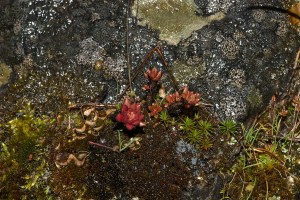
My Montana friend “Montucky” has been running his Montana Outdoors blog for some years now and has gathered over time a surprising variety of high country photographs. He spends a lot of time on trails and forest service roads and always has his camera. You’ll see scenics, river pictures, and hundreds of wildflowers. Most recently, he showed us the beauty of Lichens and moss. Montucky makes frequent posts, and I have found a lot of serenity in stopping by his blog of late to see the last snowfalls and the first spring flowers. His blog is almost as good as flying out to Montana, though considerably less expensive! (However, as soon as Hollywood calls and makes me an offer for this book or that, I’m buying a plane ticket or a suite on the Empire Builder.)
Florida Memory photo
In my recent post on my Sun Singer’s Travels weblog, I couldn’t resist placing my characters in Florida’s Garden of Eden, I continue a series of novel-location-essays focused on my new contemporary fantasy novel The Seeker. In the 1960s when the novel is set, the Florida Panhandle preserve now called the Apalachicola Bluffs and Ravines was touted as being the location of the Biblical Garden of Eden. There were signs all over the place, including one that said “Here Adam and Eve Built Their First Home.” The Garden of Eden trail is still there, but a lot of the former rhetoric and publicity about Arks and gopher wood has faded into the past. The habitat is exceptionally rare no matter what you believe about its past. I habitually use many real settings in my novels and short stories as a way of contrasting fantasy and reality, adding depth to my locations, and (in a small way) keeping a bit of local history alive.
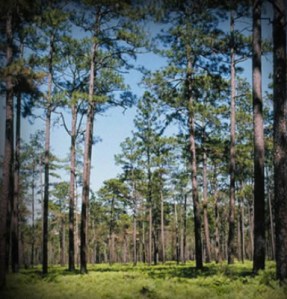
97% of this forest is gone, leaving only isolated pockets of longleaf pines
“The average American’s view of the natural communities of the Southeastern U.S. is that it is comprised mainly of swamps, alligators and big, old moss-hung cypress trees. On the contrary to this view, when early explorers visited the southeastern region they saw “a vast forest of the most stately pine trees that can be imagined, planted by nature at a moderate distance. . . enameled with a variety of flowering shrubs.” Fire defined where the longleaf pine forest was found and fostered an ecosystem diverse in plants and animals.” – Longleaf Alliance
I have been working on another short story for my evolving “Land Between the Rivers” collection about the animals who lived along the Florida Gulf Coast before man showed up and who are now endangered species.
These stories are set in what is now called “Tate’s Hell Forest,” a diverse habitat along the gulf coast near the mouth of the Apalachicola River. This mix of swamps and wet prairies and mixed forests used to flow into the continuous longleaf pine forests as shown on the map.
Why I Like the Setting
When men came, the found a forest they could drive their wagons through. – Longleaf Alliance Photo
The endangered gopher tortoise, the main character in my current story, loves sandy areas for creating its underground burrows and depends on the grasses and other plants the grow on the floor of a well-maintained longlreaf pine forest. Unlike hardwood and mixed forests, longleaf forests feature widely spaced trees with minimal brambles, mid-level trees and shrubs. These forests are maintained by natural fires that roar through and clean away the clutter that would eventually destroy the forest.
The den of a gopher tortoise is great protection against such fires, fires that often run through quickly without burning as hot as summer fires in hardwood forests, especially where brush has built up.
In addition to logging off most of the longleafs and replanting with slash pines and loblolly pines, many don’t understand the need for fires and tend to put them out before they do what nature intended.
Fortunately, enlightened forest management specalists are showing show landowners, as well as active forest companies, the value of these trees, not only commercially as tree farms, but for the environment as well. Click here if you live in the Southeastern United states and would like to visit a longleaf pine forest park or recreation area near you.
Realism and Magic Together
According to Seminole legends, the Earth’s animals emerged from the Creator’s birthing shell in a specific order long before man arrived. My stories about the animals of this time focus on their learning what their living place is all about—what to eat, how to find shelter, how to raise their young. I mix my talking animals out of myth with settings as realistic as I can make them. So now I’m studying the tortoise’s habitat.
Every time I pick a new animal and a somewhat new habitat, I have a good excuse for learning more about the Florida world where I grew up. I started writing these stories when several sequences in my upcoming novel The Seeker were set here and I fell in love with the place all over again.
When friends and family visited us in north Florida, we would often take them to nearby Wakulla Springs to ride in the glass bottom boats and then on the so-called “Jungle Cruise” along the St. Marks River. First, they noticed all the alligators along the river’s bank. And the turtles.
The anhingas, also called snake birds, attracted a lot of attention, because they spent a fair amount of time on tree limbs holding their wings out while drying their feathers. Why? Their plumage lacks the oil of ducks and other water birds and takes a while to dry before they can easily take off again. As the excerpt below shows, taking off with wet wings was a noisy business.
Snake birds swim under water with only their heads and above the surface. They look like snakes. Well, odd snakes. We always told tall tales about this. I finally wrote one down. It appears in Quail Bell Magazine and can be read the story here .
It begins like this:
On a long-ago summer afternoon in the land between the rivers, Tcheecateh was enjoying a long, cat-like stretch of a nap on a fallen sabal palm until the snake bird created a raucous spectacle by running, splashing and wing flapping across the previously calm water of the swamp. Although the blissful quiet returned when the bird finally became airborne, the panther kitten hissed at a blowing leaf out of frustration and stood up to see who else was awakened by Chentetivimketv’s noisy takeoff.
I’m happy to announce the publication of my e-book short story “Cora’s Crossing” released this week by Vanilla Heart Publishing. Priced at only 99 cents, this Florida Panhandle ghost story is already available on Kindle, PDF on OmniLit, and in multiple formats at Smashwords. The Nook version will be available soon.
Ghost Stories as “Local Color”
If you do a Google search like “Florida Ghost Stories” or “Swamp Ghosts” or “Southern Ghosts,” you’ll get hundreds of hits for spooky stories, haunted cemeteries and houses, and ghost hunter expeditions. Stories and legends are, as authors and journalists often say, part of the “local color”—the yarns, history and experiences that make places unique.
Local color in Marianna, Florida, the panhandle town most tourists know as the home of Florida Caverns State Park, includes a local legend about the haunted Bellamy Bridge across the Chipola River a few miles north of the caves. The story has been around for over 150 years and focuses on a young bride who died when her wedding dress caught fire. Since then, she has—some say—taken up residence at the old bridge, and possibly at the wood bridges that crossed the river before that. Local historian Dale Cox writes about the differences between the legend and the real-life Elizabeth Jane Bellamy in his new book The Ghost of Bellamy Bridge.
“Cora’s Crossing” is Pure Fiction
I’ve always enjoyed reading stories in which everyday people suddenly run afoul of ghosts (and other creatures) out of local legends. Truth be old, when I last drove over Bellamy Bridge, I didn’t see a ghost. However (and this is important), I knew better than to drive over it at night. In “Cora’s Crossing,” two young men do drive over it at night and find more than they bargained for when they discover an injured young woman on the shoulder of the road and learn that the people who put her there are coming back.
The Florida Panhandle is filled with remote coastal areas, swamps, blackwater rivers, and other locations that are perfect for ghosts. Growing up there, I heard hundreds of ghost stories, usually at night when we were on Scout camping trips. Most of them began with, “On a dark and stormy night not far from our camp site. . .” Nothing like falling asleep with a ghost story on your mind. My Boy Scout troop never met up with any of the ghosts in those stories.
But what if we had? Worse yet, what if I had driven my ancient Chevy over Bellamy Bridge on a rainy night? I promise you, I didn’t. This story never really happened. Feel free to go visit the bridge during a thunder storm. Everything will be fine.
Updates are collected at the end of the post. As you’ll see, the updates focus on the school rather than on the books. Most recent update is July 2019.
A writer friend of mine in Florida who knows I’ve been working on a series of short stories set in the Florida Panhandle, sent me this link as an idea for a story: Mystery surrounds graves at boys’ reform school. Here’s how it begins: This Florida panhandle town is the home of a mystery that has been lost to time. A small cemetery buried deep into the grounds of a now-defunct boys reform school dates back to the early 1900s. Rusting white steel crosses mark the graves of 31 unidentified former students. (See updates at the end of this post.)
When I read the story, I didn’t initially recognize the school because its most recent name, Arthur G Dozier School for Boys, didn’t connect in my brain with the name, Florida Industrial School for Boys, used for the Marianna, Florida reform school when I was living in Florida in the 1950s and 1960s. The Florida Department of Juvenile Justice operated the school between 1900 to 2011.
Several facts became clear as I read the story and then followed links and Google searches to other stories. The use of the word “school” to describe a physical plant that looked Edenic but which contained unidentified graves of former “students” was misleading to the general public, including those of us who lived in the state capital 85 miles away who had no clue that some of the authorities there based their approach to “reform” on the worst techniques for the control of “undesirables” coming out of World War II POW camps.
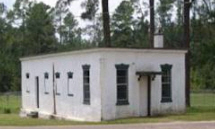
The White House
The ugly truth
Connecting the dots, the boys’ “progress” in the school included a small white house where the rapes, beatings and other horrors occurred after which possibly some of them were buried in the unmarked graves now being investigated. Logically, this is unlikely because, as local historian Dale Cox notes, why would the state murder a student and then mark and maintain his grave? Others contend the graves are for those who died in an influenza outbreak and a fire.
Fortunately, most of the men survived; unfortunately, they have enough haunting memories to last a lifetime.
Some 300 of these survivors have formed an organization called The White House Boys. On their website, you will find news about recent press reports, stories contributed by those who are just now coming forward to tell the world what was happening in Marianna, and links to recent press reports about the State of Florida’s investigation that began several years ago.
I got through high school without any brushes with school authorities or police. Some of those who had problems, many of them trivial, were packed off to reform school. I don’t know if any of the White House Boys were in school with me at Tallahassee’s Leon High School. I haven’t yet seen any names I know. The “problem” students just went away: expelled, dropped out, or joined the service. If they caught the State’s attention through what (for them) was called “the justice system,” news stories in the local paper often said they were being sent to “reform school.”
The old secret.
Then, I had no concept what was supposed to happen at a reform school. Remedial classes? Encounter groups? Campfire sings? Rape and beatings never crossed my mind as mainstays of the curriculum. Right now, I’m too angry about it to remotely consider writing fiction.
I’m angry because it happened in a nearby town I visited often (due to the Florida Caverns State Park there), and I’m angry that it happened right under the noses of state lawmakers and they were either blind or indifferent to it, and I’m angry that even now the story about the investigation, the abuses and the graves has been going on across the border in Florida and I heard nothing about it until my friend sent me that link.
If you want to learn more, and you really don’t even though you must, click on the White House Boys link and/or do a Google search and you will find more than you can bear to know.
The Books
Two books are among those spelling out the details: The White House Boys and The Boys in the Dark.
The White House Boys: An American Tragedy, by Roger Dean Kiser, publisher’s description:
Hidden far from sight, deep in the thick underbrush of the North Florida woods are the ghostly graves of more than thirty unidentified bodies, some of which are thought to be children who were beaten to death at the old Florida Industrial School for Boys at Marianna. It is suspected that many more bodies will be found in the fields and swamplands surrounding the institution. Investigations into the unmarked graves have compelled many grown men to come forward and share their stories of the abuses they endured and the atrocities they witnessed in the 1950s and 1960s at the institution.
The White House Boys: An American Tragedy is the true story of the horrors recalled by Roger Dean Kiser, one of the boys incarcerated at the facility in the late fifties for the crime of being a confused, unwanted, and wayward child. In a style reminiscent of the works of Mark Twain, Kiser recollects the horrifying verbal, sexual, and physical abuse he and other innocent young boys endured at the hands of their “caretakers.” Questions remain unanswered and theories abound, but Roger and the other ‘White House Boys’ are determined to learn the truth and see justice served.
–
The Boys of the Dark: A Story of Betrayal and Redemption in the Deep South, by Robin Gaby Fisher, Michael O’McCarthy, and Robert W. Straley, publisher’s description:
A story that garnered national attention, this is the harrowing tale of two men who suffered abuses at a reform school in Florida in the 1950s and 60s, and who banded together fifty years later to confront their attackers.
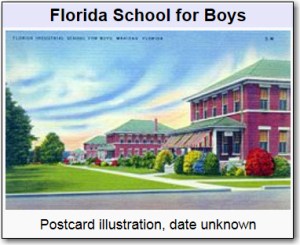
Michael O’McCarthy and Robert W. Straley were teens when they were termed “incorrigible youth” by authorities and ordered to attend the Florida School for Boys. They discovered in Marianna, the “City of Southern Charm,” an immaculately groomed campus that looked more like an idyllic university than a reform school. But hidden behind the gates of the Florida School for Boys was a hell unlike any they could have imagined. The school’s guards and administrators acted as their jailers and tormentors. The boys allegedly bore witness to assault, rape, and possibly even murder.
For fifty years, both men—and countless others like them—carried their torment in silence. But a series of unlikely events brought O’McCarthy, now a successful rights activist, and Straley together, and they became determined to expose the Florida School for Boys for what they believed it to be: a youth prison with a century-long history of abuse. They embarked upon a campaign that would change their lives and inspire others.
Robin Gaby Fisher, a Pulitzer Prize–winning journalist and author of the New York Times bestselling After the Fire, collaborates with Straley and O’McCarthy to offer a riveting account of their harrowing ordeal. The book goes beyond the story of the two men to expose the truth about a century-old institution and a town that adopted a Nuremberg-like code of secrecy and a government that failed to address its own wrongdoing. What emerges is a tale of strength, resolve, and vindication in the face of the kinds of terror few can imagine.
Looks like a college – Wikipedia Picture
I thank my friend for sending me the link. I don’t have the knowledge to turn this into a gripping novel. But then, I don’t need to, for those who were there are already telling their stories. I can’t so better. I wouldn’t presume to try. And, as a 1968 newspaper story about the school (Hell’s 1,400 acres) suggests, Florida didn’t just learn about this problem.
UPDATE: From NBC news on December 11, 2012: Abuses at infamous Florida boys reform school even more widespread, report says – “Scientists have found 19 previously unknown grave shafts on the grounds of a notorious Florida reform school, suggesting that many more boys died there amid brutal conditions than had previously been known”
UPDATE: (January 28, 2014): Remains of 55 bodies found near former Florida reform school – “Excavations at a makeshift graveyard near a now-closed reform school in the Florida Panhandle have yielded remains of 55 bodies, almost twice the number official records say are there.”
UPDATE: (March 8, 2016) State offers to rebury victims of Dozier School abuse – “A measure intended to help heal a community and people who suffered at a former reform school where the remains of 51 boys have been unearthed is headed to the desk of Gov. Rick Scott.”
UPDATE: (November 5, 2016) Special Report: Dozier School, What’s Next? Talks are underway about what should be done with the school’s property so that it can transition into another use that would have a positive economic impact on the community. But first, the state has to relinquish the property.
UPDATE: (January 13, 2017) Discussions are underway about whether to tear down or preserve the building known as the White House where boys were abused.
UPDATE: (May 23, 2018) “White House Boys’ Tour Dozier Campus” – “MARIANNA, Fla. – Friday, the ‘White House Boys’ toured the Dozier School for Boys Campus and held a memorial service, for closure.The tour was private and members of the group would not talk with the media.”
UPDATE: (October 11, 2018) – Author Colson Whitehead’s latest novel, The Nickel Boys, will be released next summer. According to the New York Times, “Colson Whitehead was set to write a crime novel set in Harlem. But he couldn’t stop thinking about a story that haunted him, about the abuses — beatings, torture, neglect, suspicious deaths — that took place at the Arthur G. Dozier School for Boys, a reform school in the Florida panhandle that operated for more than a century.”
UPDATE: (April 12, 2019): More ‘possible graves’ found at Dozier School for Boys – Tampa Bay Times: “A company doing pollution cleanup at the old Dozier School for Boys property in Marianna, 60 miles west of Tallahassee, has discovered 27 ‘anomalies’ that could be possible graves.”
UPDATE: (July 17, 2019): Researchers to look for more graves at Florida reform school – “University of South Florida forensic anthropologist Dr. Erin Kimmerle will be back at the former Dozier School for Boys on Monday, the same place where she spent four years researching and unearthing the remains of boys buried on the massive 1,400-acre site in Marianna, located about 60 miles (96 kilometers) northwest of Tallahassee.” – Associated Press 7/23: No new graves were found.
UPDATE: (July 17, 2019) Rooted In History, ‘The Nickel Boys’ Is A Great American Novel (Review) – “It’s pretty rare for a writer to produce a novel that wins the Pulitzer Prize and the National Book Award and, then, a scant three years later, bring out another novel that’s even more extraordinary. But, that’s what Colson Whitehead has done in following up his 2016 novel, The Underground Railroad, with The Nickel Boys. It’s a masterpiece squared, rooted in history and American mythology and, yet, painfully topical in its visions of justice and mercy erratically denied.” – NPR. See also, this review: For The ‘Nickel Boys,’ Life Isn’t Worth 5 Cents.
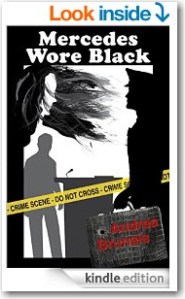 I’m enjoying this smartly written political thriller set in Florida where I grew up. As a former college publications adviser from a “journalist family,” I see immediately that Andrea Brunais knows the world of reporting and gets it right, especially in the domains of murder, political intrigue and the often-losing out Florida environment.












 Malcolm's Round Table