Briefly noted: ‘Red Sulfur’ by Robert Bosnak

Man is a thinker.redsulfur
 He is that what he thinks.
When he thinks fire
he is fire.
When he thinks war,
he will create war.
Everything depends
if his entire imagination
will be an entire sun,
that is, that he will imagine himself completely
that what he wants.
— Paracelsus

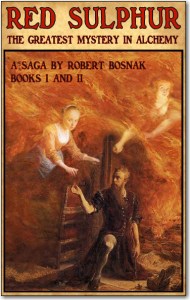
Red Sulphur: The Greatest Mystery in Alchemy [Kindle Edition], by Robert Bosnak, Red Sulphur Publications (December 8, 2014), 508pp

As I read this book, I cannot help but think of author Katherine Neville (The Eight, The Fire) who popularized the magical saga long before Dan Brown took the form to even larger audiences. I also cannot help but note that Robert Bosnak is a long-time Jungian analyst with widely-read nonfiction books to his credit who has studied alchemy for years. Jung was also a student of alchemy, seeing it as widely applicable to the understanding and development of the self. The heritage behind Red Sulphur brings great promise to this novel.

From the Publisher: It is 1666, the Year of the Beast, seen by many as the moment the Devil will appear on earth.

Science is in ascendance, crowding out other systems of thought. The ancient art of alchemy is in retreat. No one has been able to make the Philosophers’ Stone for over a hundred years, but many of the best minds of the age are still in a desperate search for it. Stories vividly abound how alchemists of yore had created a powerful stone of sorcery, rejuvenating all it touches — turning decrepit old lead into precious fresh gold. A universal medicine known to the alchemists by its true name: Red Sulphur.

From the Novel’s Epigraph: “This saga is based on the last verified historical reports by credible withesses about a mysterious transmutation. It follows the lives of a great alchemist and the two extraordinary women he loves. The last in the world in possession of the miraculous Red Sulphur, the source of all creative powers, they are pursued by dark forces and powerful world leaders. This is a visionary tale spanning two generations in the last days when magic was strong. It is the story of the final embers of the long gone days when the Magi could still do what we, children of science, hold to be impossible.”

Editorial Reviewer Comment: “A book both compelling and haunting. Robert Bosnak’s saga Red Sulphur traces the history of the split between alchemy and science in a tale of lust, greed and abiding passion.” – Penny Busetto:

Bosnak
Bosnak

From the author’s Amazon Page: “ROBERT BOSNAK grew up in Holland, trained in Switzerland, and has studied alchemy for over 40 years. He is a noted Jungian psychoanalyst specialized in dreaming with a practice in Los Angeles, and is the author and editor of 7 books of non-fiction in the fields of dreams, health, and creative imagination. His bestselling A Little Course in Dreams was translated into a dozen languages. He developed a method called ’embodied imagination’ used widely in psychotherapy and applied worldwide to a variety of creative endeavors. The Red Sulphur saga is his first published work of fiction. He lives in the mountains of Santa Barbara.”

You have to be an alchemist, a Jungian or a mystic to love this book. That’s the beauty of it as a saga. You don’t need footnotes; instead, you need simply to love a story. The story might change you in ways you don’t expect, but then reading always has that kind of power over those who resonate with the characters, plots and themes.

Malcolm

Seeker for promo 1Malcolm R. Campbell is the author of magical realism and contemporary fantasy novels including “The Seeker.”

Tell me a story

Hey! Mr. Tambourine Man, play a song for me
 I’m not sleepy and there is no place I’m going to
 Hey! Mr. Tambourine Man, play a song for me
 In the jingle jangle morning I’ll come followin’ you
–Bob Dylan

We who write are tambourine men, poets, liars, con men, dreamers, pied pipers, spinners of yarn, spinners of mirages, tinkerers with reality, profane disciples of all that’s engraved in the sand on a beach, creators and destroyers of worlds, demons and tricksters and gods, snakes in the grass, and golden eagles flying high above the divides between night, day, worlds, sleep and consciousness.

minotaurWe who write intend to lead you astray for that is where you will find yourself, your salvation, your journey’s beginning, your lover, your treasure and everything that matters and gives substance to life.

If you read our words, if you follow the jingle jangle of our stories, we promise you that whatever you thought was engraved in stone was in fact fluid and that whatever you thought was fluid was your imagination and that reality is always a deck of cards that you can choose to play face down or face up depending upon your penchant for fate and destiny.

We who write cannot be trusted to give you a straight answer for we only know dark and crooked roads and the stories that live alongside them. But do not take care or look behind you for the prize comes with the unexpected, the epiphany hidden amongst devils and the light that shines on the darkest night for those who walk with their eyes wide open.

Believe what you will, but when you follow tambourine men, poets, and liars there is no turning back though you may believe some dream or illusion that you have turned back as we all go deeper into the labyrinth toward Minotaurs that will–if the gods be kind–tell us the secrets of life if we survive the journey.

We who write are always en route to the center of the labyrinth where all stories lead us, and where they will lead you, too, if you dare to say, “Tell me a story.”

Malcolm

Malcolm R. Campbell is the author of “Conjure Woman’s Cat.”.

Fiction writing: is it about the money?

Yes and no.

moneyYes, because unless you’re writing stories for your children, for your own amusement, or for small, non-paying newsletters and magazines, full-time fiction writers consider their career a business even if they are partially supporting themselves as teachers, researchers and other jobs.

No, because focusing on money–for most writers–gets in the way of developing and telling a story. This is not to say that we’re unaware of the realities regarding salable novels and short stories by writers at one stage of their career or another. One reality is that, without a strong platform or a lot of friends in the business, most unknown writers will not be able to sell novels as long as those written by Diana Gabaldon, Eleanor Catton and Donna Tartt. Another reality is that, if we’re writing in a genre, we know what’s more or less acceptable within that genre and what isn’t.

So, while we can choose to stray outside the “rules” of genres, especially as defined by the mainstream of out intended readers and we can choose to write 500,000-word first novels, most choices about characters, plots, settings, dialogue and themes are (or should be) divorced from the question: will this make me more money or less money?

I dislike the trite phrase that “writers must wear multiple hats.” But it’s short, sweet and true. At some point–and perhaps this usually comes from experience–we learn how to compartmentalize our writing business. While those compartments–marketing, sales, research, writing, editing–obviously interact with each other, having such divisions in our work allows us to concentrate on one or the other without being distracted by concerns that don’t relate to the task of the moment.

Worrying About Work That’s Already Completed

New writers worry a lot about rejection slips and why it’s taking publishers or agents so long to respond to manuscripts and queries. Quite often, they’re spending so much time checking the mail and e-mail for a yes/no response about the last story they sent out, they find themselves unwilling or unable to work on the next story. Then, if the response they’ve been waiting for finally comes in as a NO, they’re in the worst possible place to be thinking up something new when, if they had something new already in progress, they could go back to it.

Writers also learn–and maybe this is another experience thing–to separate the kinds of writing they do. Those of us who have partially supported ourselves by writing feature articles, grant requests, news releases, computer help files, and training materials can step from one to the other without having to re-learn approaches and styles. The same is true when fiction’s involved. We can transition from writing news releases during the day to writing a Gothic novel at night without getting mixed up about what we’re writing any more than a tennis player worries about using different techniques and equipment when s/he plays a round of golf.

Compartmentalizing our work not only helps us organize the work week rather than trying to run a business by randomly jumping from one task to another, it helps us tell stories without thinking about money. If we write commercial fiction as well as literary fiction, we learn to step into the needs of the story and genre we’re dealing with. We know before we start what the rules are and we know that the commercial fiction is probably more salable, but then we put that knowledge aside and tell the story.

If money’s a concern while we’re writing the story, the story will probably suffer for it.

–Malcolm

thesailorcoverMalcolm R. Campbell is the author of contemporary fantasy, satire and paranormal stories and novels, including “The Sailor.” The novel tells the story of a pacifist who ends up serving aboard and aircraft carrier during the Vietnam War. Truth be told, friends and family cause more trials and tribulations than most of the demands of shipboard life.


Is a copy of the publication suitable payment for your work?

This is the inside joke of creative writing programs in America. We know creative writing doesn’t make money, and yet we continue to graduate talented writers with no business acumen. At best, it is misguided. At worst, it is fraudulent. –  Nick Ripatrazone in his essay in The Millions, Practical Art: On Teaching the Business of Creative Writing

The short answer: can you use that copy to pay the rent, buy a Happy Meal or a new toner cartridge for your printer? If not, why would any writer want to work for a copy of a magazine or anthology while the publishers make money off his/her work?

Another short answer: or, maybe you can legitimately view writing for payment in copies as similar to blogging which–unless you have a highly popular, monetized blog–isn’t paying the rent either. Blogging is part of an author’s platform. That’s how we justify doing it. In both cases, free blogging and unpaid publication in anthologies and little magazines sooner or later have to lead to a money making business or they are not doing what they’re supposed to be doing: improving your craft and moving you from a hobby writer to a professional writer.

The Longer Answer: When mainstream fiction magazines were more prevalent, writers were told that writing stories for “little magazines” and for non-paying anthologies for free was a necessary part of building up a list of writing credits. If BIG MAGAZINE ABC saw that you had been published in MEDIUM MAGAZINE YXZ, you supposedly had a better chance of acceptance. The practice still has value and, perhaps, may be even more important for those in publish or perish careers. This view has many ramifications to it depending on the kind of paid writing you ultimately want to do and how valuable those at the top of that ladder view publication in one place or another as a prudent step.

“What does it mean,” asks Ripatrazone, “that we, in the literary community, have accepted lack of monetary payment as commonplace?”

While I’m old school enough to impractically view college as a place heavy with liberal arts that teaches students how to think rather than providing then with a certificate that allows them to move right into a job like a technical school, I see the need that Ripatrazone sees when he says writing programs often do little or nothing to prepare graduates for the business side of their chosen profession. Likewise, many writers groups online and offline, though self-publishing has brought marketing and PR more heavily into the discussions and seminars.

As he puts it, the art of writing is sometimes taught as though it’s a spiritual process in which long-term practical, positive results are viewed as an unnecessary luxury. According to the disciples of this approach, finding yourself and telling your story are the important things even if nobody pays a dime to read what you write.

The odds of making that dime are long odds. That’s reality. But saying that dime doesn’t matter sounds like a lot of self-effacing denial to me. “Payment for little old me? Golly, writing the story is what counts.”

Maybe so if you plan to live with your parents into your 40s or find a spouse that makes enough money to support you while you find yourself or you win the lottery or you work at a day job and stay up all night writing.

Look at the Business Side in Addition to the Art of Writing

Ripatrazon’s essay includes a handy checklist of ideas for bringing students more into the mainstream of what their chosen profession is all about, from demystifying publishing to an introduction to freelance writing and how it works to what editors want and how they want to see it presented to them.

Writing nonfiction can become a viable means of supporting oneself while working on fiction after hours. Taking a look at such magazines as the Atlantic and the National Geographic is proof enough that nonfiction isn’t a secondary kind of writing. Becoming good at it, helps improve a writer’s art and craft while building a list of credits. Writing for low rates of payment at first and working up to higher rates of payments seems to me to be a much better route than writing for copies of publications.

That’s not a hard and fast rule, especially if you’re making money some other way to pay the rent. And who knows, getting accepted by a prestigious publication might help your career. It’s hard to say, because no matter how much all of us study the business side of writing fiction, making money from novels and short stories is always a gamble. The number of writers who live off fiction writing is a very small number.

When we write, we can’t be like our non-writer friends who go to a 9-5 job that pays them to work their craft in a cubicle or assembly line without having to worry exactly how customers are found and products are marketed. Even if we’re lucky enough to find helpful publishers’ editors, agents or even business managers, we’re still–as novelists–both the CEO of the whole process as well as the craftsman down in the shop.

We need two mindsets, one that sees the dollars and sense in practical terms and one that sees the beauty of a well-told tale coming together on the page. As Ripatrazone says, “I need my students to know that they will likely struggle every step of this way in this business. They must be shrewd and determined and aware. But when they close the door and go to their writing desk, they must be generous, sensitive, and open to the mystery of this art.”

Being too willing to write for copies may be a sign that we’re not really looking at the practical side of the profession. Or maybe for a while it’s an expediency.

Malcolm


Review: ‘Suicide Supper Club’ by Rhett DeVane

suicidesupperclub“Life is crap and the weather is stupid-hot: reasons enough for four small-town Southern women to plan ‘the easy way out,’” the publisher’s description for Suicide Supper Club informs us. Rhett DeVane (“Cathead Crazy”) brings her trademark sparkling prose and deep insights into human nature to this story of the darkness and light in the lives of Abby, Loiscell, Sheila and “Choo-choo.”

Truth be told, the light is in short supply.

The lives of these kindred spirits play out in the Florida Panhandle between Chattahoochee, a small town with a main street dominated by a mental institution, and Tallahassee, the state capital, 44 miles away. Most of the festering family secrets, declining health, estrangement and physical abuse live and breathe in Chattahoochee for Abby, Loiscell, Sheila and Choo-choo. Tallahassee is for shopping, fine dining, cancer treatments and a prospective appointment with a hit man.

Suicide and humor are usually mutually exclusive worlds. But they seamlessly merge through DeVane’s inventive plot, fully realized characters, knowledge of Southern life and customs, and sense of place. Readers cannot help but feel the characters’ reactions to the darkness in their lives and, quite possibly, understand the rationale for a suicide supper club.

The light in Suicide Supper Club comes from the great love and esteem the four women have for each other and the ways they find for coping with the Florida heat and the crap. I grew up in the Florida panhandle, so it was easy for me to see near the beginning of this novel that when it comes to Chattahoochee and Tallahassee and the people who live there, Rhett DeVane gets it right.

You’ll see that, too, long before you reach the last page and learn whether or not Abby, Loiscell, Sheila and Choo-choo are still among the living.

Malcolm

Review: ‘What Casts a Shadow?’ by Seth Mullins

“Events are not things that happen to you. They are materialized experiences formed by you, according to your expectations and beliefs.” – Seth via Jane Roberts

whatcastsNOTE:  Over the years, Seth Mullins and I have discussed in various blogs and e-mails our affinity for the metaphysical information from the entity known as Seth who was channeled by Jane Roberts between 1963 and 1984 and subsequently chronicled in a series of books beginning with The Seth Material in 1970 (republished in 2011). Seth Mullins has previously explored spirituality, dreams and reality in Song of an Untamed Land and Song of the Twice Born while I have explored similar themes in my novels.

I hadn’t heard from him in some time when I received an e-mail asking my current address so he could send me a copy of his new novel What Casts a Shadow? (January, 2014).  He said that, among other things, the novel was an exploration of Seth’s view of reality in a contemporary story. Yes, there are multiple Seths here, but the one in Italics refers to the Seth as channeled by Jane Roberts and the Seth without the Italics refers to the author of this inventive novel.

What Casts a Shadow?

While the Seth material channeled by Jane Roberts was immensely popular during the 1970s and 1980s and continues to have a wide following today, my experience is that rather than feeling empowered by the phrase “you create your own reality,” a fair number of people fear and/or angrily reject the idea. For one thing, the idea doesn’t appear to make logical sense. Otherwise, people say either “if I create my own reality, why is my life filled with so many disappointments?” or “my thoughts must be totally screwed up to have created what I’m experiencing.” People had a similar reaction to ideas about “the law of attraction” as presented in The Secret and other books.

Seth Mullins’ protagonist Brandon Chane in What Casts a Shadow? has similar reactions when a psychologist suggests that the “world out there” isn’t out there. After Brandon’s mother died, he was stuck living with a drunken and abusive father who believes neither Brandon nor his new heavy metal rock band will ever amount to anything.

After his father lashes out at him prior to a performance, Brandon thinks: “My world is painted black; my entire inner landscape is barren. All the roads in my head lead to horrific ends. At the bleakest margins of this particular attack, I didn’t even care about the gig. I wanted nothing but oblivion.”

Mullins’ three-dimensional character is in many ways symbolic of creative people who want to express their unique visions of life through art, music, writing and other avenues but simultaneously believe that the world (or fate) is against them. Brandon and his best friend Tommy want to translate their feelings into their music; their music, they hope, will be their salvation.

Brandon reacts to the slings and arrows in his life with violence. Physical fights seem justified and bring release. Writing songs and performing them in front of an audience also bring release, but at the beginning of What Casts a Shadow? the songs aren’t as potent as knocking somebody down.

After a confrontation that involves the police and an interview with a consulting psychologist at the police station, Brandon ends up on Saul’s doorstep. Saul is a licensed therapist who believes individuals create their own reality.

Saul is a “new age” guru with a more or less conventional counseling approach. That is, he doesn’t sell guided-meditation CDs, lead drumming groups in the woods or ask his patients to recite affirmations. Instead, he asks Brandon to see his beliefs as beliefs rather than as facts and to compare his experiences with the states of mind leading up to them.

Mullins has created a protagonist that readers can easily identify with who has dreams that are running afoul of a seemingly apathetic world with bad people in it. Other than Saul’s active listening, Brandon will find clues that he might not be not doomed and worthless: Tommy understands him, his younger sister trusts him, the girl he meets doesn’t run away from him, and the music is evolving. Yet, his violence and anger feel so natural and justified!

Transformation and “success” in Brandon’s world will not come from a magic spell, a miracle drug or the intervention of a benevolent spirit guide. He will have to slog it out like we all do, day by day, doubt doubt, and reaction by reaction. What Casts a Shadow? will pull both open minded and skeptical readers into its story because that story mirrors so much of today’s world.

Malcolm

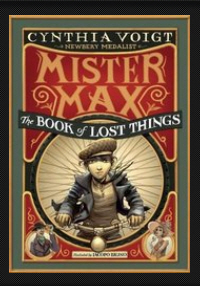
Book Review: ‘Mister Max’ by Cynthia Voigt

mistermaxNewbery medalist Cynthia Voigt (“Kingdom,” “Tillerman” and “Bad Girls” series) brings her considerable storytelling experience to an inventive adventure with a unique and resourceful protagonist. Intended for readers from 8-12, Mister Max: The Book of Lost Things is the first in a planned trilogy about the likeable and realistically drawn twelve-year-old Maximilian Starling.

Day to day, he’s just Max, a schoolboy who doesn’t quite fit in with his peers because his parents are larger-than-life and excessively flamboyant theater people who find drama in everything. Just Max is just “different.” Max’s has a nagging problem: his parents are lost. They’re lost as in missing, misplaced, misunderstood, potentially kidnapped, or enacting a drama without due regard to Max who’s been left behind in an empty house.

Fortunately, his grandmother lives nearby. Unfortunately she is, in Max’s opinion, inclined to be bossy. They agree, however, that it’s better for Max’s school to assume Max is on a trip with his parents. After all, that was the plan before William and Mary Starling of the Starling Theatrical Company disappeared. Grammie and Max also agree that the authorities, whoever they may be, need not know about Max’s mostly empty house.

Readers will identify with Max because, like any twelve-year-old with lost parents, Max is a bit overwhelmed by the questions and emotions racing through his head. However, he is determined to meet the challenges of independence head on. He needs money and that means he needs a job even though nobody seems to be hiring twelve-year-old applicants without experience.

Voigt has blessed her protagonist with a skill he doesn’t immediately see has having any value outside the walls of the Starling Theatrical Company: he knows about roles and costumes. While he doesn’t really want to call himself a private detective, the world of roles and costumes and his preoccupation with that which is lost make him adept at helping others–at a reasonable fee–find what they need to find.

The story is filled with memorable characters, humor and a series of lost and found adventures that will stir up the imaginations of young readers who might speculate about what they would do if their parents were lost. Voigt’s words, which (figuratively, of course) dance and sparkle on the page, are supported by Iacopo Bruno’s magical illustrations.

The illustrations and plot twists bring a heady 19th-century daring-do to a story that sweeps toward a suitably over-the-top cliffhanger ending that should satisfy readers while Voigt decides how Max is going to find his way out of his next dilemma. Young readers will find that Mister Max is filled with wonder, mystery and plenty of adventure.

Malcolm R. Campbell is the author of contemporary fantasy short stories and novels including “The Seeker” and “Emily’s Stories.”

On location: Glacier Park’s Iceberg Lake

I used Glacier National Park’s Iceberg Lake in “High Country Painter,” of the three short stories in my family-oriented e-book/audio book Emily’s Stories.

Where Is It?

icebergmapIceberg Lake is a 5.9- mile hike from Many Glacier Hotel on the east side of Montana’s Glacier National Park. The lake, which is frozen over during the winter months, is named for the chunks of ice that float in it throughout the summer. It’s one of the most popular trails in the area.

En route to the lake from the hotel, the elevation increases 1,200 feet, however most of the uphill sections of the trail are gradual. For those who haven’t yet gotten used to the elevation or long walks, the hike provides a half-day of exercise.

In his book The Best of Glacier National Park, Alan Leftbridge lists Iceberg Lake as one as one of Glacier’s seven best day hikes. His level of difficulty for the hike is moderate. Hiking in Glacier calls the hike strenuous. (I guess it depends of whether or not one is out of shape!) If you don’t have a hiking guidebook, this web site provides a good overview of the trip.

How I Used it In the Story

Trail to Iceberg Lake - Photo by GlacierGuyMT
Trail to Iceberg Lake – Photo by GlacierGuyMT

Young Emily Walker and her family travel from Florida to Glacier National Park for a family vacation. She accompanies her father on the hike while her mother spends the day around  the hotel. Since she occasionally talks to birds and spirits, she knows something unusual will happen at the lake.

Why I Used the Lake

Iceberg Lake
Iceberg Lake

Emily and her father are used to the sinkhole lakes and blackwater rivers in the Florida Panhandle. I wanted to put them into a new environment. The arête in the picture is called the Garden Wall and it not only provides a lot of ice and snow to look at, but frequent mountain goats as well.

The lake sits in a cirque, a carved-out bowl left by ancient glaciers, and since it’s such a popular spot, hikers will  almost always find ground squirrels and chipmunks there begging for food. The lake sits in bear country, so it’s always good to check with the rangers for to see if there have been any grizzly bears in the area before you begin your hike.

The hike also features many wild flowers as well as some very different views of the mountains than one sees from the hotel. There are good views of many rock formations and other features of glaciation,

The first mile of the hike is on the paved road that connects the hotel complex to the camp store and the campground; park your car at the store to save a bit of walking.

Excerpt from Emily’s Stories

Available on Kindle and as an audio book

The horizon was hidden by a grey wall of rock which, according to the pack, also concealed incoming storms; now, carrying rain jackets on a sunny day made sense. By the time they passed the noisy waterfall and strolled through lacey-white bear grass (without bears) and scattered Indian paintbrush that gentled the grey rock (“limestone,” her dad said, descriptively), Emily was ready for lunch.

Deep snow lay hard-packed around the lake’s far shore where the limestone wall created a playground for mountain goats running across their grey and white world as nimbly as Southern chameleons ran along the Walters’ brick house. Sunny Florida was, as advertised, sunny and hot, but here deep summer had only melted the ice off half of the lake’s surface.

“I am astonished,” said Emily, dropping her knapsack on the ground and running down to the water. The water was as cold as it looked.

“Punkin, ‘astonished’ is a new word for you,” her dad said. He knelt down and splashed water over his
face.

Summing Everything Up

My teenaged protagonist talks to birds and spirits, so her stories are always set outdoors. Like other visitors to the hotel, the hike to the lake is one she would probably take. It provides great scenery for Emily to experience with her father as long with the possibility a bear might appear.

I worked at the hotel as a bellman for two summers and walked up to this lake many times. Using it in the story is an example of a writer writing what he knows.

Malcolm

The library and College Avenue remembered in fiction

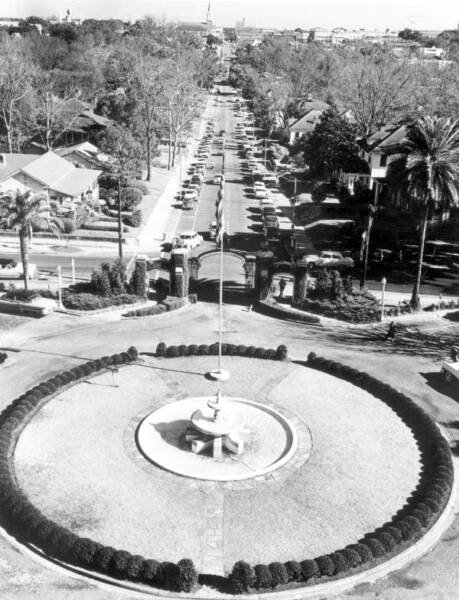
College Avenue in 1964 looking from the unniversity toward downtown

I grew up in a town where College Avenue led straight from the main business district to the university’s main gate.  I liked the sweeping hill, the brick paving, and the older homes that owned the street as it drew closer to the university’s administration building. As I wrote The Seeker, College Avenue at night looked like the perfect place for a stalker.

And I knew exactly where that stalker would come from: the university library. I worked there as a student assistant to help pay the bills. It was my favorite place on campus except for the fact somebody there was spying on young women. He pushed books out of the shelves in a signature way so he could, apparently, look up dresses and ogle legs.

We never caught him. One minute an aisle leading through the open stacks was pristine; the next minutes there were books on the floor. I often wondered what kind of a sick person was on the loose. I never knew, but my imagination supplied plenty of details for the 1960s-era College Avenue chapter of The Seeker.

Protagonist David Ward is there in the dream world because he fears the stalker is following his girl friend Anne Hill. There’s little he can do, though, but watch the night unfold. He feels as powerless as I did in the library trying to get “the library guy.”

Except from The Seeker

Kindle Version
Kindle Version

David stood at the corner of College and Monroe in Tallahassee, Florida. To the north: the primary downtown business area, including the Florida Theater, which was showing Send Me No Flowers with Rock Hudson and Doris Day. To the west: the State Theater presented Elvis Presley in Roustabout. Farther west, College Avenue grew dark as it approached the university and the night beyond.

He dreamt and he knew he was dreaming. The sounds of the city were clear and, so, too, the conversations of the people on the sidewalk between the theaters, and some of their thoughts as well, expectations of popcorn, concerns about recent exams and questions about who they would see this evening and whom they would be with. Unlike his standard dreams, David walked like a ghost, unseen and unheard among the students and family groups and scattered grandparents. Yes, he could follow Anne or Nick or even RC without their knowledge. But if danger threatened, he could shout no warnings nor take any action.

He walked north and found Anne in front of the Florida Theater with Marta and Karen. Karen and Marta wanted to go out to a hamburger place with three students in a double-parked car. Anne didn’t.

“I’m fine, just a bit of a headache,” she said.

“We should stay together,” said Marta.

Staying together is smothering me.

“The streets are crowded,” said Anne. “It’s a safe night for walking back to the dorm.”

The car pulled away and Anne walked toward College Avenue with David, though she didn’t know it. Her hair was in a ponytail and she wore a light blue sweater against the gentle chill of the evening. The rivers of people coming and going from the theaters converged at College Avenue with cars driven by dates, friends, and parents in a clamor of horns and shouted greetings.

Very few people are walking toward the campus. The hill is dark past Schwobilt’s Department Store and the Baptist Church. Not good. Somebody’s whistling off key across the street. Maybe I should see Roustabout. Afterwards, perhaps a group of students will head back toward from front gate.

David also heard the whistling, but he saw no one there, heard no thoughts to follow within the rag-tag, repetitive “Lord, I Want to be a Christian” that swirled like an ill wind around the YMCA building and several small clothing shops across the street.

Anne hovered hear the ticket booth within the safe glow of light beneath the marquee.

“Go inside, Anne,” he said. While she didn’t hear him, David heard her think of him, wishing she had invited him down for Thanksgiving. The young woman in the glass booth
looked up, smiled.

David would hate Roustabout, but at least he would be here.

“I’m thinking about it,” said Anne.

This is silly.

She looked at the movie posters in the glass cases. Glanced across the street, and then walked away, comforted—he could tell—by the elderly couple standing in front of the jewelry store. She heard them talking about wedding rings and didn’t want to intrude. The Big Bend Bookstore caught her eye. She tried the door. It was locked.

Why are they closed so early? A good night for strolling, movies, and bookstores. I could pick up a copy of Herzog even though Marta thinks it’s strange.

Except for the wedding ring couple and the two girls looking at clothes in the Schwobilt’s window, people were disappearing into the night. The lady in the ticket booth turned off her light after putting up a SOLD OUT sign. Anne stood in front of the bookstore looking at the stacked up bestsellers for ten minutes. David saw a few tempting titles, but then, he wasn’t really there.

But he who whistled that song was there.

He’s watching me.

David stared past the clothing shops toward Monroe Street. Nobody. The notes we louder now and more off key, rather like the sound from a poorly made slide whistle prize out of a cereal box.

“Anne, go inside the theater.”

In my heart, in my heart, in my heart. Damned mocking notes, it’s “Nick of Time” Nick looking for girls to pray with him and then what, a private communion?

The song unsettled her. She hurried across Adams Street and tried the locked door at Schwobilt’s as the notes of the song grew closer, then farther away; there were no polices car in sight, no wedding ring couple, and no RC.

The dorm will be safe. No men in the hall.

David walked through every shadow and looked around all the corners, but the tune was everywhere at once.

The church was locked.

No sanctuary here. Just: “ … be a Christian, to be more loving, to be more holy, to be like Jesus,” over and over like a 45 rpm record stuck on a turntable replaying until the power fails.

If I were to visit my old hometown today, I seriously doubt I’d feel comfortable walking down College Avenue at night: I’ve seen that stalker scene so many times, the street has changed.

Malcolm

Great Fiction: Location, Location, Location

These days, most people say they like character-driven novels. As Barbra Streisand sang years ago, “People who need people, Are the luckiest people in the world.” We want to read about people, pretend to be them, laugh at them, hate them, learn from them and, if nothing else, see what they’ll do next.

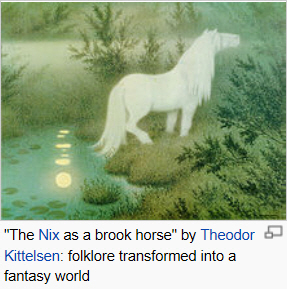
nixNonetheless, location can make or break a novel. Picture this:

  • The Night Circus set in the day time or, worse yet, Dubuque.
  • The Prince of Tides without the tides or, worse yet, without the the lush bays and swamps an estuaries of the South Carolina coast. (“It was growing dark on this long southern evening, and suddenly, at the exact point her finger had indicated, the moon lifted a forehead of stunning gold above the horizon, lifted straight out of filigreed, light-intoxicated clouds that lay on the skyline in attendant veils.”)
  • Jonathan Strange & Mr Norrell set in modern times or, worse yet, within the 1950s neighborhood of Happy Days or the early 1960s city ambiance of American Graffiti. (“Where does the wind come from that blows upon your face, that fans the pages of your book? Where the harum-scarum magic of small wild creatures meets the magic of Man, where the language of the wind and the rain and the trees can be understood, there we will find the Raven King.”)
  • All the Pretty Horses moved from Texas onto a Star Wars planet or, worse yet,  the Catskill Mountains.

Setting is more than a generic backdrop for the action

In his essay, “Setting as Character,” Crawford Kilian wrote, “Whether it’s Scott Fitzgerald’s 1920s Long Island or Tolkien’s Shire, the setting really is a kind of character in the story. Geographically and socially, the setting shapes the other characters, making some actions inevitable and others impossible.” The novels I listed above not only didn’t happen somewhere else, they couldn’t.

ozmapOn a similar note, a recent post on ProActive Writer, explored the importance of settings with the idea that “ignoring setting, or even giving it only a passing consideration, will lead to an unconvincing story.” The post views setting as the framework or the skeleton that holds up your plot and characters. Some authors build worlds for their novels before writing the novels; others let the worlds evolve while they write their stories. Either way, the worlds—real or imagined—must be convincing, they must fit the story like a warm mitten on a winter evening.

My Location Settings

I say all this as a way of introducing a series of posts on my Sun Singer’s Travels blog about the location settings in my novels. These easy-to-read posts explain each setting, show or describe what happened there in the novel, and explain why I chose the setting.

My approach to settings is organic and intuitive. By that I mean that I don’t make fiction-class lists of the attributes of the settings I want to use. No literary theory here; just places and reasons why I liked them. So far, the series has three installments:

Future posts will look at the world of a city in the Midwest, an aircraft carrier, a bridge over a wild river, and a sailor town. Stop by and see what you think. Whether you agree or disagree with my rationale, perhaps these posts will help you choose the best possible settings for your short stories and novels.

Malcolm

Malcolm R. Campbell is the author of contemporary fantasy novels.

Read it now on your Kindle