Novel samplers – Examples of a writer’s work

1760 Sampler - Wikipedia

Students learning needlework used to demonstrate their skills in samplers that showed examples of what they could do. Traditional samplers included motifs, borders and alphabets in various kinds of stitches. Those of us who like chocolate see the same approach in the famous Whitman’s Samplers, the boxes of candy with a representative assortment of the company’s many varieties.

Vanilla Heart Publishing is taking the same approach to its novelists’ and short story writers’ work. The publisher is bringing together samples of a writer’s work in free PDF documents that can be easily downloaded and then sampled.

I like the idea. As publishing transitions from bricks and mortar bookstores to online bookstores that provide either paperbacks or e-books, it’s nice having a way to see what we’re buying before we click on the BUY button. In a neighborhood bookstore, you can pick up a book and see what it’s like, browsing, reading a bit here and a bit there. Amazon has addressed the issue of excerpts with its READ INSIDE service. Smashwords gives readers a free look at the first chapter or so of each book.

Malcolm's Sampler

The samplers, though, bring multiple works together in one document. My sampler, for example, includes examples of my Jock Stewart stories, excerpts from my two Glacier Park novels (“The Sun Singer” and “Garden of Heaven: an Odyssey”) and some of the lunacy from my satirical “Jock Stewart and the Missing Sea of Fire.”

I can’t demonstrate my skill with the many variations of chain stitches on a decorative square of fabric. But my publisher’s sampler brings a bit of humor, adventure, description, and excitement together in one file. In an e-book world, it’s a good way to get the feel for a book before you decide to put it on your Kindle or your Nook, or order the paperback version for your shelf.

Malcolm

You can find more novel samplers for Vanilla Heart Publishing’s authors here.

Zen and the Art of Editing

“When you seek it, you cannot find it.” — Zen Proverb

When editing and revising a novel in progress, I try not to seek anything. While I sometimes jot down things to consider, I don’t make lists of characters, events, dialogue snippets or internal monologues as I ponder the latest draft of my manuscript. If I do, I suddenly can’t see the forest for the trees.

Like a hiker on an unknown trail, I try to get a sense of the place–in this case, that place is the world created by the novel. Casually, I wonder: What is going on here? Who are these people? What do they want?

If I were to look too hard for specifics, it would blind me to what is missing, what could have been said, what might have been done. In many ways, I’m reading my manuscript the way I would read another author’s novel for the first time—with as few expectations as possible.

In my Sarabande’s Journey blog, I have been writing about some of the issues, symbols, motifs, and themes that are often found in a heroine’s journey story.  While my novel in progress, Sarabande, is a heroine’s journey, I do not read my manuscript looking for those issues, symbols, motifs and themes.

First, I need to internalize all of that before I begin writing; otherwise, the novel sounds like I’m simply pasting ideas into a story say, the way somebody might randomly use words in a language they don’t know in a conversation with a native speaker. Second, I don’t intend for my fiction to be a demonstration of the heroine’s journey theme or to explore everything that has been written, say, about women in a man’s world. The novel is a story before it’s anything else.

I know before I begin writing where my character is going and why. I know how the novel will end. I try to keep everything in between loose and flexible until I begin to write. Then, I go where the story carries me. When I edit and revise a manuscript, I try not to have a destination. I want to see where I am being carried by the currents and tides of the work. Editing this way is relaxing if you don’t fret about it.

Worrying about whether one ought to be doing one thing or another thing with the story doesn’t help the work. Actually, nothing helps the work more than staying out of the way of the story as much as possible. When I put on my editing hat, I’ll “fix” a lot of things and re-do a lot of things without being heavy handed.

Does this sound chaotic? Not at all. When you’re not actively looking for a result, the novel begins to edit itself.

Malcolm

Malcolm R. Campbell is the author of the recently released Bears; Where they Fought: Life in Glacier Park’s Swiftcurrent Valley, a glimpse at the dramatic history of the most beautiful place on Earth. A Natural Wonderland… Amazing Animals… Early Pioneers…Native Peoples… A Great Flood… Kinnickinnick… Adventures… The Great Northern Railway.

“Give a month at least to this precious reserve.  The time will not be taken from the sum of your life. Instead of shortening, it will indefinitely lengthen it and will make you truly immortal. — John Muir, “Our National Parks,” 1901

Where do writers go when they write?

When I’m working on a novel, I’m not really here in the real world. That’s what my wife tells me.

I’m variously not present, not listening, forgetful, zoned out, in limbo, or in a cocoon.  When I emerge—hopefully with a completed manuscript for a book that will no doubt soar to the top of the New York Times Bestseller list—I hear what I’ve missed:

  • The neighborhood was taken over by rogue ground squirrels.
  • Iran and Iraq both filled out the paperwork to become U.S. states.
  • Jennifer Lopez appeared at the front door in her new snakeskin blouse and miniskirt and asked if Malcolm could go library and museum hopping with her.
  • All the known planets lined up, creating some interesting birth charts and a few more predictions about the end of the world and/or the end of good taste.

My wife is always the first to know when I type the words THE END on a major draft of a manuscript. I’m like a man who’s just come home from the war, amnesia or prison. And trust me, I have a lot of catching up to do.

Meanwhile, as I typed the words THE END on the manuscript for my newest Glacier National Park novel, Sarabande, today I felt like a child on Christmas morning. Those are very exciting words for an author even though they don’t mean the book, much less the work, is done.

They are a new beginning. The manuscript is fine-tuned. An editor takes a serious look at it, weeding out all the misspelled words, punctuation glitches and any inconsistencies the author hasn’t discovered yet. Cover artwork and release dates are discussed.  And, as I wondered when The Sun Singer and Garden of Heaven were in their about-to-emerge-from-the-cocoon status, I thought how will readers react?

After an author lives inside his story for a while, missing J. Lo’s visit to the front door and the ground squirrels romping through the yard, he hopes readers will also enjoy losing themselves in the story as soon as it appears as an e-book and a paperback.

I don’t put a warning label on it, though. You’re on your own recognizance. If you zone out and miss exciting international events or important wedding anniveraries and birthdays, don’t call me. I’ll be zoned out in another universe.

Malcolm

Malcolm R. Campbell is the author of the recently released Bears; Where they Fought: Life in Glacier Park’s Swiftcurrent Valley, a glimpse at the dramatic history of the most beautiful place on Earth. A Natural Wonderland… Amazing Animals… Early Pioneers…Native Peoples… A Great Flood… Kinnickinnick… Adventures… The Great Northern Railway.

“Give a month at least to this precious reserve.  The time will not be taken from the sum of your life. Instead of shortening, it will indefinitely lengthen it and will make you truly immortal. — John Muir, “Our National Parks,” 1901

Summer Reading…as the LA Times Sees It

Can you hear the bandwagon, the buzz and the hype? All that sound and fury is the mad rush of newspapers, magazines and blogs to trot out their lists of the hottest, sexiest, and scariest summer reads for beach, boudoir and ballpark. Yes, there’s a lot to like. I have already found some “must reads” on the lists, including The Final Storm by Jeff Shaara and The Chieu Hoi Saloon by Michael Harris.

Yet, from my perspective, the LA Times doesn’t “get it.” Neither do most of the other summer reading lists bring disseminated by the older, well-established newspapers and magazines. What we have here is “old media” promoting “old media.” By that, I mean the traditional big boys in the fading world of print are promoting large, old media publishers as though the congomerates are the only game in town.

It’s been an elite club for years. Look at the names of the publishers on the LA Times’ list. You’ll be hard-pressed to find an independent and/or small press publisher in the group. You’ll find Scribner, W. W. Norton, Penguin, Random House, Knopf and William Morrow.

I’ll stipulate that even in a world where many old-line publishers are in trouble, where book stores are failing, and where e-books are overtaking print books in sales, most of the buzz and the books sold are still coming from the old-media conglomerate publishers. But that’s just the tip of the iceberg when it comes to reading opportunities.

Depending on those estimate you like, there are about 300 medium sized pubishers in the U.S. Most of them, much less the small publishers, never appear on the summer reads or the Christmas reads lists. (I was happily surprised to see a McSweeney’s book on the LA Times list.) But otherwise, what a shame, ignoring most of the publishers in the country.

New Pages features a fine list of Independent Publishers and University Presses here. The majority of the reading public either doesn’t know those publishers exist or inaccurately presumes the books coming from them are filled with footnotes and niche-market symbolism and weird experimental stuff. But take a look. See what you’ve been missing.

Alternative Selections

A Heaven of Others by Joshua Cohen from Dzanc Books.

Knuckleheads by Jeff Hass from Dzanc Books.

Bogmeadow’s Wish by Terry Kay from Mercer University Press.

The Coffins of Little Hope by Timothy Schaffert from Unbridled Books.

Scorpion Bay by Michael Murphy from Second Wind Publishing.

Light Bringer by Pat Bertram from Second Wind Publishing.

Hyphema by Chelle Cordero from Vanilla Heart Publishing.

Maze in Blue by Debra H. Goldstein from Chalet Publishers.

These books ought to be enough to get you started this summer.

Malcolm

Jock Talks…The Collection combines four e-books in one for only $3.99.

Jock Stewart, who refutes charges that he was raised either by alligators or hyenas, believes that modern-day journalism would be going to hell in a hand basket if hand baskets were still readily available. He has chosen to make his stand for old-fashioned reporting at the Junction City Star-Gazer, a newspaper that—while run by fools and buffoons—knows the difference between real news and “stuff that sounds like real news.”

Is there a Red Herring in the room?

Today’s guest post is by Chelle Cordero, author of the recently released novel Hyphema (Kindle Edition, Vanilla Heart Publishing, April 15). She is the author of eight novels, including “Bartlett’s Rule,” “Hostage Heart,” and “Final Sin.”

You can see the “Hyphema” book trailer here , Chelle’s web site here and Chelle’s blog here.

Is there a Red Herring in the room?

The heroine of my latest novel, Hyphema, is a recent immigrant from Pakistan. Sudah has a reasonable command of the English language, but American idioms sometimes confuse her. I wonder what she would think of the expression “Red Herring”?

According to Wikipedia, the idiom “Red Herring” in a mystery story refers to something thrown in to distract the reader, perhaps to make the “whodunit” a bit harder to figure out.

I used Sudah’s ethnic background, and her Muslim religion, as an excuse in my story ~ an excuse for the local police and her husband’s coworkers to assume the strange happenings threatening Sudah’s family were just the locals letting their feelings be known. In today’s contemporary society, isn’t that what often happens? Even though Muslims have been in this country for years, since September 2001 there has been a heightened suspicion of this group of people. Add to that Sudah’s brown skin and the hajib (scarf) she wears in public, and a lot of people look at her with resentment and mistrust in their eyes.

Sudah is married to Matt Garratti, an “All American male” (at least a few generations), a flight medic, a Christian, and a New York transplant. They share a son. Sudah was just a child in Pakistan the day extremists hijacked four airplanes to use as weapons. She remembers her mother consoling a friend whose husband had come to America and hoped to become a citizen and bring his family along only to die along with three thousand innocent souls simply because he ran to the towers to try to help.

It’s a sad commentary when we accept intolerance and it’s sad when we direct our hyper-vigilance towards an entire ethnic group. And just perhaps, the police in this story are a little too quick to assume that someone is out to get them because of Sudah’s ethnic background.

Excerpt from Hyphema

Click cover for sample

“I don’t have to calm the hell down!” Matt’s voice rose. “We could have died a couple a weeks ago because somebody messed with the stove pipe and my CO detector. And you didn’t do anything then. And now someone tried to kidnap my son. They probably would’ve gotten away with it if I hadn’t pulled down the road when I did.”…

 “Sit down and be quiet.” Matt blustered and finally sat. He was furious. “You’ve been making a lot of noise that the police down here aren’t doing their jobs. Now I know you’ve had a few incidents of vandalism…”

“It’s been more than a few incidents of vandalism.”

“Shut your mouth. I am still talking.” The detective stood over Matt and waited. “Now I admit you probably got a few folks around here upset thinking they might have a terrorist living here.” He tilted his head towards Sudah. “And they really should be more open minded, so you have a reason to be upset.”

“My wife is not a terrorist!”

You can purchase “Hyphema” for Kindle from Amazon (http://amzn.to/fEYUR7) or Smashwords for multiple e-book formats (http://bit.ly/epqtjy


Review: ‘The Seas’ by Samantha Hunt

The Seas: A NovelThe Seas: A Novel by Samantha Hunt
My rating: 4 of 5 stars

“Yet when she comes to earth she comes to seek for that without which her beauty will be forever cold, cold and chill as the surge of the salt, salt sea.” — Mary MacGregor in her telling of “Undine.”

Samantha Hunt’s dark, yet often whimsical, 2004 novel “The Seas” draws on the classic mythology of mermaids and mortals. The alchemist Paracelsus (1493-1521) theorized that Ondines were elemental water nymphs. According to legends, Ondines (or Undines) had no souls unless they married mortal men. Friedrich de la Motte Fouqué drew upon these legends in his highly popular German novel “Undine” (1811) as did Hans Christian Anderson in his classic “The Little Mermaid” (1837).

In “The Seas,” a nineteen-year-old protagonist whose name we never know is convinced to a certainty that she is a mermaid because her father told her so before he disappeared at sea years ago. She falls in love with a shell-shocked veteran almost twice her age who drinks and hides from his war experiences. Jude, however, is the only person in this despairing, northern coastal fishing and tourist town who cares for her. Like everyone else in town, Jude and the prospective mermaid are trapped in a life where alcoholism, boredom and a bit of fishing are the primary pursuits.

As the prologue explains, “If you were to try to leave, people who have known you since the day you were born would recognize your car and see you leaving. They would wonder where you were going and they would wave with two fingers off the steering wheel, a wave that might seem like a stop sign or a warning to someone trying to forget this very small town. It would be much easier to stay.”

She has few social skills, is viewed as deeply disturbed, if not retarded, by everyone else in town including her own mother who waits, and will probably always be waiting, for the return of her husband. Our young protagonist, who narrates her own story and–it appears–believes that we (as readers) are understanding and humane enough to be taken into her confidence, knows the mermaid legends. She fears her love will end up killing Jude.

“The Seas” is awash with water, with bleak satire and bleaker images. The writing is lyrical and precise, blending reality and fable in a way that blurs the littoral zone where the sea and the land meet, where reality and fairytale collide, where sanity and obsession become twisted together. If “The Seas” has failings–other than being darker than we can bear–it’s the occasional overly robust presentation of the author’s and/or the main character’s anti-war and society-without-pity themes.

Our narrator wants to return to the sea. Perhaps she does. Perhaps she dies. Perhaps she loses the last vestiges of her cold and chill sanity in exchange for all that she loves.

View all my reviews

Coming April 22 – “On Writing as Entertainment,” a guest post by Lauren E. Harvey, author of “Imperfect”

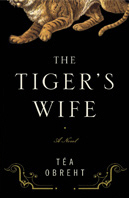
Review: ‘The Tiger’s Wife’ by Téa Obreht

The Tiger’s Wife by Téa Obreht
My rating: 5 of 5 stars

The tiger’s roar filled the cave with thunder. Mother Wolf shook herself clear of the cubs and sprang forward, her eyes, like two green moons in the darkness, facing the blazing eyes of Shere Khan. — Rudyard Kipling in “Mowgli’s Brothers” from “The Jungle Book” (1894)

Gather around, my friends, and I will tell you the story of the man who could never die, who, some say, still walks the streets of our village at night, and then—if most of you are still awake—I’ll tell you the story of the tiger Shere Khan whose eyes burn brightly in the night when he prowls near campfires like this looking for his wife.

Like all great storytellers, author Téa Obreht demonstrates beyond the shadow of a doubt in “The Tiger’s Wife” that memorable stories live at the crossroads of fact and fable. Doctor Natalia Stefanovic is treating children at an orphanage in an unspecified Balkan country when she learns that her beloved grandfather has died. The details are unclear. They provide no closure.

While seeking closure, Natalia remembers the times they spent together when she was young, their trips to the zoo to see the tigers, and the rather fantastic stories he told of his own youth. He told her the story of the deathless man and he told her the story of the tiger’s wife. Her grandfather experienced the events in these stories when he was a child, and like all memorable stories, they were somewhat true and somewhat pure potential and supposition, believed to varying degrees by those in the village who kept their children indoors at night when the tiger owned the streets.

Obreht tells us these stories in bits and pieces as Natalia juggles the real world of the orphanage and the superstitions of those in the village where the orphanage is located with the fables out of her grandfather’s past. To learn how and where he died, she will walk present-day roads laden with stories and she will walk into her memories of the tiger and the man who could never die, and when all is said and done, the truth of the matter will be a mix of everything she encounters at the crossroads.

“The Tiger’s Wife” is dark and deep and perfectly crafted, and if you allow yourself to be immersed in it, you will see the blazing eyes of Shere Khan.

View all my reviews

Malcolm R. Campbell is the author of Garden of Heaven: an Odyssey, a novel of magical realism where fact and fable mix.

Review: ‘Equinox’ by Robert Hays

Equinox, A Short StoryEquinox, A Short Story by Robert Hays
My rating: 5 of 5 stars

Essie’s late husband Arthur built her a sturdy house, taking care to place it just right to catch the Spring sunshine. Arthur carefully placed the silver maples and the catalpas to provide many years of perfect summer shade. The trees are grown now. The kids and grandkids are gone, and so is Arthur.

In Robert Hays’ well written and poetic short story “Equinox,” Essie and Plato follow long-established rhythms throughout the changing seasons, and that’s a comfort, for after their long years together, a schedule of sleeping, waking, meals and the daily arrival of the mailman anchors her life.

She had expected Arthur to be her anchor until he was killed in a coal mining accident years ago. He approached his job in the dark mine with same care and deliberation as he approached the construction of their house in the sunny valley. Like the house and the marriage, it was supposed to last.

This year, Winter has seemed permanent, closing her up inside the house with snow and ice. Essie broods about all that’s been lost and finds brief solace in fantacies about what might have been.

With Plato, she waits for the Spring equinox. It’s one of the few events she can count on, and Essie hopes it will be enough.

View all my reviews

Available in paperback and Kindle

Review: ‘kiDNApped’ by Rick Chesler

KiDNAppedKiDNApped by Rick Chesler
My rating: 4 of 5 stars

Three months after wealthy biotechnology company CEO William Archer is lost at sea or kidnapped off his research yacht in the warm waters of the Hawaiian Islands in Rick Chesler’s inventive thriller “kiDNApped,” Special Agent Tara Shores faces a very cold case.

She also faces the uncertainties of three civilians intruding into an investigation. Was Dave Turner really looking for a wedding ring on the ocean floor when his dive boat was stolen and his employer was murdered? What can Archer’s son and daughter from the mainland possibly contribute just two days before the court declares their father legally dead?

Shores, a veteran agent who first appeared in “Wired Kingdom” (2010), is about to stamp the case file “INDETERMINATE” because there are no leads and no ransom demands. While Archer’s son Lance wants to drink beer and chase girls until he can collect his inheritance, his sister Kristen wants Dave to return to the ocean floor on the off chance his interrupted search is related to her father’s disappearance.

When their dive attracts unwanted attention, Shores and her disparate crew are suddenly in the line of fire. Kristen wonders if her genius father encrypted a call for help in the DNA of ocean bacteria. Shores wonders how she can possibly babysit civilians who are more likely to get in the way and/or get killed than anything else.

Rick Chesler has written a breathtaking tropical adventure that combines a cutting-edge technology search for clues with a madcap, island-to-island race against bad guys that would put a smile on the face of any James Bond aficionado.

Agent Shores definitely needs a new rubber stamp for her case file: HAZARDOUS TO MY HEALTH.

View all my reviews

Download the magic to your Kindle today
<

Review: ‘The Wonderful Demise of Benjamin Arnold Guppy’

The Wonderful Demise of Benjamin Arnold GuppyThe Wonderful Demise of Benjamin Arnold Guppy by Gina Collia-Suzuki
My rating: 4 of 5 stars

When Alex and her husband Roy move into an apartment in a middle class English neighborhood and meet their grumpy, greedy and potentially insane neighbors, Ben and Pat Guppy, it becomes abundantly clear before chapter one ends with “And with that the battle lines were drawn up,” that any sane person would begin considering murder as a viable alternative to long-term unpleasantness.

After all, in any aquarium of dazzling tropical fish, the guppy is background clutter at best. But, should the rather plain and unamazing fish go rogue—like Benjamin and Pat in the finite world of the apartment building—then when all else fails, stricter measures appear more reasonable than reasonable measures.

In the well-written and vastly humorous “The Wonderful Demise of Benjamin Arnold Guppy,” Ben and Pat are quite accustomed to ruling their environment. New tenants, such as Alex and Roy, are informed by the 70-year-old Benjamin Guppy on day one of his rules and expectations: bedtime (and quiet) begin at ten except on Sundays when they commence at nine, dinner is at five. It gets worse. The Guppy’s don’t like to hear music, water draining out of the bathtub, or toilets being flushed.

Alex, who tells this story, says of Benjamin Guppy on the first page: “He made no effort to conceal his dislike of us from the outset, his opinion being formed immediately that we were not his sort of people. I consider myself fortunate in that.”

The Guppy’s shenanigans, and the delightfully droll and deadpan way the novel unfolds, are reminiscent of the outlandish kinds of circumstances played out in the 1970s BBC sitcom “Fawlty Towers.” Benjamin and Pat are clearly a couple of rogue guppies, yet their outlandish activities, their low character and the absurdity of their endless fishy demands for money for fabricated damages to their flat appear to be unnoticed by everyone except Alex and Roy.

Will Alex kill Benjamin? She has cause. And while her cause is a funny one—from the reader’s perspective—it’s hard to imagine Benjamin and Pat being humorous in real life. The strength of the book is an understated humor that builds throughout the novel rather like a snowball rolling down a steep hill. While some of Benjamin’s and Pat’s abusive words and deeds become a bit repetitive, Gina Collia-Suzuki’s style and tone more than makes up for that.

“The Wonderful Demise of Benjamin Arnold Guppy” is good for a lot of laughs, some uncomfortable truths about the nature of ill-bred apartment dwellers, and—for philosophers—an opportunity to ponder just how long a couple of angel fish can possibly swim in the dark and dangerous currents of an environment with so little privacy and space, the walls might as well be made of glass.

View all my reviews

Malcolm R. Campbell is the author of “Jock Stewart and the Missing Sea of Fire,” “The Sun Singer,” and “Garden of Heaven: an Odyssey.”