We lost a literary giant

Since reading is personal and visceral and very subjective, I cannot say what drew me to Cormac McCarthy’s novels year after year.  I liked his plots, his mix of minimalism and lyrical passages, the closeness of the land in his work, his ear for authentic dialogue, and a writing approach that dragged readers kicking and screaming into some of the most beautiful and the most violent tales they ever experienced.

As quoted in Wikipedia, In 2003, literary critic Harold Bloom named McCarthy as one of the four major living American novelists, alongside Don DeLilloThomas Pynchon, and Philip Roth. His 1994 book The Western Canon had listed Child of God, Suttree, and Blood Meridian among the works of contemporary literature he predicted would endure and become ‘‘canonical’“. Bloom reserved his highest praise for Blood Meridian, which he called ‘the greatest single book since Faulkner’s As I Lay Dying’“, and though he held less esteem for McCarthy’s other novels he said that ‘to have written even one book so authentically strong and allusive, and capable of the perpetual reverberation that Blood Meridian possesses more than justifies him. … He has attained genius with that book.'”

Oddly enough, his Pulitzer Prize Winning novel The Road is probably my least favorite, though I like journey stories in general. In many ways, I think it got the Pulitzer for the same reason actors sometimes win Academy Awards: the powers that be realize the recipient should have gotten the award for an early book/movie and hand out the honor as a last-ditch chance to even things up. I would have picked Blood Meridian over The Road, but I wasn’t consulted. <g>

There are quite a few McCarthy retrospectives and homages online today. It’s nice to see them because there are times when I think he’s “underread” by people who prefer lesser stuff and don’t think of him when new titles are announced.

I liked the subhead in the story in The Atlantic: “The worlds depicted in his novels are not built for mortal humans like you and me.”  CNN said, “Despite accolades, McCarthy remained relatively obscure for much of his career; as recently as 1992, 27 years after his first book was published, the New York Times Book Review said he “may be the best unknown novelist in America.”

Typical of his work are these quotes:

“You never know what worse luck your bad luck has saved you from.”

“War was always here. Before man was, war waited for him. The ultimate trade awaiting its ultimate practitioner.”

“Your heart’s desire is to be told some mystery. The mystery is that there is no mystery.”

“A man’s at odds to know his mind cause his mind is aught he has to know it with. He can know his heart, but he dont want to. Rightly so. Best not to look in there. It aint the heart of a creature that is bound in the way that God has set for it. You can find meanness in the least of creatures, but when God made man the devil was at his elbow. A creature that can do anything. Make a machine. And a machine to make the machine. And evil that can run itself a thousand years, no need to tend it.”

“That night he dreamt of horses in a field on a high plain where the spring rains had brought up the grass and the wildflowers out of the ground and the flowers ran all blue and yellow far as the eye could see and in the dream he was among the horses running and in the dream he himself could run with the horses and they coursed the young mares and fillies over the plain where their rich bay and their rich chestnut colors shone in the sun and the young colts ran with their dams and trampled down the flowers in a haze of pollen that hung in the sun like powdered gold and they ran he and the horses out along the high mesas where the ground resounded under their running hooves and they flowed and changed and ran and their manes and tails blew off of them like spume and there was nothing else at all in that high world and they moved all of them in a resonance that was like a music among them and they were none of them afraid neither horse nor colt nor mare and they ran in that resonance which is the world itself and which cannot be spoken but only praised.”

McCarthy always gave us a story and left us with divine PTSD.

–Malcolm

Sunday’s mixed bag of stuff

  • Rainy and wet today here in Northwest Georgia. Robbie, our indoor/outdoor kitty is inside. He must know that heavier rain is coming. All in all, a good day to stay inside and work on the next novel in my Florida Folk Magic Series set in Tallahassee and a fictional town near the Apalachicola River. Perhaps there’ll even be something fun to watch on TV tonight like, hmm, another episode of “Swamp People” on the History Channel.
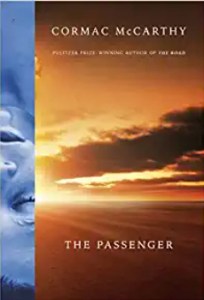
  • I thoroughly enjoyed reading Cormac McCarthy’s latest novel The Passenger. It’s different from such classics as Blood Meridian and All the Pretty Horses, but just as powerful and well-written. I agree with Ron Charles’ assessment in The Washington Post that, “McCarthy has assembled all the chilling ingredients of a locked-room mystery. But he leaps outside the boundaries of that antique form, just as he reworked the apocalypse in The Road… Western knows he’s suspected of something, but he’s not told what. The two men who repeatedly question him never drop their formal politeness—never flash a bolt gun like Anton Chigurh in No Country for Old Men—but Western knows that his life is in danger and that he must run… The style—a mingling of profound contemplation and rapid-fire dialogue, always without quotation marks and often without attribution—is pure McCarthy.” I haven’t bought Stella Maris, the companion novel yet, but I will.
  • The Guardian story about the police murder in Memphis is headlined: “Tyre Nichols’s death after police encounter was ‘failing of basic humanity’, says Memphis chief.” The newspaper notes that there were 1,176 “police-involved” killings in 2022. The daily news routinely includes a police atrocity like this or a mass shooting by some thug from the community. Many newspapers and commentators say that inflation or possibly problems at the U.S./Mexico border are the country’s top news stories. They’re wrong, I think. Violence ought to be at the top of the list.

  • No, I don’t plan to watch the upcoming Super Bowl Game. I haven’t cared for years, though if the Atlanta Falcons were playing, I might watch. I tend to watch college football, especially if the Florida State University Seminoles are playing. They had a decent season, though not as good as the University of Georgia’s Dawgs, a team I only root for when they’re playing the University of Florida Gators.
  • Okay, I’m still addicted to Kathy Reichs’ Temperance Brennan books and have three on order to read before getting to Stella Maris. I hope all of you are reading quality books these days.

–Malcolm

All four novels in the Florida Folk Magic Series are available in one Kindle volume, a nice savings.

Cormac McCarthy’s two-novel release of the year

“These new novels flush McCarthy out of his rhetorical cover, and his decidedly austere and unillusioned answer to both of these questions is no. In a world lit by the “evil sun” of nuclear invention, all history, Bobby thinks, is nothing more than “a rehearsal for its own extinction.” And, when the world finally kills itself off, nothing will be left—not words, not music, not mathematics, not God. Not even the Devil.” – James Wood in “Cormac McCarthy Peers Into the Abyss,” The New Yorker.

Fans of Cormac McCarthy–and I am one of them–will see in the two paired novels (The Passenger and Stella Maris) which can be purchased separately or as a boxed set, a gift from the eighty-nine-year-old novelist that (perhaps) represent a swan song, a look at something different, the abyss as James Wood says.

The Passenger

NEW YORK TIMES BEST SELLER • The Pulitzer Prize–winning author of The Road returns with the first of a two-volume masterpiece: The Passenger is the story of a salvage diver, haunted by loss, afraid of the watery deep, pursued for a conspiracy beyond his understanding, and longing for a death he cannot reconcile with God.

NEW YORK TIMES BEST BOOK OF THE YEAR

“McCarthy returns with a one-two punch…a welcome return from a legend.” —Esquire

“Look for Stella Maris, the second volume in The Passenger series, available now.

“1980, PASS CHRISTIAN, MISSISSIPPI: It is three in the morning when Bobby Western zips the jacket of his wet suit and plunges from the Coast Guard tender into darkness. His dive light illuminates the sunken jet, nine bodies still buckled in their seats, hair floating, eyes devoid of speculation. Missing from the crash site are the pilot’s flight bag, the plane’s black box, and the tenth passenger. But how? A collateral witness to machinations that can only bring him harm, Western is shadowed in body and spirit—by men with badges; by the ghost of his father, inventor of the bomb that melted glass and flesh in Hiroshima; and by his sister, the love and ruin of his soul.
 
“Traversing the American South, from the garrulous barrooms of New Orleans to an abandoned oil rig off the Florida coast, The Passenger is a breathtaking novel of morality and science, the legacy of sin, and the madness that is human consciousness.”


Stella Maris

“NEW YORK TIMES BEST SELLER • The Pulitzer Prize–winning author of The Road returns with the second volume of The Passenger series: Stella Maris is an intimate portrait of grief and longing, as a young woman in a psychiatric facility seeks to understand her own existence.

“1972, BLACK RIVER FALLS, WISCONSIN: Alicia Western, twenty years old, with forty thousand dollars in a plastic bag, admits herself to the hospital. A doctoral candidate in mathematics at the University of Chicago, Alicia has been diagnosed with paranoid schizophrenia, and she does not want to talk about her brother, Bobby. Instead, she contemplates the nature of madness, the human insistence on one common experience of the world; she recalls a childhood where, by the age of seven, her own grandmother feared for her; she surveys the intersection of physics and philosophy; and she introduces her cohorts, her chimeras, the hallucinations that only she can see. All the while, she grieves for Bobby, not quite dead, not quite hers. Told entirely through the transcripts of Alicia’s psychiatric sessions, Stella Maris is a searching, rigorous, intellectually challenging coda to The Passenger, a philosophical inquiry that questions our notions of God, truth, and existence.”

The Passenger and Stella Maris are spun around existential themes and big ideas like morality and science. They follow the story of two siblings, Bobby and Alicia Western, who are tormented by the ghosts of their physicist father, inventor of the atom bomb that “melted glass and flesh in Hiroshima.” In The Passenger — which opens on a frigid night at Mississippi’s Pass Christian in 1980 and traverses the 19th century American South — salvage diver Bobby Western becomes a “collateral witness” to machinations that put him in harm’s way.  McCarthy, as ever, is interested in the “madness called the human consciousness”. – Nawaid Anjum in “Inside the violent, visceral world of Cormac McCarthy, one of America’s greatest writers” The Federal.

–Malcolm


Cormac McCarthy: Maybe not the best author to read during a pandemic

When I run out of factory fresh books, I turn to my bookshelves and re-read older books. I stumbled into the Cormac Mcarthy section recently (I have most of his books) and read Cities of the Plain. Most things go wrong in this book, but I read it all the way through because l like McCarthy’s dialogue, descriptions, and the tone of his books. I think he writes with grit and stars rather than ink. This book has a few good people in it.

I thought, what the hell, I’ll read another. I chose Outer Dark. This novel has a lot more grit in it and even the stars aren’t clean. It doesn’t have any good people in it, though some try hard to be good in narrow ways.

Guy Davenport, in The New York Times, said, “Nor does Mr,. McCarthy waste a single word on his character’s thoughts. With total objectivity, he describes what they do and records their speech. Such discipline comes not only from mastery over words but from an understanding wise enough and compassionate enough to dare to tell o abysmally dark a story.”

The fact that it’s so well written commits one to keep reading even though reading McCarthy is often like drinking poison for recreation. If it were badly written, it wouldn’t bother readers so much, especially when the world around us during this pandemic seems to have come out of something McCarthy might have orchestrated for his next novel or screenplay.

Time to move on to another section of my bookshelf.

Malcolm

Malcolm R. Campbell’s Mountain Song is free on Kindle.


When the muses outdo themselves: Favorite passages from books

Sometimes sentence or paragraph in a novel stops me in my tracks because it’s perfect, perfectly beautiful, dangerously apt, and it flows from word to word like birds or gods singing. Here are a few of my favorites:

  1. The Prince of Tides by Pat Conroy: It was growing dark on this long southern evening, and suddenly, at the exact point her finger had indicated, the moon lifted a forehead of stunning gold above the horizon, lifted straight out of filigreed, light-intoxicated clouds that lay on the skyline in attendant veils. Behind us, the sun was setting in a simultaneous congruent withdrawal and the river turned to flame in a quiet duel of gold….The new gold of moon astonishing and ascendant, he depleted gold of sunset extinguishing itself in the long westward slide, it was the old dance of days in the Carolina marshes, the breathtaking death of days before the eyes of children, until the sun vanished, its final signature a ribbon of bullion strung across the tops of water oaks.
  2. Sunset Song in the Scots Quair trilogy by Lewis Grassic GibbonSo that was Chris and her reading and schooling, two Chrisses there were that fought for her heart and tormented her. You hated the land and the coarse speak of the folk and learning was brave and fine one day and the next you’d waken with the peewits crying across the hills, deep and deep, crying in the heart of you and the smell of the earth in your face, almost you’d cry for that, the beauty of it and the sweetness of the Scottish land and skies. You saw their faces in firelight, father’s and mother’s and the neighbours’, before the lamps lit up, tired and kind, faces dear and close to you, you wanted the words they’d known and used, forgotten in the far-off youngness of their lives, Scots words to tell to your heart, how they wrung it and held it, the toil of their days and unendingly their fight. And the next minute that passed from you, you were English, back to the English words so sharp and clean and true–for a while, for a while, till they slid so smooth from your throat you knew they could never say anything that was worth the saying at all.
  3. The Night Circus by Erin MorgensternSomeone needs to tell those tales. When the battles are fought and won and lost, when the pirates find their treasures and the dragons eat their foes for breakfast with a nice cup of Lapsang souchong, someone needs to tell their bits of overlapping narrative. There’s magic in that. It’s in the listener, and for each and every ear it will be different, and it will affect them in ways they can never predict. From the mundane to the profound. You may tell a tale that takes up residence in someone’s soul, becomes their blood and self and purpose. That tale will move them and drive them and who knows what they might do because of it, because of your words. That is your role, your gift. Your sister may be able to see the future, but you yourself can shape it, boy. Do not forget that… there are many kinds of magic, after all.
  4. The Shadow of the Wind by Carlos Ruiz ZafónEvery book, every volume you see here, has a soul. The soul of the person who wrote it and of those who read it and lived and dreamed with it. Every time a book changes hands, every time someone runs his eyes down its pages, its spirit grows and strengthens. And also this: Once, in my father’s bookshop, I heard a regular customer say that few things leave a deeper mark on a reader than the first book that finds its way into his heart. Those first images, the echo of words we think we have left behind, accompany us throughout our lives and sculpt a palace in our memory to which, sooner or later—no matter how many books we read, how many worlds we discover, or how much we learn or forget—we will return.
  5. All the Pretty Horses by Cormac McCarthy: They heard somewhere in that tenantless night a bell that tolled and ceased where no bell was and they rode out on the round dais of the earth which alone was dark and no light to it and which carried their figures and bore them up into the swarming stars so that they rode not under but among them and they rode at once jaunty and circumspect, like thieves newly loosed in that dark electric, like young thieves in a glowing orchard, loosely jacketed against the cold and ten thousand worlds for the choosing.

You probably have some favorite lines as well, lines you might even copy on to scraps of paper to be hidden away in your wallet or purse for those moment when you need to prove again to yourself that there is still hope for the world.

Malcolm