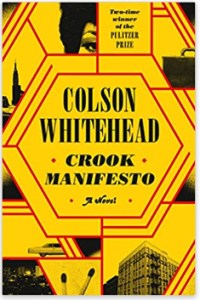
After writing about Whitehead’s Harlem Shuffle yesterday, I thought I might as well focus on its sequel, Crook Manifesto, which was released today by Doubleday. The book allows Whitehead to continue his focus on Harlem and treat his readers to the characters they got to know in Harlem Shuffle. The books are part of a planned trilogy. I like the Minneapolis Star-Tribune’s comment, “A masterwork of stylish noir and social satire … Whitehead’s larger project propels us forward, probing the whipsaw of race and the ouroboros of virtue and vice.”
From the Publisher
It’s 1971. Trash piles up on the streets, crime is at an all-time high, the city is careening towards bankruptcy, and a shooting war has broken out between the NYPD and the Black Liberation Army. Amidst this collective nervous breakdown furniture store owner and ex-fence Ray Carney tries to keep his head down and his business thriving. His days moving stolen goods around the city are over. It’s strictly the straight-and-narrow for him — until he needs Jackson 5 tickets for his daughter May and he decides to hit up his old police contact Munson, fixer extraordinaire. But Munson has his own favors to ask of Carney and staying out of the game gets a lot more complicated – and deadly.
1973. The counter-culture has created a new generation, the old ways are being overthrown, but there is one constant, Pepper, Carney’s endearingly violent partner in crime. It’s getting harder to put together a reliable crew for hijackings, heists, and assorted felonies, so Pepper takes on a side gig doing security on a Blaxploitation shoot in Harlem. He finds himself in a freaky world of Hollywood stars, up-and-coming comedians, and celebrity drug dealers, in addition to the usual cast of hustlers, mobsters, and hit men. These adversaries underestimate the seasoned crook – to their regret.
1976. Harlem is burning, block by block, while the whole country is gearing up for Bicentennial celebrations. Carney is trying to come up with a July 4th ad he can live with. (“Two Hundred Years of Getting Away with It!”), while his wife Elizabeth is campaigning for her childhood friend, the former assistant D.A and rising politician Alexander Oakes. When a fire severely injures one of Carney’s tenants, he enlists Pepper to look into who may be behind it. Our crooked duo have to battle their way through a crumbling metropolis run by the shady, the violent, and the utterly corrupted.
CROOK MANIFESTO is a darkly funny tale of a city under siege, but also a sneakily searching portrait of the meaning of family. Colson Whitehead’s kaleidoscopic portrait of Harlem is sure to stand as one of the all-time great evocations of a place and a time.
“Returning to the world of his novel ‘Harlem Shuffle,’ Colson Whitehead’s ‘Crook Manifesto’ is a dazzling treatise, a glorious and intricate anatomy of the heist, the con, and the slow game. There’s an element of crime here, certainly, but as in Whitehead’s previous books, the genre isn’t the point. Here he uses the crime novel as a lens to investigate the mechanics of a singular neighborhood at a particular tipping point in time. He has it right: the music, the energy, the painful calculus of loss. Structured into three time periods — 1971, 1973, and finally the year of America’s bicentennial celebration, 1976 — ‘Crook Manifesto’ gleefully detonates its satire upon this world while getting to the heart of the place and its people.”
“The twin triumphs of The Underground Railroad (2016) and The Nickel Boys (2019) may have led Whitehead’s fans to believe he would lean even harder on social justice themes in his next novel. But by now, it should be clear that this most eclectic of contemporary masters never repeats himself, and his new novel is as audacious, ingenious, and spellbinding as any of his previous period pieces.” – Kirkus Reviews
This book’s been out a while (August 9, 2022) and Whitehead’s most recent book Crook Manifesto will be released tomorrow, so it’s past time to say something about it. It’s good. Actually, it’s better than good. The New York Times calls it “A sizzling heist novel” and the San Francisco Chronicle says it’s “Fast-paced, keen-eyed and very funny.”
From the Publisher
“Ray Carney was only slightly bent when it came to being crooked…” To his customers and neighbors on 125th Street, Carney is an upstanding salesman of reasonably priced furniture, making a decent life for himself and his family. He and his wife Elizabeth are expecting their second child, and if her parents on Striver’s Row don’t approve of him or their cramped apartment across from the subway tracks, it’s still home.
“Few people know he descends from a line of uptown hoods and crooks, and that his façade of normalcy has more than a few cracks in it. Cracks that are getting bigger all the time.
“Cash is tight, especially with all those installment-plan sofas, so if his cousin Freddie occasionally drops off the odd ring or necklace, Ray doesn’t ask where it comes from. He knows a discreet jeweler downtown who doesn’t ask questions, either.
“Then Freddie falls in with a crew who plan to rob the Hotel Theresa—the “Waldorf of Harlem”—and volunteers Ray’s services as the fence. The heist doesn’t go as planned; they rarely do. Now Ray has a new clientele, one made up of shady cops, vicious local gangsters, two-bit pornographers, and other assorted Harlem lowlifes.
“Thus begins the internal tussle between Ray the striver and Ray the crook. As Ray navigates this double life, he begins to see who actually pulls the strings in Harlem. Can Ray avoid getting killed, save his cousin, and grab his share of the big score, all while maintaining his reputation as the go-to source for all your quality home furniture needs?
“Harlem Shuffle’s ingenious story plays out in a beautifully recreated New York City of the early 1960s. It’s a family saga masquerading as a crime novel, a hilarious morality play, a social novel about race and power, and ultimately a love letter to Harlem.”
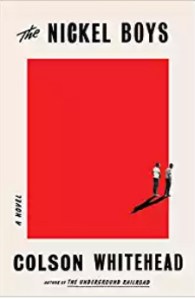
Colson Whitehead’s The Nickel Boys evokes race in America not as a concept but as a condition of being. In this modern historical novel, Whitehead exposes the Nickel Academy and the fate of its boys. With profound compassion and the elegance of a skilled craftsman, he reveals the tragedy of our not-too-distant past, which is also the tragedy of our present. Like all classics, the book works on many different levels: a significant social drama, it is direct, accessible and unrelenting both as allegory and as cautionary tale. This is our history. It is our story. – Kirkus Reviews.
Click on graphic for info about Nonfiction and Yong Readers prizes.
The Nickel Boys is a powerful and well-written novel, all the more chilling for those of us who grew up in the Florida Panhandle and heard horror stories about the Dozier School on which this story was based. (You can learn more about the Dozier School’s survivors on the White House Boys website.)
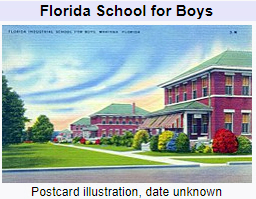
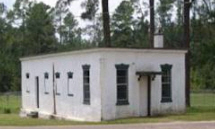
Looks like a safe campus, doesn’t it? – Wikipedia graphic
When I reviewed the book, I gave it three stars because I thought Whitehead used a point of view trick to make for a more powerful ending. I thought the trick could have been easily avoided by a simple edit without detracting from the ending of the novel. Since nobody else has mentioned this trick, it’s possible that I misread the section, though I looked at it several times and still thought I was seeing a flaw.
Florida failed its population as well as those sentenced to the Dozier School, some for very minor “infractions.” There were rumors about the school for years, covered over by a code of silence by those involved and others who knew the truth.
This novel helps call attention to the kinds of abuses that were born during the Jim Crow era–I suspect we haven’t found them all.
This powerful story needed to be told. That power comes, in part, through Whitehead’s restraint as he tells a fictionalized story about Florida’s notorious Dozier School (called Nickel in the novel) in a straightforward, almost deadpan style. That is, he lets most of the atrocities speak for themselves rather than resorting to purple prose and sentimentality.
Floridians, who grew up in the panhandle and knew Dozier was a hell hole before the authorities knew (or admitted) it was a hell hole, will appreciate the care Whitehead took with his research into the school itself, the environment, and the Tallahassee neighborhood where college-bound Elwood Curtis grew up. The random and unfair vicissitudes of life for African Americans are aptly and horrifyingly demonstrated early on via the event that sends Curtis to the Nickel School.
Yet, I was disappointed in this novel and ended up with mixed feelings about it. One flaw came from the sudden uses of an omniscient author to explain Nickel customs and realities that should have been communicated to readers via dialogue or through the actions of the characters. Suddenly, Whitehead was more reporter than novelist.
Without giving away a spoiler here, suffice it to say that the authorial trickery in several places where the narrative jumps into the future are intolerable. The sections are not only jolting when they suddenly appear out of sequence with the chronological story but mislead the reader so that Whitehead can enhance the drama surrounding Curtis near the end of the novel. The realities here are interesting and make for an engaging subplot that could have been written without lying to the reader.
The protagonist’s near-worship of Dr. Martin Luther King, especially King’s belief that no matter what was done to the African American race, it should return only love–serves as an effective counterpoint throughout the novel. Can Curtis love his tormentors? The Nickel School tests Curtis over and over again, making it difficult for him–and the other “students”–to maintain a true sense of self in a land where the realities inside the school are similar to the realities outside the school.
The book is strong. It could have been stronger. I recommend it in spite of the flaws.
Malcolm R. Campbell grew up in the Florida Panhandle in the era when the novel is set, delivered telegrams in the Frenchtown neighborhood where the protagonist grew up, and saw the Dozier school many times before it became a news story. He mentioned the Dozier school in his short story “Cora’s Crossing,” included in the collection Widely Scattered Ghosts.
There are some books I don’t want to read. The latest is The Nickel Boys, by Colson Whitehead, based on north Florida’s notorious Dozier reform school.
I don’t want to read it because the real school was used by teachers and coaches in my Tallahassee, Florida high school as the ultimate threat should we transgress too often, or just once if we were black. At the time, there weren’t any black people in our school, but the newspaper was filled with accounts of students from other schools who were shipped to Marianna 57 miles west of us.
Some people, you know which ones I mean, disappeared from our high school and were never seen again. Some were in jail. Some were in reform school and might never emerge. We never knew.
We didn’t know how bad the reform school in Marianna was until much later. There were always inuendos, ghost stories, and talk in the barbershop. But nothing much came of it until relatively recently. No matter where you live, you’ve probably read the stories of the so-called White House Boys who survived the beatings and the stories about the graves of those who didn’t.
I would like to say that I’m horrified. But so many things in this world have gotten so much worse than we ever imagined, that I’m starting to lose bits and pieces of my humanity and become hardened, somewhat jaded, and partially immune to such things. So far, I still have the capacity to be angry at those responsible.
So now I have a copy of The Nickel Boys. The first sentence in the prologue is “Even in death the boys were trouble.” I want to set the book down, but I can’t and I won’t.
Updates are collected at the end of the post. As you’ll see, the updates focus on the school rather than on the books. Most recent update is July 2019.
A writer friend of mine in Florida who knows I’ve been working on a series of short stories set in the Florida Panhandle, sent me this link as an idea for a story: Mystery surrounds graves at boys’ reform school. Here’s how it begins: This Florida panhandle town is the home of a mystery that has been lost to time. A small cemetery buried deep into the grounds of a now-defunct boys reform school dates back to the early 1900s. Rusting white steel crosses mark the graves of 31 unidentified former students. (See updates at the end of this post.)
When I read the story, I didn’t initially recognize the school because its most recent name, Arthur G Dozier School for Boys, didn’t connect in my brain with the name, Florida Industrial School for Boys, used for the Marianna, Florida reform school when I was living in Florida in the 1950s and 1960s. The Florida Department of Juvenile Justice operated the school between 1900 to 2011.
Several facts became clear as I read the story and then followed links and Google searches to other stories. The use of the word “school” to describe a physical plant that looked Edenic but which contained unidentified graves of former “students” was misleading to the general public, including those of us who lived in the state capital 85 miles away who had no clue that some of the authorities there based their approach to “reform” on the worst techniques for the control of “undesirables” coming out of World War II POW camps.
The White House
The ugly truth
Connecting the dots, the boys’ “progress” in the school included a small white house where the rapes, beatings and other horrors occurred after which possibly some of them were buried in the unmarked graves now being investigated. Logically, this is unlikely because, as local historian Dale Cox notes, why would the state murder a student and then mark and maintain his grave? Others contend the graves are for those who died in an influenza outbreak and a fire.
Fortunately, most of the men survived; unfortunately, they have enough haunting memories to last a lifetime.
Some 300 of these survivors have formed an organization called The White House Boys. On their website, you will find news about recent press reports, stories contributed by those who are just now coming forward to tell the world what was happening in Marianna, and links to recent press reports about the State of Florida’s investigation that began several years ago.
I got through high school without any brushes with school authorities or police. Some of those who had problems, many of them trivial, were packed off to reform school. I don’t know if any of the White House Boys were in school with me at Tallahassee’s Leon High School. I haven’t yet seen any names I know. The “problem” students just went away: expelled, dropped out, or joined the service. If they caught the State’s attention through what (for them) was called “the justice system,” news stories in the local paper often said they were being sent to “reform school.”
The old secret.
Then, I had no concept what was supposed to happen at a reform school. Remedial classes? Encounter groups? Campfire sings? Rape and beatings never crossed my mind as mainstays of the curriculum. Right now, I’m too angry about it to remotely consider writing fiction.
I’m angry because it happened in a nearby town I visited often (due to the Florida Caverns State Park there), and I’m angry that it happened right under the noses of state lawmakers and they were either blind or indifferent to it, and I’m angry that even now the story about the investigation, the abuses and the graves has been going on across the border in Florida and I heard nothing about it until my friend sent me that link.
If you want to learn more, and you really don’t even though you must, click on the White House Boys link and/or do a Google search and you will find more than you can bear to know.
The Books
Two books are among those spelling out the details: The White House Boys and The Boys in the Dark.
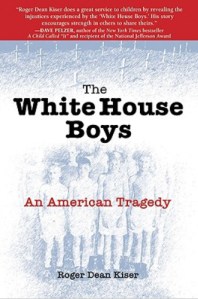
The White House Boys: An American Tragedy, by Roger Dean Kiser, publisher’s description:
Hidden far from sight, deep in the thick underbrush of the North Florida woods are the ghostly graves of more than thirty unidentified bodies, some of which are thought to be children who were beaten to death at the old Florida Industrial School for Boys at Marianna. It is suspected that many more bodies will be found in the fields and swamplands surrounding the institution. Investigations into the unmarked graves have compelled many grown men to come forward and share their stories of the abuses they endured and the atrocities they witnessed in the 1950s and 1960s at the institution.
The White House Boys: An American Tragedy is the true story of the horrors recalled by Roger Dean Kiser, one of the boys incarcerated at the facility in the late fifties for the crime of being a confused, unwanted, and wayward child. In a style reminiscent of the works of Mark Twain, Kiser recollects the horrifying verbal, sexual, and physical abuse he and other innocent young boys endured at the hands of their “caretakers.” Questions remain unanswered and theories abound, but Roger and the other ‘White House Boys’ are determined to learn the truth and see justice served.
–
The Boys of the Dark: A Story of Betrayal and Redemption in the Deep South, by Robin Gaby Fisher, Michael O’McCarthy, and Robert W. Straley, publisher’s description:
A story that garnered national attention, this is the harrowing tale of two men who suffered abuses at a reform school in Florida in the 1950s and 60s, and who banded together fifty years later to confront their attackers.
Michael O’McCarthy and Robert W. Straley were teens when they were termed “incorrigible youth” by authorities and ordered to attend the Florida School for Boys. They discovered in Marianna, the “City of Southern Charm,” an immaculately groomed campus that looked more like an idyllic university than a reform school. But hidden behind the gates of the Florida School for Boys was a hell unlike any they could have imagined. The school’s guards and administrators acted as their jailers and tormentors. The boys allegedly bore witness to assault, rape, and possibly even murder.
For fifty years, both men—and countless others like them—carried their torment in silence. But a series of unlikely events brought O’McCarthy, now a successful rights activist, and Straley together, and they became determined to expose the Florida School for Boys for what they believed it to be: a youth prison with a century-long history of abuse. They embarked upon a campaign that would change their lives and inspire others.
Robin Gaby Fisher, a Pulitzer Prize–winning journalist and author of the New York Times bestselling After the Fire, collaborates with Straley and O’McCarthy to offer a riveting account of their harrowing ordeal. The book goes beyond the story of the two men to expose the truth about a century-old institution and a town that adopted a Nuremberg-like code of secrecy and a government that failed to address its own wrongdoing. What emerges is a tale of strength, resolve, and vindication in the face of the kinds of terror few can imagine.
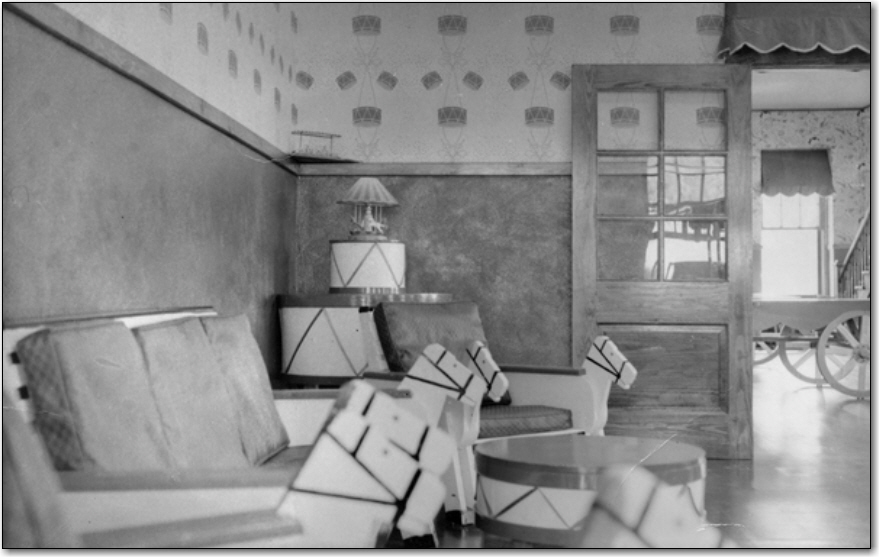
Looks like a college – Wikipedia Picture
I thank my friend for sending me the link. I don’t have the knowledge to turn this into a gripping novel. But then, I don’t need to, for those who were there are already telling their stories. I can’t so better. I wouldn’t presume to try. And, as a 1968 newspaper story about the school (Hell’s 1,400 acres) suggests, Florida didn’t just learn about this problem.
UPDATE: From NBC news on December 11, 2012: Abuses at infamous Florida boys reform school even more widespread, report says – “Scientists have found 19 previously unknown grave shafts on the grounds of a notorious Florida reform school, suggesting that many more boys died there amid brutal conditions than had previously been known”
UPDATE: (January 28, 2014): Remains of 55 bodies found near former Florida reform school – “Excavations at a makeshift graveyard near a now-closed reform school in the Florida Panhandle have yielded remains of 55 bodies, almost twice the number official records say are there.”
UPDATE: (March 8, 2016) State offers to rebury victims of Dozier School abuse – “A measure intended to help heal a community and people who suffered at a former reform school where the remains of 51 boys have been unearthed is headed to the desk of Gov. Rick Scott.”
UPDATE: (November 5, 2016) Special Report: Dozier School, What’s Next? Talks are underway about what should be done with the school’s property so that it can transition into another use that would have a positive economic impact on the community. But first, the state has to relinquish the property.
UPDATE: (January 13, 2017) Discussions are underway about whether to tear down or preserve the building known as the White House where boys were abused.
UPDATE: (May 23, 2018) “White House Boys’ Tour Dozier Campus” – “MARIANNA, Fla. – Friday, the ‘White House Boys’ toured the Dozier School for Boys Campus and held a memorial service, for closure.The tour was private and members of the group would not talk with the media.”
UPDATE: (October 11, 2018) – Author Colson Whitehead’s latest novel, The Nickel Boys, will be released next summer. According to the New York Times, “Colson Whitehead was set to write a crime novel set in Harlem. But he couldn’t stop thinking about a story that haunted him, about the abuses — beatings, torture, neglect, suspicious deaths — that took place at the Arthur G. Dozier School for Boys, a reform school in the Florida panhandle that operated for more than a century.”
UPDATE: (April 12, 2019): More ‘possible graves’ found at Dozier School for Boys – Tampa Bay Times: “A company doing pollution cleanup at the old Dozier School for Boys property in Marianna, 60 miles west of Tallahassee, has discovered 27 ‘anomalies’ that could be possible graves.”
UPDATE: (July 17, 2019): Researchers to look for more graves at Florida reform school – “University of South Florida forensic anthropologist Dr. Erin Kimmerle will be back at the former Dozier School for Boys on Monday, the same place where she spent four years researching and unearthing the remains of boys buried on the massive 1,400-acre site in Marianna, located about 60 miles (96 kilometers) northwest of Tallahassee.” – Associated Press 7/23: No new graves were found.
UPDATE: (July 17, 2019) Rooted In History, ‘The Nickel Boys’ Is A Great American Novel (Review) – “It’s pretty rare for a writer to produce a novel that wins the Pulitzer Prize and the National Book Award and, then, a scant three years later, bring out another novel that’s even more extraordinary. But, that’s what Colson Whitehead has done in following up his 2016 novel, The Underground Railroad, with The Nickel Boys. It’s a masterpiece squared, rooted in history and American mythology and, yet, painfully topical in its visions of justice and mercy erratically denied.” – NPR. See also, this review: For The ‘Nickel Boys,’ Life Isn’t Worth 5 Cents.
 It’s 1971. Trash piles up on the streets, crime is at an all-time high, the city is careening towards bankruptcy, and a shooting war has broken out between the NYPD and the Black Liberation Army. Amidst this collective nervous breakdown furniture store owner and ex-fence Ray Carney tries to keep his head down and his business thriving. His days moving stolen goods around the city are over. It’s strictly the straight-and-narrow for him — until he needs Jackson 5 tickets for his daughter May and he decides to hit up his old police contact Munson, fixer extraordinaire. But Munson has his own favors to ask of Carney and staying out of the game gets a lot more complicated – and deadly.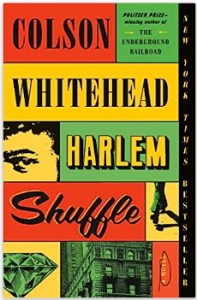
 “Arch Colson Chipp Whitehead (born November 6, 1969) is an American






 Malcolm's Round Table