Philosophers have said that a weed is a perfectly innocent plant that just happens to be growing where you don’t want it to be.
I don’t buy it.

Case in point: Septic Tank Field Line.
In the old days, when you built a house in the country, you added an outhouse. Later, when indoor plumbing came into fashion, the county required a perc test to make sure what you flush actually went away from the septic tank within a preferred amount of time. Our county changed the rules about a half hour before we started building our house.
First let me point out that our area has hundreds of houses with indoor plumbing that are connected to septic tanks placed after a perc test was done. So far, none of those houses has become an EPA clean-up site.
So now, the county requires a soil sample. Our test said we had bad soil except in a half-acre space that used to be a garden. The system of field lines required by the county was almost prohibitively expensive. Because those lines are close to the surface and because we’re next to a farm with heavy cows that would make a mess of those field lines if they walked through the old garden, we had to fence it in.
As we were paying for all this, my question to the county was why were two people living in a house such a big sanitation issue when there were over eighty head of cattle next door doing their business without environmental issues–or bad smells? I never got an answer because the county blamed the feds.
So, the highest weeds in the yard are in the fenced-in field line plot. Well, they’re certainly being watered often enough. If I mow them on the first day of the month, the weeds will have to be mowed again in a couple of weeks. By then, they’re taller than the riding mower.

Case in Point: The Old Chicken House
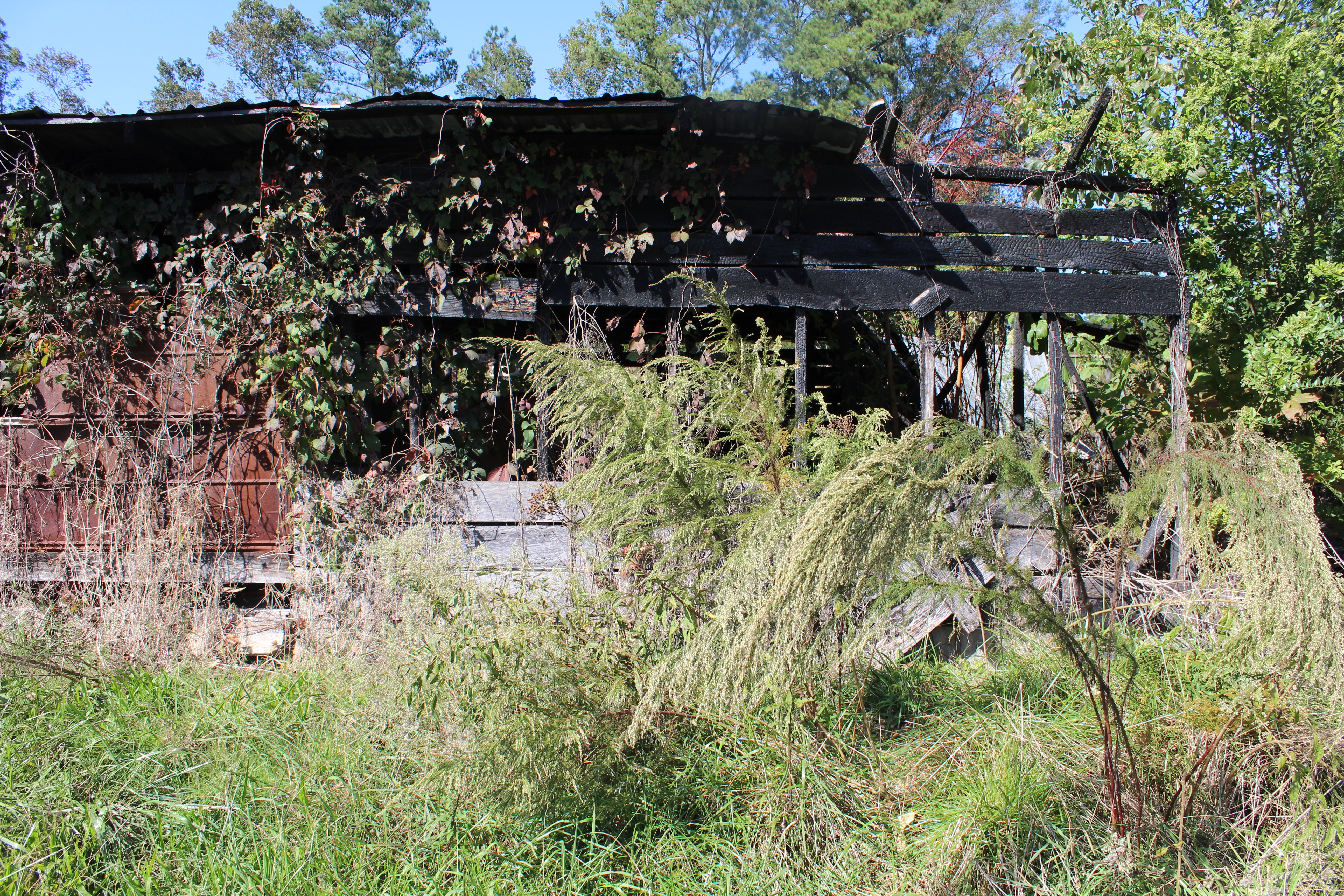
Chickens haven’t lived in the old chicken house since before my wife was born. When she was a kid growing up on this property, bales of hay were stored there. At some point, a section of it burnt down and was just left that way because hay hadn’t been stored there for years. Mainly, it was full of farm debris nobody knew what to do with, so it ended up there.
A year ago, just after I stored a whole lot of new debris in there, we had the burnt end of it shored up. Also, a lot of the weeds and brush were cleared away from it. I haven’t needed to get rid of any junk for a while, so we haven’t been in there. Now that I cleaning out the other half of our 1920s garage and have stuff to move to the chicken house, I can’t get in.
Why not?
Weeds. I’m not talking about dandelions and other tiny plants, but big woody plants whose goal is to become the forest primeaeval. I tried to explain to them that there are a lot of other places on this property where they can set up housekeeping and raise families. No luck. So, I spent the morning with long-handled pruning shears clearing a tunnel through the mess so I could get into the chicken house with debris that one day down the road the heirs to this property will have to deal with.
Case in Point: The Yard
Modern-day environmentalists complain a lot about yards. Even in ticky-tacky subdivisions, they (the environmentalists) say the yard should be left in a wild state or turned into a garden. Homeowners associations and city commissions don’t like that because both plans destroy the conformity of the neighborhood, tick off neighbors, and purportedly provide places for evildoers to hide.

We’re slowly getting rid of the grass in our yard by adding small trees so that one day, the yard will be nothing but shrubs, wildflowers, trees, and mulch. Until we finish this project, the yard is rather like a huge weed. We can have a month of drought followed by a day-long monsoon, and suddenly the yard-weed comes to life and grows so fast that after we mow it, people say we should have baled the cut grass for the cattle.
Nothing on the property grows as fast and as stubbornly as the weeds. I’m sure we’ll have to replace the riding mower blades soon because grass and weed height are doing them in. Some people say we should buy goats because they’ll take care of the problem, can “do their business” like the cows without an expensive septic tank, and are cute.
I guess we could put them in the chicken house if we can ever get inside. If we don’t, the coyotes will carry them off during the night. Grim people say that if the world ends, only the cockroaches will survive. They may be right. And they’ll have plenty of weeds to hide behind.
–Malcolm


 Malcolm's Round Table