 I no longer remember what led me to the Book of Changes known as the I Ching. Most likely it was something Carl Jung wrote. He was a friend of sinologist Richard Wilhelm (1873-1930) who brought to the western mind the first translation of the I Ching, a work that so impressed Jung that he wrote a forward to it. I believe it was first translated into English in 1951 and, of all the translations, some say it is still the best.
According to Princeton University Press, “The I Ching, or Book of Changes, a common source for both Confucianist and Taoist philosophy, is one of the first efforts of the human mind to place itself within the universe. It has exerted a living influence in China for 3,000 years, and interest in it has been rapidly spreading in the West.”
The universe, we suspect, is always in a state of flux, sometimes favoring things we may consider doing and sometimes not. The I Ching when used as an oracle shows us whether or not conditions are right for our plans just as a weather report tells us whether today is a good day to put out to sea. Most sailors wouldn’t begin a sea voyage in a hurricane. Likewise, when considering conditions with the I Ching, those with a Taoist perspective wouldn’t begin a project on a day when doing so goes against the universal flow.
In his foreword to the Wilhem edition, Jung said, “For more than thirty years I have interested myself in this oracle technique, or method of exploring the unconscious, for it has seemed to me of uncommon significance. I was already fairly familiar with the I Ching when I first met Wilhelm in the early nineteen twenties; he confirmed for me then what I already knew, and taught me many things more.”
As an oracle, used for divination or for meditation, The I Ching is–so to speak–like a wise and all-knowing companion on one’s life’s journey. I probably started using the I Ching in high school and, basically, found that when I used it often, life just seemed to go more smoothly. I still have my original copy, though I’ve supplemented it with Rudolph Ritsema and Stephen Karcher’s I Ching: The Classic Chinese Oracle of Change [The First Complete Translation with Concordance].
The publisher’s description said, “We need the book when we stand at a crossroad of the soul.” I agree. The book’s answers to a flippant question are often like getting one’s hands slapped So, don’t ask it where you left your car keys or if you’re going to “get lucky” on your date tonight.
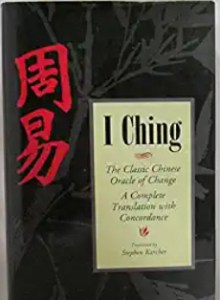
In this 1995 edition, the authors write, “The I Ching is a diviner’s manual or active sourcebook for what C. G. Jung called the archetypal forces. It organizes the play of these forces into images so that an individual reading becomes possible. . . These forces represent the flow of life and the experience of its meaning, its way or tao.”
Consistent use of the I Ching slowly changes an individual view of and approach to life. This benefit cannot be overstated.
I believe that most of our problems come from the arrogance of living outside the universe, a belief the I Ching would caution the seeker against.
–Malcolm



 Malcolm's Round Table