Gifting a book to a good home

What do you do when it’s time to downsize your personal library? I suppose you can sell some of the books on eBay or Amazon, but most  buyers at these outlets won’t pay more than a few pennies over shipping costs. That’s certainly not the fate most of us want for the older editions of niche books and classics.
Click on the graphic to see a newer edition on Amazon

A Facebook friend of mine used her intuition plus a healthy dose of reality based on the subjects I’ve discussed on my blogs about the research I’d been doing for two folk magic novels. She sent me a message telling me she was thinning out her library and thought she had a book that needed to be in mine. Would I take it in. It was an adoption, I thought even though I’d have to wait and see what it was.

Of course, when it comes to adopting pets, we seldom say we’ll adopt a pet without knowing what it is; nobody wants to be contemplating a regal cat or a playful puppy and have a tiger snake or an alligator show up. But, knowing S___, I didn’t think I’d end up with anything like those living books in the Harry Potter series that have teeth and are always angry when the wrong person tries to read them.

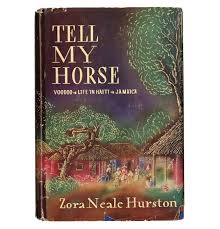
Her intuition was spot on. She sent me the 1938 original edition of Zora Neale Hurston’s Tell My Horse, an anthropological study of Voodoo in Haiti and Jamaica blurbed by Carl Sandburg, no less, with words like “bold,” “beautiful,” “priceless,” and “unforgettable.” The New York Times said of it, “Strikingly dramatic, yet simple and unrestrained…an unusual and intensely interesting book richly packed with strange information.”

I’ve read a lot of Hurston’s work from her novel Their Eyes We Watching God to her news coverage of the unfairly conducted 1952 Florida murder trial of Ruby McCollum to stories and books like Mules and Men collected while she was gathering hoodoo and other Florida folklore for the Works Progress Administration’s (1935-1943) Federal Writers Project. But Tell My Horse wasn’t in my library until yesterday afternoon at 4 p.m. when the mail arrived.

I know little about Voodoo (a religion), having mostly researched hoodoo (folk magic) except when I’ve stumbled across accounts out of New Orleans about notables such as Marie Laveau. So, I will enjoy reading this study about a related subject from one of my favorite authors; I’ll treasure the book and my highly intuitive Facebook friend who gifted it to me. I don’t know how long she had the book. When I told her Tell My Horse arrived, she said, “I knew you’d give it a good home. It languished with a friend of mine who was an antiquarian bookseller, until I found it in a dusty corner. I came to her through the experimental film of Maya Daren who was allowed to film and participate in voodoo rituals as Hurston did in her medium. It is a great relief to find her a place to thrive.”

S___, the book won’t languish in a dusty corner and, if you happen to stumble across this blog, I love you for your spirit of adventure, your kindness and your wonderful gift.

Now I know a good way to send my old books off into the world before they take over the house (my wife says they already have). Like Tell My Horse, many of my books are older than I am and will need loving homes rather than moldy basements and dusty attics.

–Malcolm

Malcolm R. Campbell is the author of two, Florida folk magic novels “Conjure Woman’s Cat” and “Eulalie and Washerwoman.”

So, you’re writing a novel and can’t think of a title for it

My muse tells me what my titles are going to be, so there it is.

But there are other approaches. Maybe a line out of a poem or your story’s plot in three words or the name of the main character along with a nice key word like “Joe’s Plague” or “Bob’s Dungeon” or “Mary’s Escape.”

booktitleTucker Max says, “The title is the first piece of information someone gets about your book, and it often forms the reader’s judgment about your book. Let’s be clear about this: A good title won’t make your book do well. But a bad title will almost certainly prevent it from doing well.”

Whether you’re shopping on line or in a bookstore, the title and the cover art are the first things you see. Their potential impact on sales is enormous.

Lynne Cantwell’s post in Indies Unlimited surveys a number of authors who have a smorgasbord of ways they come up with titles for their books. For me, it’s fun to see how others do this in case they have a technique worth borrowing.  Since I’m familiar with these authors’ books, it’s also instructive seeing when and how they decide on their titles.

Looking at what successful authors and teachers say about titles seems more reasonable than going to an online book title generator even though the headline of this post makes it look like a software-generated title is best: Book Title Generators: Free Tools To Help You Pick A Winning Title.

Agent Rachelle Gardner writes , “I was talking to a writer who mentioned she hadn’t worked too hard to come up with a great title for her book. When I asked her why, she said she’d been to a workshop taught by an editor at a major publishing house, who said, ‘Don’t get too attached to your title — there’s a good chance the publisher will change it anyway.’” Perhaps there’s some truth in that if you’re going with a big New York publisher. But most of us aren’t.

She quickly adds that you need to start with your best possible title even if you’re presenting the book to agents and editors who might ultimately suggest you change it. She follows that up with links to her post called How to Title Your Book.

Everyone who sees your book from beta reader to freelance editors to publishers will be impacted by your title. It shows them a lot about your intentions when it’s paired with your synopsis and/or sample chapter. So, what’s in a name?

Almost everything.

–Malcolm

Campbell’s Kindle books “At Sea,” “College Avenue,” and “Lady of the Blue Hour” will be free on Amazon on Black Friday. Click here for my website which has links to the books at the top of my home page.

Books, the new heroin

While I was finally getting rid of a 20-year addiction to cigarettes, I read a detailed description of what happens when a person tries crack. The description was so powerful that I would have tried crack if any had been lying around. Instead, I lit another cigarette, postponing my last tobacco day for several weeks.

A writer friend of mine just sent me an excerpt from her work in progress. The result: instant addiction. But, since the rest of her story wasn’t lying around, I had a bourbon and Coke instead. Better than nothing, but not as good as her writing.

heroinHello, addiction, my old friend. I’ve been there and done that and ought to have a tee shirt. Perhaps some will say that an addiction to books is a good thing, especially if those books are wonderful novels that are good enough to elevate the soul through the mere contact with the words.
Ever since I finished my recent work in progress, Eulalie and Washerwoman, and sent it to my publisher, I’ve lost all my discipline and have been reading books at flank speed. I know I have to come down off of this and get stuff done, but coming down is almost as difficult as giving up Marlboros.

Some suggest that addiction to a positive thing is good. They equate it with the oneness promised to the seeker who becomes one with the god of his or her heart so that the two are synchronized. I don’t think that kind of addiction is true enlightenment because with the dominance of the large over the small, the small is lost and no longer has the freedom to continue the relationship.

We’ve seen this dominating kind of addiction a lot during the Presidential race. Movers and shakers and every day voters have become so addicted to the candidate of their choice that they can no longer think for themselves. So, they are lost and have neither arrived at Nirvana nor a meaningful psychological balance–much less a logical political decision.

Some days, we need to put down the book we’re reading and do something else. No, it’s not easy. That’s why it’s called addiction and it represents a loss of free will. Even the “most positive addictions”–love, God, freedom, justice, compassion–can steal souls and render us less than ourselves.

As a reader and a writer, I know how easy it is to lose oneself in a book or a cause. Saying “no” really doesn’t fix it. It takes a strength of will to be oneself and get rid of the best of things that have entrapped you.

–Malcolm

Hex Free (mostly) Halloween Book Sale

Yes, you can go door to door begging for free candy and still take advantage of my 99% Hex Free Halloween Book Sale.

hexfreeSale dates: 10/28/16 through 10/31/16

Free Books: Waking Plain, Dream of Crows, At Sea, Willing Spirits

The Stories:

  • Waking Plain is a story about a sleeping prince who is so plain nobody wants to kiss him and wake him up. Bummer.
  • Dream of Crows is a story about a poor slob who’s being led into an early grave. Warning: it just might be you.
  • At Sea is a novel about a conscientious objector serving on an aircraft carrier during the Vietnam War. As it turns out, friends and family are more dangerous than the Viet Cong.
  • Willing Spirits is a story about a girl who waited to the last minute to do her book report and asks the dead author for help. You know before you start reading that this can’t be good.

Warranty: In spite of modern technology no reputable author can guarantee that his or her books are 100% hex free. We do our best to keep hidden hexes and subliminal messages out of our books. But a small percentage of you might fall under a spell that will cause you to buy more of our books and/or steal your children’s Halloween candy.

Malcolm


This and that on a blustery October weekend

Sunshine and gusty weather here in northwest Georgia. Here’s a little this and that:

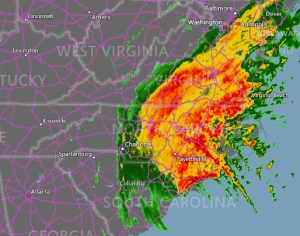
  1. matthew2My brother, sister in law, and publisher who live in two counties in central Florida came through the hurricane okay even though they’re still without power.
  2. As you see from the map, I live 275 miles from the Georgia coast. Sure, we have a wind advisory, but not a drop of rain. Meanwhile, my daughter and her family in Maryland will be getting rain soon if it isn’t already there. So, our drought continues while a lot of places have seen way too much water.
  3. The cover art work is done for my upcoming novel Eulalie and Washerwoman. I can’t show it to you yet because my publisher won’t be able to see it until her power comes back on. It looks good. It was done by the same artist who did the artwork for Conjure Woman’s Cat.
  4. While the hurricane was deluging Florida, I was writing a short story about a hurricane. I want you to know what I didn’t use any spells to attract Matthew even though Eulalie loves to whistle up the wind.
  5. I’ve added another poem to the selection in my Kindle stories and poems book College Avenue. When I originally uploaded the book, I couldn’t find a copy of my poem “Sock Puppet.” It first appeared in the former “Smoking Poet” Magazine, but was missing from their archives. Finally, my brother found a copy of it. Thanks, Barry.
  6. Okay, maybe I can show you a little piece of the cover art work, enough to tip you off there’s an alligator in the story:

ewgator


–Malcolm

do you know why you read what you read or does it just kind of happen


“A reader’s tastes are peculiar. Choosing books to read is like making your way down a remote and winding path. Your stops on that path are always idiosyncratic. One book leads to another and another the way one thought leads to another and another. My type of reader is the sort who burrows through the stacks in the bookstore or the library (or the Web site — stacks are stacks), yielding to impulse and instinct.” ― Jane Smiley

I’m a creature of habit and my strongest habit is inconsistency.

During the Vietnam War, bar girls in navy liberty ports used the phrase “butterfly man” to describe sailors who weren’t “loyal” to the same woman every time they came to port.

Assuming I can forget where that phrase came from, it aptly describes the apparent inconsistency of a writer’s reading habits as well as his/her seemingly slapdash approach to the art and craft of writing itself.

As Smiley says, our paths are winding and are choices along them are idiosyncratic and ruled by impulse and instinct. I grab books off the shelves because they seem like they’re going to be good. I am seldom fooled by this approach, though I have gotten stuck with a few books I wished I hadn’t grabbed off the shelves.

When I try to outline or, so to speak, plot out my reading choices (such as reading only one genre or reading all the books that receive certain prizes), I end up with a mess. Inconsistency makes perfect sense to me because I trust instinct and impulse more than I trust to-do lists and step-by-step plans.

I spent a lot of time out doors when I was growing up, and while certain things were good to do based on experience, one had to be ready for anything, to watch for signs, changes of weather, become attuned to sounds and scents and wrap that all together into moving up a mountain or along a trail with a fair amount of intuition. Sure, a lot of it was knowledge that had become internalized and then followed without having to think about it. But instinct kept one aware of dangers and wonders that plans never uncovered.

The worst thing people can for me is to recommend books. Then, suddenly, I start feeling an obligation to read those books, and get back to them the moment I’m done as though I’m doing a school book report. Funny, how there are people I like and agree with about a lot of things except the books they want me to read. “They want me to read book ABC because it’s by the same author and/or similar to book XYZ which they know I liked.”

I know NPR and other media outlets mean well with their lists of a year's best books, but I don't take those ideas a gospel.
I know NPR and other media outlets mean well with their lists of a year’s best books, but I don’t take those ideas a gospel.

I dislike most of the books suggested to me based on that kind of reasoning.

This will sound superstitious and insanely inconsistent, but I’m a “force is with me” kind of reader and writer. That is to say, if I’m “supposed to read” a certain book, I’ll find if by myself one way or another. If it’s a book I probably won’t like, I either don’t hear of it or stay away from it for unknown reasons.

My wife and I often finish each other’s sentences, but we seldom finish books one of us reads and recommends to the other. If you’re not my wife (and the odds are 100% that you’re not) you have a snowball’s chance in hell of handing me a book to read that I’ll be happy with.

Over the years, family members have given up on picking books for me as gifts. When Christmas and my birthday approach, they want to see a wish list from which to choose. (I just need to remember not too buy anything off the list before December 25th and August 12th have come and gone.)

So, how have you fared? Do family members and friends tend to know what you want to read and suggest or send books to you that you actually like. Or do they strike out?

I feel bad when people send me books I don’t like because having to tell them I don’t like the book they selected is about as difficult to do without injury as answering such questions as “how do you like my new dress,” “isn’t my hairdo just perfect,” and “would you like some more of my green bean casserole?” So many hurt feelings, busted noses and broken marriages come from answering those questions incorrectly.

Seriously, if we like each other, please don’t say, “Malcolm, you really need to read Lust in a Broken Birdbath (or whatever).”

Malcolm

Malcolm R. Campbell’s Vietnam novel “At Sea” is free on Kindle August 15-17.

Quickly Noted: ‘The Little Red Chairs’ by Edna O’Brien

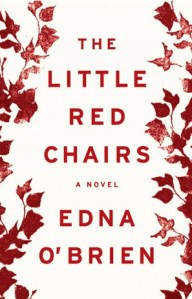
“On the 6th of April 2012, to commemorate the 20th anniversary of the start of the siege of Sarajevo by Bosnian Serb forces, 11,541 red chairs were laid out in rows along the 800 meters of the Sarajevo high street. One empty chair for every Sarajevan killed during the 1,425 days of siege. Six hundred and forty-three small chairs represented the children killed by snipers and the heavy artillery fired from the surrounding mountains.” – from “The Little Red Chairs”

What do the fairy tale setting in a remote Irish town and Radovan Karadzic, the Butcher of Bosnia, have in common? In a sane world, nothing. In her alternate history, 85-year-old Edna O’Brien combines what begins as an apparent folktale with the chilling angst of an Irish woman, Fidelma, who stumbles beneath the butcher’s spell before she knows he’s the butcher. As a stranger in her small town, Vlad is an event, a hypnotizing holy man and trickster with wisdom and danger in his eyes, the kind of man every mother warns every daughter about.

littleredchairsAs the story begins with all the charm of “The Music Man,” it’s easy to fall beneath the steel wheels of O’Brien’s spell and hope against hope tht her words are leading toward something perhaps a bit scandalous, something that might leave the townspeople–and especially Fidelma–with a few bittersweet scars of the kind that aren’t really cut that deep. But O’Brien’s tale goes where it must, to graphic and unspeakable horror from which Fidelma cannot quite escape. None of those 11,541 chairs was for her, but–if she had lived and breathed outside of fiction–destiny owed her a chair and, perhaps, absolution.

The Butcher of Bosnia is, in some mysterious way, the air which this story needs in order to breathe, and yet in other ways who he is and what he did are not the novel’s focus. The focus is Fiedelma, her suffering, her acts which were a curse to her village, her misplaced innocence that brought her, as naivete often does, to a hell from which there was no escape.

This novel is not for the faint of heart. As Joyce Carol Oates wrote in her New York Times review, “O’Brien is not interested in sensationalizing her material, and ‘The Little Red Chairs’ is not a novel of suspense, still less a mystery or a thriller; it is something more challenging, a work of meditation and penance. How does one come to terms with one’s own complicity in evil, even if that complicity is ‘innocent’? Should we trust the stranger who arrives out of nowhere in our community? Should we mistrust the stranger? When is innocence self-destructive? Given the nature of the world, when is skepticism, even cynicism, justified? Much is made of innocence in fiction, as in life, but in O’Brien’s unsentimental imagination the innocent suffer greatly because they are not distrustful enough.”

When we consort with the devil, by whatever name he identifies himself, should we not expect betrayal? It’s not an easy question, spells being what they are and innocence being what it is. Is there a message in this book? Yes: trust ensures our doom.

Oates’ questions are ever on our minds these days when terrorism comes out of nowhere and visits pleasant communities and exuberant celebrations in large cities.  I wonder if we can afford to be innocent these days. If not, what a pity. Suffice it to say, Fidelma will find little pity because those who (we often say) should have known better are seldom afforded the compassion granted the skeptical or the ignorant.

Yes, this novel is a masterpiece. Yes, it is well told, dark and deep. But it should carry on its cover a warning: “Abandon all hope, ye who enter here.” You cannot read this novel without being forever changed. I dealt with the book quickly here because I am too faint of hear to speak about it at length.

Malcolm

You might just win a Kindle Fire Tablet if you sign up for my publisher’s newsletter

tjlogoThomas-Jacob Publishing is starting a newsletter to help its adoring readers keep up with upcoming books and events. Since this is my publisher, I hope the readers are adoring. I’m proud of our catalogue, featuring books by:

  • Malcolm Campbell
  • Melinda Clayton
  • Tracy Franklin
  • Michael Franklin
  • Robert Hays
  • Smoky Zeidel.

Okay, moving onto the Kindle Fire Tablet. Click on the graphic below to go to the newsletter signup page. Just a few fields to fill out and then you’re done.

The first place winner of the tablet and the two second place winners of a free paperback from Thomas-Jacob’s list will be selected in a random drawing August 17th.

TJnewsletterpromo

Good luck in the drawing!

–Malcolm


Seriously, more of y’all need to go off and make baskets instead of writing

According to an unfortunate statistic, 81% of the public thinks they have a book in them. “In them” doesn’t mean they swallowed a book. It means they want to write a book. This statistic tells me why it’s so hard for authors to sell books. Too many people are writing and too few people are reading.

Consider Basket Weaving

Baskets have been around longer than books. In general, people like baskets even if they’re not sure what they’re going to put in them. I can’t find any statistics claiming that a sizable percentage of the population thinks they have a basket in them, so if you’re writing, stop it and do something where there’s less competition.

Wikipedia Photo
Wikipedia Photo

When I first became an author, I set up sales tables for my books at harvest festivals, art in the park, and other local fairs where people sold their stuff. I noticed several things.

  1. People selling homemade crafts, including baskets, sold more than authors even though their baskets, potholders, paintings,  etc. were priced higher than our books.
  2. Customers like being the first person to discover a new basket weaver, while readers are more like lemmings and won’t buy a book unless all of their friends already have it.
  3. Readers balk at an $8.00 paperback at a local festival while thinking nothing about slapping down $25 for a basket.
  4. Nobody asks a basket weaver if there’s a cheaper Kindle version. They buy the real thing rather than seeing the basket in a display and then rushing out to buy an e-basket from Amazon.
  5. People seldom compare your baskets with those by famous basket weavers because they don’t know any  famous basket weavers, whereas readers are likely to say, “you’re no Nora Roberts.”

Baskets Are Practical

If a basket looks awesome, people will buy it even though they have no earthly idea what they’re going to do with it. In contrast, readers have a 100-point checklist they go through before they’re risk buying a book from an unknown author that begins with “did Nora Roberts write it” and ends with whether there’s a lot of sex and violence on the first page and possible a nude on the cover.

Baskets are probably used for collecting dust on top of kitchen cupboards more than anything else. Most people can’t reach that high anyway, so once the basket’s up there, that’s it. If you own cats, they’ll get in the baskets, Otherwise, the baskets are up there for decoration. Books, on the other hand, require an investment of time. It takes time to read them, time that’s precious in a busy schedule of surfing the net, texting, watching “reality” shows on television, playing video games, and other urgent activities. The basket takes no time at all for customers to use.

Even without bothering to gather provable evidence, I think I’ve shown here that writing is a losing proposition compared with basket weaving. Baskets might lead you to more riches than uploading a Kindle novel which just sits there.

We don’t need 81% of the population out there writing a book. That’s way too much supply. But basket weaving, that could be a powerful niche business that doesn’t even require you to establish a platform, identify your target audience, or do daily blog posts.

–Malcolm

Malcolm R. Campbell is the author of “Conjure Woman’s Cat” and “Jock Stewart and the Missing Sea of Fire.” Both novels are available in paperback, e-book and audiobook editions. Check my website for more information.

Publishers Weekly Leads Petition Drive to End Cuba Book Embargo

Cubans and Americans haven’t had much access to each other’s literature for fifty years. Even though relations are becoming more normalized between the two countries, the overall embargo remains in place.

PWlogoPersonally, I don’t think an embargo on consumer products ever made sense, much less now.

According to the Publishers Weekly article A Letter from PW on the Cuba Book Embargo, “The Cuban people’s desire, and need, for American books was evident during the February U.S. publishing mission to Cuba, organized by PW and Combined Book Exhibit, in close cooperation with Cuban government officials.”

Click on the link in the paragraph above to see why PW thinks the embargo should be lifted. Or, if you already believe it should be lifted, you can read the petition here.

The embargo can only be lifted through Congressional action.

–Malcolm