This and that for avid readers

Even though July 30th was yesterday, this selection of posts about magical realism is still available. If you love the genre, you’ll find some fascinating ideas.


New from Thomas-Jacob Publishing, Transformed, a Kindle short story by Smoky Zeidel.  “The way I see it,” said Daniel, “the fence lizard eats the fly, so the fly becomes part of the fence lizard. The fly is the fence lizard. The fence lizard gets eaten by the snake, and thus becomes the snake. What’s to say that snake won’t get snatched up by a Golden Eagle, and thus become the eagle?” Does the same principle apply to humans? Marina is about to find out.

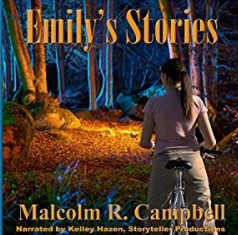
Thank you to all the readers who participated in the recent sweepstakes for Emily’s Stories on Audio Book Reviewer. Kelley Hazen and I are glad you stopped by and signed up. Congratulations to the winners and thanks to those of you who have already posted reviews.

Here’s a copy of my Amazon review for Don Westenhaver’s mystery thriller Missing Star

This post WWI thriller mixes historical and fictional characters in a fast-paced search for a missing actress (Joyce) in the very different Los Angeles of another era. The ambiance and history anchor the story which pits ex-marine aviator (Danny) and against the seedy unknowns of the big city where overlapping police jurisdictions and the corrupt politics of prohibition make it easy for many crimes to fall through the cracks.

Danny is determined to find Joyce in spite of impossible odds, and this makes him a believable and determined main character. Inasmuch as missing persons cases typically includes gaps of time when no new information is found, the story takes a few side trips that, while relevant, slow down the pacing a bit. It also doesn’t seem likely that Danny, as a civilian, would be included in police actions. Otherwise, the story moves well with a high degree of credibility toward a satisfying conclusion. Readers will feel anger over Joyce’s circumstances and respect for Danny’s perseverance, and cannot help but hope that they find each other again and make the bad guys pay for what they’ve done.


Recently released from Thomas-Jacob Publishing, Tizita, a new novel by Sharon Heath: “Physics wunderkind Fleur Robins, just a little odd and more familiar with multiple universes than complicated affairs of the heart, is cast adrift when her project to address the climate crisis is stalled. Worse still, her Ethiopian-born fiancé Assefa takes off right after her 21st birthday party to track down his father, who’s gone missing investigating Ethiopian claims to the Ark of the Covenant. Fleur is left to contend with the puzzle of parallel worlds, an awkward admirer, and her best friend Sammie’s entanglement with an abusive boyfriend. Assefa’s reconnection with a childhood sweetheart leads Fleur to seek consolation at Jane Goodall’s Gombe Stream Chimpanzee Reserve, but it’s through a bumbling encounter with her rival that the many worlds of Fleur’s life begin to come together. In the experience of tizita—the interplay of memory, loss, and longing—Fleur is flung into conflicts between science and religion, race and privilege, climate danger and denial, sex and love. With humor, whimsy, and the clumsiness and grace of innocence, Fleur feels her way through the narrow alleyway between hope and despair to her heart’s sweetest home.”

New, from Theodora Goss, my favorite review book for 2017, The Strange Case of the Alchemist’s Daughter. See my review here. From the publisher: “Based on some of literature’s horror and science fiction classics, this is the story of a remarkable group of women who come together to solve the mystery of a series of gruesome murders and the bigger mystery of their own origins. Mary Jekyll, alone and penniless following her parents’ death, is curious about the secrets of her father’s mysterious past. One clue in particular hints that Edward Hyde, her father’s former friend and a murderer, may be nearby and there is a reward for information leading to his capture…a reward that would solve all of her immediate financial woes. But her hunt leads her to Hyde’s daughter, Diana, a feral child left to be raised by nuns. With the assistance of Sherlock Holmes and Dr. Watson, Mary continues her search for the elusive Hyde and soon befriends more women, all of whom have been created through terrifying experimentation: Beatrice Rappaccini, Catherin Moreau, and Justine Frankenstein. When their investigations lead them to the discovery of a secret society of immoral and power-crazed scientists, the horrors of their past return. Now it is up to the monsters to finally triumph over the monstrous.”

–Malcolm

Malcolm R. Campbell is the author of magical realism books set in Florida.


Review: ‘The Strange Case of the Alchemist’s Daughter

The Strange Case of the Alchemist's DaughterThe Strange Case of the Alchemist’s Daughter by Theodora Goss
My rating: 5 of 5 stars

Imagine “monsters” from science fiction and horror classics written by H. G. Wells, Mary Shelley, Nathaniel Hawthorne, and Robert Lewis Stevenson working together with Sherlock Holmes, Dr. Watson and Inspector Lestrade to track down the killers in a string of gory London murders.

Odds are, the resulting story would be a chaotic, unbelievable mess. Or, if the muses were kind and the odds were defied, the resulting story would be a breathtaking and expertly plotted Victorian-era fantasy in which the plots, characters and themes of fictional legends fit together in a believable, wondrous harmony.

Theodora Goss’ muses were kind.

The protagonists of legend believed they could create evolved humans out of bits and pieces of the dead. They failed. The evil scientists in Goss’ story have similar ideas. “The Strange Case of the Alchemist’s Daughter” has been assembled from the remains of its legendary predecessors, yet unlike the “monsters” of yore, it is strikingly beautiful, functions elegantly with the well-focused skills of its creator, and contains a radiant soul.

Readers familiar with the original stories will enjoy references to even the smallest of details. For everyone else, no footnotes are required because the story stands on its own.

The plot is complicated and compelling and the pace is rapid and perfectly synchronized with a dash of humor. As a writer, I wonder how Goss created a novel that is better than the works from which it takes it themes. I suspect her precision as a poet and short story writer, her love of fairy tales and folklore, and her long-term research into the “monsters” of literature are factors. But those factors are only bits and pieces of the author’s craft, imagination and creative spirit.

Rather than analyse how Goss turned an accident waiting to happen into one of the best novels of the year, I’m willing to write it off and say: “It must be magic.”

View all my reviews

–Malcolm

Malcolm R. Campbell is the author of contemporary fantasy, folklore and magical realism short stories and novels.

Summer Sale – Two Free Books

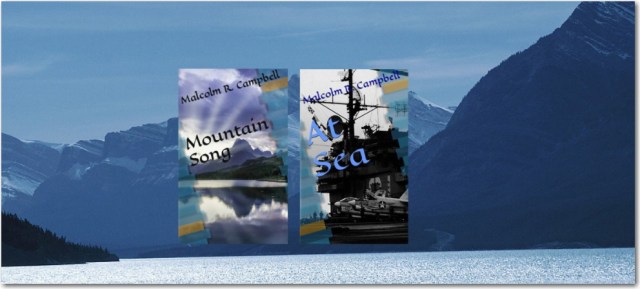
To celebrate the arrival of summer, my companion novels Mountain Song and At Sea are free on Kindle June 22 through June 26.

Mountain Song

David Ward lives in the Montana mountains where his life was impacted by his medicine woman grandmother and his utilitarian grandfather. Anne Hill suffered through childhood abuse and ultimately moved in with her aunt on the edge of a Florida swamp. Their summer romance at a mountain resort hotel surprises both of them. But can they make it last after the initial passion wears off and they return to their college studies far apart from each other especially after an attack on a college street changes Anne forever?

At Sea

Even though he wanted to dodge the draft in Canada or Sweden, David Ward joined the navy during the Vietnam War. He ended up on an aircraft carrier. Unlike the pilots, he couldn’t say he went in harm’s way unless he counted the baggage he carried with him. As it turned out, those back home were more dangerous than enemy fire.

–Malcolm

Malcolm R. Campbell is also the author of Conjure Woman’s Cat and Eulalie and Washerwoman.

Subscribe to our newsletter and receive a free book

Thomas-Jacob Publishing is offering free copies of Melinda Clayton’s novel Making Amends to those who sign-up for our newsletter via the InstaFreebie site. This offer is good through the end of this month.

Just enter you name and e-mail address, and then choose the file type you want: MOBI, EPUB, or PDF.

We promise not to send you a deluge of stuff. We hope you’ll like what we do send: announcements of new books, a few poems, and a bit of news.

I enjoyed reading Making Amends. Here’s the publisher description from Amazon:

On a beautiful fall evening, in the middle of a game of hide-and-seek, five-year-old Bobby Clark is kidnapped by his estranged father, a shiftless man with a history of domestic violence and drug abuse. Bobby’s twin brother Ricky watches, terrified, from his hiding place behind the bougainvillea, while mother Tabby, who also struggles with addiction, lies inebriated on the living room floor. Bobby isn’t seen by his loved ones again until a fateful morning twenty-five years later, when video of his arrest dominates the morning news. He has been charged with the murder of his father, but before the trial can begin, he manages to escape. As Tabby and Ricky absorb the news of Bobby’s return and subsequent escape, Tabby is convinced he’ll come home to the quiet Florida street from which he was taken so long ago. But when events begin to spiral out of control, she’s left to wonder: is a child born to be evil, or shaped to be evil? And in the end, when it’s time to make amends, does it really matter?

I hope you enjoy the book and the Thomas-Jacob newsletter. The next issue should be out near the end of this month.

–Malcolm


Briefly Noted: “Turning Radius’ by Douglas G. Campbell

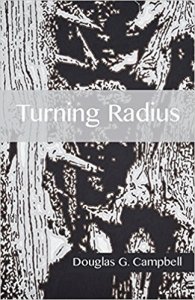
Reader reviews and editorial book reviews written by husbands, wives, brothers, sisters, mothers, fathers, colleagues and next door neighbors are quite rightfully looked upon with a jaundiced and cynical eye by prospective readers. So, I cannot review my brother’s book of poems Turning Radius (Oblique Voices Press: March 2017). Nor can I rate it with stars on Amazon or GoodReads.

I can tell you that it exists.

From the PublisherA book of 100 poems written during the years before the author’s stroke in 2012. Rather than organizing the poetry as a volume with a single formal or thematic focus, this book’s seven sections coalesce as something more like an omnibus, or, on closer reading, like a jewel with seven facets, each of which displays a different aspect of the author’s rigorously lived inner life.

The book’s seven sections are Lemonade Days, Canticles of Humanness, Turning Radius, Spirits of the Earth, Nature’s Continuum, Listen to the Earth, and War and Art. In his foreword, William Jolliff writes that these sections suggest “an unsettling consistency, and that consistency is discovered as a complex of attributes that have characterized all of Campbell’s artistic work: an attention to everyday details, startling in its intricacy; a sense of irony that laughs and rages but is slow to anger; a knowledge of natural phenomena that attests to many hours in the wilderness as well as in the studio; and a practiced craft that inevitably chooses the perfect form for the message conveyed.”

From “Dark Canticle”When I should be resting/vast empty spaces of the earth/ swallow my heart.

From “Carnival”Embrace your wrinkled exteriors/for they are your salvation;/in this nation of smooth talkers/they are a testimony/bearing witness to truth.

From “Turning Around”Too many times/I have not stopped/to turn around/to stoop/to bring into focus/some curiosity/clinging/to the edge of sight.

The book is available in paperback. I enjoyed reading it from cover to cover: I think I can tell you that.

Malcolm


In fifteen minutes, it will be time to feed the cats

I have no ideas for a fresh blog post. That’s why I typed the header about the cats. Right now, none of my three cats are anywhere. They lurk. I think they actually have a Narnia-wardrobe somewhere in the house and disappear for voyages on the Dawn Treader with Lucy, Edmund, Eustace, and Prince Caspian.

Fine, maybe they’ll start writing sage and quasi-luminous posts in exchange for their four squares a day.

[time passes as I wonder how many people reading blogs today know what four squares a day means.]

In ten minutes, it will be time to feed the cats. I’ll probably get to the kitchen on time because I’ve decided that those who don’t know what “four squares a day” means can Google it.

I thought perhaps I’d announce a book sale or an Amazon giveaway. Tomorrow, I think. Watch my twitter account (https://twitter.com/MalcolmCampbell) for notices. That’s where I mention Amaon giveaways because those come and go way too fast for a WordPress post.

The lights just flicked. One thing about being hard of hearing means that I don’t hear rain. The weather radar, which is showing red for this part of the county, indicates it’s raining like hell outside. Who knew?

Maybe that’s why the cats are missing. They’re under a bed or a couch.

[time passes while I go look outside]

I hope the weather radar liars got their pay docked today. It’s not yet raining like hell outside. But now that I wasted time going to look, I’m probably going to be late feeding the cats.

It’s what they’ve come to expect. I don’t know about you, but just looking at the photograph of their dinner makes my mouth water.

Keep watch on that twitter account tomorrow for some great giveaways.

–Malcolm


How do you contend with the hubris of thinking anyone has or should have any interest in what you have to say about anything?

In his Salon interview with five authors (“Figuring out that page-turning quality is tougher than it looks”), Teddy Wayne asked, “How do you contend with the hubris of thinking anyone has or should have any interest in what you have to say about anything?”

I especially liked Sara Flannery Murphy’s (“The Possessions”) answer: “I always remind myself that I’m not entitled to anybody’s attention. That way, I feel a lot of gratitude for the people who do listen, knowing that they’re giving their attention to me freely and generously.”

Authors have been asked this question for years. Some are considered arrogant, egotistical, and vain, filled with self-importance as though they are kings and queens who must be served by millions of little readers. Some write that they write and hope the readers who like their plots and characters find their books.

Some authors are very commercial: they have a knack for knowing what sells well and how to keep writing it so that over time they develop a reputation for delivering stories in their genres of choice that are guaranteed to keep their fans forever turning pages and waiting for the next book.

Some authors are more comfortable in niches and (perhaps) believe they’re lucky if anyone finds their books.

Today, a lot of authors think the way to success is to sell stuff cheaply. Maybe that works. But really, the thing all authors are asking their readers to give them is their time. Whether those readers pay 99¢ or $29.95 for the book, the time it takes for them to read the novel, short story collection, or nonfiction is more valuable to them than the cash. Whether they read the book in an afternoon, a long weekend, or a few pages every night for weeks before going to bed, they had unlimited options for spending that time. But they chose the book.

That’s why I like Murphy’s answer. And frankly, there’s no way to truly thank a reader who has spent many hours “freely and generously” reading something we’ve written other than doing our best to tell the story well.

Malcolm


Review: ‘The Man Without a Shadow’ by Joyce Carol Oates

The Man Without a ShadowThe Man Without a Shadow by Joyce Carol Oates
My rating: 4 of 5 stars

After a brief illness destroys Elihu Hoopes’ short-term memory, he becomes frozen in time. Long term, he thinks he’s still the age he was when he became ill. Short term, he lives in the now of 70-second bursts of knowledge about what he’s doing and who he’s with. What he’s doing is living with a relative and coming to the university for testing intended to advance scientific knowledge about memory loss. This knowledge will help everyone but Elihu because he will probably never get any better.

In many ways, this novel reads like nonfiction with short scenes depicting the psychological testing Hoopes undergoes almost daily. As the novel proceeds, we learn more about the brilliant young researcher Margot Sharpe who begins work at the lab while working on her degree. She stays on. She becomes three-dimensional to the reader, but–we might speculate–one-dimensional to herself. And that one dimension appears to be an obsession with her “patient.”

The novel’s short scenes, with Oates’ typical reliance on up-close detail, tend to mimic Hoopes’ periods of contiguous present-day memory. As a person with a continuing existence, other characters (and the reader) know more about his life than he does–except for the past which for him is always yesterday. He sees others aging but is not aware he is aging.

As one reads, one suspects Sharpe’s life is in danger of losing it’s wholeness. She’s becoming famous for her brilliance as a researcher while becoming more single minded in her devotion to Hoopes. She questions not only the ethics of the testing, but also her own ethics wherein her feelings for Hoopes begin to look like a one-sided fantasy which has a history for her but not for him. He seems to have some consciousness of her over time even though she has to introduce herself every time she sees him–even if she leaves the room for a minute.

The opening lines of the novel tell you where all this is going:

“Notes on Amnesia Project ‘E.H.’ (1965-1996).
“She meets him, she falls in love. He forgets her.
“At last, she says good-bye to him, thirty-one years after they’ve first met. On his deathbed, he has forgotten her.”

It’s a bumpy ride. Some readers will get lost with the repetition of the testing scenes, while others might find their eyes glazing with the titles of the scholarly papers that arise out of what Sharpe and her colleagues learn. Others will enjoy the exploration of Hoopes’ and Sharpe’s loneliness and how their fragmented lives fit together, and then they don’t, and then fit together, and then they don’t, rather like a jigsaw puzzle in a windstorm.

With diligence, and an ability to live only within the present moment while reading, readers will discover this book has something profound to offer them.

View all my reviews

–Malcolm

Malcolm R. Campbell is the author of paranormal, magical realism, and contemporary fantasy.

A new poll says people are still reading

A new Gallup poll summarized by Art Swift and Steve Ander shows the following:

  • 35% say they read more than 11 books in the past year
  • 53% of young adults read between one and 10 books in the past year
  • 73% prefer printed books to e-readers or audio books

According to Swift and Ander, “Despite the abundance of digital diversions vying for their time and attention, most Americans are still reading books. In fact, they are consuming books at nearly the same rate that they were when Gallup last asked this question in 2002.”

Writers’ magazines love including essays with titles like “Death of the Novel.” While it’s true that most commercial magazines no longer carry serialized novels or short fiction, bricks and mortar stores and online booksellers are still moving books into people’s hands and hearts. And just type the words “book blog” into a search engine and look at the number of hits. A lot of people are talking about books.

galluppollSome say the business is easier for authors these days because we’re not shackled to BIG PUBLISHERS, some of whom won’t even consider a book unless it can sell 50,000 copies. So we self-publish and bring out our books through smaller publishers. Unfortunately, our main sources of editorial reviews have declined so there are fewer ways for new and so-called “midlist” authors to reach the public’s consciousness. It wasn’t too many years ago that solid newspaper review sections were written by local editors and staff writers, and–in addition to mainstream authors–covered local and regional authors as well as metro bookstore readings and signings.

In spite of that, readers are finding books. It’s a pity so many of them rely on Amazon and that so many of them think books ought to be free or nearly free. I often argue in this blog that while it’s true that a Kindle file doesn’t have the physical costs behind it that a hardcover book has, it still represents (possibly) a year or so of the author’s life in addition to the expense of editors, cover designers, proofreaders and publicists. As authors, we’re not selling the file: we’re selling what’s in it.

I still prefer printed books because I like the art and craft of them and find them easier to read in bed, in a car, on a bus, on the beach. Plus, I stare at a screen all day, so the last thing I want to do when I relax with a good book is stare at another screen. But that’s me. Reading from a screen is better than not reading. And, as we’re hearing, audiobooks are doing a lot better than most of us would have guessed if we’d been asked about their future ten years ago.

One positive note in this year’s survey over the one done in 2002 comes from the fact older Americans are reading more books than they used to. The poll doesn’t say why, but I like the increase in the numbers. Another thing I can’t tell from the poll is whether (or if) avid readers skew the numbers, making the averages look better than they are. Comparing notes at the end of 2016, another writer and I figured we read almost one book a week. So, do my 52 books per year counteract the answers from 51 people who didn’t read at all? In changing McCoy’s of Star Trek line, my response to that is, “Jim, I’m not a mathematician, I’m just a country storyteller.”

Yes, arts/humanities education is suffering

Every year, I read that one school system or another has further diluted the classroom hours devoted to the arts, what we used to get in courses labeled “Art” and “English” and, sometimes, “Humanities.” This introduction to books and other arts seems indispensable if we want a nation of informed readers, so it’s a pity we’re losing it. I wish those who have national platforms (talk show hosts, actors, singers) would talk about the value of reading. When Oprah’s show was going strong, she did a lot for the country’s authors because she had a popular platform. We need more of that, I think, before diminished exposure to the arts in school finally impacts a future Gallup poll.

Like the long-time literacy-based organization says, Reading is Fundamental. It’s sobering to see on their website that 93 million Americans can’t read well enough “to contribute successful in society.” For people who can’t negotiate all the forms, signs, jobs, news sources and other writing they require for day to day for basic needs, books aren’t even on the radar. I think we need to understand why this is the case before we understand why reading ten or eleven books per year is a pitifully low number for our national average even though the poll says things haven’t gotten worse.

When I served as a literacy volunteer between college and military service, I thought the need was incomprehensibly large and that progress seemed so slow at times, it was like trying to empty the ocean with a thimble. Yet, we can’t stop, can we? I’d like to see a Gallup poll that shows more people not only know how to read, but are reading more books and magazines as well.

–Malcolm

Malcolm R. Campbell is the author of magical, paranormal, contemporary fantasy and satire novels and and short stories. You can learn more about them on his website here.

Review: ‘The Magic Strings of Frankie Presto’

The Magic Strings of Frankie PrestoThe Magic Strings of Frankie Presto by Mitch Albom
My rating: 5 of 5 stars

Mitch Albom’s words and the songs they play in “The Magic Strings of Frankie Presto” comprise a “Pure Perfect Fifth,” a term related to an ancient system of musical tuning that has been linked to alchemy and the transformation of souls. Narrated by Music himself, this tale about an orphan from Villareal, Spain who becomes the best guitar player in existence is the quintessence of a well-told tale accompanied by the music of the spheres and the wisdom of many players.

Frankie’s mentor, known as El Maestro, reveres composer and guitarist Francisco Tárrega, teaches the classics, demands constant practice, and tells his young student to respect his left hand by keeping the nails trimmed so that the sensitive fingertips feel the pain of every note. They begin with Tárrega’s “Lágrima” (teardrop), and that song becomes a fitting leitmotiv throughout the novel.

Frankie can play it all, from the free strokes and rest strokes of Spanish guitar, to every standard rock and roll chord progression, to the worried notes of the twelve-bar blues. Though Frankie Presto plays a guitar with magic strings, his life is almost pure blues, pure “Lágrima.”

He is forever haunted by the violent unknowns of his childhood, people who suddenly go missing, the comings and goings of fame and not fame, his lover Aurora’s long absences, injuries and penances, and the on-going conflict between a beautiful voice that makes him rich and a guitar technique that nourishes his soul. Once, when he told El Maestro he wanted to be perfect as both a singer and a guitar player, Le Maestro said that both was the same as neither.

Frankie is forever running and forever searching. Through it all, his music leads him while he feels the pain of every note. Near the beginning of Albom’s novel, we learn that Frankie is dead, that we are standing around before the funeral talking with Music about Frankie’s life through a Chroma-filled remembrance that includes all his sharps and flats and rests. His story is filled with mystery, too, the unexpected riffs that come out of nowhere like the here-and-gone notes of a jam session, moments that fall together that had seemed separate, and a hidden continuity Frankie doesn’t know about until late in life. The unexpected arises again and again in different keys from the walking base line that drives the story measure by exceptional measure. And he wonders, is this gig destined synchronicity or perfectly orchestrated manipulation. He will have to decide that before the plays his last song.

By the end of the novel, with the help of an all-wise narrator and the testimonies of those who knew him in ages past, Frankie knows everything about himself and his magic strings, why things happened as they did, and the blessings of music as his song resolves into a coda of joy with a lasting counterpoint of “Lágrima.”

–Malcolm

View all my reviews