He’s been called “a loose cannon,” a “pain in the ass” and a “white traitor.” For more than 15 years, Jerry Mitchell has unearthed documents, cajoled suspects and witnesses, and quietly pursued the evidence in unsolved murders of civil rights activists. Mitchell’s investigative reporting and sustained coverage for The Clarion-Ledger in Jackson, Mississippi, has brought to justice four Ku Klux Klan members, beginning with the conviction of Byron De La Beckwith for the 1963 assassination of Medgar Evers and, most recently, Edgar Ray Killen who was found guilty in June for orchestrating the murders of Andrew Goodman, James Chaney and Michael Schwerner in 1964. – Columbia School of Journalism, Chancellor Award Winner Bio of Jerry Mitchell
If you’re old enough to have been around during the 1960s violence led by the KKK (I am), then you know that fires, bombs, clubs, knives, and bullets wielded by the KKK took a lot of lives but these events seldom led to arrests and convictions. I grew up in that world and I knew the reason why. Nobody saw nothin’.
However a reporter named Jerry Mitchell thought there had probably been much to see and that since there’s no statute of limitations on murder, those unsolved KKK murders needed another look. As John Grisham said, “For almost two decades, investigative journalist Jerry Mitchell doggedly pursued the Klansmen responsible for some of the most notorious murders of the civil rights movement. This book is his amazing story. Thanks to him, and to courageous prosecutors, witnesses, and FBI agents, justice finally prevailed.”
From the Publisher
 On June 21, 1964, more than twenty Klansmen murdered three civil rights workers. The killings, in what would become known as the “Mississippi Burning” case, were among the most brazen acts of violence during the Civil Rights Movement. And even though the killers’ identities, including the sheriff’s deputy, were an open secret, no one was charged with murder in the months and years that followed.
It took forty-one years before the mastermind was brought to trial and finally convicted for the three innocent lives he took. If there is one man who helped pave the way for justice, it is investigative reporter Jerry Mitchell.
In Race Against Time, Mitchell takes readers on the twisting, pulse-racing road that led to the reopening of four of the most infamous killings from the days of the Civil Rights Movement, decades after the fact. His work played a central role in bringing killers to justice for the assassination of Medgar Evers, the firebombing of Vernon Dahmer, the 16th Street Church bombing in Birmingham and the Mississippi Burning case. Mitchell reveals how he unearthed secret documents, found long-lost suspects and witnesses, building up evidence strong enough to take on the Klan. He takes us into every harrowing scene along the way, as when Mitchell goes into the lion’s den, meeting one-on-one with the very murderers he is seeking to catch. His efforts have put four leading Klansmen behind bars, years after they thought they had gotten away with murder.
Race Against Time is an astonishing, courageous story capturing a historic race for justice, as the past is uncovered, clue by clue, and long-ignored evils are brought into the light. This is a landmark book and essential reading for all Americans.
–
In 1964, I didn’t think anyone would have the guts to find and publish the truth, the in-depth truth that names names and brings people to court. Jerry Mitchell did what all reporters should have been doing. This book came out a year ago: since then, I hope it has inspired other reporters to look deeper into their stories about racial violence stemming from hate groups.
—Malcolm
 Malcolm R. Campbell is the author of four anti-racism novels: “Conjure Woman’s Cat,” “Eulalie and Washerwoman,” “Lena,” and “Fate’s Arrows.” They are available in e-book, paperback, and hardcover through major online booksellers and via your local bookstore’s orders from its Ingram Catalog.,
 But I have always wondered. Anna and I might have gotten married in Göteborg (shown in the photo). I would have learned Swedish and looked for a job–with the assistance of the Swedish government as a requirement for being granted asylum. While I thought I might never see the U.S. again, Jimmy Carter granted amnesty in 1977. Would I have come home? Well, probably for a visit. Obviously, I know what happened here that would not have happened if I had chosen Sweden.
 Even so, years after those days, few people know what to make of the 1960s, the era of flower children, anti-war protests, and distrust of “the establishment.” Nancy Kwan, who appeared in the public eye with the release of “The World of Suzie Wong” in 1960, was a welcome distraction to the forces wreaking havoc on the United States and its institutions.
 “Flower Drum Song ” (1961) definitely kept Nancy Kwan on our minds while we were advocating “Make Love Not War.” Wikipedia notes that “”Flower Drum Song became the first major Hollywood feature film to have a majority Asian-American cast in a contemporary Asian-American story. It would be the last film to do so for more than 30 years, until The Joy Luck Club (1993). In 2008, Flower Drum Song was selected for preservation in the United States National Film Registry by the Library of Congress as being “culturally, historically, or aesthetically significant”
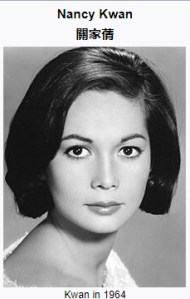 I’m happy that Nancy Kwan is still around, some years older than me, because her presence on this earth reminds me of Hong Kong, the war, Japan, the draft, and all the other good and bad things of those days when most of us lost our innocence and thought absolution would come through hopes we could never attain.
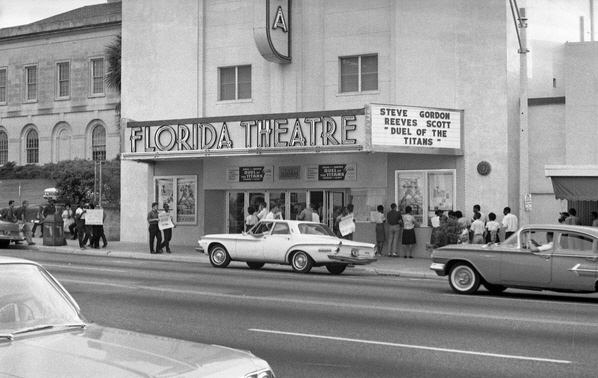

 I delivered telegrams in the 1960s when the service was still in demand due to the high prices of long distance calls in those days. There were Candygrammes, of course, and messages that required WU to sing. Frankly, I preferred it when the telegraphers at the local office–who looked like character actors out of “Medicine Woman” or “Gunsmoke” or “High Noon”–gathered around a telephone and sang “Happy Birthday” to the person receiving the message.

 Malcolm's Round Table