I’m reading Alice Hoffman’s novel The Book of Magic, unfortunately, the last in a four-book series that began in 1995. As I read, everything I know from studying magic comes to mind rather like hearing an old song brings to mind where you were and the people you were with when you first heard it.

I have no idea whether thoughts of magic are stirred up in the minds of most readers or just those who’ve studied magic. Maybe this happens with people who study other subjects. If you studied kings and queens in college courses, does reading novels about kings and queens remind you of what you learned in college and/or what you saw when you visited historic locations? Or is it just magic?
In Man in Search of Himself,” physicist Jean E. Charon wrote that works of art communicate via an innate knowledge shared by artist and viewer in a language that “awakens unconscious resonances in each of us.” At a deep level, I think, we recognize connections between what we know, think, and feel and the material we’re seeing on the page of a novel or nonfiction book.
If an author is writing the truth, the reader intuits that truth even in fiction and that awakens many memories. In a 2021 interview in The Writer, Hoffman said, “I don’t purposely pursue magic – it’s just part of the prose that I write. I grew up reading fairy tales and myths. For me, magic has always been a part of literature as a reader and as a writer. Magic doesn’t have so much to do with plot as it does with voice. For instance, you can tell a story in a realistic way, and if you’re Hemingway, it’s great, and it works. For me, magic is about the way the story is told rather than the story itself. It’s not a hocus-pocus influence in the plot. It’s more the tone of the story, the way the story tries to draw you in and create a fictional world. I’d like to add that I think the most important thing for beginning writers is to find their own voice.”
I agree with that. Since I do, Hoffman’s work resonates with me more than a novel that sets out with an overt plot involving magic rather than a story in which magic is one part of the characters’ lives. Those of us who write magical realism see magic as a normal part of life, a life that might otherwise be just as logical and rational as most of the people we meet.
For me, the shared knowledge with an author, as Charon sees it is strong when the subject is magic and less strong–to nonexistent–when the subject is black ops and police procedurals.
Like influences like, people say. They may be right.
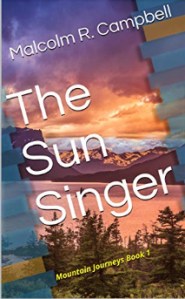
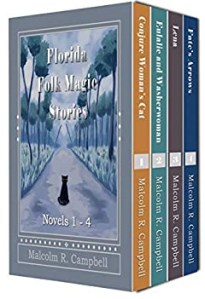
 Malcolm R. Campbell is the author of the Florida Folk Magic Series that begins with “Conjure Woman’s Cat.” The audiobook, narrated by Wanda J. Dixon, received an Earphones Award from AudioFile Magazine.




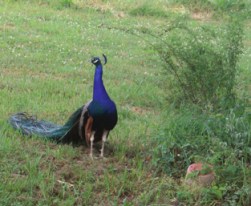 This peacock is one of our frequent visitors from the farm across the road. He looks for bugs while we’re mowing the yard or soon after. Often has several peahens with him. The focus is a bit off because he was so close I had to take the photo through the dirty windows on the front door.
 Our unopened backup jar of Jiff peanut butter is included in the batch being recalled. I’m happy we hadn’t opened it yet. I’m unhappy that the solution is to throw it in the trash.
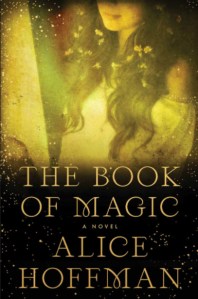 While waiting for Alice Hoffman’s The Book of Magic to arrive, I pulled my copy of the 1992 Richard Powers’ novel The Goldbug Variations off the shelf thinking I’d re-read some of it. Hmm, perhaps not. I thought it was weird in 1992 and I still do, so I doubt I can stay with it even though I have no trouble staying with Pirsig and Joyce. In its review, the New York Times said, “In his third novel, Richard Powers is up to something very unusual. “The Gold Bug Variations” is a little bit like Robert Pirsig’s “Zen and the Art of Motorcycle Maintenance,” in that it carries us on a cerebral quest for a philosophical heffalump; it’s a little bit Borgesian in its love of the complex and cryptic; it’s a little bit Joycean in its size and difficulty. It’s a “science” novel, but closer to science fiction in its inventiveness, its hardware vocabulary and software characterization, and in the uncritical pleasure it takes in the purely clever, the nifty.” Maybe I’ll just read cereal boxes for a few days.
 The grocery store nearest my house has a decent selection of wine in the low-price (swill) category, plus a few other red wines that I actually like. However, the store is discontinuing Yellowtail shiraz. This is almost as bad as Outback Steakhouse taking Black Opal Cabernet off the menu. I contacted customer service to suggest that they keep the wine in stock. Yeah no, like that’s going to happen. The wine goes well with steak and typing blog posts.
 Writing professors and other gurus have for years sounded like a broken record on the “write daily” mandate because (supposedly) if you don’t, you’ll lose your talent and skills, be treating writing as an occasional hobby rather than a job or avocation, heading for the gutter, turning to drink, and other horrid outcomes. I think that’s nonsense.

 You can learn about this battle online on more sites than Wikipedia, and they give a decent overview of the battle. Yet I feel it’s through the lens of somebody watching it from outer space. I can’t afford to buy books about the war just to fill in background information about my characters. Fortunately, I have most of Jeff Shaara’s historical novels including The Frozen Hours about Korea. The novel brings me a close-in view of what it was like to be fighting a superior-in-size Chinese force in sub-zero temperatures where weapons malfunctioned and frostbite was a killer.
 The ancestors that impact my life on a daily basis are more recent. They were farm people, and that’s fine. Being farm people, they ate their evening meal (called dinner except on Sundays when it was called supper) at 5 p.m. Dinner continued to be served at 5 p.m. (or else) even after the farms were sold off and folks moved into town. This habit was passed down to my parents who ate at 5 p.m. even though doing that was falling out of fashion. My wife tells me that her mother (a farm person) and my mother (a farm person) were also “ruined by home ec because it taught them how to cook the kind of meal a farm family would eat along with where all the flatware and glasses and plates and saltshakers should be positioned on the table.
 “You can’t go back home to your family, back home to your childhood … back home to a young man’s dreams of glory and of fame … back home to places in the country, back home to the old forms and systems of things which once seemed everlasting, but which are changing all the time – back home to the escapes of Time and Memory.” – Thomas Wolfe in You Can’t Go Home Again

 Malcolm's Round Table