The man who made the mandolins has died

Bad news travels fast in a small town.

Eighteen miles away, the story in the Athens newspaper began:
A 60-year-old Jefferson woman and an unidentified man were killed in a Friday morning wreck in Banks County, according to the Georgia State Patrol’s post in Gainesville.

The “unidentified man” is Tony Ianuario and the “60-year-old Jefferson woman” is his wife Ann. His custom-made mandolins have been played by well known performers including Bill Monroe and Jesse McReynolds. The Smithsonian knows his work and Hearts and Hands: Musical Instrument Makers of America recognizes him as one of the top 250 instrument makers in the U.S.

His full white beard and costume (designed by Ann) have been transforming him into Father Christmas for local children for 17 years. Ann’s writing and her work as a Master Gardener are widely appreciated throughout the region. She was a long-time library and museum volunteer.

The local paper had more details: A well-known Jefferson couple was killed in a Banks county wreck Friday on Hwy. 63 at Hwy. 51. Killed were Tony and Ann Ianuario, Jefferson. The wreck reportedly involved a tractor trailer and a SUV, but no official details were available Saturday about the cause of the wreck.

The response of neighbors and friends was more personal, spread via phone calls and knocks on the front door, had we heard about Tony and Ann? When had we last seen them? Weren’t we planning to call with a new volunteer project? Hadn’t some of Ann’s writing just been posted? When was the next bluegrass jam session scheduled?

More often that not, I saw Tony and Ann at the local Food Lion as we raced up and down the aisles grabbing a few groceries for the week. A quick hello, small talk. and the latest news before they were off to pick up a half gallon of Mayfield Milk and I was off for another box of Cheerios.

They died together. That was for the best, people said. Even so, we wished there had been a moment for a last goodbye and an encore performance of one more song.

Review: ‘Secret Son’ by Laila Lalami

secretson1Youssef and his mother Rachida live in a one-room house with no windows and a tin roof held in place by stones in a Casablanca slum. When it rains, the roof leaks. When it’s not raining, they live in the yard beneath a sky as spacious as Youssef’s dreams.

When it rains, they carry their life back inside the whitewashed house: the divan, the food bowls, the clean clothes off the line, and the black and white photograph of his father that hangs in the yard above the divan. The young man who forever smiles out of that old photograph was in his 20s, not so many rears older than Youssef is now as he prepares to enter college in Casablanca.

He thinks often about the man in the picture who died in an accident, his mother told him, when Youssef was two; he was a well-respected man, a dedicated school teacher and, as Youssef learns a few pages into Laila Lalami’s powerful debut novel, an invention.

As Rachida’s secrets unravel, the following facts emerge: Youssef is the product of his mother’s affair with a married man, a man who is not only very much alive, but a wealthy and influential Casablanca businessman. While his doting mother is content to play the role of the grieving widow, as Youssef sees it, and to eke out a living in a slum, he is now free to escape from all that’s been denied him into a life of achievable dreams.

Against his mother’s wishes, he leaves the windowless house to discover his true identity. While she prays her son will make something of himself by staying in college, he has set his sights on greater things. He leaves Rachida’s whitewashed house with food for thought. When the rains came, a volatile Islamic fundamentalist group called “The Party” brought aid to the flooded slum while the state handed out promises it would not keep.

Readers of Lalami’s collection of short stories released in 2006 may reflect on the title of that highly acclaimed volume, Hope and Other Dangerous Pursuits, as Youssef makes his way through a labyrinth populated by corrupt commercial interests, inept government employees, “The Party,” and news media with a spider web of conflicting agendas.

Lalami’s prose and plot in Secret Son are devoid of moralizing and sentimentality, and therein lies the power of her story. The story is not unkind; it’s ardently realistic. While the conclusion of Youssef’s essentially illegitimate journey into the treacherous world outside his claustrophobic station is by no means predictable, it’s as inevitable as Icarus’ fall from the spacious sky.

Copyright (c) 2009 by Malcolm R. Campbell for POD Book Reviews and More, 2/28

Snowfall

North Georgia
North Georgia

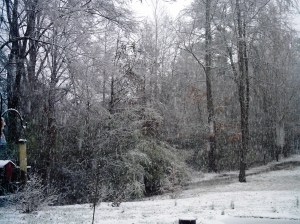
Six inches of snow are enough for officials to call a snow day for students throughout Jackson County, 50 miles northeast of Atlanta. Now, where did I leave that old set of studded snow tires?

Somebody on Twitter asked this morning how the snow is affecting us. So far so good as the power flickers from time to time rather than going out. Makes me glad we have APC surge protectors with battery backup for our computers.

There’s been more time to read. I just finished a review of Secret Son by Laila Lalami and am now reading Saara’s Passage by Karen Autio.

I’m giving some thought to clearing away some of these piles of paper that have drifted high along the counters and desk in my office and them seemingly frozen there even though each item seemed important when it was carefully added to the top of the clutter.

With no grocery shopping to do this morning (my usual Monday morning chore), I had more time to put out a fresh block of suet for the red bellied woodpecker who was, instead, pecking at the few remaining seeds in a feeder. The titmice and chickadees and cardinals now have a fresh storehouse of sunflower seeds. There are breadcrumbs out there for the bluejays. Crunching about in the frozen snow was certainly more relaxing than wheeling a cart up and down the aisles at the grocery.

Since I don’t have to commute several hours to work, I can enjoy our snow day, though I’m not enough of a kid to go outside and make any snow angels in the front yard.

Hero’s Journey Curriculum

4/18/20 UPDATE: The links are no longer working. One goes to a message that says the hero’s journey site is being updated. Don’t know how old that message is; if it’s been there for a while, perhaps that means this lesson plan is no longer being sold. If anyone knows, let me know in a comment. Thanks.

“Dating from before history, the Hero’s Journey duplicates the steps of the Rite of Passage and is a process of self-discovery and self-integration. The Hero’s Journey is a concept drawn from the depth psychology of Swiss psychologist Carl Jung and the scholar and mythologist Joseph Campbell, author of The Hero with a Thousand Faces.” — Nina Munteanu

The hero path, as postulated by Joseph Campbell in 1946, has not only proven to be a durable means of exploring mythic heroes but as a way of exploring great literature and our personal journeys. While adding additional hero’s path resources to the web site of my hero’s journey novel The Sun Singer, I re-discovered the Harris Communications site with its excellent Hero’s Journey Curriculum. Written by a teacher, this curriculum has been tested by years of experience as well as its usage in many school systems.

If I had kids in a K-12 environment, I’d use the curriculum in homeschooling or hope at least one of the public school teachers was using it. Whether you personally need the curriculum yourself or for your children’s teachers, the web site has many interesting articles and resources that show the positive impact of the hero’s journey ideals for children.

Hero's Journey
Hero\’s Journey

Publisher’s Description: The Hero’s Journey: A Guide to Literature and Life is a 184-page teacher’s manual designed to help instructors teach and use the hero’s journey pattern in class. The curriculum, which has been in print for 13 years, includes:

* Full lesson plans, with background notes and suggested approaches;
* Student projects and activities,
* Student handouts and graphic organizers,
* Samples and models for projects and activities
* Spiral bound to open flat for lecture or copying.
* Space for your own notes and plans

Click here for more information.

REVIEW “Faust” by E. A. Bucchianeri

Faust: My Soul be Damned for the World: Volume I Faust: My Soul be Damned for the World: Volume I by E.A. Bucchianeri

My review


rating: 4 of 5 stars
E. A. Bucchianeri describes her two-volume work on the back cover as “a comprehensive exploration of Dr. Faust, the man who sold his soul to the devil, and those who lived to tell his tale.”

“Comprehensive” is almost an understatement, for the scope and scholarship of this two-volume, large-format “Faust – My soul be damned for the world” is astonishing. Bucchianeri traces the evolution of the Faust legends and literature from the historical individual who called himself “Faustus” (c1466 – c1538) through early folktales and Christopher Marlowe’s drama “The Tragical History of Doctor Faustus” (1604) to Goethe’s closet drama “Faust: The Tragedy Part One” (1829) and “Faust: The Tragedy Part Two” (1832).

Clearly, the Faustian literature evolved with the times, and at each stage, Bucchianeri shows how the influences of the church, state, society and the education, upbringing and life experiences of the of the principal authors and commentators changed the intent and flavor of the legend. The Faust story, as Joseph L. Henderson notes in “Man and his Symbols” (Carl Jung, Ed.) dramatizes man’s battle with the dark or negative side of his personality, the “‘shadow’ figure that Goethe describes as ‘part of that power which, willing evil, finds the good.'”

One of the greatest strengths of Bucchianeri’s work is in its heavily documented presentation of the vast symbolism found throughout the multiple versions of the legend.

The historical Dr. Faustus, Faust books and folk tales, Marlowe’s drama with its “A and B texts,” the puppet plays, and Lessing’s unfinished drama comprise Volume I. At the outset, Bucchianeri writes, “Faust, the notorious reprobate who willingly forfeited his immortal soul to the devil in exchange of the fleeting illusory pleasures of the world as recounted in famous works of drama, literature, drama and music did not originate as the imaginary brainchild of a literary genius. A historical figure named ‘Faust’ did exist.”

Separating the historical personage from the folklore that quickly arose in letters, pamphlets and that individual’s own circulated exaggerations of his “powers”” requires careful research. “Faustus,” was the title/pseudonym used by Georg Helmstetter who was born in or near Heidelberg, Germany in the mid-1400s. He was an educated man and, according to reports, an accurate astrologer. His self-aggrandizing claims of dark-side occult powers and an association with the Devil gave rise to the initial folklore and popular Faust books.

Bucchianeri brings order to the documented facts about Christopher Marlowe’s contribution to the Faust legend during Elizabethan times. She writes that the poet and dramatist “recognized in the character of Faustus his personal cynicism in regard to the subject of religion and his ardent desire to accomplish great deeds in the world.”

Here, as with the Goethe material, the author ostensibly presents readers with a miniature biography of the dramatist as a means of demonstrating important themes in the resulting play. Marlowe’s difficult route to a college degree and his rebellious views and lifestyle play into his version of “Faust.”

Goethe worked on “Faust” throughout his lifetime. Like Marlowe, Goethe had deep and basic questions about religion. He brought to “Faust” his youthful, manic-depressive mood swings and a wealth of study into subjects including the greater and lesser mysteries, alchemy and freemasons as Bucchianeri shows in Volume II.

Written in an academic style, “Faust – My soul be damned for the world,” will be of especial interest to scholars as well as serious students of the Faust legends, Marlowe, and Goethe. The scope of work and impeccable research may, in fact, be definitive insofar as the development of the literary Faust is concerned.

Some readers will find the biographical detail about Marlowe and Goethe to be too lengthy, far exceeding that which is required to illustrate how their personalities and their lives and studies influenced their Faust dramas.

If a second edition of “Faust – My soul be damned for the world” is released, the work will be greatly strengthened by the addition of an introduction that explains how this work differs from earlier Faust literature, concise chapter summaries and additional subheads and sidebars to break up the ponderous sections of straight text, a biography showing the author’s credentials for writing the book, and a comprehensive index.

That said, this work is a labor of love that greatly adds to our understanding of the literary Faust as he grew with the changing times.

View all my reviews.

Oklahoma Panhandle Perfect Setting for Zabel’s New Novel

300-croppedVivian Zabel, author of Prairie Dog Cowboy joins us today to talk about the setting for her new novel published in October by 4RV Publishing. The 180-page book set in the Oklahoma Panhandle in 1899 is primarily intended for ages 9-12.
Buddy, the main character begins learning how to work a ranch when he’s just four years old. The work of a cowboy is in his blood and that’s what he wants to do when he grows up. A neighbor who believes in him makes him a promise: when you’re good enough to rope a prairie dog, you can have a job on my ranch.

I met Vivian on the Published Authors Forum. She’s a fellow contributor to the Forever Friends anthology published last year and the author of Midnight Hours and Case of the Missing Coach. I’m happy to welcome her to the Round Table.

The Prairie of Prairie Dog Cowboy
by Vivian Zabel

cowboy The setting for Prairie Dog Cowboy was fictionalized but exists in the Oklahoma Panhandle. The prairie runs from what is now northeast Oklahoma, the Texas Panhandle, and north into Kansas and Nebraska. The area is also considered part of the High Plains.

Many people think the panhandle is drab, ugly, and flat. Not so. Yes, a person may think the land is flat because few, if any hills, are found, but the land has unexpected valleys and gullies that contain green, living things.

The view is spectacular in its own way. I’ve stood outside the house where my husband grew up and looked “forever” in all directions. The sky bright and blue arched above my head. The horizon stretched at the edge of the skyline miles and miles away. At night, the stars against the black velvet of darkness seemed closer than in other places. The lights of towns twenty to thirty miles away could be seen without trouble.

The gullies, deep and rather narrow cuts in the land caused by wind and rain run-offs, often hide green grass when the land above is dry and grass is brown. Valleys, which are different than gullies in that they are usually wider and have more flood plain created by rivers, are filled with trees and lush plant life.

Along the roads, in pastures of prairie grass and man-induced plants, cattle graze, slick and fat. Fields of wheat or milo, sometimes corn, can be found creating breaks between thousands of acres of native pasture.

In the book, the ranches owned by the Hyman family and James Buck are found along the Beaver River. Much of the area used as the Buck ranch and a portion of the ranch used as the Hyman ranch were taken by the government to make Optima Lake and a reserve and hunting area. The land still exists though, cutting through the Oklahoma Panhandle prairie.

Buddy rode and worked the land that can still be found, rich and valuable, filled with hardworking people.

Prairie Dog Cowboy can be purchased through any book store, Amazon.com, Barnes and Noble.com, and/or 4RV Publishing.

Prairie Dog Cowboy
4RV Publishing
Vivian Gilbert Zabel

Note: anyone leaving a question or comment will be entered into a drawing to receive one (1) of four (4) canvas bags with a 4RV logo.

Review: “Burning Bright”

Burning Bright Burning Bright by Tracy Chevalier

My review


rating: 3 of 5 stars
London at the time of the French revolution takes center stage in this beautifully written novel featuring location and themes over plot. When craftsman Thomas Kellaway moves his wife Anne and teen-aged children Jem and Masie from the Piddle Valley in Dorset to London in March of 1792, they are all but overwhelmed by the contrasting grandeur and ugliness of the big city. Thomas hopes he can better support the family making chairs for the circus and Anne hopes distance will heal her tortured mind after the accidental death of their son Tommy.

Tracy Chevalier has drawn a deep and richly detailed portrait of London, especially the Borough of Lambeth where the noisy, dirty and boisterous lifestyle of the poor that differs so greatly from the quieter world of Dorset is accentuated when the circus comes to town.

Contrasts flow through the Kellaway’s lives as surely as the Thames flows through London, and here the author draws upon William Blake’s focus on “contraries,” or pairs of opposites, for the novel’s theme. London, in “Burning Bright” becomes an alchemist’s athanor wherein the Kellaways will undergo their transformations beneath the piercing gaze of Blake, the adept who applies his “Songs of Innocence” and “Songs of Experience” within the novel as Holy Scripture.

Blake serves as a catalyst within the story line, yet he is a one-dimensional character who primary speaks in philosophic riddles and quotes from his favorite poems. While Jem, Masie and their new, streetwise friend, Maggie, view the home of William and Kate Blake as calm sanctuary within a world where the trials of childhood are greatly magnified by the dangerous environment, the reader will come away having learned more about the Borough of Lambeth and than the famous poet and print maker.

Like her adult characters in “Burning Bright,” Chevalier appears unwilling to step past Blake’s fame, notoriety and fiery persona and confront the poet head on. Doing so would have brought closure to the novel for readers and characters alike. We have a well-crafted slice-of-life portrait of a rural family’s brief sojourn into the big city. What we don’t have is an overt look at what it finally meant to them.

View all my reviews.

The answer can be found in emptiness

“Buddhism often compares the perfect mind state to a desert. The term sunyata, or the emptiness of emptiness, is a state in which no thoughts exist, no time exists, and the mind is empty completely in order to receive what the universe has to offer.” —Nora Caron

We endlessly chatter to ourselves inside our heads–commentaries, expectations, remembrances of things past, what we plan to do tomorrow, what we’ll do tomorrow if certain problems were to arise.

How do we ever enjoy the now of each moment?

For writers, this chattering drowns out the voice of the muse; for mystics in meditation, the voice of the universe; for the faithful in prayer, the voice of God.

May I suggest that it is hard to learn anything new when the mind is focused on the old that we already know? In fact, our expectations pre-define our reality and our understanding of it rather than allowing space for spontaneity and truly new experiences.

The answers we’re looking for are more likely to occur to us only after we firmly tell that voice inside our heads to shut up.

Copyright (c) 2009 by Malcolm R. Campbell

Review: Women of Magdalene

Women of Magdalene Women of Magdalene by Rosemary Poole-Carter

My review


rating: 5 of 5 stars
My review from Powell’s Books:

“It’s easy to get in, but once there it is impossible to get out,” New York World reporter Nellie Bly wrote in her “Ten Days in a Mad House” expose about the poor conditions and mistreatment of patients at Blackwell’s Island asylum in New York in 1887. Deplorable by today’s standards, the approach to mental health then wasn’t far removed from the days when professionals considered the insane to be those suffering God’s punishment or the Devil’s possession.

The fictional Magdalene Ladies Lunatic Asylum in Rosemary Poole-Carter’s darkly beautiful novel fits perfectly into a time period when the treatment of female mentally ill patients was likely to be neither moral nor effective. Confinement was often a matter of convenience for the families of women viewed as domestic failures who were best kept out of sight and out of mind.

When young Civil War surgeon Dr. Robert Mallory arrives at the Louisiana institution for employment as general practitioner after the war, he soon sees that God and the world have forgotten the women of Magdalene, and the only devils on the premises are the asylum’s owner Dr. Kingston, his former assistant Dr. Hardy, and their dictatorial matron.

When Robert questions Kingston about the inhumane treatment of the women housed in the former plantation mansion, Kingston discounts Robert’s competence to judge what is right and proper in the realm of mental illness. Later, Robert will ask why no women are ever cured and allowed to leave the facility. Cures? There are no cures, only what Kingston describes without noticeable guile as “sanctuary.”

In Poole-Carter’s haunting, yet gritty prose, Magdalene floats almost dreamlike within a misshapen world of malaise and mist that will ultimately claim all who remain there–and for a high price. Robert, like the women, arrives at the asylum having been harmed by the world and with a growing expectation that he will be injured further by the methods and practices within the shelter of Magdalene’s walls.

This novel casts multiple spells over its readers and its characters. Readers with a growing understanding that the abuses at the fictional Magdalene were drawn from the world of standard abuses of the times, won’t be able to forget what they see there. As for Robert Mallory, in spite of his resolve, he’s not sure he can complete his personal journey out of the past and cure what ails Magdalene before he becomes yet another shadow alongside the old plantation’s dark river.

View all my reviews.

Note: Author Vivian Zabel will visit the Round Table on February 19th to discuss her novel Prairie Dog Cowboy.

Great Backyard Bird Count – coming soon

JOIN THE GREAT BACKYARD BIRD COUNT

Count for Fun, Count for the Future

New York, NY and Ithaca, NY—Bird and nature fans throughout North America are invited to join tens of thousands of everyday bird watchers for the 12th annual Great Backyard Bird Count (GBBC), February 13-16, 2009.

A joint project of the Cornell Lab of Ornithology and the National Audubon Society, this free event is an opportunity for families, students, and people of all ages to discover the wonders of nature in backyards, schoolyards, and local parks, and, at the same time, make an important contribution to conservation. Participants count birds and report their sightings online at www.birdcount.org.

“The Great Backyard Bird Count benefits both birds and people. It’s a great example of citizen science: Anyone who can identify even a few species can contribute to the body of knowledge that is used to inform conservation efforts to protect birds and biodiversity,” said Audubon Education VP, Judy Braus. “Families, teachers, children and all those who take part in GBBC get a chance to improve their observation skills, enjoy nature, and have a great time counting for fun, counting for the future.”

Anyone can take part, from novice bird watchers to experts, by counting birds for as little as 15 minutes (or as long as they wish) on one or more days of the event and reporting their sightings online at www.birdcount.org. Participants can also explore what birds others are finding in their backyards—whether in their own neighborhood or thousands of miles away. Additional online resources include tips to help identify birds, a photo gallery, and special materials for educators.

The data these “citizen scientists” collect helps researchers understand bird population trends, information that is critical for effective conservation. Their efforts enable everyone to see what would otherwise be impossible: a comprehensive picture of where birds are in late winter and how their numbers and distribution compare with previous years. In 2008, participants submitted more than 85,000 checklists.

“The GBBC has become a vital link in the arsenal of continent-wide bird-monitoring projects,” said Cornell Lab of Ornithology director, John Fitzpatrick. “With more than a decade of data now in hand, the GBBC has documented the fine-grained details of late-winter bird distributions better than any project in history, including some truly striking changes just over the past decade.”

Each year, in addition to entering their tallies, participants submit thousands of digital images for the GBBC photo contest. Many are featured in the popular online gallery. Participants in the 2009 count are also invited to upload their bird videos to YouTube; some will also be featured on the GBBC web site. Visit www.birdcount.org to learn more.

Businesses,  schools, nature clubs, Scout troops, and other community organizations interested in the GBBC can contact the Cornell Lab of Ornithology at (800) 843-2473 (outside the U.S., call (607) 254-2473), or Audubon at citizenscience@audubon.org or (202) 861-2242, Ext 3050.

The Great Backyard Bird Count is made possible, in part, by support from Wild Birds Unlimited.