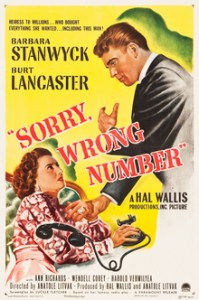
“For sheer, unadulterated terror there have been few films in recent years to match the quivering fright of Sorry, Wrong Number–and few performances to equal the hysteria-ridden picture of a woman doomed, as portrayed by Barbara Stanwyck.” — Cue Magazine.
My wife and I enjoy noir films. Fortunately, Turner Classic Movies (TCM) owns a lot of them and shows them frequently.
“Sorry, Wrong Number” began its life as a 1943 radio play written by Lucille Fletcher and starring Agnes Moorehead. When Fletcher was asked to expand her play into what became the 1948 feature film, Moorehead was considered a character actress and didn’t get the role. That went to Barbara Stanwyck who–in my view–turned in a stunning performance that received an Oscar nomination. Some critics thought the radio play was stronger due to the scenes that had to be added to bring the story up to feature film length. According to WNYC, “No less an authority than Orson Welles called it ‘the greatest single radio script ever written.’”
In short, a neurotic invalid (Stanwyck) accidentally overhears a phone conversation plotting her own murder. She’s bedridden and spends most of the movie on the phone trying to puzzle out the strange mix of conversations, callers, and busy signals. At one point Stanwyck is told to call a specific number for information about her husband and, after trying and not getting an answer, she asks the operator what the number goes to. The morgue, she’s told.
Of course, we wait for the line “Sorry, wrong number.” We wait a long time. When we finally hear it, it packs a punch. The suspense is off the scale and that’s what makes it a great noir film.
When I was five years old my parents, my two younger brothers, and I were traveling between adjacent states to visit relatives. We were in a hilly area when the tractor-trailer we were passing drifted into our lane to (apparently) pass a smaller car in front of it. In those days, it was common to honk the horn twice before passing, so the driver of the truck either didn’t hear our horn and/or didn’t check his side mirrors before starting to pass.
Our Nash was similar, though two years older, than the 1951 model shown here.
Mother honked the horn again. When the truck driver realized we were there, he overcorrected and ran off the road to the right, rolling over and over through a rough field. Our car didn’t come into contact with the truck. We stopped. Somebody called the highway patrol, and I remember sitting for ages in our car on the road’s shoulder while the police talked to my parents and checked on the truck far across the field.
Apparently, drivers in other cars confirmed what happened, so we were finally allowed to leave. My only memory of the conversation was the officer’s comment that the kids didn’t need to be punished by having to sit in a hot car any longer. At the time, I didn’t like his use of the word “punished.”
I don’t remember my parents ever mentioning the accident in my presence after we left. At the time, of course, in this pre-seatbelt era, I had no concept of the condition of the people in the truck. By the time I seriously thought about it, my parents had died and my brothers have no memory of the incident. I have no idea why I didn’t think about the accident, say, while in high school or college, and ask my parents about it. I’m certain though that if one or more occupants in the truck were killed, my parents wouldn’t have told me. They concealed the worst of the past from us.
Online searches have yielded nothing either in public records or newspaper accounts. And yet I wonder, decades after the accident, about what happened to the people in that truck. Perhaps it’s best not to know, though I don’t think so.
–Malcolm
Malcolm R. Campbell is the author of magical realism novels including “Fate’s Arrows.”
“The fashion calendar has four main seasons: Spring/Summer (SS), Autumn/Winter (AW), Resort/Cruise and Pre-Fall. The first two are the main runway seasons presented at fashion weeks, and the latter inter-seasonal collections have been introduced to bridge the gaps between the main two seasons and introduce newness more frequently.” – Retail Dogma
I don’t have the money, the inclination, or the sense of style to wear the “proper” clothes for the official fashion seasons. So, I have no need for an expert to help me do a twice-a-year “closet swap” to keep what I’m supposed to be wearing easy to pull off the hangar. I have clothes for two seasons of the year stored at opposing ends of the closet, flannel season and denim season.
The flannel season begins when things (the weather, letters from the feds, people’s expressions) get frosty, i.e. about November 1. Denim season begins in the spring whenever the hell that turns out to be. Flannel comes from places like Land’s End and L. L. Bean. My wife finds denim jeans and shirts (always Wrangler) at various online sites now that I can no longer shop at Sears.
I’m currently wearing this “Men’s Scotch Plaid Flannel Shirt” from L. L. Bean. This is a buffalo plaid and one of my favorites in addition to the Stewart and Campbell plaids. I probably wear the Campbell “Black Watch” pattern the most because it is, after all, the family’s colours.
Now these shirts serve as light-weight jackets, though when I lived in northern Illinois, they needed multiple layers of additional jackets on top to be somewhat warm. One didn’t worry too much about fashion when commuting an hour to work on show-covered Chicago freeways, mainly the Edens.
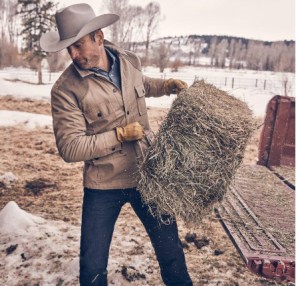
Denim season ended on Hallowe’en. I know the Levi name is famous, but Wranger, which came on the scene in 1947, fits better for those who work rather than those who want to look like they work. Seriously, Wranglers are much better than Levis if you like horses. Wrangler advertises its denim with this picture which–trying to be modest here–looks like me.
Suffice it to say, Wrangler clothes are tough and functional. According to the company’s website, “Wrangler® is enduring American freedom; it’s in the spirit of people who work hard, have fun and recognize courageous individuality. As a company, we believe in solid commitments and perseverance in the face of obstacles and challenges. Most of all, we respect ourselves, each other, our western heritage and the environment in which we live.”
So there it is flannel and denim. There’s nothing else I need in my closet.
“A torch song is a sentimental love song, typically one in which the singer laments an unrequited or lost love, either where one party is oblivious to the existence of the other, where one party has moved on, or where a romantic affair has affected the relationship. The term comes from the saying, ‘to carry a torch for someone,’ or to keep aflame the light of an unrequited love. It was first used by the cabaret singer Tommy Lyman in his praise of ‘My Melancholy Baby.'” – Wikipedia
Torch singers appeared in supper clubs featuring music and dancing and were often shown in movies with such clubs. I loved torch songs whether it was Patsy Cline singing “Crazy,” Billie Holiday singing “Solitude,” or Dale Storm singing “Dark Moon.” My family wasn’t affluent enough to go to supper clubs or adventurous enough to go to the better dive bars, so my exposure to torch singers came exclusively through movies, records, and the singers’ TV appearances.
1948 photo
Though I was a big fan of Patsy Cline, when it came to torch singers, my favorite was Julie London who had an active singing career (32 albums) up until the late 1960s. She recorded “Motherless Child,” “Don’t Worry About Me,” “A Foggy Day,” and many other standards. As her sultry, contralto voice began to falter, she turned to acting in movies (“Man of the West,” “The Wonderful Country”) and television (“The Julie London Show, “The Big Valley.”)
She appeared as head nurse Dixie McCall throughout the entire 122-episode run of the action-adventure drama “Emergency!” from 1972 to 1977. The series focuses on the paramedics, firemen, and hospital support staff, showing (I think) a more accurate look at firefighting techniques than shows like “Chicago Fire.” London’s second husband Bobby Troup (to her right in the photo) was also in the cast. The show was produced by her first husband Jack Webb. Like London, Troup came from the music business.
I’ve had fun watching the currently available “Emergency!” reruns via the DISH Network and appreciate the style and presence she brings to the role even though it’s a bit difficult to stop seeing London as a sexy torch singer.
First, I’ll leave Andy Borowitz’s satircal column in the New Yorker out of that point of view. He’s a pro and manages to keep turning out good stuff.
Most of my satirical books disappeared when my former publisher suddenly closed without assiging the rights to its authors works to the authors.
Otherwise, I find that a lot of the real news sounds like satire (and might be) or is too grim to satirize. Even if it were funny, satire aboud the Israeli war in Gaza and the latest mass shooting would be in very poor taste.
I tended to write satire about the parts of government I don’t like, the TSA and Homeland Security, for example. The most fun-to-write satire (for me) took something the government was actually doing and maded it worse than it was–assuming that was possible.
But now I find most of the news so grim, it’s hard to place a humorous spin on it. That’s too bad because satire has been a time-honored method of poking fun at inept leaders and their policies. “MAD Magazine” was a favorite of mine when I was in highschool. Even better was “Punch Magazine” (1841 – 1992 with a short-lived revival between 1996 and 2002) from Britain. I found it amusing even thouh I was never really up to dte about British politics.
I’m also a fan of France’s Charlie Hebdo which features work that’s a bit edgy.
The Shakespeare plays are filled with statire, lines that work within the context of the story and also poke at the existing monarchy. My favorite comes from Hamlet in the lines: “The play’s the thing/ Wherein I’ll catch the conscience of the king.”
In satire, we’re always trying to catch the conscience of the king or the president or the head of some agency.
To my mind, government lends itself to satire because it’s so inept at everything. That’s my Libertaian point of view. Like Jonathan Swift, we all want to write a modest proposal.
Many of those who know he’s the suspect in the Lewiston, Maine mass shooting on October 25 in which eighteen people were killed and thirteen were injured probably don’t want him to survive. I guess the people who think that way think his death “evens things out.”
Hardly.
There have been 487 mass shootings in the U.S. this year with 571 dead and 1,947 injuries. You don’t need a complicated equation to see that the country is averaging over one shooting per day. While I’m against the ownership of military-style weapons by civilians because they greatly increase the number of casualties, I think the issue is larger than too many guns.
Are we bored with the problem yet? Perhaps because as individuals we’re apparently powerless to stop the epidemic short of bashing the NRA which, while not surprising, hasn’t solved the problem of why this is happening.
According to Everytown Research, “Mass shootings haunt our nation’s collective conscience. Each breaking news alert floods the nation with grief, fear, and anger at the countless acts of preventable violence happening in schools, churches, parks, supermarkets, and other places where people are going about their everyday lives.”
True, but hardly earthshaking.
The Pew Research Center provides a lot of statistics for analysis, but they are more WHAT than WHY. Likewise, the Violence Project. Numerous other Internet sites provide simiar stats.
An EFSGV report states thatm “More than two-thirds of mass shootings are domestic violence incidents or are perpetrated by shooters with a history of domestic violence, according to one of the first peer-reviewed research papers exploring the links between domestic violence (DV) and mass” Okay, there’s a clue, but where does it lead us?
Dr. Jillian Peterson says “Perpetrators tend to be radicalized through studying other shooters before them. Many of them spend time on the internet in kind of these dark chat rooms where violence is really celebrated and validated. And then they go into this act knowing it’s their final act. So they’re kind of actively suicidal, planning to die in the act. They have access to the firearms that they need. And many of them leak their plans. Many of them tell other people they’re thinking about violence before they do it. And then they go out and they choose a location that’s symbolic of their grievance with the world because they’re looking for this fame and notoriety in their death that they didn’t have in their life.”
Helpful to know as is the entire interview. What frustrates me, and perhaps others is that the statistics don’t lead us to an answer, and neither do the best analyses of what’s happening and how we can stop it. That is, we can’t go out an arrest everyone who can get a gun, who has a grievance, who has mental issues, who comes from a dysfuntional family, or who is simply pissed off at the world or his/her workplace.
So, we’re stuck watching it happen like a bad movie without an ending. The shootings make many of us feel powerless less and perhaps that’s the way the killers feel.
Goodness knows, he left enough on the front porch. He must have slacked off when we didn’t bring them into the house and fry them up with sawmill gravy. I swept them off into the yard hoping they’d serve as warnings to new rats moving into the area.
Apparently not.
So as time went by, the rats that did not heed the dead in the yard and set up housekeeping in the crawl space and caused $2,500 worth of damage.
I guess we should have crawled around down there more often. Or at least once. But there was no appeal to that, so we didn’t. The exterminators are under the house now. Better them than me. It’s almost worth $2,500 to never go in there.
The exterminator protects the house against termites. So how the guys stumbled across the rat infestation, I don’t know. Fortunately, no rats got into the main part of the house. And maybe as part of our crawl space investment, they (the exterminators) will post “warning signs” to keep new uninvited guests out of the place.
My tip to you–part of my lifelong learning experience–is if you have a crawl space, crawl inside from time to time. Make it a hobby.
–Malcolm
When Malcolm isn’t writing magical realism or posts about rats, he’s writing satire.
“Stretching 380,000 acres from the Beaverhead Valley through the Blacktail Range and into the Centennial Valley, the Matador is teeming with wildlife, cold trout streams, and healthy soil and grasslands. A working ranch, caring for 12,000 head of cattle outside of Dillon, Montana, Matador Ranch and Cattle is a fusion of the former Beaverhead and Selkirk Ranches, Matador Ranch and Cattle is honored to uphold and enhance the high standards in agricultural and environmental practices while advancing new and innovative projects on the ground.” – Matador Ranch website
From the Publisher
“A Montana Cowboy. A Large Corporation. A Clash of Values.
“When Ray was hired on to the Matador cowboy crew in 1974, his youthful dreams came true. Montana’s sprawling Matador Cattle Company ranch had genuine cow camps, horses galore, and thousands of cattle. The 240,000-acre ranch, owned since 1951 by Koch Industries Inc., was known internally as the Beaverhead Ranch.
“Beyond his dreams, Ray would manage the productive ranch for twenty-one years as it expanded to over 530 square miles of prime Montana ranch land and open space. As ranch manager, Ray led Montana’s Matador to new heights of environmental and economic excellence. What happened in 2011, as he approached the finish line of a stellar career is staggering.
“Woven throughout this memoir of family, faith, and work are nuggets of wisdom and valuable secrets for students planning a corporate career in ranching or corporate management. This true story will appeal to lovers of the American West, history fans, ranchers, and anyone who ever wanted to be a cowboy.”
This 352-page book was published in August 2022 by Raymond Marxer
About the Author
Marxer
“Ray Marxer, a 4th-generation Montana agricultural producer, worked 37 years for Koch Industries, Inc. on the massive Matador Cattle Company ranch in southwest Montana. As Ranch Manager for 21 of those years, Ray’s innovative approach to business guided the ranch to consistent annual profit and a record 11-year tenure average for employees.
“Environmental achievements led to numerous stewardship awards. Six national-level awards included the National Cattleman’s Beef Association Environmental Stewardship Award and the International Association of Fish and Wildlife Agencies Private Lands Stewardship Award.
“Ray served on several Governor-appointed boards for wildlife, land use, and animal health, as well as many organizational committees and boards. He runs a few cows in his retirement, in addition to his consulting and artificial insemination business, Ranch Services West.
“Ray’s passion, superseded only by his faith and family, is for the heritage of the American West, as well as providing help and encouragement to aspiring ranch producers.”
Montana Standard Review
The reader soon realizes the author is a rancher to his core. Clues include observations that horses are one of God’s greatest gifts to mankind and that carefully crossbred cows possess beautiful udders.
The reader recognizes that the author has managed a massive cattle ranch for a distant corporation when he writes about the often unwelcome dictates passed down by dudes in suits from Koch Industries in Kansas.
Ray Marxer’s recently self-published book, “Cowboy in a Corporate World,” corrals a diverse herd of ranching anecdotes, facts, triumphs and struggles, along with testimonies about religious faith and more into 246 pages.
The book is clearly written, easy to follow and features photos from Susan Marxer, the author’s wife.
When I was in college, the wine hidden in dorm rooms and under the seats of our cars was usually Mateus. This rose wine from Portugal came on the scene in 1942 and was a part of rapidly developing wine markets in the U.S., U.K., and elsewhere. It’s a nostalgic drink for my generation now, though I haven’t had rose wine for years.
According to the Wikipedia entry, “Sogrape, the family company which owns the brand and which is the largest wine producer in Portugal, has more recently diversified into other areas of the Portuguese wine industry, as the popularity of its Mateus brand has declined. In the UK in 2002, the wine was re-packaged and relaunched in a deliberate effort to capitalise on 1970s nostalgia, although the wine itself had already been made less sweet and slightly more sparkling, in response to modern popular preference for slightly drier wine. The wine continues to be sold, however, in its distinctive narrow-necked, flask-shaped bottle, with unique “baroque historic mansion” label (Mateus Palace in Vila Real, Portugal) and real cork stopper, but also comes with a screw top from some distributors in Northern European countries and the U.K. market.”
“We” saw drinking people in groups: the Mateus group, the Budweiser group, and the bourbon group. We seldom mixed people from the non-wine groups because–how do I say this?–they had no culture and brains the size of raisins. Most of us grew up and decided that rose wines were pretty much like Kool-Aid. After a brief flirtation with Christian Brothers Napa Rose, we left wine for beer and cocktails because those were “adult” drinks, and becoming adults seemed like an important rite of passage.
Now I drink wine or Scotch because they require no mixing and no expensive selection of the supplies needed for cocktails. And when I drink wine, it’s always dark red. But when I think of the wonder years, I recall Mateus as a part of growing up.
One of the best vacations we ever had was a trip to Rhinelander, Wisconsin where some friends of my Illinois grandparents owned some cabins on nearby Pelican Lake. We spent most of our time swimming or trying to catch a Pike or a Musky. We came back with a lot of crappies while the big fish illuded us. We were warned not to stay out on the lake after dark because we might end up as bait for a fearsome home Hodag.
I mean, who the hell wanted to confront that? We always brought to boat back to the cabins before sunset. Years ago, a group of us were chewing the fat at a north Georgia museum when the guy from Wisconsin said he wished he were sitting in a boat in the middle of Pelican Lake fishing for pike. We said we’d done that, too. He thought we were making it up until we mentioned the Hodag.
It was apparently discovered in 1893. According to Rhinelander’s website, “An expanded edition of “Fantastic Beasts and Where to Find Them”—the book about the magical creatures that populate the Harry Potter series, supposedly written by famed magizoologist Newt Scamander—was released in 2017 and included an entry on the Hodag. Scamander’s description of the Hodag matches previous accounts, identifying the creature as roughly the size of a large dog and horned with a frog-like head and glowing, red eyes. The book’s entry also says that “like the Snallygaster, the Hodag is a North American creature whose antics have excited considerable Muggle interest and curiosity.” (Ain’t that the truth?)
We knew he wasn’t making this up.
No doubt the cabins are long gone. But they make for fond memories of spending time with a couple who loved the lake, the fishing, the chipmunks that ran wild and could be tempted with peanuts we dangled on strings, and even the “monster” hiding out there in the dark. In all ways, the place was heaven and I have always wished that a ripple in the space-time continuum would make it possible to go back.
Maybe the Hodag would meet us for a couple of Pabst Blue Ribbon beers at the annual Hodag festival. Now that would be something to write home about.
–Malcolm
Malcolm R. Campbell is the author of the Florida Folk Magic Series which, sad to say, has no Hodags in it.
 “For sheer, unadulterated terror there have been few films in recent years to match the quivering fright of Sorry, Wrong Number–and few performances to equal the hysteria-ridden picture of a woman doomed, as portrayed by Barbara Stanwyck.” — Cue Magazine.
 When I was five years old my parents, my two younger brothers, and I were traveling between adjacent states to visit relatives. We were in a hilly area when the tractor-trailer we were passing drifted into our lane to (apparently) pass a smaller car in front of it. In those days, it was common to honk the horn twice before passing, so the driver of the truck either didn’t hear our horn and/or didn’t check his side mirrors before starting to pass.
 I’m currently wearing this “Men’s Scotch Plaid Flannel Shirt” from L. L. Bean. This is a buffalo plaid and one of my favorites in addition to the Stewart and Campbell plaids. I probably wear the Campbell “Black Watch” pattern the most because it is, after all, the family’s colours.
 Denim season ended on Hallowe’en. I know the Levi name is famous, but Wranger, which came on the scene in 1947, fits better for those who work rather than those who want to look like they work. Seriously, Wranglers are much better than Levis if you like horses. Wrangler advertises its denim with this picture which–trying to be modest here–looks like me.
 She appeared as head nurse Dixie McCall throughout the entire 122-episode run of the action-adventure drama “Emergency!” from 1972 to 1977. The series focuses on the paramedics, firemen, and hospital support staff, showing (I think) a more accurate look at firefighting techniques than shows like “Chicago Fire.” London’s second husband Bobby Troup (to her right in the photo) was also in the cast. The show was produced by her first husband Jack Webb. Like London, Troup came from the music business.
 But now I find most of the news so grim, it’s hard to place a humorous spin on it. That’s too bad because satire has been a time-honored method of poking fun at inept leaders and their policies. “MAD Magazine” was a favorite of mine when I was in highschool. Even better was “Punch Magazine” (1841 – 1992 with a short-lived revival between 1996 and 2002) from Britain. I found it amusing even thouh I was never really up to dte about British politics.
 I’m also a fan of France’s Charlie Hebdo which features work that’s a bit edgy.
 Goodness knows, he left enough on the front porch. He must have slacked off when we didn’t bring them into the house and fry them up with sawmill gravy. I swept them off into the yard hoping they’d serve as warnings to new rats moving into the area.


 When I was in college, the wine hidden in dorm rooms and under the seats of our cars was usually Mateus. This rose wine from Portugal came on the scene in 1942 and was a part of rapidly developing wine markets in the U.S., U.K., and elsewhere. It’s a nostalgic drink for my generation now, though I haven’t had rose wine for years.
 No doubt the cabins are long gone. But they make for fond memories of spending time with a couple who loved the lake, the fishing, the chipmunks that ran wild and could be tempted with peanuts we dangled on strings, and even the “monster” hiding out there in the dark. In all ways, the place was heaven and I have always wished that a ripple in the space-time continuum would make it possible to go back.
 Malcolm's Round Table