This rainy Sunday morning

“Let the rain kiss you. Let the rain beat upon your head with silver liquid drops. Let the rain sing you a lullaby.” – Langston Hughes

“Rainy days should be spent at home with a cup of tea and a good book.”  – Bill Watterson

Generally speaking, rain is good. Unless there’s too much of it. Unless it appears on the day scheduled for a picnic, a hike, an outdoor wedding, or perhaps a war.
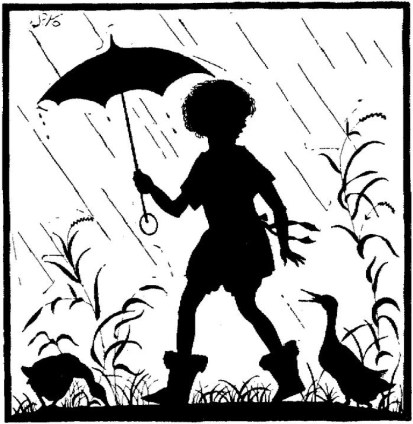
Jupiter Images graphic

None of those activities were penciled into this morning’s calendar, so I’m writing and reading (with coffee rather than tea) with the sound of its lullaby. Perhaps I’ll doze in my chair. That can happen. I probably won’t go outside and walk in it or ride a bike in it–aiming for the best puddles on the road–because I don’t do that any more, though I probably should.

As usual, the morning news is filled with discouraging words, mostly plots within plots, and–to roughly paraphase Victor Hugo–the deaf keeping the blind informed. The rain washes all of that away for a while. Perhaps I’m dozing in my chair now, dreaming about writing a post that mentions rain and the deaf leading the blind. If only.

If you’re inclined to love magic, you probably have noticed that rivers, oceans, and rain facilitate intuition, communication with Spirit, and writing letters or novels about magical moments. I write better on rainy days and Mondays than when the sun is out. On rainy days, one can dream without falling asleep, the perfect prescription for poets, novelists, mystics, and lovers.

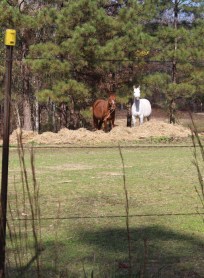
The two horses at the farm across the road are munching grass up near the fence line. I’m tempted to walk over there and give each of them a wet apple and scratch their wet-horse-smelling heads. But my wife has saved the few remaining apples in the bowl for a pie and I really don’t want to have to explain where they went. Nonetheless, the horses are part of the rainy morning and it’s a comfort seeing them there, dreaming perhaps whatever horses dream in the medium of water.

John Updike wrote somewhere that “Rain is grace; rain is the sky descending to the earth.” Yes it is. When I was young, I collected rainwater for my aquariums, mother collected it for her gentle plants, years ago people saved it in cisterns as a defense against droughts. Conjure woman collect rainwater for spell work. Farmers and gardeners pray for it before everything they care about dries up. Rain is both a prayer and an answer to prayer. As some say, rain is good medicine.

When the worst flood in recent history hit northwestern Montana in June 1964, a Blackfeet elder was quoted as saying the deluge was too much good medicine. I was there and I remember that rain and thought of it as Mother Nature on drugs or, as one newspaper headlined, “Mother Nature Turns Outlaw.” Floods tend to give rain a bad name until the next drought. There’s no lullaby or kiss in a flood.

The creek below our house floods one of the two roads into town when there’s too much rain. I’m not sure what the cows think of that. I drive my old Buick through it because that’s an adult’s way of remembering what it was to be a kid on a bike in a rain storm. I’m no longer a fan of muddy trousers and shoes, so I tend to stay away from fields of standing water unless the cows get out and then when it comes down to it, getting wet no longer matters until we’re done chasing and herding all of the cattle back inside their fences. You haven’t lived a complete life until you’ve chased black cattle on a black rainy night. Cattle will make a fair mess of your yard if they get into it during a rain storm. I don’t see any magic in that.

But this morning, the cattle are inside the fence because the fence is relatively new and sturdy and follows the rise and fall of the land perfectly enough to cover over the places where cows shinnied under the barbed wire or jumped over it. So, this morning I’m content with my coffee and books without having to check outside ever once in a while to see how many of the cows are on the road stopping traffic.

It’s been a comfortable morning for lullabies and dreams and for dozing in a chair while pretending to read a book.


Malcolm 


The tale of two literary forums (updated 02/07/19)

If you were out on the Internet in the 1980s, you probably remember that CompuServe was a major ISP, providing e-mail and forums for millions of users. In those days, almost every hi-tech company, whether hardware or software, had a forum staffed in part by representatives of the company to help people with bugs, usage issues, and other information. In addition to these forums, CompuServe also maintained forums for pets, religion, political discussions, hobbies, and literature.

Jupiter Images art

The forums all provided discussions in threads–originally in a DOS/non-graphic mode–that looked sort of like the outline-style comments on many blogs as well as on Facebook posts. As CompuServe (which became part of AOL) lost market share over time, these forums dwindled in number so that on December 14th when the remaining forums were shut down by CompuServe’s parent (a Verizon subsidiary), there were relatively few forums left compared to the old lineup.

In the late 1980s and early 1990s, I was a regular participant on CompuServe’s Literary Forum. That name was later changed to Books and Writers. Those who participated in the forum in those days had a rare treat, seeing the birth of now-bestselling author Diana Gabaldon’s Outlander series. In those days, she was a very active participant and helped many of us get our start in the writing business. She answered questions from everything from craft issues to publication and promotion issues. While her active participation seemed reduced to me due to her busier schedule, she was still on the forum when CompuServe pulled the plug this month.

Like many early participants, I was lured away from the forum by the more cutting-edge software at MySpace and then Facebook. Also, the software at CompuServe’s forums changed so that when you replied to a comment, your reply was no longer posted beneath the message you were responding to, but at the end of the thread. For me, that made navigation a punishing task. Plus, many of the people I knew there when I was a regular had drifted away, and so I had less incentive to go there as fewer and fewer people knew me. My personal opinion was that the staff had become a bit heavy handed, though others didn’t see it that way.

Now, there are two forums to choose from

  1. The management of the former CompuServe forum, that is to say, the forum’s contract holder and the staff members (called Sysops and Section Leaders) changed the name back to Literary Forum. You can find it here: http://www.thelitforum.com/
  2. Meanwhile, a group of former-participants at the CompuServe forum who disagreed with various of the forum’s policies, started its own Literary Forum. You can find it here: https://forumania.com/      This screen is a landing page for multiple forums, one of which is Literary Forum with a button to click on to go to the forum. UPDATE: This forum has closed.

Both forums are new. So there are probably software issues still to be worked out. The first forum listed here has more posts because they apparently were able to bring over posts from CompuServe. The Forumania Literary Forum doesn’t have a fan base and has fewer discussions to involve yourself with. I am a participant in both forums, but have a strong preference for the new Literary forum on Forumania.

Both forums require you to create an account if you want to respond to posts or start your own threads. Both are free. Both forums offer sections (groupings of threads) that will appeal to many readers and writers. There are discussions of current books, genres, the writing craft, and promotional matters.

I invite you to look at each of them, learn how they are organized, and see if you can find a niche there that fits your preferences for talking about the books you’re reading and/or the books you’re writing and promoting. Unfortunately, neither forum has been able for afford software that places responses to threads in the order they’re posted. I figure that if Facebook and WordPress can display responses in an outline form, everyone ought to be able to do it–and CompuServe knew how to do it decades ago. So navigation isn’t as user friendly at either place as it is at other websites.

However, I received a lot of writing help and inspiration at the original Literary Forum when I was starting out. Perhaps you’ll find this kind of help at one of these literary forums as well. They are worth the time and effort and a good place to make some new online friends.

–Malcolm

Malcolm R. Campbell is the author of magical realism, paranormal, and contemporary fantasy novels and short stories, many from Thomas-Jacob Publishing.


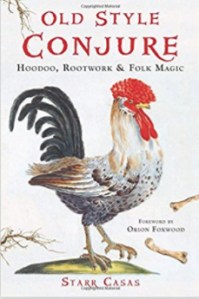
Briefly Noted: ‘Old Style Conjure’ by Starr Casas

Those who know Mama Starr Casas from her Old Style Conjure website, need no introduction to this practical guidebook published in September. Like her website commentaries, it’s blunt, practical, based on the culture she grew up in, and overviews works (spells) and approaches in an easy to understand manner. The book reminds us that conjure (hoodoo, rootwork) is directly linked to African American ancestors, the Christian Bible, and common sense approaches to magic based on the materials at hand in a typical Southern household.

Conjure workers are usually Christian. I like Casas’ statement, “If you remove the Bible from Old Style Conjure work then what you are doing really isn’t Conjure work! It then becomes something else. If you can hold the greatest Conjure book ever written in your hands and learn the power from it; why in the world would you let anyone stop you?” She also doesn’t agree with people who mix hoodoo with other forms of magic in a roll-your-own approach.

Publisher’s Description:

Conjure, hoodoo, rootwork―these are all names for southern American folk magic. Conjure first emerged in the days of slavery and plantations and is widely considered among the most potent forms of magic. Its popularity continues to increase, both in the United States and worldwide. This book is a guide to using conjure to achieve love, success, safety, prosperity, and spiritual fulfillment. Author Starr Casas, a hereditary master of the art, introduces readers to the history and philosophy of conjure and provides practical information for using it. Featuring Casas’s own rituals, spells, and home recipes, the book provides useful information suitable for novices and seasoned practitioners alike.

In its pages, you’ll learn about:

  • Bone reading
  • Candle burning
  • Conjure bags
  • Building your own conjure altar

Research or Practical Use

This book is readable and should be very helpful to those who are interested in folk magic as an avocation, want to try out spell work themselves, or are fascinated by the history and culture of hoodoo. Students of magic will also enjoy the inspirational forward by Orion Foxwood.

–Malcolm

Malcolm R. Campbell is the author of two hoodoo novels, “Conjure Woman’s Cat” and “Eulalie and Washerwoman.”

Book Bits: Robert Hastings, Saudi Theaters, Psychobabble,’Spy of the First Person’, Roy Moore

My Facebook author’s page has been hogging many of the authors and publishers links that I used to include in my Boot Bits feature. I won’t promise to fix that until the cows come home, but for now, here are a few links:

  1. Obituary: Robert Hastings – “Robert Hastings, publisher at Black Spring Press, died November 30, the Bookseller reported. He was 52. Hastings founded Black Spring Press in 1985 to “breathe new life into neglected classics.” Its first publication was a reprint of Anais Nin’s D.H. Lawrence: An Unprofessional Study, and the press subsequently produced work by Julian Mclaren-Ross, Patrick Hamilton, Nick Cave, Charles Baudelaire, Kyril Bonfiglioli, Carolyn Cassady and Leonard Cohen, among others.” Shelf-Awareness
  2. New TitleThe Dangerous Power of Psychobabble: Ramblings of a Disillusioned Psychotherapist, by Rae Franklin – In this self-help book, Rae Franklin, a retired state-licensed, nationally certified psychotherapist, dives in headfirst to deconstruct five of the most destructive psychological myths permeating modern-day society. In the midst of her deconstruction, she offers pointers for raising psychologically healthy children and tips for healing ourselves.
  3. QuotationI always felt and still feel that fairy tales have an emotional truth that is so deep that there are few things that really rival them. – Alice Hoffman
  4. Film News: Saudi Arabia is lifting a 35-year ban on movie theaters, and Twitter is thrilled, by Jarrett Lyons – After decades of being banned from Saudi Arabia, national authorities have announced that movie theaters will once again be allowed in its borders in a landmark decision. – Salon
  5. Book Review: ‘Spy of the First Person,’ Sam Shepard’s poignant goodbye, comes to the page, by Jocelyn McClurg – “It’s hard to think of an affliction crueler than ALS, or Lou Gehrig’s disease, a neurodegenerative disorder that, over time, renders its victims helpless. And so there’s something beautiful about the slender, cryptic, almost hallucinatory volume of prose that Pulitzer Prize-winning playwright and actor Sam Shepard, who died of ALS complications at age 73 on July 27, left behind as an epitaph.” USA Today
  6. Journalism: How Washington Post journalists broke the story of allegations against Roy Moore, by Libby Casey – “Post reporters Stephanie McCrummen and Beth Reinhard describe how the story started with on-the-ground reporting in Alabama and locals in the Gadsden area sharing memories about Moore’s past. Through dozens of interviews and weeks of fact-checking, what started as a tip became a story that could shake an election.” The Washington Post
  7. Interview: Judith Flanders (Christmas: A Biography), with Lily McLemore – “Ultimately, my research showed that Christmas isn’t so much wrapped up in nostalgia, as nostalgia is a major part of the holiday. It is a way of creating a collective illusion that life was once better—an illusion we need, one that lets us believe we can get back to that state once more.” – Book Page
  8. PublishingLittle Brown Scrambling to Meet ‘Obama: An Intimate Portrait’ Demand, by Jim Milliot – “One of the early hot books of the holiday shopping seasons appears to be Obama: An Intimate Portrait by Pete Souza, the White House photographer during Obama’s two terms. The $35 hardcover, published by Little, Brown, features hundreds of photographs plus a foreword by the former President.” Publishers Weekly
  9. Writing Tips: Is It Too Late to Start Writing After 50?, by Julie Rosenberg – “Today, I am over age 50 with a full-time career in a demanding corporate role. It may seem to some like far from the ideal time to write a book. In fact, several family members and friends told me that I was nothing short of crazy when I mentioned my book idea.” Jane Friedman
  10. Feature Story: Adam Gopnik: ‘You’re waltzing along and suddenly you’re portrayed as a monster of privilege’, by Hadley Freeman – “The New Yorker essayist on his latest memoir, At the Strangers’ Gate, and the problem of writing about happiness.” The Guardian

Book Bits is compiled randomly by Malcolm R. Campbell, author of magical realism, contemporary fantasy, and paranormal short stories and novels.


Me, Too – New York City, June 1967

“I’d like to scrape up some sense of triumph over the fact that many courageous women have raised their voices. But I don’t feel triumphant. I feel humiliated and angry. They hate us. That’s my immediate thought, with each new revelation: They hate us. And then, a more sick-making suspicion: They don’t care about us enough to hate us. We are simply a form of livestock.” – Gillian Flynn in “A Howl”

What I have to say after fifty years of silence is relatively insignificant when contrasted with what many courageous women have lived with and finally come forward as the true silence breakers–as Time Magazine calls them–to tell us about the verbal and physical sexual harassment they suffered through.

Grand Central Station – Wikipedia Photo.

Some women have been asked why they didn’t speak out sooner. Quite often, they feared for their safety, their careers, and for the blame and condemnation that society would bestow upon them as insult on top of injury. Many, I think, can echo Gillian Flynn’s statement, “I feel humiliated and angry.” That’s how felt after a smaller event in 1967.

During my summer break at Syracuse University, I took the New York Central train from Syracuse to New York City’s Grand Central Station. I’d been at the midtown Manhattan station before, knew my way around, and understood that it’s best in big cities to walk with a sense of purpose rather than standing around like a greenhorn who doesn’t know where he is or where he’s going. I was headed for Europe for volunteer work and planned to have breakfast and then grab a cab to the National Council of Churches office on Riverside Drive.

When I got off the train with my suitcase, an African American man in his late 30s appeared, grabbed by suitcase, and said, “I’ll help you figure out where you are.” I assumed he was a thief or a tout from a nearby hotel. I’ve always had fast reflexes. Before he could take a step, I grabbed the suitcase handle. He didn’t remove his hand, choosing to continue the side-by-side contact of our hands and looked me in the eye in a way I didn’t like.

“What are you seeking?” he asked.

“Breakfast,” I said.

He let go of the suitcase, saying, “Follow me out on the street and I’ll point out a place with the second best eggs and bacon in the city.”

I was surprised when he simply pointed to a restaurant a half a block away and disappeared into the crowd.  The encounter seemed odd, but I put it out of my mind as I went inside the place–I no longer remember the name–and saw that it was typical New York, efficient, brusque, and carried the aroma of great food. I found a booth so I’d have a place to stash my suitcase, glanced at the menu for a nanosecond before a waitress appeared and said, “Yeah?” I have no idea what I ordered: bacon, eggs and hash browns, probably, because before the food arrived, the guy from the train station showed up, slid into my side of the booth like we were together, and asked what I’d ordered. When I told him, he said that wasn’t bad, but that he could fix me something better at his apartment a few blocks away.

Had my coffee arrived, I would have done a spit take and showered him with coffee.

“Why would I do that?” I asked.

“Because I want to make love to you?”

“My girl wouldn’t approve. I wouldn’t either.”

He laughed the way people laugh when they think they’ve heard a falsehood.

“Why didn’t this girl of yours meet your train?”

“She’s at work.”

“Where?”

“Riverside Drive.”

“High class girl. What’s she look like?”

The waitress set down my meal and fled the scene with a frown that gave me little confidence she’d kill the guy while I escaped out the backdoor.

“Catherine Deneuve,” I said, because I had a crush on the actress.

“Can’t compete with that,” he said, fetching a piece of bacon off my plate. He was sitting closer than necessary. In fact, there was no space between us and his arm was behind me on the back of the booth.

“Nobody can. Go find an easier mark at the train station.”

He acted like I’d plunged a knife into his heart, a thought that crossed my mind, and then we argued as I tried to eat my breakfast while he became a lawyer, so to speak, claiming that a guy like me couldn’t possibly have a girl who looked like Catherine Deneuve.

Finally, he said, “I say it’s because I’m black and have a bigger dick than you’ve ever seen in your life. You want to run but you don’t.”

“I have no interest in men.”

“Ever tried one?”

“I don’t need to try a collie dog to know that there’s no future for Lassie and me.”

He put his hand on my thigh. “You need it bad. Here you are in the big city with a fake girl friend on Riverside drive and no place to lie down. I bet you don’t even have a hotel reservation.”

“The Woodstock,” I said, mentioning a reasonable place that had apparently gone down hill since my family stayed there some ten years earlier.

He seemed surprised to hear the name of an actual hotel. “That dump? Don’t make me laugh.”

“Get your hand off me.”

“You want it there. I can see that.”

I shoved the remains of my breakfast away, caught the waitress’ eye, and handed her enough to cover the meal and the tip. When he didn’t leave the booth, I pushed him away, got my suitcase and left the restaurant. I went to the first cab in the queue and when the driver came out and put my suitcase in the trunk, he asked, “where we headed?”

“475 Riverside Drive,” I said.

There he was, hovering next to line of taxis. “I guess you weren’t shitting me about Riverside,” he said. “Your loss.”

I ignored him even though he was holding on to the frame of the open window. I felt like telling the driver something out of the movies, “We’re being followed. Can you do something about it?” But I just let him drive away at his own speed because I was already wondering what I could have possibly done to attract this guy in the first place and how I could have gotten rid of him sooner.

Well, he was soon going to be a world away from me and out of mind. I sailed for Europe on an Italian ship the following day, happy to see he hadn’t come aboard. The summer in Europe captured my thoughts, but he remained in the background as a  haunting specter whom I still wonder about from a day I felt humiliated and vulnerable.

–Malcolm


Nobody cares: my SPAM queue is empty

When I log on, I normally see a WordPress notice that says there are 100000000000 messages in your SPAM queue. Basically, I think that if a spammer does such a poor job trying to comment on one of my posts that his/her comment ends up in the SPAM queue, s/he is sending substandard SPAM. But today, the queue was empty.

I felt so alone, discounted maybe. Perhaps spammers are boycotting my blog because they go in the SPAM queue where their efforts are all for nothing.

Here are some examples of the kinds of wonders I usually find in the queue:

  • I notice that you need some interesting posts in this blog. Get posts from our software and you’ll never write another one. (Hey clown, have you noticed that I’m a writer and can hardly call attention to my work by using canned posts?)
  • Date Russian babes. (My wife doesn’t allow me to date Russian babes.)
  • Try this safe and effective Viagra substitute for a stunning 15-hour erection. (If I go into the gigolo business and/or start dating multiple Russian babes, I’ll let you know. Don’t call me, I’ll call you–yeah, right.)
  • Our off-grid investment plan is so effective and private that only 10% of our clients end up in jail for money laundering. (I hope those clients weren’t using too much bleach.)
  • I’m going to bookmark this post so I can come back and read it again. (Please don’t.)
  • Free burial insurance without having to list preexisting conditions. Many of our clients have been dead for weeks before a well-meaning relative forges their signature on the application. We guarantee that only 10% of our clients wind up in the wrong grave yard. (Tempting, but no.)
  • We’re selling real SPAM at a discount. This week, 50% off “SPAM® with Portuguese Sausage Seasoning” that normally sells for $3.50. Free “Wood SPAM® Brand Piggy Cutting Board” with every thousand dollars you order. (Okay, you’re Hormel Foods trying a new marketing approach, right?)
  • Scientists have proven it’s now safe to brush your teeth with Saniflush if you don’t use it 100 times a day. We have a warehouse full of the stuff we snapped up when the brand was discontinued, and that means a deal for you. (No.)
  • New home security system test. Our pros will attempt to break into your house to see if your system works. If you don’t see us, your system failed. If you do, your system is effective. Send $1000 and your address along with the typical times of day when nobody’s home. (You guys work for SNL right?”)
  • Guard your Internet connection from fake news. Download our $56.00 virus and you’ll never see another phony news story again. (Will I see any more SPAM?)

If your comments ever end up in my SPAM queue, try again, you know, if you feel lucky.

–Malcolm

Malcolm is the author of the satirical crime novel “Jock Stewart and the Missing Sea of Fire.” (Only 10% of his readers go nuts before getting to the end up this novel.)

Should our fiction focus more on why you should beware of those you love?

“Stay away from the ones you love too much. Those are the ones who will kill you.” – Donna Tartt, The Goldfinch

“You’re more likely to be hurt or killed by someone you know or love. And you’ll probably be at home when it happens.” – Mother Jones Magazine

“Over half of the killings of American women are related to intimate partner violence, with the vast majority of the victims dying at the hands of a current or former romantic partner” – The Atlantic

“Over the past 10 years, more than 20,000 American children are believed to have been killed in their own homes by family members. That is nearly four times the number of US soldiers killed in Iraq and Afghanistan.” – SPCC

As I look at articles written for and about writers and their work these days, the focus of late seems to be mirroring the political issues debated in the press, in Congress, in churches, and in social media.  I am seeing more essays, poems, and short stories by writers who–like everyone else–are trying to make sense of environmental problems, personal rights, racial issues, economic imbalances, health care priorities, terrorism, immigration, and religion as it impacts governmental policies.

Some writers write to figure stuff out: the resulting poem or short story might help readers figure stuff out. And if the writer is good, this can be done without making the poem or story sound like a political tract or a news release from a social service organization. It’s been said that many people learn more history from well-written historical novels than they do from the basic history courses they were required to take in high school and college? Why? The drama of the story catches their attention. The same can be said about fiction that focuses on the issues of the day.

For those of us who haven’t yet become immune to the horrors reported in the daily news, the quotes at the beginning of this post are shocking. The thing is, most news stories about family-related abuse and murder focus on one family or one person. So, while the numbers of the dead, dying, and traumatized continue to add up through the calendar year, nothing focuses our attention on them with high amount of impact of terrorist shootings such as 58 people killed and 546 injured at the Las Vegas Harvest music festival on October 1.

We lost our innocence a long time ago, those of us who–as children–believed that the world would be better off by the time we grew up than it has turned out to be. We believed in Superman and other heroes who would find ways to prevent every potential Las Vegas horror without infringing on our liberties. And we believed in the power of churches, laws, social service institutions, education, and the general evolution of society to end the abuse and murder of family members, especially women and children.

So here we are today, focused on terrorism–which we seriously do need to sanely address–while deaths and injuries of family members stack up like cord wood with fewer headlines to remind us that those we love are more likely to hurt us or kill us than a terrorist or some other thug on the streets. I’ve seen novels and poems about this, but not enough. It’s easier to find novels about fighting terrorism than fighting child and spousal abuse. I’m not surprised: after all, a government security contractor that isn’t bound by the rules governing police/FBI fighting a group that wants to blow up Washington, D. C. is more likely to be a bestseller than a novel about a woman who keeps calling the local police department with fears about what her husband might do.

We can do better, I think. We can look at family-oriented abuse and murder and–perhaps, first–join nonprofit groups that are fighting it and educating the public about it. But writers can take another step. They can experiment with themes and plots and characters and find compelling ways to tell stories about individuals who are–so to speak–living in hell next door while we focus on people caught up in the national news miles away. We need writers creating short stories, essays, memoirs, and poetry about this as a means of figuring out why it’s happening, and of reminding readers that it’s happening closer than they think.

–Malcolm

News: Free book and a new title

For your consideration when you’re looking for something to read:

  • Mountain Song is free on Kindle December 2 and 3: David Ward lives in the Montana mountains where his life was impacted by his medicine woman grandmother and his utilitarian grandfather. Anne Hill suffered through childhood abuse and ultimately moved in with her aunt on the edge of a Florida swamp. Their summer romance at a mountain resort hotel surprises both of them. But can they make it last after the initial passion wears off and they return to their college studies far apart from each other especially after an attack on a college street changes Anne forever?
  • Quotation: “After a while, the characters I’m writing begin to feel real to me. That’s when I know I’m heading in the right direction.” – Alice Hoffman
  • A Shallow River of Mercy, a new title from Robert Hays, released December 1 by Thomas-Jacob PublishingErnst Kohl has spent nearly half his life in prison after being convicted of murder as a young man. Upon his release, with nowhere else to go, Kohl returns to his old family home on the outskirts of a small Michigan town, hoping for redemption, or at least understanding. He finds a dog, a girlfriend, and a job in quick succession, and it seems as if he might finally be able to leave the past behind and make a quiet life for himself. But some of the residents, including the town’s corrupt deputy sheriff, are less than thrilled to see him, and will stop at nothing to rid the town of its infamous resident. As events hurtle to an inevitable conclusion, Kohl is left to decide: At what point might a man break, and at what cost to himself? 
  • Thanksgiving: I hope all of you had a wonderful Thanksgiving or–if needed–survived the relatives. We enjoyed a nice visit with my brother and his wife who drove up from Florida, shared wine and food and a thousand-piece puzzle, and provided a lot of great conversation. The lights and wreath went up (not by themselves) on the front door today while inside we’re wrapping gifts to hand over to the post office, hopefully for delivery.
Malcolm

Walking off Thanksgiving dinner

According to statistics–which I don’t feel like looking up right now–Americans are generally heavier than they should be. And, we don’t get enough exercise (which is probably one reason we’re heavier than we should be).

I live in the country with an office on the front of the house, giving me a front row seat on the road where a lot of people walk, ride bikes, ride horses, and sometimes walk their dogs while they (the dog owners) ride horses while holding onto long leashes connected to the dogs. We have an old house sitting on the far end of the property and it still has a separate mailbox. I made a vow two years ago to walk down there to check the mail a couple of times a week. I’ve done that once or twice, preferring to use the riding mower to save time. It’s a good thing that vow wasn’t a formal resolution or a promise to Santa Claus.
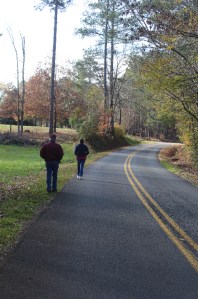
My brother and his wife take walks several times a week. Fortunately, they do this in central Florida so that I don’t get trapped into participating in their bad habits. They walk (who knows where) away from the house for 25 minutes. Then they walk home for 25 more minutes. During that time I can eat an entire box of Kispy Kreme doughnuts. Trouble is, when they visit us for Thanksgiving, they continue this notorious walking hobby and want me to go with them. This past week, they walked four times, conning me into going on two of them.

Talk about tired. I suppose I could claim it was “a good tired” and that I should feel virtuous. On the the plus side, it (the walk) burnt off calories. According to my brother and this wife, calories are bad. I tried to point out to them (my brother and his wife) that I’ve been slowly losing weight for the past year using a mind control/positive thinking program that didn’t require walking along country roads where everyone’s dog barks at you and speeding pickup trucks almost knock people into the ditch.

We’re lucky to be alive.

They (my brother and his wife) set a fast pace. Even the trucks have to go into overdrive to get around us. If you’re paranoid while walking in the country, you’ll get worse because every cow and horse along the route is going to be staring at you. I’m not sure just why four, puny little humans should be a threat to an entire herd of heavy black Angus cattle, but all those eyes focus on us until we’re out of sight and out of mind. Those eyes watch us again on our way home. And the same dogs come racing out to the highway thinking, “WTF, I thought I chased those clowns away 25 minutes ago.”

One dog chased us for 15 minutes, disappearing into the woods again and again and then lunging out at new spots to take us by surprise. His owner was chasing him, ticked off–by the expression on her face–that we dared walk by her place and disturb the 200 dogs they have there keeping watch on things.

We had plenty of Thanksgiving food to eat along with some Scuppernong wine, but I’m in the clear because I walked it off. I’m seeing a lot of whining on Facebook from people who suddenly gained 25 pounds last Thursday afternoon. They’re on treadmills when they’re not heading off (in their cars) to the gym. Poor bastards.

–Malcolm


Linking Book Editions on Amazon’s Author Central

In case you’re not aware, Amazon’s Author Central is a FREE service. If you missed our very first tutorial on setting it up, see that HERE. If you haven’t already, read it. Do it. Then come right back here and I’ll show you how to merge your books. I heard that grumble. Yes, you need to merge your books. Here’s why.

via How to Link Book Editions on Amazon’s Author Central ‹ Indies Unlimited ‹ Reader — WordPress.com

Here’s a handy tip for using Author’s Central. If you’re an author and don’t have an Amazon author’s page, you’re missing a free opportunity for publicity. The page displays when a prospective reader clicks on your name on any of your book’s listings. The page not only shows readers all your books, but bio information and your latest blog post.

Naturally, as K. S. Brooks suggests, if you have multiple editions of a book, it helps to link them together on the page.

–Malcolm