PEN AMERICA AND HIGH-PROFILE SUPPORTERS, CALL FOR RELEASE OF NARGES MOHAMMADI AHEAD OF NOBEL PEACE PRIZE AWARD CEREMONY

FOR IMMEDIATE RELEASE

Click on this graphic to sign the open letter

(NEW YORK) – Hundreds of the world’s most prominent writers, artists, human rights activists, allies, and civil society organizations have signed on to an open letter created by PEN America calling for the immediate release of jailed Iranian human rights activist and writer Narges Mohammadi prior to the Nobel Peace Prize ceremony, scheduled to be held in Oslo on December 10.

“Narges’ story is one of extraordinary courage in the face of adversity, making her name synonymous with the fight for human rights in Iran. Her experience underscores the global struggles for free expression and women’s equality and serves as a stark reminder of the heavy price that dissidents and activists pay in the name of freedom and equal rights,” the PEN America open letter says.

The letter, signed by more than 250 writers and allies, including Abraham Verghese, Arundhati Roy, Azar Nafisi, Emma Thompson, George Saunders, Khaled Hosseini, John Green, Kylie Moore-Gilbert, Margaret Atwood, Mary Karr, Nazanin Boniadi, Sandra Cisneros, and Viet Thanh Nguyen; fellow Nobel Laureates Shirin Ebadi, J.M. Coetzee, and Orhan Pamuk; and at least 40 civil society organizations, including Freedom House, Frontline Defenders, Human Rights Watch, the Center for Human Rights in Iran, PEN International, and more than 30 PEN Centers from around the world. Mohammadi, the 2023 Nobel Peace Prize laureate, was honored with PEN America’s 2023 PEN/Barbey Freedom to Write Award in May.

Mohammadi, 51, is currently being held in Evin Prison, where she is serving multiple politically-motivated sentences totaling more than three decades. Over the years, she has been subject to numerous ordeals, including abusive treatment in custody, prolonged periods in solitary confinement, and enforced separation from her immediate family, including a ban on phone contact with her husband and teenage children. Mohammadi, who suffers from both heart and pulmonary issues, is regularly subjected to serious medical neglect, prompting her to undertake a 3-day hunger strike in early November after she was denied urgently needed medical care as a result of her refusal to wear a hijab.

Signatories demand Mohammadi be released before December 10 and allowed to travel to Oslo for the Nobel Peace Prize award ceremony, where she would be united with her family. The letter closes with a “call on the international community to urgently press for Narges Mohammadi’s release. It is a moral imperative to prioritize human rights over political considerations and to advocate for the freedom of those who use their voices to defy tyranny and to champion justice and equality. Narges’ continued imprisonment is not just a violation of her rights but a stark reminder of the extent of the brutal persecution still faced by political dissidents and human rights defenders in Iran and around the world today.”

New House Rules Representatives Must Be Smarter Than Their Constituencies

Washington, D.C., November 27, 2023, Star-Gazer News Service–On a vote of 1-0 here today, the House of Representatives has mandated that no state may send any man, woman, or pet as its representative to Congress who has a lower IQ than the average IQ of the state’s population.

Immediately after the new rule was passed, half of  California’s fifty-two house members were called home where they were urged to go to night school or barber college.

According to the assistant interim chairman of the House Rules Committee, Homer Simpson, “Democracy is not served by seating members who are dumb as a post based on the results of a  Wechsler Adult Intelligence Scale (WAIS) test.”

According to the Department of Intelligence,  most California Congressmen and Women scored between 70 and 84 on the standard test while most posts scored 85.

The American Civil Liberties Union immediately filed suit, claiming that “stupid people have rights even though nobody’s sure what they are.”

According to Simpson, California is known for passing the strangest state laws in the country, but from now on out, it will be required to keep the nonsense at home.”

Several states have already inquired about sending fence posts as representatives since posts will almost always be smarter than the general population except in Nevada. The request is under review by the few remaining Congressmen and Women after “the big purge.”
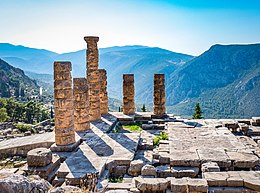
A White House spokesperson said that the new rules would, unfortunately, impact blue states more than red states since blue states are usually “off the deep end” when crafting meaningful legislation. 

“We deserve smart people leading us even if we have to brainwash them,” Simpson said.

–Jock Stewart, Special Investigative Reporter


‘Know thyself, and thou shalt know the universe and the gods.’

This statement, which is inscribed at the Temple of Apollo at Delphi is said to have originated with Thales of Miletus (c. 626/623  – c. 548/545 BC) who was purportedly one of the “Seven Sages” who served Apollo. He is credited with being the first philosopher to rely on natural science rather than myths and legends to explain ourselves and our world. His interests ranged from math to astronomy to engineering to meteorology.
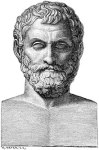
According to Wikipedia, Aristotle said, “Thales thought “all things are full of gods”, i.e. lodestones had souls, because iron is attracted to them (by the force of magnetism). The same applied to amber for its capacity to generate static electricity. The reasoning for such hylozoism or organicism seems to be if something moved, then it was alive, and if it was alive, then it must have a soul. As well as gods seen in the movement caused by what came to be known as magnetism and electricity, it seems Thales also had a supreme God which structured the universe: “Thales”, says Cicero, “assures that water is the principle of all things; and that God is that Mind which shaped and created all things from water.”

I’m not a philosopher, more of a shade-tree mechanic who tinkers with the simpler parts of the universe and hopes he gets the wires hooked up right.  That said, I’ve never run across a more important admonition than “Know thyself, and thou shalt know the universe and the gods.” We are, I believe, the keys to the kingdom, the eyes that look out on creation and–over many lifetimes, perhaps–will grasp the importance and the meaning behind the curtain imposed on the scene by day-to-day life. Believing this is not a prideful thing, but a humbling look at what is given us to understand–when we finally learn how.

So, we begin with ourselves and look outward–or perhaps inward–from there until we are privileged to see and understand that, as the Huna mysticism of Hawai’i believes, there is nothing that is not God. Fortunately, we don’t start with the “big picture” and work our way back to ourselves. We start with us, an entity we should be able to one day understand.

So, we start with knowing ourselves. A tall order, really, but something we can fathom after years of effort. We can do his. Look in the mirror and you’ll see where the universe begins.

–Malcolm

If you weren’t a writer, what would you be?

When I’m interviewed, I dislike interviewers who don’t know anything about me and read through a list of lame questions they probably use for all writers. I won’t play that game, so I try to derail it as soon as I hear the first stupid question.

Book Blogger: If you weren’t a writer, what would you be?

Me: Lying drunk in a gutter on the south side of Chicago down where Mickelberry’s Log Cabin Restaurant used to be.

BB: (Those who aren’t listening move on to the next question but a few rephrase the question.) No, seriously what would you be doing?

Me: Working as a feature film leading man while dating Helen Mirren.

BB: Oh, wow, what a life that would have been.

Me: Helen liked it. So did I–until Liam Neeson came along.

BB: Oh, wow, so when did the writing start?

Me: When Liam Neeson came along and “Readers Digest” offered me a boatload of cash to write about who was doing it with whom in Hollywood.  I used a pseudonym because anyone who told that story under his own name would have ended up wherever Judge Crater ended up when he disappeared in 1930. Actually, his picture rather messes up this post, but such is life. Anyhow, nobody ever knew I wrote the “tell-all” about everyone in or near Hollywood.

BB: Do you know where Judge Crater is?

Me: Dead.

I dislike the “what would you be” question because inept interviewers usually save it for writers when they would get better interview material if they asked a mobster how he got into the business. Most of the mobsters I know really wanted to teach kindergarten, but the family won out career-wise.

Great Northern Empire Builder at Glacier Park

But nobody asks the head of a funeral parlor, the desk sergeant at the local precinct, or the guys busting into the house during a home invasion what careers they wish they had. If you must know, I wanted to work for the Great Northern/Burlington  Northern/BNSF railway, but that doesn’t grab as many headlines as talking about Hellen Mirren even though it’s the closest I can come to telling you the truth.

Quite likely, most of us don’t know what we’d be doing if we weren’t doing what we’re doing. So don’t ask because most of us will lie to you.

–Malcolm

I don’t have to tell you what an adze is, do I?

In a recent episode of “The Curse of Oak Island,” a core drilling machine brought up a large piece of wood that team members said looked like it had been shaped by an adze. I was amused to see a little graphic and description of an adze as though the tool isn’t commonly known. Okay, if you were born yesterday or a few days before, you probably haven’t been allowed to use an adze. They are not as common as they were when I was young, so maybe you see “adze” as a handy word or use in a crossword puzzle or a scrabble game.

We had at least one adze, a relatively small one about 1/4 the size as the one in the graphic, in our garage used for scraping wood when the size of the job was much too big for using a plane. The adze in the graphic might be your tool of choice if you were in Scouting and were making a canoe from scratch.

Times change so fast that I guess I shouldn’t be surprised at the tools we used years ago that a lot of people don’t use now or have never heard of. Wikipedia says that “Modern adzes are made from steel with wooden handles, and enjoy limited use: occasionally in semi-industrial areas, but particularly by “revivalists” such as those at the Colonial Williamsburg cultural center in Virginia, United States. However, the traditional adze has largely been replaced by the sawmill and the powered-plane, at least in industrialized cultures. It remains in use for some specialist crafts, for example by coopers. Adzes are also in current use by artists such as Northwest Coast American and Canadian Indigenous sculptors doing pole work, masks, and bowls.”

When my brothers and I were little, my grandfather made things out of wood, so we were used to well-tended tools that could be found on a farm or in any woodworking operation. I’m happy to see that you can still buy an adze at Home Depot even though they are calling it a “forged hoe” though it appears when I search for “Adze.”
I guess you could use it as a hoe, but that would incur my grandfather’s wrath as he shouted, “Go get a maddock.” You know what that is, right? My brothers learned early on to use tools for what they were intended rather than making do with the wrong thing–like using a wrench as a hammer.

I think I need a drink.

–Malcolm

Celebrating Thanksgiving but not Black Friday

“Lord, we cleared this land. We plowed it, sowed it, and harvest it. We cook the harvest. It wouldn’t be here and we wouldn’t be eating it if we hadn’t done it all ourselves. We worked dog-bone hard for every crumb and morsel, but we thank you Lord just the same for the food we’re about to eat, amen.” – Jimmy Stewart as Charlie Anderson in “Shenandoah.”

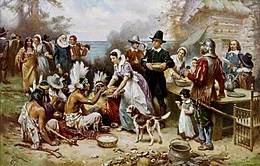
Everyone was dressed in the wrong clothes and the table wasn’t there.

Sad to say, a lot of people think like Charlie Anderson in the 1965 film and don’t know who or what to thank on this day.  Thanksgiving is a harvest festival that might have been first celebrated in 1621 by the Pilgrims and the Wampanoag Nation.  The idea still seems fine even though most of us have little to do with the production of crops and see the day as a time spent with family.

Black Friday casts a pall over the holiday because it traditionally marks the Christman shopping season where we all rush out and buy what nobody really wants other than to brag we got it cheap. Every major holiday is sulled up by turning into a commercial farce.

This is a sad Thanksgiving for my wife and me because we normally visit my daughter, her husband, and my two granddaughters on Thanksgiving, but illness is keeping us away.

In many ways, Thanksgiving bothers me because–assuming the first celebration happened as history and legend tell us, the hope and thanks of those days turned into a nightmare for the country’s indigenous people that is still going on today. So, the first Thanksgiving is rather like going over to some new friends’ house and then killing them after dinner and stealing the house.

But never mind that since most of us have spent many memorable days with family and friends eating a wonderful meal (not counting family members we normally try to avoid), and eating until the football games begin and we fall asleep on first and goal.

Mother often noted when my two brothers and I were growing up, that the meal took hours to make, fifteen minutes to eat, and another hour for cleaning up the kitchen. I still like the turkey drumstick best in spite of the bones in it. And as far as I know, I’ve never touched Stove Top Stuffing. My wife and I make our own and it’s do much better than the mysterious stuff that comes out of a box.

But, I digress. I hope we remember what this holiday celebrates.

–Malcolm

Remembering Peter Matthiessen

After mentioning a favorite of mine, Peter Matthiessen (May 22, 1927 – April 5, 2014) in yesterday’s post about The Land’s Wild Music, I thought, “Why not talk to Peter, see how he’s doing, find out who he likes in the college football bowl matchups, &c.” Easier said than done. It took me several hours to find my Ouija board. It was under the bed with my Radio Flyer wagon, an old baseball glove, and assorted monsters.

He was happy to have a little conversation and to let me now that he now sees two or three snow leopards every day, something he hoped for in his trek through the Tibetian Plateu in the 1973 with biologist George Shaller, recounted in his 1978 book The Snow Leopard. I’ve read a lot of Matthiessen’s work, but always return to The Snow Leopard as my favorite, winner of the National Book Award in 1979. The current edition has an introduction by Pico Iyer which is fine, but which I skip when reading old classics that are new to me.

I don’t want any help or advice when reading such words as these from the book: “The secret of the mountain is that the mountains simply exist, as I do myself: the mountains exist simply, which I do not. The mountains have no “meaning,” they are meaning; the mountains are. The sun is round. I ring with life, and the mountains ring, and when I can hear it, there is a ringing that we share. I understand all this, not in my mind but in my heart, knowing how meaningless it is to try to capture what cannot be expressed, knowing that mere words will remain when I read it all again, another day.”

I also especially liked At Play in the Fields of the Lord, Blue Meridian, African Silences, Far Tortuga, and In the Spirit of Crazy Horse.  As for the last book on my list, Wikipedia says, “Shortly after the 1983 publication of In the Spirit of Crazy Horse, Matthiessen and his publisher Viking Penguin were sued for libel by David Price, a Federal Bureau of Investigation agent, and William J. Janklow, the former South Dakota governor. The plaintiffs sought over $49 million in damages; Janklow also sued to have all copies of the book withdrawn from bookstores. After four years of litigation, Federal District Court Judge Diana E. Murphy dismissed Price’s lawsuit, upholding Matthiessen’s ‘freedom to develop a thesis, conduct research in an effort to support the thesis, and to publish an entirely one-sided view of people and events.’ In the Janklow case, a South Dakota court also ruled for Matthiessen. Both cases were appealed. In 1990, the Supreme Court refused to hear Price’s arguments, effectively ending his appeal. The South Dakota Supreme Court dismissed Janklow’s case the same year. With the lawsuits concluded, the paperback edition of the book was finally published in 1992.”

The book focuses on Leoard Peltier’s 1977 murder conviction for purportedly killing two FBI agents during the agency’s misguided attack on the American Indian Movement. I followed the case and agreed with Matthiessen’s assessment. Peltier is still in prison. I don’t think he should be.
Wikipedia writes: “In 2008, at age 81, Matthiessen received the National Book Award for Fiction for Shadow Country, a one-volume, 890-page revision of his three novels set in frontier Florida that had been published in the 1990s. According to critic Michael Dirda, ‘No one writes more lyrically [than Matthiessen] about animals or describes more movingly the spiritual experience of mountaintops, savannas, and the sea.'” I agree.

–Malcolm

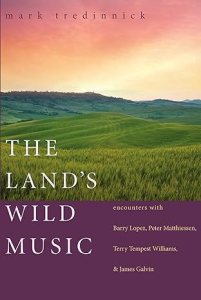
‘The Land’s Wild Music: Encounters with Barry Lopez, Peter Matthiessen, Terry Tempest Williams, and James Galvin’ by  Mark Tredinnick 

I should have read this book sooner because I would like to talk to Barry Lopez (via Ouija Board), Peter Matthiessen (same Ouija board), James Galvin, and Terry Tempest Williams. And also, I like the wild music the land sings to us when we walk slowly and listen. The awareness one finds when listening to Earth’s music and, perhaps, the Creator’s music is what I was talking about in yesterday’s post about “gnosis.” That music is more difficult to hear inside a building, no matter how sacred the structure.

From the Publisher

“‘The Land’s Wild Music’ explores the home terrains and the writing of four great American writers of place―Barry Lopez, Peter Matthiessen, Terry Tempest Williams, and James Galvin. In their work and its relationship with their home places, Tredinnick, an Australian writer, searches for answers to such questions such as whether it’s possible for a writer to make an authentic witness of a place; how one captures the landscape as it truly is; and how one joins the place in witness so that its lyric becomes one’s own and enters into one’s own work. He asks what it might mean to enact an ecological imagination of the world and whether it might be possible to see the work―and the writer―as part of the place itself. The work is a meditation on the nature of landscape and its power to shape the lives and syntax of men and women. It is animated by the author’s encounters with Lopez, Matthiessen, Williams, and Galvin, by critical readings of their work, and by the author’s engagement with the landscapes that have shaped these writers and their writing―the Cascades, Long Island, the Colorado Plateau, and the high prairies of the Rocky Mountains. Tredinnick seeks “the spring of nature writing deep in the nature of a place itself, carried in a writer’s wild self inside and resonated over and over again at the desk until it is a work in which the place itself sings.”

About the Author

Mark Tredinnick is an essayist, poet, and writing teacher. He is the author of The Blue Plateau: A Landscape Memoir and the editor of A Place on Earth: An Anthology of Nature Writing from Australia and North America. His essays and journalism have appeared in Island, ISLE, Orion, Resurgence, the Bulletin, and the Sydney Morning Herald. Winner of the 2005 Wildcare Tasmania Nature Writing Prize, Tredinnick lives in the highlands southwest of Sydney, Australia.

–Malcolm

Gnosis

When some people think of religious gnostics, they consider the 12th-century Cathars in Europe who, among other things, believed in truth that came from awareness rather than through the dogma of a hierarchy. The Catholic Church, by edict of Pope Innocent III–who seems to me to be very un-innocent–wiped out this group in 1229 through the genocidal Albigensian Crusade. Rome wanted a hierarchy with engraved-in-stone rules and anything else was called a heresy.

I interpret gnosis as awareness and think that those of us who think that awareness makes more sense that a hierarchy of preachers often get bad PR because people are quick to list the other beliefs of the Cathars which seem very strange to me.  If you watched the TV show “The Waltons” you may remember that the father didn’t feel his beliefs came from a church but through contemplation within nature. I feel the same way.

My distrust of authority included that of the church fathers–the elders and the deacons in the Presbyterian Church where I grew up. Sunday school and vacation Bible school teachers found me a challenge because I thought every person should find the truth in his/her own way and not through the promptings of teachers and pastors.

I was proud of the pastor of our church for threatening to leave if the church did not allow African Americans to attend. The church elders did not fight him on this, and we had a good many African Americans who came, (a) to see if they could, and (b) to see what was happening. Most did not come back because (if I may say so myself, Presbyterians are the most boring of all denominations) “nothing was happening.” They invited us to their church which presented an exciting experience!

At any rate, the Sunday school and Vacation Bible school teachers didn’t want me in their classes because they knew I was “trouble.” My poor parents heard more of their “concern” than I did, their son, for example, saying that the doctrine of predestination was preposterous. I said if the doctrine was true, we were all going to Heaven or Hell no matter what we did because our fate was already decided. The teachers had no answer for that. Now, I think the Presbyterians have moved away from that belief.

My teachers said I came to class to learn how to act within the scope of Christian beliefs. I said I already knew that and didn’t need another person presuming to tell me. That never went well. I maintained that we were taught to pray and to listen for a response. What more could we need?

And like John Walton on the long-running TV show, I found more answers in nature than in a building where I was told what to think and believe.  That’s gnosis and it combines with mysticism for individual transformation and knowledge.

–Malcolm