“So what was it like to have a story go viral? For a few hours, before I came to my senses and shut down my computer, I got to live the dream and the nightmare of knowing exactly what people thought when they read what I’d written, as well as what they thought about me. A torrent of unvarnished, unpolished opinion was delivered directly to my eyes and my brain. That thousands—and, eventually, millions—of readers had liked the story, identified with it, been affected by it, exhorted others to read it, didn’t make this any easier to take. The story was not autobiographical, but it was, nonetheless, personal—everything I write is personal—and here were all these strangers dissecting it, dismissing it, judging it, fighting about it, joking about it, and moving on.”
Most authors hope this will happen to one of their articles, short stories, or blog posts because they have been working for years as a virtual unknown writing what reviewers and friends tell them is good stuff even though none of that good stuff sells well on Kindle or anywhere else.
We don’t think about the flip side. Do we really want the world peering through our online windows asking who the hell we are, why the hell we wrote what we wrote, and what exactly was the whole point of it?
When a writer’s novel suddenly becomes a bestseller, the old joke is that s/he is an overnight sensation that was years in the making. That his to say, the public discovered the writer today even though s/he has a resume full of books written over a decade or more that few people noticed.
The dangers of things going viral are, I think, greater with a magazine article or a short story because even if the primary version appears in print, the online version will have a link that makes it easy to access and read quickly in its entirety–as opposed to a 400-page novel. Suddenly, everything about the author and his/her piece is all over the Internet and people are saying this sucks or this is great. Yes, writers dream about becoming known, seeing their work sell, and actually earning a living off their efforts.
I’m not sure going viral as Kristen Roupenian describes in her article is the way I’d want to go. How about you? If you write a short story that does viral, you’ll probably be able to get an agent and a publisher for your book. Yet, are you sure the intrusion of the universe into your writing room is worth it?
Loved ones of those suffering from Epilepsy walk to raise money. I know so many people who walk these walks for different medical conditions, it’s almost overwhelming.
“Epilepsy is the most common serious brain disorder worldwide with no age, racial, social class, national nor geographic boundaries (World Health Organization). Seizures steal moments and memories, can change lives, impact development, affect learning and can even result in death.”
If you can walk, walk. If you can’t, send a few dollars to those who are.
“You’ve got to be very careful if you don’t know where you are going because you might not get there.” – Yogi Berra
This blog came into being after I tinkered with earlier blogs on Blogger, MySpace, Typepad, and Xanga. Since this blog doesn’t have a real niche, you might say that in all its incarnations I never knew where I was going. Except in wholly practical matters like getting on a plane and ending up where my ticket says I’m supposed to end up, I much prefer not to be going to any particular place. I dislike planning.
I took a look at the first post on this blog in 2008 to see if I began with a plan, forgot about it, and then decided there was no need for a plan:
As of 2008
Photo by João Barbosa on Unsplash
A friend asked in a recent post on her MySpace blog “How Do You Define Success?”
Essentially, her answer was finding the freedom to be herself and to follow her dreams. The challenge for her–for many of us–was that while following our dreams requires a measure of security and financial well-being, if we spend too much time or stress establishing that, we may not ever get to our dreams.
My answer to her question was similar to hers. Success to me is doing what I’m here to do: making an inner journey and writing about it. This blog represents my random thoughts, and a lot of yours, about the challenges we face and about the things we see along the trail.
I’m influenced, as many of you can tell, by the work of such writers as Edward Abbey and Colin Fletcher and by the dedication of volunteers in such organizations as the Sierra Club and the Nature Conservancy. I’m also influenced by Jane Roberts’ “Seth Books,” by the writings of Carlos Castaneda and Caroline Myss.
As we walk the trail, we learn–as Carlos was taught–that our outer journey is a reflexion of our inner journey and, conversely, that if we are impeccable in what we do in the physical world, we will be more centered within.
For me, success is being on the path and experiencing what I find there and then putting those feelings into words on the page.
What about you?
As of Right Now
My novels and blog posts still reflect my inner journey–more or less. The journey has been satisfying, if not profitable. This doesn’t mean I couldn’t have done better, though I’m not sure better would have yielded the same lessons.
What about you? Have you changed your basic philosophy and/or how you view success since 2008?
I envy people who keep diaries, real diaries rather than those they write in such a way that people years down the road will read them with great admiration. I could never do that. I either couldn’t stay with it or I couldn’t stay with it without fictionalizing what was happening while it was happening. Maybe the embellishments were the real me. I don’t have a clue, and that’s probably just as well. But those can do keep honest diaries can go back and see what the hell they were thinking long, long ago.
I think this blog is just as chaotic now as it was when it began. I like it that way because it makes every day a blank slate where everything is possible. Plans seem to limit what is possible because they’re based on preconceived notions about what I ought to be doing tomorrow or next week.
My wife will tell you that–like most men–I don’t like to stop and ask directions. Frankly, I don’t know why that lack of practicality is a “male thing.” If we’re on the way to the hospital ER or maybe to pick up the Pulitzer Prize, I’d ask somebody where we were and where we needed to go.
Otherwise, I don’t want to know. I want the road to surprise me.
I’m curious why so many writers go directly into self-publishing rather than trying to find a traditional publisher or an agent first. How do you feel about it?
Note, with a mainstream publisher, you don’t pay for editing or cover design and you may have a shot at major review sites and interviews that are difficult for self-published authors to get.
Actually, it’s not all luck. Since my hearing is terrible, the publishers’ skills in selecting prospective readers, listening to reading samples taken from the text of the books, and negotiating costs and schedules are more important than the luck. My audiobooks are available on Audible and Amazon. Those are good places to check out if you’re looking for your first audiobook. Or, you can go to the primary publication covering the market, AudioFile. In addition to industry information and profiles of narrators, they also publish reviews. What you want to look for there are reviews in the books have been designated as Earphones Award Winners. Those not only have a great story but a great narrator (also called a reader).
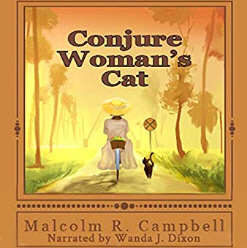
The audio edition of my novel Conjure Woman’s Cat has a wonderful narrator with lots of presence in her voice and style, that I wasn’t surprised when “AudioFile” liked her work and awarded her with a pair of red earphones in the review. Wanda J. Dixon turned in what, in the movies, would have been an Oscar-winning performance.
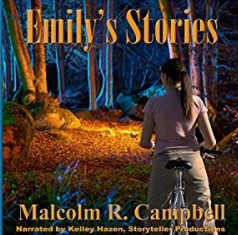
The first book of mine to come out in an audio edition was Emily’s Stories. (The e-book and paperback editions are out of print, but I’m happy to say that the audio edition narrated by actress Kelley Hazen is still available). It was strangely wonderful to hear (to the extent that I can) the voice of an actress I’d seen in movies and television reading my lines. “AudioFile” liked the book but didn’t award it with a pair of red earphones. That surprised me because the narration is spot on with multiple tones of voice for the different characters, including a bird and a ghost.
The second book in my Florida Folk Magic Trilogy, Eulalie and Washerwoman, was wonderfully narrated Tracie T Elice Christian. We’re currently in audiobook production for Lena, the final novel in the trilogy. An early satire of mine, Jock Stewart and the Missing Sea of Fire is, sad to say, out of print. However, the audiobook, with R. Scott Adams providing the realistic narration is alive and well on Amazon.
If you’re heading out on a long trip, maybe you should grab up several of these to relieve you of the boredom of hours and hours of clouds outside your aircraft or the trash trees and sagebrush outside your car window. Of course, it’s still legal to listen to audiobooks in your hot tub or recliner.
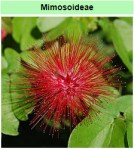
This herb is also called “Cassie Flower” and “Gum Arabic” among other names. In her wonderful Hoodoo and Root Magic book, catherine yronwode warns against confusing Acacia with Cassia Sienna, Cassia Bark, or Quassia (bitter root). They are not the same. Acacia’s classification is Leguminosae (Mimosacaceae).
In her book, yronwode mentions the fact that today’s conjure workers tend to be less aware of the herbs they’re using because they aren’t growing them or finding them in the forest. This opens them up to fraud, especially from merchants who substitute herb XYZ and call it ABC. If you don’t know what the plant looks like in the wild, this is a danger.
Medical Uses
According to Web MD, As a medicine, acacia is taken by mouth for high cholesterol, irritable bowel syndrome (IBS), and weight loss. It is also used to remove toxins from the body and as a prebiotic to promote “good” bacteria in the intestine.
Acacia is applied to the skin inside the mouth for plaque and gum inflammation (gingivitis). It is also applied to the skin to decrease skin inflammation (redness).
Conjure
This plant symbolizes immortality and, as such, can be used to communicate with the dead. It can be mixed with holy water or burnt as an incense. You can also use it as an aid to psychic dreams and visions.. According to Occult1.com, Acacia can be “used as a Holy Oil for candles and your Altar. You will find this oil mentioned in the bible Exodus chapter 25. This is a very holy oil, used to anoint items that are used on the altar, used in the bath for Jinx Removing.rituals or at a time of prayer. You may also anoint your body at times of worship. • Due to the holy influences, Acacia is also known to be a protection oil, and one used for blessings, it should be worn on your wrists, palms and heart.”
Can you use it to summon the dead? Perhaps. Suppliers that mention this sell the plant as a curio only to avoid legal trouble. As a writer rather than a rootworker, I can’t really say what works and what doesn’t. I simply enjoy the research in support of the characters in my novels.
Yes, the Internet is filled with arguments about cornbread with sugar and cornbread without sugar. I conducted an informal poll which showed that those who put sugar in cornbread represent the unwashed, uncultured, and wholly ignorant segment of society. In fact, they don’t even deserve to be considered part of society.
Some clowns add wheat flour to cornbread. This group is descended from a grandmother off in Peoria who got roaring drunk one morning and reached for the wrong flour sack.
Unfortunately, there are heretics everywhere. Shun them. A site called Genius Kitchen provides a recipe for Old Fashioned Southern Cornbread. Pshaw. They list one teaspoon of sugar. Who are these people?
In my novel Eulalie and Washerwoman, Eulalie says that the people who buy homes in a new subdivision after the African Americans were run out will be the kind of people who put sugar in their cornbread. If you’re not from the South, maybe you didn’t know she was mocking the lah-tee-dah faux culture people who don’t know their butts from a hole in the ground.
You probably know that I’m a white male. What this means among other things is that these days, is that “my kind” is slandered by everybody. Being from the South adds another level of malice to that slander. So, you probably won’t believe me when I tell you that sugar in cornbread is not necessarily a “white thing.” I don’t know any Southern white people who put sugar in their cornbread unless they moved here from the North.
Cat Cora, an Iron Chef from the Food Network lists cornbread’s ingredients as 5 tablespoons unsalted butter, plus more for the pan, 3/4 cup all-purpose flour, 3/4 cup yellow cornmeal, 1 1/2 teaspoons baking powder, 1/2 teaspoon baking soda, 1/2 teaspoon kosher salt, 1 cup buttermilk (shake before measuring), and 2 large eggs. Okay, I’ll quibble about the kosher salt, but the main thing we don’t see here is SUGAR.
Most great Southern cooks–and that includes my wife–don’t need a recipe for cornbread any more than they need a recipe for real Southern biscuits. But Cat Cora’s is pretty darn close to what quality people make without a user’s manual when it comes to cornbread. I should mention that you need a cast-iron frying pan, but you can skip that if you don’t know what that is. Unfortunately, young people often need a recipe for cracklin’ bread, corn pone, johnny cakes, and hushpuppies because they weren’t brought up right when it came to kitchen skills.
(Note to my reader in England: When I say we eat hushpuppies with mullet [a tasty fish], we’re not eating baby dogs or Hush Puppies shoes.)
Here’s my advice if you want quality cornbread: The next time you’re served cornbread at a restaurant, see if it tastes sweet. If it does, shout out as loudly as you can: “Who’s the bastard who f_cked up my cornbread with sugar?”
If your parents or spouse serve you sweet cornbread, I suggest leaving our the words “bastard” and “f_cked up” while making the point that you refuse to eat that kind of swill in the future.
My trip to Hawaii got messed up when this happened and the cruise line won’t give me a refund.
If you waste more than 15 minutes per day looking at Yahoo news or Facebook, it will be easy to get the impression that everything about the human condition that you really don’t want to know about went viral eight minutes ago and you’re the last to know.
Even deadly viruses are losing out to videos of some guy running over a kid’s new tricycle and rude customers in fast food restaurants screaming at cashiers who won’t sell them an actual whopper instead of a burger with so much bacon on it there’s no room for the bun.
At first, it’s a bit humorous. On Facebook, people use the smiley face a lot to indicate that in an online world gone nuts with the inane and the innocuous, pictures of cats sleeping on a sofa get more attention that announcements that a person has gotten married and/or fallen into a volcano at a scenic location.
Weeks later, folks on your friends’ list hear a rumor about your wedding or the volcano incident and scream, “OMG, when the hell did that happen?” If you say, “It happened the same day you were clicking on hundreds of pictures of cats shredding throw pillows or pigeons throwing up in the back seats of brand new convertibles,” they’ll (the friends) run off in a snit.
As an author, I won 200 Nobel/Pulitzer/Hugo prizes last year and nobody heard about it because pictures of some guy in bed with the wrong bride at a deluxe honeymoon hotel in the middle of a volcano kept grabbing people’s attention. The whole Internet has turned into a hideous car wreck and even people who say they don’t look keep looking.
All of this came to mind today while I was updating my website and happened to see the statistics page that tracks people who almost stopped by but then didn’t because:
10% were looking at a cartoonish video showing a fake snow storm in a fake forest and commenting, “ain’t nature beautiful when it happens somewhere else.”
10% were arguing about the differences (if any) between “to,” “too,” “two” and “2.”
10% were reading the comments at the end of a news story about attention deficit disorder where they thought it necessary to say, “real news has gotten so long these days, I never make it to really horrible stuff that I never used to look at.”
70% were stuck watching a Facebook video of a dog licking its butt in a hurricane while little old ladies couldn’t cross the street because none of the Boy Scouts noticed them.
If you have no idea what I’m talking about, you’re not online enough to catch the irrelevance disease or notice the world is going to hell in a handbasket while citizens stare at slow motion videos of hummingbirds having sex.
Scientists warned us all this crap was going to happen but nobody saw the story because they (whoever) were hooked on histrionics.
–Malcolm
Malcolm R. Campbell has two cats, but them I’m sure you’ve seen pictures of them taking a leak in a birdfeeder on a clear day in Nebraska when they could have noticed they could see forever if they took a minute to look.
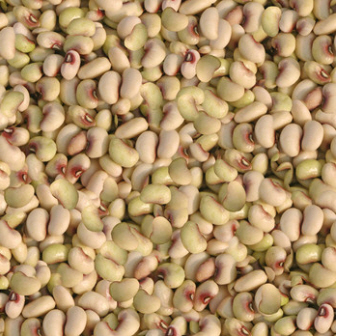
When I was a kid, I hated black-eyed peas because the cooks at the high school cafeteria boiled them into a brown mush that was best used for various construction projects like mortaring bricks together. Or, low-grade library paste.
Does eating them bring good luck? The one year my mother fixed them the traditional Southern way (brown mush) something bad happened. It was so bad, I’ve blocked out what it was. I vowed to never again eat black-eyed peas that looked like mush.
Mother usually served them the way a Midwestern cook would serve regular peas. Those I liked. But nobody else in the Florida Panhandle cooked them that way. Unlike my parents, I liked a lot of traditional Southern foods: boiled peanuts, mullet, grits, rosin baked potatoes, collards, hush puppies, anything out of New Orleans, traditional Southern fried chicken, pan fry bread, sugar cane stalks to chew on, green beans cooked with bacon, plenty of gravy, catfish, and Apalachicola oysters.
Every new year, I see my Facebook friends showing pictures of their January 1 meals with heaping ladels of mushy black-eyed peas. Okay, so my parents came from the midwest and the northwest and didn’t boil peas into a road-tar like mess that could be used to resurface city streets.
No, I’m not totally Southern when it comes to black-eyed peas. Give me a sack of boiled peanuts any day.
“A library is a good place to soften solitude; a place where you feel part of a conversation that has gone on for hundreds of years even when you’re all alone. The library is a whispering post. You don’t need to take a book off a shelf to know there is a voice inside that is waiting to speak to you, and behind that was someone who truly believed that if he or she spoke, someone would listen. It was that affirmation that always amazed me. Even the oddest, most peculiar book was written with that kind of crazy courage–the writer’s belief that someone would find his or her book important to read. I was struck by how precious and foolish and brave that belief is, and how necessary, and how full of hope it is to collect these books and manuscripts and preserve them. It declares that all these stories matter, and so does every effort to create something that connects us to one another, and to our past and to what is still to come.” – Susan Orlean
Publisher’s Description
“On the morning of April 29, 1986, a fire alarm sounded in the Los Angeles Public Library. As the moments passed, the patrons and staff who had been cleared out of the building realized this was not the usual fire alarm. As one fireman recounted, ‘Once that first stack got going, it was Goodbye, Charlie.’ The fire was disastrous: it reached 2000 degrees and burned for more than seven hours. By the time it was extinguished, it had consumed four hundred thousand books and damaged seven hundred thousand more. Investigators descended on the scene, but more than thirty years later, the mystery remains: Did someone purposefully set fire to the library—and if so, who?”
Assessment
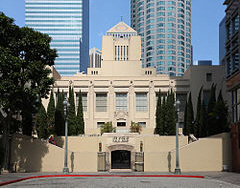
If you Google this fire, you will find many pictures that are sad to see because they show the mess fire, smoke, and water make of books. The images I saw are copyrighted, so I can’t show them here. Frankly, in reading Orlean’s book, I was surprised at the number of damaged books that were saved, many by a long process of removing the moisture from the sodden pages. In many of the older books that escaped the fire and water, the smell of smoke still lingers.
Main Los Angeles Library – Wikipedia Photo
You can also learn on the Internet that even though there was an arson suspect who couldn’t (or didn’t want to) keep his own alibi straight, there was never enough evidence for an indictment. While the book delves into the stories of that suspect, it’s difficult to read The Library Book with this lingering lack of closure about an unsolved crime. If this book were fiction, let’s say a whodunnit, the author would be criticized for the failure of the characters to solve the crime and bring the perpetrator to justice. The lack of closure creates within this book a lack of focus. That is, the book wanders a bit.
Nonetheless, the book is well written and demonstrates Orlean’s long-time and well-known talents for interviewing people and finding out what makes them tick. I worked in the college libraries at the universities I attended, so I share Orlean’s love of the library and, as such, see this book as not only the history of an important U.S. library but as a love letter to libraries and those who manage them.
Oddly, the fire–and the public’s support of the library after the fire, and seven years later when the main library reopened–might have saved the historic building. The building had for years been discussed as out of date and too small, along with having inadequate fire repression methods. So, a new wing was built and the old building remains, more vibrant and busy than before. If you love libraries, and especially if you have worked in libraries, you will probably enjoy this book. I did.
A Personal Note
I cannot bring myself to feel that, as an author, I am brave in any way for writing novels I hope people will read. More likely, I am foolish, for such a small percentage of books, including those from major publishers ever succeed in finding enough readers to support the publisher’s and author’s investment. Nonetheless, writing is typical of me, just one more example of my impractical life’s focus.
I never expect Hollywood or the New York Times to call and request either a film option or an interview. I have always expected more of my personal friends and online friends to read the books, but to the extent, they read novels at all, they choose the bestsellers from major publishers as a sure thing. Novels are different than other businesses in which community support often favors the local store rather than the chain. Buy local! But that seldom applies to books. The nursery, pharmacy, tire store, restaurant, and the grocery store expect my support, but they don’t buy my books. That’s a sad thing, I think, but when I read a book like this one, I have faith and hope that somebody, somewhere will ultimately find the stories I have to tell.
Susan Orlean has given us all a very memorable story and I appreciate it.
 Most authors hope this will happen to one of their articles, short stories, or blog posts because they have been working for years as a virtual unknown writing what reviewers and friends tell them is good stuff even though none of that good stuff sells well on Kindle or anywhere else.


 This plant symbolizes immortality and, as such, can be used to communicate with the dead. It can be mixed with holy water or burnt as an incense. You can also use it as an aid to psychic dreams and visions.. According to Occult1.com, Acacia can be “used as a Holy Oil for candles and your Altar. You will find this oil mentioned in the bible Exodus chapter 25. This is a very holy oil, used to anoint items that are used on the altar, used in the bath for Jinx Removing.rituals or at a time of prayer. You may also anoint your body at times of worship. • Due to the holy influences, Acacia is also known to be a protection oil, and one used for blessings, it should be worn on your wrists, palms and heart.”
 You probably know that I’m a white male. What this means among other things is that these days, is that “my kind” is slandered by everybody. Being from the South adds another level of malice to that slander. So, you probably won’t believe me when I tell you that sugar in cornbread is not necessarily a “white thing.” I don’t know any Southern white people who put sugar in their cornbread unless they moved here from the North.
 Does eating them bring good luck? The one year my mother fixed them the traditional Southern way (brown mush) something bad happened. It was so bad, I’ve blocked out what it was. I vowed to never again eat black-eyed peas that looked like mush.
 Malcolm's Round Table