Be careful when asking for opinions about stories you haven’t started writing

“Hold off asking for opinion. The earlier you ask for feedback, the more likely you are to get deterred from what might be your best writing. The best judge of a good idea is you, but only after you’ve mulled it over for a long while, or tested it by writing a draft, or rewritten it three or four times. After you’ve read similar works to compare. After you’ve honed your writing skills to develop the chops to even write the concept.” C. Hope Clark

I can’t find the quotation now, but Hemingway once warned writers against talking their ideas away. That is, telling others the plots of stories they were about to write. After all was said and done, possibly at a table with several bottles of wine, the author would realize that in all the give and take about his or her prospective project, s/he had lost it.

In this week’s Funds for Writers newsletter, Hope Clark expressed similar reservations about rushing out and telling friends, fans, and other writers what you’re thinking about writing–all in hopes of getting feedback about its viability.

Personally, I don’t understand this at all unless, perhaps, you’re floating an idea with your publisher or agent about what you want to write next. Otherwise, early on, what the hell kind of feedback could anyone possibly offer? So, telling–let’s say–your usual beta readers that you’re starting a new series may elicit a lot of pats on the back with little useful feedback.

The more you say, the more likely it is that their comments and questions will derail the project or somehow change it into something outside the scope of what you want to do.

Personally, I don’t like or understand the concept of beta readers unless I’m writing nonfiction and am looking for an unofficial peer review of my approach before devoting too much time researching the project. So I never ask anybody what they think of a prospective story idea because any input I get is doing to be detrimental to what my muse and I are considering.

If you feel better asking for feedback, my suggestion is to wait until you have the first draft. At that point, you have enough of a story for others to understand your plot, theme, characters, and style. When you wait, you’re more sure of yourself and your story, including its focus and ending, and distracting and negative comments are less likely to derail you. Now, quality beta readers may, in fact, find holes in the story, inconsistencies, and other issues that fall far short of destroying your work in progress.

Malcolm


My granddaughters will have to wait a while for my ghost story book

My granddaughters are 11 and 6 years old, so I thought it would be cool to dedicate my new collection of stories (Widely Scattered Ghosts) to them so that when they are in their 50s they can take a copy to Antiques Road Show and learn that the book–at auction–is then worth $1000000000000.

This haunted Florida bridge is the setting for one of the stories.

They live in Maryland, so I’m going to mail the book. But I can’t address it to them because they love getting things in the mail, especially packages. But they’re way too young to read any of the stories. Even though none of the stories are the Stephen King variety, Freya and Beatrice will need to wait until they’re teenagers (I guess) before they get to see the book.

So, the mail is going to my daughter with instructions to hide the book and to remember where she hid it. My father was an author. I always thought it was neat to have copies of some of his books autographed for me. Maybe the girls will feel the same way even though I’m no James Patterson or John Grisham.

Four of the stories are about an inquisitive and highly intelligent teenager named Emily who talks to ghosts. She reminds me of my daughter (except for the talks-to-ghosts part). As a grandfather, I get to brag and say that I think my granddaughters will grow up to be smarter than Stephen Hawking.

That makes me wonder if they’ll correctly guess the endings to each of the stories before they get there.

Malcolm


So, y’all like cat posts, do you?

Well.

I didn’t expect so many people to stop by and read about Katy’s view of my reading books in bed. I’m glad you did.

Katy with one of my novels. This picture got a million responses on Facebook (naturally).

I shouldn’t have been surprised. After all, I’m on Facebook where I notice that for every story about the end of the world that gets one or two reactions, there are a hundred cat pictures and posts that have hundreds of responses and shares. Why should WordPress be any different?

Sometimes I think all that cat action is due to the fact that people are still trying to figure out cats, some wondering why they can’t be more like dogs, some wondering why they don’t seem grateful for anything we do for them, and how it is that they understand the word “no” but don’t pay much attention to it.

The cats in the bed routine got started when we moved into this house. The cats (we had three at the time) didn’t like it any more than they liked the three-hour car ride over here from the old house. They started out in the master bedroom. When my wife and I went to bed, the cats all got in the bed. They stayed in the bed for a couple of days or so before they finally ventured out and discovered there was more to their new digs than a single room.

Our two remaining cats don’t have run of the bedroom 24/7, but they expect to be allowed in there every night at bedtime. Prior to bedtime, they’re usually asleep on the living room furniture while my wife and I are watching highly cultural shows on TV (NCIS, FBI, Grey’s Anatomy). So, basically, we have to wake the cats up when it’s time to go to bed. They’re asleep again before we are.

When people ask me where I live, I tell them I live in a cat house. My wife is used to my saying that, but I suspect she thinks it would be better if I stopped saying that. We’ve had cats since before we were married: Needles, OK, BK, Duncan, Marlo, and Katy. The cat house comment is really quite true <g>.

We’ve talked about getting a kitten, but I’m worried about what Kary and Marlo will think about that. When they arrived in our old house, they took a dim view of our elderly orange kitty (OK), so unless we get a huge, Maine Coon Cat, I worry that things won’t go smoothly. Of course, daily life in a cat house doesn’t go smoothly, so how much worse could it be?

Malcolm


Katy thinks my bedtime reading is annoying

Katy and her spooky reflection

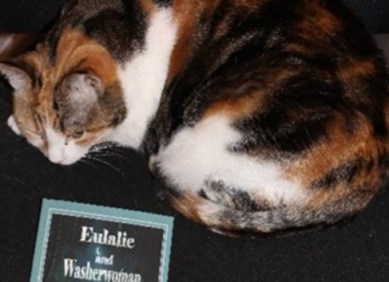
Katy is a giant Calico cat.

She becomes annoyed if things run behind schedule. One thing, in particular, is how long I read in bed before turning off the light.  I read for about twenty minutes. That’s all. Katy is there, of course, griping if I pay her no attention. She is leaning against me while I read, sometimes pushing on the book on my lap, sometimes learning her head against my hand, sometimes stalking around the bed in disgust when I read longer than “necessary.”

What she wants is for me to turn out the light and go to sleep. That means she can lie on top of my legs and go to sleep. I have no idea why she thinks that’s a comfortable place for her to be.

The odd thing is, if I’m tired and skip the reading and turn off the light immediately, she doesn’t know what to do. She prowls around the bed, walking back and forth across me like I’m part of the covers, leaves the room, comes back, and finally settles down. It’s much better for me to fake reading a book for five minutes than to put up with all that.

I’ve tried to teach Katy how to read, but she doesn’t grok the concept. I’ve tried to explain to her that when I’m reading about a bunch of good guys who are about to walk into an ambush, I need a few more minutes to see what happens.

Her response is usually, “I don’t give a shit.”

I don’t think that’s very friendly, but then I guess she learned her profanity from my wife and me during times when we were ticked off about something on the news. So now, as I write this, it’s suddenly 4 pm, and Katy and her sidekick Marlo are acting totally aggrieved because I’m one minute late with their 4 p.m snack.

Gosh, who’s in charge here, anyway.

We were warned early on when we adopted these cats that Calico cats are filled with attitude. “How bad could it be?” we asked. Now we know.

–Malcolm

Some people wonder why the main character in my Florida Folk Magic series of novels is a cat. If you have to ask that question, you don’t know how pushy cats can be.


The OSCARS risk becoming irrelevant

Once upon a time, I watched the Academy Awards on TV without fail. I loved the movies and everything about them. But not anymore.

What’s changed?

On a practical note, I’m too hard of hearing to go to movies. I don’t see them until months after their release dates when they finally appear on TV with closed captions. So, as of OSCAR night, I have seen none of the nominated films and, other than a few news stories and trailers, have no clue what they’re about. That pretty much kills my interest in the broadcast.

But even if my hearing were fine and I had seen a fair number of the nominated films, I wouldn’t watch. Yes, I might care about the winners, but I’d learn about that the following day on the news.

I am tired of actors and actresses using the OSCAR broadcast as a political pulpit. Like most viewers (I hope), I see the broadcast as being about the movies, not poltical statements in opening monologues, sketches, and acceptance speeches. I get more than enough of this from the news and social media day in and day out and think it’s out of place on an awards program.

Hollywood stars have just as much right as anyone else to express their opinions. Nonetheless, the Academy Awards broadcast is not the forum for that.

When they speak of politics during the broadcast, they appear to be stumbling over each other to prove that they are the most liberal, the most intelligent, and the most politically correct person in the theater. Do they not realize that everyday people see them as members of the so-called filthy rich? I want to shout, how dare you lecture me on politics when you earn more in a year than I do in a lifetime and own multiple homes, each of which is worth more than my entire neighborhood.

You, dear actors and actresses, who can afford the taxes that you might be forced to pay if your left-leaning social programs were implemented, fail to realize that the rest of us cannot afford a government that looks like an unlimited charity. Sure, we support many of the same ideas, but you go too far because you can afford to go too far. You stand on that stage in clothes worth more than my annual income and–with a knowing wink and nod to the audience–advocate programs that will raise my taxes to the point where I cannot afford to live in this country.

Of course you believe you can do this because believe you are America’s royalty, right? We wish we were you, right? We wish we could sit for a few moments in your presence, right? We go to your movies because we love you and know that you care about all of us, right?

Frankly, I would be embarrassed to be you.

So you are turning the OSCARS into a PAC, so to speak, that’s out of sync with most of the country. That’s why, one day soon, we’ll stop caring about you and your awards program. You want us to think OSCAR night is about the movies. But that’s not true, is it?

–Malcolm


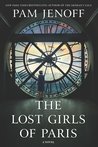
Review: ‘ The Lost Girls of Paris’ by Pam Jenoff

The Lost Girls of ParisThe Lost Girls of Paris by Pam Jenoff
My rating: 4 of 5 stars

Jenoff has written a compelling novel about female British agents serving in occupied France during World War II. In many ways, it’s a heartbreaking novel since we learn early on that the odds are against many of the agents lasting long in the field before they’re captured and executed.

The novel is easy to follow since it focuses three characters, albeit with a good supporting cast: Eleanor, who works for the British SOE (Special Operations Executive) and champions and then trains and manages female agents in the field; Marie, whom Eleanor recruits due her flawless French; and Grace, who finds an abandoned suitcase in a New York train station after the war and becomes interested in a packet of the agents’ pictures.

The novel moves well, giving readers a sense of what it might have been like for these women to suddenly leave the country without telling anyone where they were going and, after arduous training, finding themselves in harm’s way. Fans of black ops novels might wish that more of the novel concentrated on the field work itself rather than the worries and intrigues at SOE headquarters. However, the girls’ work in the field is well researched and authentic.

The problematic character in the novel is Grace. After stumbling upon the pictures, she feels compelled to learn more about the SOE, Eleanor, and the girls in the packet of photographs. While Grace is a realistic character, inserting her life and her problems into this story takes away from the primary focus of the novel. She is more or less a device the author has used to help convey the story to the readers. While Grace “works” as a character, the novel might well have been stronger if she hadn’t been included.

Taking the story as it is with Grace in the mix, the material is well presented and interesting. Goodness knows the story in “real life” could have happened this way with an unconnected person stumbling upon it and trying to learn more. That said, the novel is well worth the reader’s time.

View all my reviews

Here be dragons, yeah, right

Here’s the thing. About 100000 times a year, I read that old maps used to place the words HERE BE DRAGONS in areas that nobody knew anything about. The odd thing is, nobody has ever found an old map with those words on it.

It’s quite possible that I was a cartographer in a previous lifetime, though I’ll claim that I misspoke if I’m ever asked any questions about that by a Congressional committee.

Florida Photographic Collection

Maps fascinate me. Always have. Maybe this character flaw began when I was growing up and got bored between stops on long family vacations. We always went by car. After a while, the landscape outside the windows got repetitive, so I’d turn my attention to the service station maps we carried and made a game out of predicting when we would arrive at various locations down the road. Now, our cell phones do all this for us. But then it was fun.

In those days, I could predict within a few minutes when we’d pass the cities limits sign of every town down the road. Now I spend time trying to figure such things out when my stories involve people traveling. If a character is walking, riding a horse, on a train, in a car, or flying, when will they arrive where they’re going? I find myself looking up lengths of stride, terrain, and all sorts of things so that a hike in my story takes the same amount of time as the hike would take in real life.

In one recent short story, a father and his daughter were driving from Tallahassee, Florida to St. Marks, Florida while listening to a Scott Joplin recording. I kid you not, I timed out the lengths of the songs with the mileage so I could say stuff like “as they passed through Woodville, such and such a song was playing.”

When I was working on my two Glacier Park novels, The Sun Singer and Sarabande, I had a hiking map on my desk. Since I had hiked most of the trails in the section of the park where my stories were set, I knew how long it took to get from one place to another if one walked at a steady pace. Along with the map, I had a trail guide. That reminded me what the landscape looked like at each fraction of a mile along the trail.

While many authors look at me like I’m crazy when I mention such things, I don’t think I’m the only author who does this. I read a lot of novels set in a lot of cities and many of them are very specific about what a character can see while walking down one named street or another.

I guess it comes down to wanting to orient my characters in the places where they are just as I have always liked feeling oriented in the places where I am. If you have a compass and a map, but don’t know where you are, you can take sitings of recognizable landmarks and find the answer. I’ve always done this. So now, I’ve passed that trait along to my characters and maybe a few readers. And, if I’m lucky, maybe a dragon or two.

–Malcolm

Malcolm R. Campbell is the author of the recently released collection of short stories called “Widely Scattered Ghosts.” You won’t be surprised to hear that it includes a story named “Map Maker.”


Magnolia Florida, long gone and almost forgotten

“Magnolia, Florida was a thriving river port town in southern Wakulla County, Florida (until 1843, Leon County, Florida), established in the 1820s and is classified as an “extinct city” by the State Library and Archives of Florida. All that remains of the city is the rundown cemetery – the last known burial was in 1859.[1] The cemetery is on land now owned by the St. Joe Paper Company. The town was located near the small city of St. Marks, Florida.” – Wikipedia

People Playing Croquet in Magnolia – Florida Memory Project photo

When I was little, the old-timers in Tallahassee, Florida spoke of the extinct town of Magnolia, south of town on the St. Marks River, that developers once hoped would be a port city for cotton and other products.

There was nothing left of the town but a small cemetery that local ghost enthusiasts claimed was haunted. If you live in Tallahassee now and have been around for a while, you might recall that between 1963 and 1977, Elizabeth F. Smith captured the spirit of the area in her publication “The Magnolia Monthly” out of Crawfordville, Florida.

Magnolia–not to be confused with Magnolia Springs in Florida’s Clay county–was well-planned, but failed because the Railroad needed for its survival bypassed it and went to St. Marks instead. The town was founded by the Ladd family which you can learn more about here.

The remains of that railroad came up for sale when I was younger, and I thought then that it would make a nice tourist attraction. Never happened, for better or worse, though it might have improved the financial status of Wakulla County.

But my fascination for the town, the river, and the slash pine forests owned by the paper company stayed with me. I mention the town in my short story “Sweetbay Magnolia” in my new short story collection Widely Scattered Ghosts. In fact, the grandmother in the story had a house in Magnolia and the sweetbay magnolia in her back yard reminds her of old days and old loves.

As always, it’s the real places that get my attention.

–Malcolm

All that remains of the town. Florida Memory Project photo.


A broken man lives on my street

Years ago, he made a mistake in the name of love. He still remembers when he was the sun and she was the moon. Now he reads the news reports about global warming and believes down to his marrow that Earth’s problems are his fault.

He told me not to reveal his name because people would say, “Well, that old man is full of himself, thinking he has or ever had the power to play a role in climate change.” Naturally, a few people would believe him and they’d kill him or put him in a home (he’s not sure which of those fates is the worst.)

The year it began, there was a war on. People were crazy, wild, prepared to live on the edge before they were sent to the front. So, he met a girl who claimed beneath the starry sky on an October night that her true name was Mother Nature. He didn’t believe her then because Mother Nature was a figure of speech and if she wasn’t a figure of speech, why would she want him when there were plenty of kings and queens and Hollywood celebrities available?

“You have a heart of gold,” she told him. She must have known he had always wanted a heart of gold or that he was otherwise susceptible to the feminine wiles of any lady who noticed the guy with the Coke bottle glasses who had never been on a date.

They became lovers. He told me that she taught him everything he knows about love and sex but that now he’s too old to use any of that information. Their daughters were hurricanes and their arguments were droughts, but heaven help him, he was addicted to her charms and her power.

Their liaisons were secret. They met in sheltered rooms and other uncertain places. While both of them wanted to go dancing, have wonderful meals at fine restaurants, partake of Broadway plays and theme parks, her power and beauty attracted too much attention. So they hid in the backs of rental cars and met behind abandoned buildings.

“She was my heroin,” he told me, “but I didn’t care until I finally understood that she was not truly a human woman and that she was transforming me (without malice) into an inhuman man. No man can sleep with a goddess and remain unscathed. If you read mythology, you know that.”

So he broke it off.

She went after him with global warming inasmuch as she wasn’t used to men turning her away before they died in her bed. Today he looks out the window at the endless rain and wonders what any sane man would have done in his shoes even though he feels certain he’s too broken to be sane. He’s thinking about going back to her since that’s the only thing he knows that will stop her fury.

“If I could turn the clock back to the day we met,” he said, “I wouldn’t change a thing. That proves I’m just as crazy as everyone else who looks back on the stupid things they did when they were young and knows they’d do it all again if they could.”

The last time I drove by his house on the way to town, I saw him sitting on his front porch with a cigarette and a Mason jar of moonshine. He was waiting for her even though he knew she would be the death of him.

Most of us would be, wouldn’t we? Our mistakes have become our fondest memories.

–Malcolm

Malcolm R. Campbell is the author of magical realism novels and short stories, including the recently released “Widely Scattered Ghosts.”


All that inspiration for just a few dollars

When I walk out of a theater after watching a wonderful movie where good and love triumph, I feel inspired. Perhaps it’s simply the story, whether derring-do or comedy or noir. Or music. Or the cinematography. Often it’s the acting. When I was young, I’d walk down the street after seeing such a movie and think I can do those things. I’d imagine myself beating up the bad guys, taking a hill with a company of marines, finding the magic in the secret cave.

Now I walk out of such movies thinking that I can do my things, whatever my goals may be.

I feel that way when I finish well-written books. Somehow the book or the movie works as a spell and unlocks dreams and abilities and willpower I didn’t know I had. (Or that had gone dormant.) Sometimes they work more like a confidence potion or maybe an angel’s gift. At some level, I suppose, it’s all just a fantasy. There are times, though, when I see differences in my life. Usually, an infusion of energy or a renewed devotion to a long-time project.

I often wonder how many others feel this way after seeing a movie or reading a book. Reading gurus have many theories about the impact of a good story. I don’t have any theories that I know of because having them seems to jinx the whole business. If your theory is that watching a certain movie or reading a certain book is going to turn you into a god or an avatar, then forget it. But, if you don’t think that, you may well be transformed.

As I read this week about a religious pilgrimage that occurred many years ago in the kingdom of Sikkim (now part of India) I find myself thinking more positively about myself and the world than usual even though I have no desire to go there and follow the seeker’s paths. For one thing, I don’t have the patience to spend hours in meditation. I never have. I know I should do it, but I don’t. All that seems so cumbersome to me. But reading about the journey and the seeker’s devotion seems to change me for the better.

And, the book and the movie only cost a few dollars. What a bargain!

Subconsciously, maybe all of us know that in addition to the escapist fun of reading a great novel or seeing a wonderful movie, we will be changed for the better by the experience. I read for the fun of it, not as a spiritual practice. But when I put the book down, I realize I’m a different person than the one who picked up the book.

Perhaps this happens to you as well.

–Malcolm

Malcolm R. Campbell is the author of “Widely Scattered Ghosts,” a new collection of short stories from Thomas-Jacob Publishing.