Review: ‘Temptation Rag’ by Elizabeth Hutchison Bernard

Temptation RagTemptation Rag by Elizabeth Hutchison Bernard
My rating: 5 of 5 stars

Temptation Rag immerses readers into a historical novel set during the heydey of ragtime (1895-1919) and vaudeville (1880 – 1920) with a cast of real and fictional characters grappling for love, freedom, and artistry in New York City. Ragtime gave way to jazz and vaudeville gave way to the cinema so, like almost every period in music and theater, the times were short, competitive, and bittersweet as talents and fortunes rose and fell depending on the inequalities imposed by the rich and famous, public taste, and racial/gender barriers.

Bernard’s story has a large cast of characters all of whom come across as multi-dimensional in her well-researched tableau. May Convery is a young woman from a rich family, who’s briefly smitten with vaudeville theater musical director Mike Gilbert at the beginning of his rise to fame as a ragtime composer and performer. Their lives criss-cross throughout the novel as they did in history in a soap opera basket of emotions that manages to haunt both of them forever.

As May finally comes into her own as an author and a volunteer in many causes, Mike’s life while seemingly larger and financially richer appears more brittle. Among all the vicissitudes of a musical career in the public eye, Mike is constantly compared with the popular performer Ben Harney who claims to have originated ragtime itself. Scott Joplin (“Maple Leaf Rag” and “The Entertainer” both brought back to public attention in the 1973 movie “The Sting”) is in the stratosphere of rag, talked about in the novel but not a character.

May’s friendship with African-American singer Abbie Mitchell and African-American composer J. Rosamond Johnson gives strength to a primary theme of the novel: racial/gender inequalities. While the barriers were historically real and are well-shown in the novel, some of May’s feelings appear to have been slightly influenced by contemporary attitudes about race relations.

The characters are strong enough and complex enough to pull readers through this well-written story almost as though we’re watching their lives play out in modern times on the television news. When the novel’s last lines scroll past its readers’ eyes and Temptation Rag is stowed away on the bookshelf, May will remain in mind one way or another.

View all my reviews

Malcolm

BigAl’s Books and Pals Review: ‘The Sun Singer’ by Malcolm R Campbell

This is one of Campbell’s earlier books (first published 2010) and already his gifts for drawing warm characters and laying out a story so it flows towards and immerses the reader are well developed.

Source: BigAl’s Books and Pals: Review: The Sun Singer (Mountain Journeys Book 1) by Malcolm R Campbell

First Edition

Seeing this unexpected review appear on my Facebook news feed this morning makes my week (much more than yesterday’s after-supper lawn mowing), brings back a ton of nostalgia, and makes me wonder once again whether I made a very bad decision pulling it away from the agent who had my typewritten manuscript for the book in the 1980s.

The reviewer mentions that the book was inspired by the mountains of Glacier National Park Montana where I worked two summers as a hotel bellman. Those of you who have read my blogs for years also know that it was also inspired by a famous statue called “The Sun Singer” which I saw at Allerton Park, Illinois when I was (I think) in junior high school.

The novel is a bit earlier than the reviewer knows. I wrote it in the 1980s, got it accepted by a small but influential agent, and then waited for almost a year with no word. She liked the novel, but her small agency had also taken on a novel that turned out to be as huge then as The Game of Thrones is now. (I refuse to mention the title of the book or its sequels.) She said my wait would be an even longer one, so I took the manuscript back.

Was that a mistake? I guess I’ll never know. She might have found a publisher when she finally got around to actively shopping it, or she might not. The fact that an agent liked it led me to believe I could find a publisher who liked it. That took 24 years. I was gratified by the fact the book’s 2004 first edition was a “Foreword Reviews” book-of-the-year finalist but less than pleased that my publisher was iUniverse, a vanity press. But I would always wonder if the book might have received a wider audience in less time if I’d left it with that agent.

Current Edition

Later, several small traditional publishers wanted it, and this led to the 2010 edition. That publisher and I ultimately had a contractual disagreement, and that led to the current (2015) Kindle edition.

It’s interesting to me that several passages in the novel that happened more or less simultaneously were typeset by iUniverse in side-by-side columns. Nobody else has been able to do that since, including several other prospective publishers. I grew up in a letterpress-evolving-to-offset printing world where those columns wouldn’t have been a problem. “Progress” into a print-on-demand/Kindle world has taken away an option for small-press authors.

Nonetheless, this weird history of the novel doesn’t take away my gratitude that a reviewer found and liked the book after all these years. With a bit of luck, maybe my first novel will find a few more readers.

Malcolm


Now that we’ve moved past the author’s newsletter idea. . .

. . .we’re back to being content to write a blog, maintain a website, and keep up with an author’s page on Facebook.

I read an interview this morning with an author whose focus is memoirs and essays. The interviewer said he thought she tended to use an extraordinary amount of personal material in her nonfiction. And she said, when she cared enough to write about an issue, it was usually because she had personal experience with that issue and so all her fears, battles, and second-guessing of herself flowed into the essay making it very personal.

I’m afraid that would happen if I wrote a newsletter. The thing is, a newsletter–like most of an author’s promotional efforts–is supposed to be all about you (the prospective reader) and not all about me (the author).

So, a newsletter filled with all my personal demons really isn’t going to cut it. When I see interviews with emerging authors, I really want to see more about the work they’re focussing on rather than memories about their experiences in English classes when they first wrote fiction or poetry. I want to know about their work, not their demons.

I’ve written elsewhere about the mistakes nonprofit organizations make when they advertise events and focus their news releases on how worthy their causes are rather than on what the public will get out of paying to attend the events. While it sounds crass to put it this way, when most of us see a news story about a book or a concert or even about a product, our primary consideration usually includes asking what’s in it for me? Will I enjoy the event? Is this my kind of book? Do I really have a use for the product?

So, like other small-press authors who don’t have a heavy schedule of events to publicize, a newsletter could quickly degenerate into an all about me kind of thing. That seems presumptuous. And, if those receiving the newsletter make book selections like I do, they buy a book because it looks entertaining, not because the author had to take three Xanax a day to get the thing written.

Most small-press authors don’t have enough news to put in a newsletter, so considering starting one requires a lot of thought. If you send out a newsletter too often, people start thinking they’re getting SPAM. If you don’t send out a newsletter often enough, then they probably won’t remember signing up to get the thing. So, if an author isn’t prolific and/or doesn’t have a heavy schedule of appearances, it’s doing to be difficult thinking up enough news to justify mailing anything out.

Better to leave people alone, I think, and hope they find my blog or website or Facebook page.

Malcolm

Those gurus, bless their hearts, say I need a newsletter

When I went away to college, my parents expected me to write home every couple of days. I said I wasn’t going to do that because I had nothing to say. That was true enough because every day was just like they day before it: I sat in a classroom, ate meals, studied, watched TV, went to bed, got up the next morning and sat in a classroom.

Some writers’ newsletters sound about like that. When they do, they’re so boring we can’t bring ourselves to write them, much less expect you to suffer through reading them. It’s hard enough thinking of something reasonably interesting to put in this blog. Heaven help me if I had to turn out a newsletter three or four times a month.

I’ve toyed with the idea of a fake newsletter. I could name it Trigger Warnings and fill it full of stuff that will push a lot of buttons that shouldn’t be pushed. Some folks used to argue that if a person put something nasty in quotes, they couldn’t be blamed for saying it. Trigger Warnings would be like that. I warn you with some introductory boilerplate, say stuff you don’t want to hear, and then hit the send button.
That kind of thing strikes my fancy because I have a trickster approach to life. If one just doesn’t say a thing, I want to say it.

Since quotation marks absolve me of misspeaking–as politicians often say–I could begin my newsletter with “Dear Bastards” and it would be okay. So then I could say, using an old-fashioned grin symbol <g> that while I appreciate your “congrats,” “great story,” and other fine comments on Facebook about my novels, I want to point out that if you don’t leave an Amazon reader review, my book is toast.

My wife–who has known me since 1979–is often surprised at what I say while we’re talking to “normal people.” Those “normal people” tend to get drunk after talking to me because I love saying what shouldn’t be said.

Trigger Warning: This might make you sick

Presumably, “normal people” would sign up for my newsletter and then immediately unsubscribe the first time I wrote about roadkill salad. On the plus side, roadkill salad is free unless you add mayo. And chopped pecans.

But I would want to be honest. That means if I was thinking about writing a poem about “roadkill salad,” I would have to tell you that and see what you thought. Sure, you might need a couple of Xanax to get through the newsletter, but it would still be liberating. See, that’s what tricksters do. We liberate you from everything that makes you sick, embarrassed, crazy, and politically inept.

Or, I might suggest that every subscriber had to buy 1,000 copies of my books and give them to relatives, prisoners, and random people on the street.

You can see, can’t you, why I don’t really think this newsletter is a great idea?

Malcolm


Zero Tolerance: White Supremacists Take Over D.C. Bookstore Reading

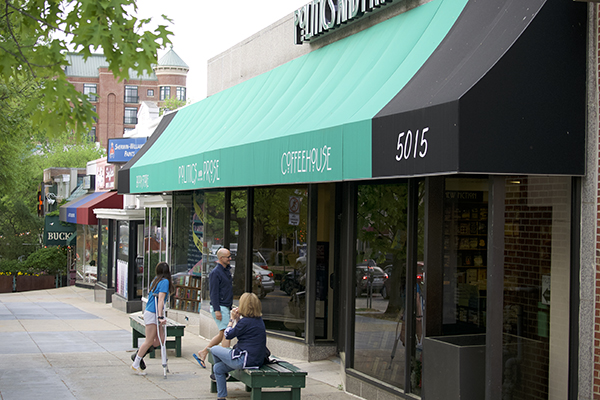
White supremacists briefly took over a reading by author Jonathan Metzl at the flagship location for Politics and Prose Bookstore in Washington D.C. on Saturday, shouting “this land is our land” and marching through the store yelling the name of a group that helped to organize the 2017 Charlottesville Unite the Right rally.

Source: White Supremacists Take Over D.C. Bookstore Reading

I am worried about the future of free speech because this kind of crap marks people of either major political party as targets for disruptive actions. That makes it harder for a person to speak out–or to have the guts to speak out.

As my novels suggest, I have zero tolerance for racism and white supremacy in any form. I also have zero tolerance for jeopardizing the right of anyone to speak out whether it’s from threats of violence at planned speeches by members of either party at campuses and other venues or hate campaigns against authors/bloggers online.

If a person or a group won’t even let the opposition speak, that person or group is bankrupt and without any value whatsoever.

–Malcolm


National Poetry Month: ‘Ariel’ by Sylvia Plath

“The collection contains some of her most celebrated poems: Lady Lazurus, Daddy; The Moon and the Yew Tree and the titular piece Ariel.  Many of these are poems written in a burst of creativity shortly before she took her life. They are poems I’ve read many times over, but only ever as individual pieces of work. When you read them as a collection, the intensity and darkness that’s visible in an individual poem is heightened and magnified many times over.”

Source: Ariel by Sylvia Plath: #1965club read ‹ BookerTalk ‹ Reader — WordPress.com

I first read Plath’s novel The Bell Jar and her collection of poems entitled Ariel when they first came out in the United States. Their combined impact on me was enormous. and, to this day, “Ariel” remains my favorite poem, second only to “Fern Hill” by Dylan Thomas.

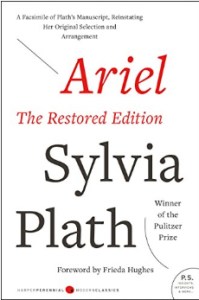
The original edition of Ariel was published after Plath’s death wasn’t what she intended. Her husband, poet Ted Hughes, changed the selection. I see that as a travesty and an arrogant intrusion into her work. I still have the original version of Ariel on my bookshelf. But if you want what the poet intended, take a look at the restore edition from 2004 shown here.

Malcolm

New ‘Conjure Woman’s Cat’ Hardcover Edition

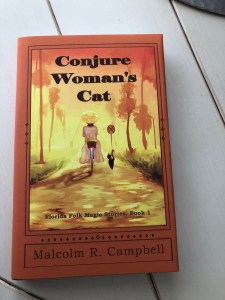
Thomas-Jacob Publishing has released a hardcover edition of Conjure Woman’s Cat by Malcolm R. Campbell. Also available in paperback, e-book, and audiobook, the story set in the Florida Panhandle in 1954 follows the efforts of a conjure woman to find justice after her granddaughter is assaulted in a small town. The novel’s sequels, Eulalie and Washerwoman and Lena will also be released in hardcover in the coming months.

Copies are already available at Amazon.com and Barnesandnoble.com and can be obtained by your nearest indie bookstore via their Ingram catalogue.

“I dearly loved Eulalie and Willie, I could easily have been friends with them both. The more I read the name Eulalie the more I adored it. It has a beautiful rhythm and made me smile every time I read it. Eulalie was a wise woman and deserved the respect she was given. Kudos to Malcolm R. Campbell for a story well told.” from Big Al’s Books and Pals

“Listeners will marvel at the magical realism in this story and benefit from the helpful glossary of the charming local dialect.” S.G.B. © AudioFile 2016

“For me to truly love a book, it needs the following: great plot with something to get fired up about, intelligent, engaging storytelling, well-defined characters, at least one of whom makes me wish I could conjure them into my life and my living room, and a deeply satisfying conclusion. Campbell’s work delivers beautifully on all of the above.

“The book is narrated by Lena, cat and spirit companion to Eulalie, Conjure Woman and human being extraordinaire. Eulalie (don’t you just love that name?) has an innate goodness that can’t be denied, but she’s no saint. She’s devout and dedicated to doing God’s work, and has a willingness to confront what others refuse to acknowledge. Her determination to set straight the injustices in her world, combined with her resilience and wisdom, made this reader fall in love with her.” – WordNerd on Amazon

“This was a delightful read, mostly because of the unique narrator … Eulalie’s cat Lena. I was taken into the heart of a world so foreign to my own, and ended up grateful for the glimpse. Poetic justice for inexcusable cruelties abounds but only because of Eulalie’s faith and intervention.

“More than simply characters in a fictional piece, I soon believed in their culture and social conventions. Most of us don’t believe in hoodoo and conjuring, but there was a time when those beliefs were much stronger. The novella took me back to that period. This book is magic.” L. Record on Amazon

Enjoy the book!

–Malcolm

Thomas-Jacob is a traditional publisher in Florida.


FEDS Announce Fix to Rising Seas Problem

Washington, D. C., April 27, 2019, Star-Gazer News Service – The U. S. Secretary of Ocean Waters and Rain (OWAR) announced here today that he has directed NASA and NOAA to partner in a “bold new program” to fix the problem of rising sea levels.

“While scientific theories approved by the federal government have yet to prove beyond a reasonable doubt why sea levels around the world are rising,” said OWAR chief Greg Gumo, “we know how to fix the problem whether it’s being caused by spurious global warming theories or the documented impact of more humans and animals peeing in the ocean.”

Gumo said that the idea dawned on him a few days ago when he was looking for extra space in the garage for his patent medicine collection. Departmental wordsmiths translated his musings into a new whitepaper called “All the Space We Need is Right Over our Heads.”
Regulations call for NOAA to transport 55-gallon drums of water–taken only from areas where the ocean is the highest–to Cape Canaveral where NASA will re-purpose Saturn V rockets and blast the extra seawater into deep space. The salt would be filtered out and sold to sea salt companies for use at fine restaurants.

According to OWAR scientists, most of the Earth’s excess sea water will be sent to to Mars, the moon, and other dry celestial objects that can benefit from the introduction of life-giving water.

The U.S. Government Accountability Office (U.S. GAO) suggests that the ALL THE SPACE WE NEED (ATSWN) program will be funded by a new toilet flush tax.

GAO spokesmen Jake Yourin said, “It hasn’t escaped our notice that sea level rise is a function of increasing populations, in short, the rise of the household and industrial wastewater. In the near future, those who pee will be those who pay.”

Number crunchers from several think tanks speculate that people can save money by drinking fewer liquids and flushing less. Meanwhile, drones and satellite imagery will ensure that people don’t start pissing in the woods

Gumo told reporters he expects both houses of Congress to fast-track and approve the enabling legislation since “nobody wants water getting into the basements of coastal hotels and condos even though those structures put pee in the ocean faster than some no-tell motel in Iowa.”

Story filed by Jock Stewart, Special Investigative Reporter.


Write what you know: but I’ve never been a bag lady

“BAG LADY: A poor woman, often homeless, who uses bags or shopping carts to transport her possessions and collect things that might be of use or traded for money.” – Urban Dictionary

Authors often joke about the feds tracking them down after they (the writers) use the Internet to learn how to kill people in various ways, break into banks, and commit other nefarious deeds for use in upcoming novels.

Yesterday, I looked at dozens of sites to learn more about bullet and arrow wounds. I found a wealth of information. So far, the police haven’t knocked on my door to talk to me about cold cases involving arrows in the ass.
Years ago, I asked a vet on a pet forum how much chocolate it would take to kill a large dog. Figured I’d get turned in ASPCA. I was surprised that we actually had a good discussion about it: he knew I was an author and not a nasty pet killer.

And then there the time I asked a forensic scientist what a dead lady would look like after she’d been buried for three months. He told me and asked for a copy of my book in which I gave him credit in the acknowledgements. Apparently, I didn’t sound crazy enough for him to suspect I was a grave robber.

It just goes to show, authors not only write what they know but write what they don’t.

So now the novel in progress has a bag lady in it. Needless to say, I’ve never been a bag lady. I once knew a lady that people in town thought was a bag lady. She looked like she was 150 years old (she wasn’t) and had the dried out look old people get who’ve smoked ten packs of cigarettes a week for 80 years. She was the cashier at a small grocery store. One time when the credit card reader was taking a long time, she asked that the screen was saying.

“Waiting for bag lady,” I said (because she bagged the groceries as she scanned them). “Most people around here think I’m a bag lady because I walk everywhere when my car won’t run which is near about always.” After that, she got ticked off if I didn’t come to her register or take her advice on my grocery buying habits. Seems like I saw her everywhere in town and about every time we’d stop to chat, somebody would ask me a few days later why I was talking to “that old bag lady.”  I told people she was giving me brokerage tips.

She’s long gone now, but I think of her as I try to come up with what the bag lady in my new novel will look like and act like. Whenever I have a female character in a novel, I have to ask my wife what kind of clothes she’d wear. I’m aware that women wear clothes, but I have no idea what any of the clothes are called or what for what occasions they’d be appropriate. My wife can’t help me as much this time out because my 1950s bag lady is wearing clothes from the mid-1940s.

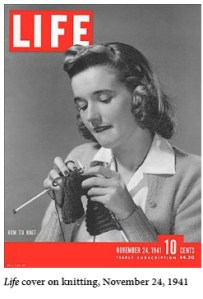
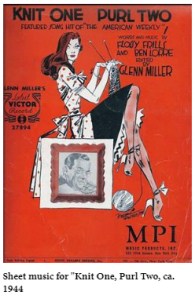
Government restrictions seriously impacted the clothing people could buy. My wife wasn’t around then, so I’me learning about color and fabric restrictions, knitting socks for troops, and the no-nonsense styles men and women wore then on line. Even Mrs. Roosevelt was purportedly knitting socks for the war effort. Needless to say, my bag lady doesn’t look like the lady on the cover of that sheet music.

If there’s a crime spree in your neighborhood targeting bag ladies, I have an alibi–enough browser history to prove I’m here in my den doing research.

–Malcolm

Malcolm R. Campbell is the author of the recently released short story collection “Widely Scattered Ghosts.”


National Poetry Month: Harjo Wins Jackson Poetry Prize

“New York, NY – April 25, 2019 – Joy Harjo has won the 2019 Jackson Poetry Prize. The prize, endowed by John and Susan Jackson, is awarded annually by Poets & Writers to an American poet of exceptional talent who deserves wider recognition. It carries a significant monetary award, increased this year to $65,000, and aims to provide what poets need: time and encouragement to write.”

Source: JOY HARJO WINS JACKSON POETRY PRIZE | Poets & Writers

Best of news. Of course, I’m biased. She’s one of my favorite current poets, mentioned here earlier this month

–Malcolm