Keeping track of the old stories

“If you know or happen upon a story, record it in some way. As a voice memo on a phone. In written form. Do the same with your friends and relatives. And archive the stories or send them to someone who keeps folklore records. Because this preservation is vital to ensure that we do not lose our old traditions or beliefs. Never assume that everyone knows why a particular road, or field, is called by a certain name. If you know the history, record it. Otherwise you do not know what may be lost in the future.” – Jon Buckeridge in “Once Upon a Time: Folklore and Storytelling” in The Folklore Podcast

Wikipedia Photo – Dutch Proverbs

Folklore is easy to lose. Mainstream history often runs roughshod over local stories. The stories themselves may have been passed from person to person to the extent that details have been lost or exaggerated or even changed. Yet, if the participants and places aren’t famous, the stories may be forgotten.

As writers, we can help keep those stories alive by writing down those we know and disseminating them in nonfiction or as the basis of our fiction. These stories can add a lot of depth to a novel.

When my wife and I moved to a small Georgia town in 2002, the subdivision we chose was once part of a farm. The subdivision was named after one of the city fathers; his name can be found in local and county histories, and in walking tour notes. The subdivision’s streets were named after members of the farm family. We were the first owners of a house that had been built the year before. You could see in the property’s deeds who owned it before we did. But you won’t find the links there between the street names and the family members’ names.

Long-time residents had known the family, so in time we learned where the street names came from. The developer/builder also knew this. We moved out two years ago. I wonder how many people in that neighborhood today know where their street’s name came from. I don’t recall the homeowners association documents including any neighborhood history. In a brief Google search, I can’t find that information on line.

I’m sure somebody in town still knows it. But have they written it down? If not, the information will disappear in time along with any remembrances people had of the family members and what they did or where they ended up. Quite likely, none of them are famous and, to my knowledge, they didn’t factor into any city or county news stories of note. But in a lot of locales, the names of streets have histories connected to them that might make for good background information in a short story of a novel.

“Stories are the very basis and heart of folklore. Certainly, when you look back at cultures that did not have a recorded history per se, or who relied on outsiders to chronicle their histories, the essence of them is held in the stories. Without those stories they will die. We need people with passion and drive to not let them die. For Jon, it does not matter whether you believe that the supernatural elements of these stories are real; what matters is that the stories, the culture and the history, and heritage of those who call a place home is preserved and held up for future generations. It is something that every person has a right to.” – Podcast Introduction.

Many of us remember our parents and grandparents telling us family stories when we were young. We remember some of them, but unless we wrote them down, we’ve probably forgotten most of them. Too bad: that’s the kind of information that can be passed down to children and grandchildren and, when it figures into the local history and development of a town or county, it quite possibly should end up in local history books, short stories, and novels.

–Malcolm

Malcolm R. Campbell’s Kindle short story (which is based on Florida folklore) “En Route to the Diddy-Wah-Diddy Landfill While the Dogwoods Were in Bloom” has been nominated the 2018 Pushcart Prize.
Should Authors Use Chapter Titles? 

“I ran across this question recently in a Facebook group, and noted there was a lot of opinion on it. Some authors are vehemently opposed to using chapter titles, while others adore them. So, what’s best?Well, the simplest answer is that it’s entirely up to the author. However, chapter titles do tend to be more prevalent in certain genres, so if that’s one you write in, you may want to adopt them.”

Source: Should Authors Use Chapter Titles? ‹ Indies Unlimited ‹ Reader — WordPress.com

R. J. Crayton provides tasty food for thought about the use of chapter titles, noting that some genres tend to use them more than others. I tend not to use them because I don’t like to tip off readers about what’s coming up.

Fortunately, Crayton doesn’t suggest a return to old fashioned chapter titles of the sort that were (a) long, and (b) spoilers, such as: Chapter Three – Where Bob Learns That When His Ship Goes Down Near Cuba, There Are Real Sharks in the Water.

Indies Unlimited offers another good post for writers.

–Malcolm

How to become a famous writer

Years ago, ruffians from the English department posted a gag flyer on school bulletin boards showing a hopeless oaf pictured with the quote: “Yesterday I couldn’t even spell ‘writer.’ Now I are one.”

For me, that flyer began a long-time distrust of high school and college English departments. The reasons run deep and belong in another post. Suffice it to say, English departments aren’t high on my list of steps to take in becoming a famous writer. Instead, I suggest the following:

Don’t Write Good.

Readers don’t like good even though many of them claim them have to have read “the good book” and that they adore every novel that features people who helps the homeless or who starve their families while donating time and money to the Salvation Army.

What readers really want is bad. Why do you think they liked The Da Vinci Code? “Christ, you’re telling me Jesus was married? Where can I get my copy?” They like heroes who use unnecessary force (as seen on the show “24”) because those tactics bring the kinds of results that generate closure to readers fighting for simple answers that work in a complex, politically correct rules.

It goes without saying that readers also buy books with back-cover blurbs like “Nymphomaniac Defrocks Beloved Priest in Forgotten Monastery” and  “Shy Housewife Kills Terrorists in Downtown Chicago with Illegal Weapons Stolen from Wimpy Cops.”

Commit a Crime

Writers with platforms sell books. If you threw your mama from a train, you have a much better chance of writing salable books than a hapless MFA-graduate whose “platform” is (a) writing good, (b) An MFA, and (c) A resume filled with angst-ridden poems and short stories set in an unbelievable universe where angst-ridden stuff actually gets onto bestseller lists.
A criminal record shows prospective agents and publishers you know how to catch the public’s attention and produce a novel that will sell 50,000 copies or more and attract options from Warner Brothers and 20th Century-Fox. What you don’t want is a novel that might attract options from the Hallmark Channel because it produces material from authors who write good.

Caution: Judges and lawmakers generally won’t allow a person to profit from a crime. If you write a novel called How I Threw Mama from the Train, your earnings will be confiscated if you really threw your mama from a train. Write about something else, using your fame as a criminal to get the attention of agents, publishers and readers. Your stuff might sell if you write good even though writing bad is better.

Become a Movie Star

If you’re a movie star or a famous Hollywood personality who looks like a slut or a stud on the red carpet, you can become a bestselling author even if you’re illiterate. How? Ghostwriters, darling. A sure way to get a publisher’s attention is by “writing” a memoir or novel based on a true story that dishes out plenty of scandal about your co-stars, lovers, and agents. The public adores stories that tell them their favorite stars aren’t really as pure as the driven snow. A bonus for movie stars is writing a book about an issue even if an expert writes it for you. Do this, and you’ll soon be testifying at Congressional hearings even though you probably know less about the issue than the average man or woman on the street.

The famous movie star approach also works for famous senators, representatives, governors, politicians and other idiots who are smart enough to understand that readers want your name on their coffee tables even if they never read a word of the drivel between the covers.

Plagiarize, Get Caught, Repent

Create a novel with a compelling plot, multidimensional characters, and a jaw-dropping title that, under normal conditions, will probably sell only one hundred copies.  Not to worry. This novel will have a secret weapon, and the big payoff comes when the secret is discovered: you’ve stolen thousands of its words from famous novels. When people find out, you’ll deny it, of course. Your readers will hate you. As your crime becomes harder to deny, you’ll claim “fair use.” That won’t work, but it may keep the wolves from your door for a while.

Finally, you’ll issue a news releasing claiming that Satan told you to do it and that your heartily sorry and never meant to harm anyone. You’ll refund the money you’ve made off the book and check yourself into a rehab center. Several years will go by. People will forget you. That’s when you strike with a book written in your own words. Readers will buy it like hotcakes because folks love repentant sinners who reform and start walking the straight and narrow. Even the New York Times bestseller list and Oprah will love you.

Your English teachers will never share any of these secrets with you. That’s okay, because nobody really needs those people as they much one needs oneself and a plan for success that really brings in the big bucks.

Malcolm


‘How?’ – the motive power of the novel

Journalists are taught that basic news stories focus on the 5Ws and the H, that is, who, what, when, there, why, and sometimes how. Consider this lead to a news story:

City council members Roger Daniels and Steve Tanner were killed when their sports utility vehicles collided at the corner of 5th and Main during the morning rush hour here today.

  • Who: Roger Daniels and Steve Tanner
  • What: Two Deaths
  • When: This Morning
  • Where: 5th and Main
  • Why: Automobile collision

If the story was written soon after the wreck, the how isn’t known? Since those involved were city council members, there may be a follow-up story explaining how it happened even before a police investigation is completed. In terms of the 5Ws, there aren’t many variations of automobile crashes at intersections.

Some gurus suggest that there aren’t many plot variations available to novelists either. They say the number is finite and/or that–in terms of the basic who-what-when-where-why series of events–all of the universe’s stories have already been told. So why, then, are writer still writing?

Because of the how.

In an interview in the September/October issue of Poets & Writers, Salman Rushdie says that James Joyce’s novel Ulysses doesn’t have much of a plot, that is to say, the who, what, when, where and why are very spartan. As he puts it, “Man works around Dublin for a day.” A lot of people do that, if not in Dublin, in some other city.

Wikipedia photo

“But the how,” he adds, “is what makes this a gigantic work of literature.” A story, he believes, “works” or “doesn’t work” based on the how. He suggests writers should take an organized approach when they contemplate writing a new story, asking themselves what are they writing about, what’s the story there, whose story are you telling, and why are you telling it?

But the important questions are how are are doing it? and why are you doing it like that?

Whether you take an organized approach via such questions, outlines, and other pre-planning or begin with a notion and simply start writing to see where the story goes, the how is the real story. A Dylan Thomas fan, I’ve always liked his poem “The Force That Through The Green Fuse” that begins: “The force that through the green fuse drives the flower/Drives my green age; that blasts the roots of trees/Is my destroyer.” That force is energy.

I see that force in stories as roughly defined by the “how of it all.”

If you were to develop a short story using the events in the accident story above as the plot, it’s likely that the story wouldn’t become a gigantic work of literature if how it happened turned out to be that one of the drivers was texting and ran a red light.

But what if it was a murder/suicide? What if criminals jimmied the brakes in both cars? What if one or both men were being controlled by a witch? Okay, now we might be going somewhere readers can’t help but read about.

–Malcolm

Malcolm R. Campbell is the author of “Eulalie and Washerwoman.” People are kidnapped everyday, but how Eulalie stops this from happening is the true energy behind the story.


Conjure Formulary: Devil’s Shoe Strings

Devil’s Shoe Strings are the root from Viburnum Opulus (aka cramp bark, Guelder-Rose, water elder, European cranberry bush) and several other similar plants that conjurers use for protection, breaking jinxes and for bringing good luck and money.

Wikipedia photo

As the name Guelder Rose indicates, the plant supposedly originated in the Netherlands. The plant stands out in with its showy white flowers in April and May, and its red fruit in the fall. While it can be invasive, it is often used in yards as a hedge, attaining heights up to 15 feet. The flowers attract butterflies and the fruits is somewhat edible (but not right off the plant).

Indians smoked camp bark as a tobacco substitute and used it to relieve spasms and cramps associated the pregnancy. According to Web MD, “These days, the bark and root bark of this plant are still used to make medicine. As the name suggests, cramp bark is used for relieving cramps, including muscle spasms, menstrual cramps, and cramps during pregnancy. Cramp bark is also used as a kidney stimulant for urinary conditions that involve pain or spasms.”

Roots as sold by a conjure shop. Lucky Mojo photo.

In conjure, devil’s shoe strings from Viburnum Opulus and similar plants have a wider variety of uses. Mixed with dirt from an enemy’s yard and red pepper, devil’s shoe strings send curses back to the person trying to harm you. Put them in your mojo bag sith a silver dime and high John the conqueror root for general protection. Put them in a bottle of whiskey or Hoyt’s Cologne, let sit for nine days, and then dampen your hair with the coction for good luck.

As Conjured Cardea notes, “Devil’s shoestring is used for protection, to ‘trip up the devil’ so he can’t get in your home or life. They are also carried for gambling luck and for gaining employment. Some folks drive them into the ground around the front door or place a bundle of them above the door or mantelpiece. In the beginning of hoodoo, people would wear an anklet made with nine pieces of devil’s shoestring and a silver dime to prevent being ‘poisoned through the feet’ by stepping in goofers dust or other foot-traffic tricks.”

You need not be a conjurer to enjoy the plant because it just looks darned pretty in your back yard in hardiness zones 3-8.

–Malcolm

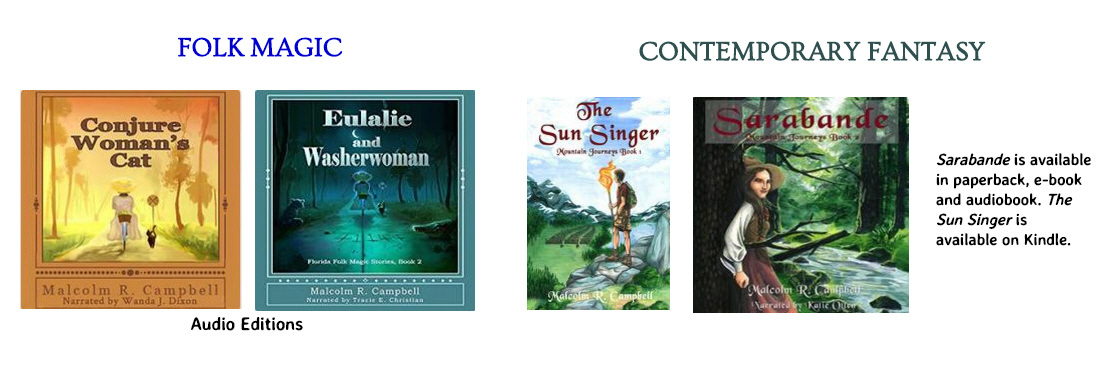
Malcolm R. Campbell is the author of four conjure novels, “Conjure Woman’s Cat,” “Eulalie and Washerwoma,” “Lena,” and “Fate’s Arrows.” They are available in e-book, paperback, hardcover, and audiobook editions.


Those messy website blues

Like a new car, a new website looks sleek, clean, and is the envy of everyone who sees it. However, like cars that get older and no longer are washed or given scheduled maintenance and oil changes, websites start showing their age as well.

Last night on MasterChef, chef Ramsay told one of the contestants that his dish was confusing because it wasn’t cohesive and was more like a smorgasbord of flavors that didn’t go together. This is another way of saying that–like the old car–a website that’s messy, confusing and probably difficult for new visitors to figure out isn’t helping you.

When I set up my website (Conjure Woman’s Cat), I had great intentions. I was going to keep it squared away (a navy terms that means “shipshape”) rather than than letting it look like our old Buick or the top of the desk in my office.

I chanced upon a writer’s website article that basically said, if you’re website is screwed up, you won’t be kissing your books goodbye because nobody will be buying them. This caught me attention because sales have been lower this year than last year. Partly, that’s Amazon’s fault for establishing a new ranking system that’s biased in favor of bestselling books from mainstream publishers. Even though the rest of us are in the chopped liver category, it was obvious to me that I needed to clean up and streamline the website.

This has taken the better part of two days. It’s by no means perfect. On the other hand, it no longer has a garage sale kind of ambiance surrounding it. One thing I tossed out was a synopsis of each of my older books. This made the site too wordy and added pages. So, I’m featuring my two latest books and putting everything else in a catalogue of covers. Might be a mistake, but the result is certainly a lot easier to figure out.

In the business world some years ago, the word “agile” was often used to refer to companies that could change quickly with the times whether they needed new products or new ways of talking about their current products. I think authors need to be agile in this way in their presentations and promotions. While the books are the same books we published some years ago, we need to find new ways of capturing people’s attention.

So, I cleaned up my website an hour ago. So far, neither Oprah or Warner Brothers has called, but I can always hope.

–Malcolm

Florida Wildflowers: Seaoats

“Seaoats are important dune builders and protect beach dunes from erosion. It is unlawful in Florida to destroy or take this grass.” – “Florida Wildflowers: a Comprehensive Guide” by Walter Kingsley Taylor

“It shall be unlawful for any person to cut, collect, break or otherwise destroy sea oat plants, Venus’s-flytrap plants or any part on public property or on private property without the owner’s consent. Any person violating the provisions of this section shall be guilty of a misdemeanor and upon conviction shall be fined not more than two hundred dollars or imprisoned not more than thirty days nor less than five days. Each violation shall constitute a separate offense.” – SC Code § 16-11-590 (2013)

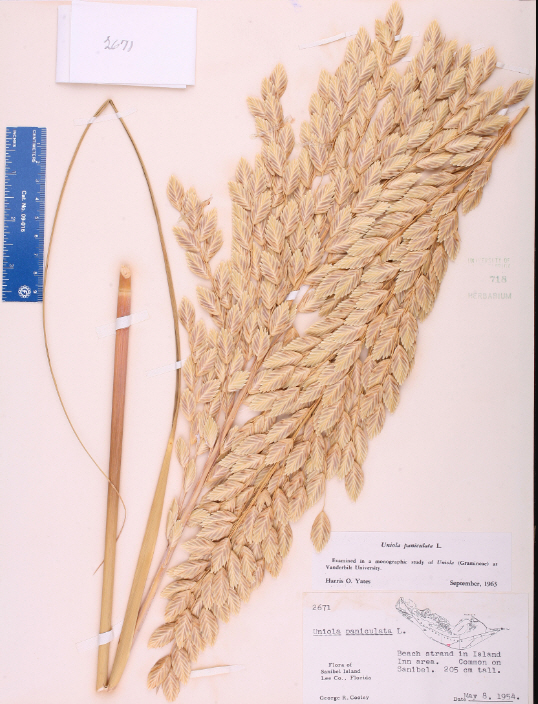
Herbarium Specimen – Atlas of Florida Plants photo.

Seaoats (Unicola paniculata) are perennial grasses, often clumped and with vast root systems, that can grow over six feet tall that are found throughout the state in coastal uplands and beach dunes. The flat, inch-long flowers (spikelets), which are slightly purple or the color of straw, blooms throughout the year.

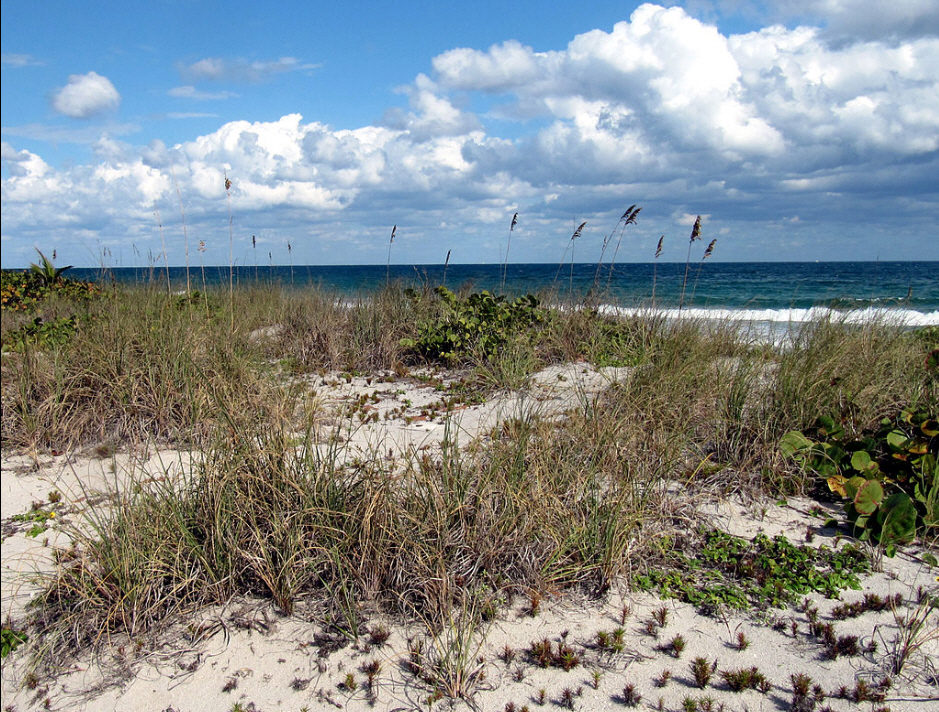
Seaoats can be found along the coasts and on barrier islands along the eastern seaboard from Virginia to Florida. Seaoats are very tolerant of salt spray. They are also very heat and drought tolerant and green until late in the summer. While the conditions under which they thrive reduce encroachments from other plants, beachfront development is a primary threat. (As you can see in the Florida state park photo below, developers, dune buggy enthusiasts, and others are likely to write the plant off as a weed.)

Some people like using them as accents in flora arrangements or as the focus of dried arrangements–one reason why some areas classify the grass as a threatened or endangered species as well in addition to being vital to soil stability within its habitats. They not only protect dunes year around but are an important factor in protecting coastal areas from the erosion associated with tropical storms. Restoring seaoats often becomes an important part of dune restoration programs.

Seaoats provide food for songbirds, burrowing owls, mice and marsh rabbits. While the grass produces numerous spikelets, these don’t generate a lot of viable seed. Fortunately, the seeds don’t have any important commercial value.

Seaoats on the crest of a dune at the John U. Lloyd Beach State Park, Florida – Wikipedia photo.

“What is so tantalizing about sea oats, making one wish to break the law to have sea oats in their own garden? For starters, they have a striking appearance growing and swaying in the slightest breeze. The decorative plumes (seed heads) are often dried and placed in floral arrangements, or displayed alone as a focal point. Sea oats are quite easy to have without breaking the law, but few people are aware seeds and/or plants may be bought legally from nurserymen licensed by the state of Florida to propagate them. These nurseries supply sea oat plants to local, state and federal government agencies for dune restoration after hurricanes; the nurseries are allowed to sell them to the public as well.” – Darius Van d’Rhys

Seaoats are edible (browned or used as a cereal), but if you want to try them, you have to grow your own. Note that the plant is not the same as Inland Sea Oats (Chasmanthium latifolium) that often grows as a ground cover in open areas and is found in northern states as well as the southeast.

–Malcolm

For a chance to win a free Kindle copy of “Conjure Woman’s Cat,” see the Amazon giveaway which runs through August 8th.


Going into the dark

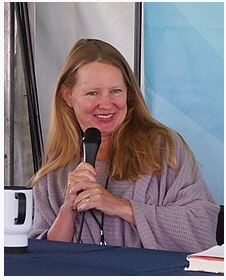
“The space Hunt’s fiction inhabits is the dark dark itself, which, she writes, is ‘unknowable, unlit, mysterious, and disappearing.’ ‘You can have one foot in a spot that’s grounded,’ she says, ‘and one foot out there in the dark, the night, the unknown, which is so tempting, and for me is the place where mystery is sighted. I can’t not go into the unknown. Where the scary music is playing and people say, ‘Don’t go in there,’ I’m the person who says, ‘What’s in there?’ I must know.”

Lucas Loredo, interviewing Samatha Hunt (“The Dark Dark”) in Kirkus Reviews

Going into the dark, I think, is the author’s first duty. That’s where our stories come from, from truths that are greater than logical, everyday world truths because they include dreams, imaginations, ponderings, and whatever goes bump in the night.

When Hunt writes in Mr. Splitfoot, “These woods are where silence has come to lick its wounds” she’s not stating anything logic can support. But we know what she means and what she means changes us the minute we consider it and know it. Perhaps, thinking of this quote, we go into the woods, hear silence at work. and understand something knew about our world, or at least, ourselves.

The writer either has to go into the woods first and discover this “truth” or s/he has to imagine going into the woods, almost like a shamanic journey, and discover what silence does. Then s/he places this discovery into a poem, essay, or story. This is not to say that writers must think and write like Samantha Hunt (though it helps); but writers must go into the unknown one way or another. That’s where the new stories are.
Whether you literally or figuratively go into the dark woods to listen to the silence or to the occasional screams and pleas that shatter that silence, you are doing something chaotic, uncontrolled, fearful, and possibly dangerous. The greater the chaos and danger, the more spectacular–and potentially transformative–the story. No pain, no gain, as people say.

The resulting story, as author Jane Yollen says–echoing Emily Dickinson–is truth told on the slant. In other words, “All storytellers are liars. We make up things to get at the truth. The truth of the story and—if we are lucky and have revised well—the truth of the world as well.”

You have probably heard–or discovered in a physics class–that when a tuning fork is struck with a hammer, a nearby tuning fork will vibrate at the same frequency. As I once wrote in a review of a book about the blues, and why that music is so powerful, “In his 1967 inquiry into the nature of man, Man in Search of Himself, physicist Jean E. Charon writes that inasmuch as the material in the unconscious is in archetypal form, works of art communicate it via an innate knowledge shared by artist and viewer in a language which ‘awakes unconscious resonances in each of us.'”

Hunt – Wikipedia photo

When a reader finds silencing licking its wounds in a poem or story and is the kind of reader attuned to such ideas, s/he will see the truth of those words at a slant, so to speak. They will convey a truth, an idea never considered, bring forth a new way of looking at wounds and woods and silence that was–in this reader–waiting to be born. Thinking of Yollen again, this is what she calls “life in truth” rather than “truth actual.” Truth actual is the apparent logical workings of the everyday world, what we expect in credible news reports and expert testimony and scientific studies. Life in truth includes the realities behind the ever-addictive illusion of a logical world.

Darkness, the place where seeds germinate to create the flowers we will one day observe, is the same place where writers’ stories germinate. As Hunt says, writers want to go into the dark to see what’s happening there and then write a story or a poem about it. Or, maybe even a blog post.

Writers seem to learn at an early age that the ability to see in the dark is a prerequisite to telling a good story.

–Malcolm

Malcolm R. Campbell is the author of Conjure Woman’s Cat and Eulalie and Washerwoman, magical novels that are on sale on Kindle on 7/21/17 – 7/23/17.


Teach your writing students not to follow the crowd

“I have no doubt that writing can be taught—but here the burden of responsibility falls mostly on the teacher, not the writer. By this I mean that writing must be taught in a way that emphasizes discovery and growth of the student-writer’s voice, rather than emphasizing adaptation of a writer’s voice to a history of literature or to current trends in literature. I believe that this is the best way to foster originality and freshness in young and so-called ’emerging writers.’” – M.B. McLatchey

Writing programs are sometimes criticized for emphasizing the best of prevailing styles of storytelling so that students end up stuck in conformity, to turning out more or what’s already been turned out by the successful writers of the day. If so, then the teachers are basically saying, “Based on the evidence, this is what editors and publishers want now, so you need to supply it.”

When I was in school, my teachers emphasized the best of the past, the so-called canon of novels we were all supposed to read to become educated. Plus, those books purportedly showed us what we needed to do to become successful authors.
We need to read new stuff and old stuff because we want to be storytellers and for us little is more enjoyable than a good book. In reading, we discover what works and what doesn’t, for we are either pulled into the tales or we’re not. At this point, the students won’t need prescriptions from the teacher so much as a blank piece of paper and a wide open door.

The sky’s the limit out there. Go find it without charts and maps, outlines, lists of DOs and DON’Ts, or recipes for success based on either history or the trends of the day. Given a chance, the student will find his/her voice and style. When s/he returns to the classroom, we can talk about the results–is there a compelling story on the page or not? If so (or if not), we can lead the students into figuring out why there is or isn’t.

If the teacher says “this is why it works” or “this is why it doesn’t work,” then those pat answers begin to channel students down roads being used by the writers that teacher admires or dislikes. When the student sees (without being led) why his/her stories are working, then s/he is ready to emerge from the classroom with the capability of telling unique stories and organic styles that belong to them alone.

–Malcolm


How well do you remember events of ten or twenty years ago?

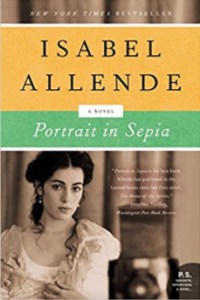
“Memory is fiction. We select the brightest and the darkest, ignoring what we are ashamed of, and so embroider the broad tapestry of our lives.” ― Isabel Allende, Portrait in Sepia

I first read Portrait in Sepia when it was released in 2000. As I re-read it for the first time this past week, I thought “how ironic this is that this is a novel about memories and I’ve forgotten most of it.”

The storylines of books tend to run together for me because I read a book per week. However, Allende is one of my favorite authors so, logically, I ought to remember more of each novel’s details. Except for high energy action books, I tend to read novels closely; I don’t scan sections or skip descriptions or conversations to get to the so-called “good parts” (as some people call the pivotal scenes).

Several weeks ago, I re-read The House of Spirits, a novel I read in 1982 when  it came out and one other time before this year. Again, the details were so hazy it was almost like reading the story for the first time. I can understand why high school and college literature teachers tell us they re-read the books they teach every semester that they reach them.

Even though I forget so many details of novels, I discover new things every time I re-read them. So, in addition to the surprise at how much I’d forgotten, there’s the excitement of seeing a character or an even in a new way.

When people ask me about my childhood, obviously I know most of it. Or, maybe I don’t. If I can’t remember a book in any detail several years after reading it, how reliable is my memory about anything in my past or the country’s past? Sketchy, at best. Though family Christmas letters have long been mocked as falsified (or carefully told) versions of what a family did during every past year, the only way I could be sure when I did something thirty years ago was looking in a binder of old Christmas letters to see what year something happened.

Things get worse when I realize that after using fictionalized bits and pieces of things I saw or did in some of my own novels, I begin to see that the line between what I really did and what a character did in my novel has gotten a little blurry.

We’ve heard often that those who witness traffic accidents and other events are often unreliable. They think they have a clear picture of the event when, in fact, they don’t. They think their view of an event was like that of a stationary security camera. In  reality, they glanced away at noises, movements of other people, etc. What they didn’t see, they think they did see because the mind fills in the gaps with what it thinks probably happened. They don’t know they’ve done this, and experts say that a lie detector test won’t pinpoint discrepancies in their versions of events.

An article in the current “Writer’s Chronicle” deals with this issue for the authors of memoirs and historical novels. It’s called “The True Story? How to Deal with Evidential Gaps While Writing a Biography,” by Viola van de Sandt. What really happened during such gaps often comes down to circumstantial evidence. Sometimes, important events can only be sketched in and presumed through fragments of diaries, articles, letters, etc.

I have often wished I’d kept a diary, a cut-and-dried account of daily events. I tried multiple times, but could never stick with it. So I have a lot of gaps in my own personal history. As Allende’s protagonist in Portrait in Sepia said, “I try desperately to conquer the transitory nature of my existence, to trap moments before they evenesce, to untangle the confusion of my past. Every instant disappears in a breath and immediately becomes the past; reality is ephemeral and changing, pure longing.”

I assume my memory is faulty. It’s been proven to be that way many times. Who I am and what I think I saw of daily events is more of an approximation than anything else. If you have a foolproof method of keeping track of your past, I’d sure like to know how you do it.

Malcolm

My novels At Sea and Mountain Song are partially based on my own experiences. But I can’t promise you I know the fact from the fiction in them.