Yogi Berra once said, (and I’m paraphrasing rather than looking it up) If you don’t know where you’re going, you might not get there.
I’ve inserted this clip art to make the post look easier to read.
This is the case when I write. I just read in the latest issue of Poets & Writers Magazine that author Richard Powers creates what amounts to a huge outline and treatise before he begins writing a novel. Far be it from me to criticize his approach because whatever he’s doing is resulting in great work.
Yet it gives me the willies. It reminds me of the research papers we did in high school where we had to turn in our note cards and outlines along with the papers. I always prepared that crap after I was done with the paper because none of it helped me write the paper. It doesn’t help me write stories now.
I think that I would miss a lot of opportunities if I created a synopsis and outline before I wrote anything. Just yesterday, I was writing with no roadmap and two new characters showed up. With my usual tact, I said, “who the hell are you?”
The ghost, whose name is Slappy, said who he is is none of my business and that I’ll discover whatever I need to know as the story unfolds. Shauna was more politically correct. Referring to my muse, she said, “Siobhan sent me. I’m supposed to play the role of a graduate student on an internship at the haunted theatre in your story.” I guessed that Slappy was there to help out with the haunting.
So far, they’ve worked out well. But, if I’d had an outline, my receptionist Gypsy Rose Lee would have turned them away at the front door. The story wouldn’t have been as much fun to write, and none of my adoring readers would have said, “How do you think up characters like this?” I would lie–because that’s what writers are expected to do–and say “my imagination.” In reality, I don’t think them up. They show up.
If you’re a planner, my approach will drive you insane. It might have already driven me insane though, typically, I’ll be the last to know. Meanwhile, I like surprises. They make writing a story as much fun as reading a story because I never know what’s going to happen next.
–Malcolm
Malcolm R. Campbell is the author of “Florida Folk Magic Stories,” a collection of my three magical realism novels, “Conjure Woman’s Cat,” Eulalie and Washerwoman,” and “Lena.”
“O, give me a home where the buffalo roam. Or a chrome-and-glass condo where the TV is on. A chipped wooden bench in a broken down railway station, under a clear, open New England sky. Or an ornate hotel lobby, hushed, with velvety banquettes, the clinking notes of silverware and china from the dining room. A sudden, rushing downpour in the fall, or searing dry heat, or the squeak of boots in snow. The dusty interior of a pick-up truck’s cab, where the characters sit in silence listening to the engine tick as it cools.” – Sarah Van Arsdale in “Atmospheric Pressure: Using Setting to Create Atmosphere & Emotions,” The Writers’ Chronicle, October-November, 2018
When a character in the novel you’re reading cuts her finger, can you smell the blood?
First edition
For years, new writers avoided describing settings in their short stories and novels because they suffered through ancient novels in high school and college literature classes with thousands of dreary words of description. Description fell out of fashion. On the plus side, readers no longer had to feel guilty when they skipped multiple long paragraphs of description. On the minus side, readers were likely to end up with a cacophony of disembodied voices in a dark room–and they were lucky if the author bothered to tell them the room was dark.
So now, authors are (I think) learning that their stories are better when they engage the five senses. Van Arsdale writes that “Readers bend toward setting because we’re bound to it with our physical bodies, we feel the humidity rise without even checking the Accuweather forecast, or we smell the damp, cave-like earth as we approach a subway station.”
I just finished re-reading Shirley Jackson’s novel “The Haunting of Hill House.” Now there’s a novel where the reader definitely knows where the characters are at and what they and the house smell like:
“No Human eye can isolate the unhappy coincidence of line and place which suggests evil in the face of a house, and yet somehow a maniac juxtaposition, a badly turned angle, some chance meeting of roof and sky, turned Hill House into a place of despair, more frightening because the face of Hill House seemed awake, with a watchfulness from the blank windows and a touch of glee in the eyebrow of a cornice.”
Place settings can be somewhat ephemeral such as this one in Mark Helprin’s “Winter’s Tale”:
“Winter then in its early and clear stages, was a purifying engine that ran unhindered over city and country, alerting the stars to sparkle violently and shower their silver light into the arms of bare upreaching trees. It was a mad and beautiful thing that scoured raw the souls of animals and man, driving them before it until they loved to run. And what it did to Northern forests can hardly be described, considering that it iced the branches of the sycamores on Chrystie Street and swept them back and forth until they rang like ranks of bells.”
Or somewhat more literal like this passage from Cormac McCarthy’s “Blood Meridian”:
First edition
“They rode on and the sun in the east flushed pale streaks of light and then a deeper run of color like blood seeping up in sudden reaches flaring planewise and where the earth drained up into the sky at the edge of creation the top of the sun rose out of nothing like the head of a great red phallus until it cleared the unseen rim and sat squat and pulsing and malevolent behind them.”
There’s no need for ungainly paragraphs of description as Pat Conroy shows us in “South of Broad”:
“San Francisco is a city that requires a fine pair of legs, a city of cliffs misnamed as hills, honeycombed with a fine webbing of showy houses that cling to the slanted streets with the fierceness of abalones.”
Now here’s a passage from Erin Morgenstern’s “The Night Circus” which is a bit long for some of today’s readers, but the writing easily holds the attention of the adventurous reader:
“The finished clock is resplendent. At first glance it is simply a clock, a rather large black clock with a white face and a silver pendulum. Well crafted, obviously, with intricately carved woodwork edges and a perfectly painted face, but just a clock. But that is before it is wound. Before it begins to tick, the pendulum swinging steadily and evenly. Then, then it becomes something else.
The changes are slow. First, the color changes in the face, shifts from white to grey, and then there are clouds that float across it, disappearing when they reach the opposite side. Meanwhile, bits of the body of the clock expand and contract, like pieces of a puzzle. As though the clock is falling apart, slowly and gracefully.
All of this takes hours.
First edition
The face of the clock becomes a darker grey, and then black, with twinkling stars where numbers had been previously. The body of the clock, which has been methodically turning itself inside out and expanding, is now entirely subtle shades of white and grey. And it is not just pieces, it is figures and objects, perfectly carved flowers and planets and tiny books with actual paper pages that turn. There is a silver dragon that curls around part of the now visible clockwork, a tiny princess in a carved tower who paces in distress, awaiting an absent prince. Teapots that pour into teacups and minuscule curls of steam that rise from them as the seconds tick. Wrapped presents open. Small cats chase small dogs. An entire game of chess is played.
At the center, where a cuckoo bird would live in a more traditional timepiece, is the juggler. Dress in harlequin style with a grey mask, he juggles shiny silver balls that correspond to each hour. As the clock chimes, another ball joins the rest until at midnight he juggles twelve balls in a complex pattern.
After midnight, the clock begins once more to fold in upon itself. The face lightens and the cloud returns. The number of juggled balls decreases until the juggler himself vanishes.
By noon it is a clock again, and no longer a dream.”
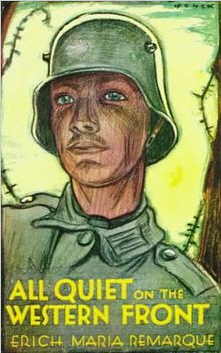
Growing up, I had more trouble getting through “All Quiet on the Western Front” by Erich Maria Remarque than any other book I was assigned to read in an English class. It was more real than I could tolerate because the author made sure I could smell the blood:
First English language edition
“I lie down on many a station platform; I stand before many a soup kitchen; I squat on many a bench;–then at last the landscape becomes disturbing, mysterious, and familiar. It glides past the western windows with its villages, their thatched roofs like caps, pulled over the white-washed, half-timbered houses, its corn-fields, gleaming like mother-of-pearl in the slanting light, its orchards, its barns and old lime trees.
“The names of the stations begin to take on meaning and my heart trembles. The train stamps and stamps onward. I stand at the window and hold on to the frame. These names mark the boundaries of my youth.”
Van Asdale writes that in spite of the author’s infatuation with his or her main character, s/he must bring that character “to a real place and time for examination. Bring the reader into the cab o the pickup truck; turn the radio on low. Or roll down one window, to hear the crickets, or those far-off traffic sounds. Watch. Listen. These details allow the atmosphere, and who among us hasn’t sat in a car late at night, talking, awash with emotion? This is what it is to create atmosphere, and to allow atmosphere to give rise to emotion. And that is, ultimately, the reason for digging your spade deeply into setting.”
I love stream-of-consciousness writing and interior monologues from characters who may or may not be reliable narrators. But even if you don’t want to tackle techniques on the cutting edge of fiction, you can still–with apt words and on-point sketches–find enough details about the setting of your story to immerse your reader into the center of the plot.
“Seven years ago, the Evil Mastermind launched Indies Unlimited. Since then, we’ve had over 2.5 MILLION page views, been named as one of Six Great Blogs for Indie Authors in Publishers Weekly, and ranked as one of the top writing-related sites by Alexa.”
Indies Unlimited is the go-to blog for writers learning their craft and then learning how to market their work in competition with the one million self-published books released each year. Since the blog is run by volunteers, it’s obviously a labor of love, though I hate using that hackneyed old phrase to describe their work.
Even if you don’t have time to check the blog every week, a scan through their archive of posts will usually materialize what you’re looking for whenever you have a question or the need for a little inspiration.
I hope Indies Unlimited is going strong seven years from now.
Researching something that may or may not help with the next book
Considering a job in the real estate business–or, basically anything other than writing
Reading another author’s books as an excuse for not writing
Studying potential marketing plans in hopes of competing with James Patterson and Catherine Coulter (haha)
Spending more money on a new website that costs more than his or her books are likely to earn
We’re always writing even if we’re not actually writing
I guess all of the above are true. Yesterday afternnoon, my wife and I went down to Duluth, Georgia to the Southeastern Railway Museum’s celebration of its move to a new site some twenty years ago. We had fun seeing a museum we hadn’t been do in a very long time. We moved away (twice) and volunteering there was no longer possible.
Funny thing is, we wandered into the museum because I was doing research on railways for a book. We got trapped. We became volunteers. We worked our butts off for about ten years there. It’s easy to become derailed when you’re doing research.
Yes, I did write the book.
But for quite a few years, the museum was a passion because both my wife and I loved history.
As you may have heard, everything a writer experiences might end up in the next book. (I usually change the names to protect the guilty.) If you think one of the characters in one of my books, you’re right, it might be you. But here’s the thing: everything we see when we’re not sitting at a keyboard might become part of the next story. Figuratively speaking, we’re always writing.
We see our lives as a series of stories, Sometimes I write them down and they become novels. Like most authors, I don’t make any money doing that because very few authors in the U.S. actually make any money. But, we’re addicted to writing when we aren’t drinking.
–Malcolm
My latest novel is called “Lena” and takes place in north Florida when the KKK was still a real problem.
Fillet of a fenny snake, In the cauldron boil and bake; Eye of newt and toe of frog, Wool of bat and tongue of dog, Adder’s fork and blind-worm’s sting, Lizard’s leg and howlet’s wing, For a charm of powerful trouble, Like a hell-broth boil and bubble.
Macbeth, Act 4, Scene 1
When you read Macbeth and hear the witches chanting about the eye of newt and tongue of dog, don’t worry. Most of those ingredients are the folk names of herbs, not critters’ body parts. Here are those added by the second witch.
Fenny Snake – Fenny refers to fens (swamps).
Eye of Newt – Seeds of Black or Brown Mustard (Brassica juncea), which–in hoodoo- are used to confuse enemies. They are often mixed with sulfur powder.
Buttercup: Steve Matson photo from Califlora
Toe of Frog – Yellow Buttercup, including within the United States, the Western Buttercup (Ranunculus occidentalis Nutt), the seeds of which were ground up by Indians with other seeds for making a flour-like staple called pinole. The flowers themselves are considered poisonous.
Wool of Bat – Holly (Ilex aquifollium), meaning “holy,” used by Druids and other ancient Europeans. Holly symbolized male and female and Yule and is still considered in conjure as not only a blessing to the household and as protection for the home.
Tongue of Dog – Houndstongue (Cynoglossum officinale), also called dog’s tongue and gypsy flower. It was once considered a cure for madness and has been used by herbalists for a variety of ailments, including venereal disease and inflammations.
Dog-tooth Violet – Wikipedia photo.
Adder’s Fork – Dog-Tooth Violet (Erythronium americanum) and related species. It’s also referred to as rattlesnake violet and serpent’s tongue. It’s not related to the violet. In conjure, it’s used to stop slander and gossip and those who are using it against you. It is placed on the doorsteps of enemies or when meddling inlaws are the problem, mixed with slippery elm into a body wash.
Blind Worm’s Sting – This is a lizard that looks like a worm. It’s sting is it’s bite. Perhaps they used the poison or tossed in the worm.
Lizard’s Leg – Ivy, genus (Hedera) and other creeping plants. Potentially, might include poison ivy and poison oak. Ivy is for binding things together as well as for ensnarring unwelcome desires (including drinking too much.) One can spend days trying to unravel the folklore and symbolism of ivy throughout the ages, including the use of the plant as a crown. Holly and ivy are among the evergreens used to decorate houses for Christmas and Yule as symbols of rebirth.
Howlet – That is to say, an owl.
–Malcolm
Florida Folk Magic series of four conjure novels. Save money buying them together in this set.
My muse and I recently went out to a local biker bar and slammed down a case of Budweiser and several guys wearing badass tattoos and dirty clothes who thought we didn’t belong there.
We probably shouldn’t have made fun of the bikers who were drinking lite beer or were riding Mopeds.
My muse does not look like this.
The good thing about going to a biker bar is this: nobody asks what you do for a job. They assume the answer is either nothing or something illegal and that asking is a good way to get beat up. Suffice it to say, biker bars don’t have Enya on the jukebox. So, don’t expect much empathy there.
The bad thing about drinking with your muse is that she doesn’t like excuses. When you explain why you haven’t been writing lately due to __________, she says “So what?”
Yes, I’m trying to juggle three writing projects at the same time. That’s a first for me. I don’t like it. When I try to tell my muse why I don’t like it, she laughs and comes up with profanity so bad I didn’t even hear it in the navy.
As I told another writer years ago, “I don’t have a muse because high school literature courses portrayed muses as women who looked like they were dying of consumption or thought they were princesses.”
After saying that, a lady named Siobhan showed up and announced that she was my muse. The first thing I learned was that if I mispronounced her name, she’d kick the crap out of me. The second thing I learned was that she’s more psychic than I am. (For those of you who didn’t grow up speaking Gaelic, her name is pronounced “Shivahn.”)
“I want the best for you and your writing,” she always tells me. My response is usually, “You’re the lady who invented tough love, right?”
After a few Buds, we’re saying things that shouldn’t be said. Yet, I have to say, muses are more forgiving than spouses. You can tell as muse to “_____ off,” and she’ll always be there. You can’t say that to your wife or husband.
Basically, my muse thinks I’m hiding behind the research. That is, that I’m doing research long after it no longer matters and that it’s time to start writing the story. Okay, she may have a point. I do have a tendency to over-research everything I write. Maybe that’s because I started out as a journalist and a technical writer. Or, maybe that’s because maintaining that I’m still doing research is a good way to avoid doing any real writing.
I don’t think I’m the only writer who does this even though I’d probably buy a Harley if the main character in one of my novels rode a Harley. Accuracy’s important, right?
My muse said, “that’s a crock.” She also said, “Why aren’t you writing the story yet?” My answer is always, “Because I’m scared that I can’t.” Suffice it to say, she doesn’t buy that.
With over 70% of my hearing gone, I live my life in a fair amount of silence. Those of you who’ve been reading this blog since 2011, know that I used to select an album I liked and play it on a continuous loop while I worked on the manuscript for a novel.
Click on the image to see Deuter’s web site.
For The Sun Singer, the album was Georg Deuter’s “Nirvana Road.” For Sarabande, it was Mary Youngblood’s “Beneath the Raven Moon.” Deuter plays multiple instruments and his blending of them seemed to me very transcendent, a strong image I had for The Sun Singer. Mary Youngblood plays the Native American flute, and it speaks to me like a voice in the wilderness, at once a cry of pain and a hymn of praise, perfect for Sarabande. (I was listening while writing the first editions of both novels.)
I don’t recall how Youngblood found out about my use of “Beneath the Raven Moon” as a muse. Maybe “Google Alerts.” She contacted me, thanking me for enjoying and mentioning the recording. She said that since I already had that album, she would send me a copy of another album in exchange of a copy of Sarabande. So, we exchanged mailing addresses along with our latest work. I hope she had time to read it.
I have no words for describing what it meant to me to hear from her, for nobody plays the Native American flute better and every one of her albums spoke volumes to me. I was in a Blackfeet shop in Browning, Montana several years ago and one of the salespeople saw me looking at the flutes. When she asked if I wanted to buy one, I said, “Only if I start playing like Mary Youngblood.” She smiled and said, “Nobody plays like her.”
Click on the image to view her website.
I knew she had listened to Youngblood’s music because she not only knew the names of the songs but also held the opinion that Youngblood created voices with the flute that technically should be impossible to create. Sadly, I left the flute behind because I knew it would sound worse than a kazoo if I dishonored it by trying to play it.
Some years ago, I stopped playing albums while writing because I could no longer hear them. It was a loss because when I was listening to them, I never had writer’s block: the albums jumped started the writing every single time. I played Deuter’s and Youngblood’s albums so many times, that if I see (or recall) the name of a song, I can hear it within the silence of my imagination. Their albums are primarily instrumental, so there were no words to interrupt my chain of thought.
While writing the three novels in my Florida Folk Magic Trilogy, my imagination played the blues and gospel, primarily the same songs I mentioned in the novels. I grew up with the blues and gospel, in part from my parents’ 75 rpm records and partly from the appearances of many of the singers on early television variety shows. The one good thing about the music I hear into the silence in this way is that I can turn it up as loud as I want it without bothering either my wife or our two cats. It also hasn’t been ruined by today’s digital recording methods.
The blues in my imagination and memory were a very effective muse. When I was in high school and learned that Beethoven didn’t stop writing music when he lost his hearing. I didn’t understand how that was possible. Now I can.
“You need emotion to make a story compelling. But every story is really just a sequence of events that need to be told in the right order. Extraneous information slows a story down and can have people wondering about the ultimate point. It’s like telling a joke: You don’t go on detours about what the chicken was doing for the last three weeks before it crossed the road. You tell only the parts that propel the joke forward. The same applies to storytelling.” – Art of Charm
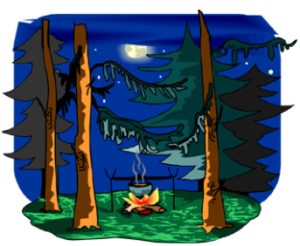
Campfires draw storytellers and audiences like moths to flames. The forest primeval, moon and stars, unknown animals hiding in the darkness, wind soughing through the trees, branches that snap, cries of birds, isolation from well-lit, safe, and civilized places, all these combine into a natural arena for the telling of tales.
If you read through sites like the Art of Charm, you’ll find many tips for telling a captivating story (with or without the campfire), including understanding that “Every story has an emotional core, and that emotional core is how the storyteller feels about the events they’re describing. Everything else is just window dressing.”
Don’t Duplicate Reality
Ineffective storytellers and those who can’t seem to tell a joke properly often think more is more. They not only put into too much window dressing but tell you how the windows were made and installed. The result is tedious because it’s not really a story, it’s a transcript.
While short passages of transcript-like, step-by-step narration can add impact, they usually destroy impact. They have all the excitement of a 24-hour webcam. The author and the storyteller must determine what’s not essential, what destroys the pacing, that dilutes the excitement and the fear and the derring-do.
Writing guidebooks frequently use the examples showing the difference between a recording of a real-life conversation and the same conversation as distilled by an author or a storyteller (because amateurs frequently believe that duplicating real life is the best way to convey a realistic story). While some say our lives are large-order stories, slices of life are not stories. For one thing, the reader/audience cannot spend the same amount of time reading or hearing a story as the same event took to unfold in front of that 24-hour webcam. Yes, you can say the webcam footage is real. But here’s the thing: real isn’t a story.
The successful author and captivating campfire storyteller will leave out most of that the webcam shows–or what their memories of the actual events they witnessed can recall. If you’re a reporter writing for a daily newspaper, you’ll take the most important moments of that webcam footage or that memory and put them first. Then you follow that up with increasingly minor details. That style is called the inverted pyramid because the most important stuff comes first.
Efficiently Moving from Beginning to End
The storyteller and the author do the exact opposite. They place the most important stuff at–or near the end–of their story or novel. As the story unfolds, the writer and the storyteller are very conscious about going from beginning to end in a dramatic way whether the story is driven by the plot or by a character. When thinking about what to leave in or leave out, the key is: does this fact, conversation, description, or thought propel the story forward? If not, it doesn’t belong there because it’s more transcript than art.
When a good editor says, “you need to tighten this up,” s/he means that the writer didn’t leave out enough of the stuff s/he should have left out and/or that even the important sentences are filled with extra words. When the Art of Charm says that the storyteller’s feelings about the story art important, we can take this advice in many ways. One way is that if the writer or storyteller doesn’t care, then neither will the readers or campfire audience. Another way is that when the writer or storyteller cares a lot, s/he will find it easier to pinpoint which “extra” scenes, descriptions, and dialogue weaken the tale-telling experience.
Knowing what to leave out is a true part of the art and craft of keeping the reader’s and listener’s participative attention.
In old movies about playwrights and stars, the cast and director and backers of a Broadway play had a cast party on opening night, after which they ended up at a bar or an all-night restaurant and waited for the morning papers to hit the streets with major reviews. Those reviews could make or break the play. With fewer reviewers and newspapers these days, I don’t know if waiting for the reviews to come in is still a part of the opening night drama.
When a play goes on the road before its opening night in a major city, it often gets revised a lot before it’s final version appears, all this is based on audience reactions and the reviews in small-town papers.
Authors also wait for the reviews to come in. Major authors published by large presses know a lot about how their books are fairing–in terms of reviews–long before publication day. The publisher usually sends books out to major reviewers four to six months before they are published. In part, this is because the publications require it; and, in part, this allows blurbs from favorable reviews to appear on the book cover and sometimes on the first several pages.
Small press authors usually don’t have enough clout or name recognition to approach review sites like the New York Times, Book List, Publishers Weekly, Kirkus reviews and others. Also, we work on shorter time-frames, so the books aren’t going to be ready for reviews six months before they’re published. Truth be told, the books won’t even be completed so far in advance.
So, our version of the traditional all-night restaurant wait is checking Amazon for reader reviews. Sometimes, small-presses have relationships with blogging sites and smaller media outlets, but these reviews almost always appear weeks after a book is released.
The first book site review for Lena appeared today at Big Al’s Books and Pals. It’s a nice site with a number of reviewers and an interest in multiple genres. Their reviewer gave Lena five stars, saying (in part), “I have been looking forward to this book. At the end of Eulalie and Washerwoman Eulalie was leaving to fetch Willie back home. They’ve had a long-standing relationship and Eulalie was ready to take it to the next level. Being a romantic at heart I was ready for this relationship to move forward. So, what does Mr. Campbell do? He puts Eulalie in peril! Which in turn kept me reading late into the night.” (Click on the graphic to read the review.)
Whew. One hopes readers will like a new book, but I’m a bit superstitious about a series because I worry that those who liked earlier books might think the author lost his focus with the new book. So, I’m relieved that a review site I trust liked the book. One never knows what to expect. Readers liked the first book in the series, Conjure Woman’s Cat, and it ended up with 22 reader reviews on Amazon. People told me that the second book, Eulalie and Washerwoman was even better, but it only has seven reviews on Amazon. So, a writer never knows what to expect.
We do appreciate those reader reviews. The existence of those reviews play in to how Amazon displays our books. They also determine whether other sites will consider our books for review. Some sites won’t consider reviewing a book if it has fewer than ten Amazon reviews. So, those reviews matter to an author just as much as they matter to the director and cast of a Broadway play on opening night.
There’s a lot of waiting and uncertainty in the writing biz, so much so that betting on a novel is probably riskier than betting on a horse. Years ago, I bet on enough horses to know how things worked. I decided I didn’t make enough money to do that even though standing next to the rail near the finish line certainly was a rush. Books are a similar gamble.
Fortunately, writing a story is a rush even before we start waiting for the reviews to come in.
Some say that a writer begins a book and a reader finishes it. That is after the book has been written and published, readers either like it or they don’t and see in it one thing or another because it’s time for the writer to move on.
For the writer, it’s like breaking up with a lover.
S/he has to begin writing the next book. Not too quickly, though, or the next book will turn into a rebound kind of thing, ill-conceived and overly filled with everything the newly released book didn’t have.
Some writers have book projects stacked up in notebooks, each waiting to capture the writer’s time and heart. I don’t. Not that I go to bars looking for them or sign up with online dating outfits: “meet beautiful Russian ideas just waiting to please” or “sexy singles in your town hoping for marriage.”
No writer wants people to say s/he’s on the make. That seems, somehow trashy as though s/he’s going to turn to a beach read or the kinds of books you find in airports or worse yet a book on a street corner that might really be a vice cop waiting to grab the writer in a hurry.
It’s sad when a writer gets so desperate to move on from the break-up from his most recent book, that s/he picks up a bereaved idea from an accident scene or a funeral like a cheap lawyer chasing a client, any client. And then, too, there some writers apparently get drunk or go nuts and pick up an idea that’s young enough to be their son or daughter or, at best, arm candy that will lead nowhere good.
Then there are the matchmakers. They have an idea or know somebody at their church with an idea or play duplicate bridge in a group with a lot of sweet young ideas all of whom are God’s gift to the right writer. Some are desperate, while others are bitter and resigned to never making it into marriage, much less into print. Others are a little rough, but I’m told they’ll “clean up nice.”
If all this is drifting into the kind of post that sounds sexist, I should tell you that an author’s relationship with a book idea is in many ways like a love affair and has similar hopes and jealousies and wrong things said (or written) at the worst possible moments. If one rushes into the right book idea too quickly, it will burst into flames and later when you chance to meet in some gin joint at a fated moment, you can say, “we always had Paris” and think sadly about the book that might have been if you hadn’t acted to crass with the delicate possibilities before the idea was fully formed in your heart and soul.
Sure, if my writer’s life was a movie, some well-meaning colleague who’s already going steady with a book idea would tell me to shave, put on a clean set of clothes and go with him or her to a nearby barn dance or USO canteen where the camera shots, dialogue, and music would clue in the audience before I knew what hit me that “this is the one.” I wish it were that easy.
Lord knows I can’t go looking for ideas at Walmart because we all know what kinds of ideas hang out there.
So, with the release of Lena, I’m sitting here alone at a silent keyboard, ashtray full of cigarette butts, a wastebasket overflowing with empty Scotch bottles, vicariously reading other people’s books.



 Here’s your multiple guess response:


![Florida Folk Magic Stories: Novels 1-4 by [Malcolm R. Campbell]](https://m.media-amazon.com/images/I/51JM4A8GQFL.jpg)



 Don’t Duplicate Reality
 In old movies about playwrights and stars, the cast and director and backers of a Broadway play had a cast party on opening night, after which they ended up at a bar or an all-night restaurant and waited for the morning papers to hit the streets with major reviews. Those reviews could make or break the play. With fewer reviewers and newspapers these days, I don’t know if waiting for the reviews to come in is still a part of the opening night drama.
 S/he has to begin writing the next book. Not too quickly, though, or the next book will turn into a rebound kind of thing, ill-conceived and overly filled with everything the newly released book didn’t have.
