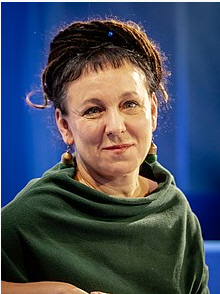
An author’s tenderness

In 2018, she won the Man Booker International Prize for her novel Flights (translated by Jennifer Croft). In 2019, she was awarded the 2018 Nobel Prize in Literature – Wikipedia

“Tenderness is spontaneous and disinterested; it goes far beyond empathetic fellow feeling. Instead it is the conscious, though perhaps slightly melancholy, common sharing of fate. Tenderness is deep emotional concern about another being, its fragility, its unique nature, and its lack of immunity to suffering and the effects of time. Tenderness perceives the bonds that connect us, the similarities and sameness between us. It is a way of looking that shows the world as being alive, living, interconnected, cooperating with, and codependent on itself.” Olga Tokarczuk, from her Nobel Lecture

If you’re an author, reading Olga Tokarczuk’s entire speech will be, IMHO, time well spent.

An atomistic approach to everything has split the world and ourselves into bits and pieces that tend to compete with each other, and become so polarized they obscure any hope of inclusiveness and oneness. While acknowledging that first-person narratives are/were a miracle in storytelling and seeing the world, Tokarczuk acknowledges that they do not allow for the importance of others and others’ views. When it comes to the world as a whole, this is rather like the lefthand having no idea or concept that it’s part of the same entity that brings forth the right hand or the feet or the heart.

“Literature,” said Tokarczuk, “is built on tenderness toward any being other than ourselves. It is the basic psychological mechanism of the novel. Thanks to this miraculous tool, the most sophisticated means of human communication, our experience can travel through time, reaching those who have not yet been born, but who will one day turn to what we have written, the stories we told about ourselves and our world.”

Seeing all our stories throughout our own first lens is natural, but we cannot stop there if we want our books to carry meaningful messages that get past the illusion of the world as a collection disparate objects and events into the oneness that is really there.

Malcolm

Novels are like cigarettes: it’s not easy to quit

When I wrote Giving Yourself Permission to Quit, I resolved to stop working on my follow-up novel to my “Florida Folk Magic Series” because the plot was giving me too much grief and I was seriously sick and tired of researching more than I wanted to know about the KKK. I resolved to stop smoking many times (yes, I finally did quit) but failed more often than now. Some said it was harder to get off cigarettes than heroin. I don’t know if that’s true, but it wouldn’t surprise me.

Safer than writing?

I’m rationalizing that I haven’t failed because, although I’m still working on that novel, I’m not inhaling. That means I’m doing more research and tinkering with notes about characters and thinking about how to untangle the story. But I’m not really doing any writing. This rationale never worked with real cigarettes, so I expect my resolve about this book is probably in the toilet.

The novel’s working title is “Dark Arrows, Darker Targets,” but that’s just speculation because I’m not really writing it even though my muse and other dark forces are telling me I really need to do it. When I lived in northern Illinois and my house and car were snowed in, I once walked several blocks to buy cigarettes because I was out of them. That took grit, I want you to know.

Quite possibly, writing this novel will take the same kind of insane grit. Please, I don’t want either applause or pity, especially from non-smokers out there who don’t know what it’s like. Smoking, as I mentioned in an earlier post, is an addiction that never really goes away. I haven’t smoked a cigarette in 25 years or so, but I’m still addicted. Like AA and drinking, one cannot smoke a Marlboro every once in a while and be in the clear.

The same must be true of writing. Like any sane person, I’ve tried to quit numerous times, but telling stories is worse than being hooked on heroin. Think about that when you sit down at your PC and think “what could it hurt?” and type the words once upon a time.

Yes, it will be a joyful experience for a while. But then, before you know it, you’ll be writing more and more and you’ll be choosing darker and darker subjects. At this point, you’re pretty much toast and you need to go to a meeting and say, “My name is ____________ and I’m a writer.”

Seriously, must of us who aren’t smart enough to go to that meeting write what we write because the stories are important to us whether they find readers or not. I have no idea why this is so. Years ago, when I worked at a developmental disabilities center and was rising up through the ranks until I became a unit manager, one of the directors asked about my goals. I said that I thought that after working there for a number of years, I would ultimately become a patient. They didn’t like that.

So, when I speak of the mental problems surrounding writers, I know how innocently is starts and that even if you begin by shooting aspiring writers while they’re still happy (as Dorothy Parker suggested), you’ll ultimately choose the dark side and become a writer yourself. There’s no exit.

And yet, when this book I’m not writing is complete, I’ll feel a sense of accomplishment. “Smokin’!!!!! Now the story’s all said and done,” I’ll be thinking when the first copies of the book arrive in the mail. After that, my muse will suggest a new book and I’ll be back to the daily grind after pretending for a while that I’m strong enough to quit.

If you’re a writer, are you trying to quit? No kidding, a pack of Marlboros might start you off on a safer addiction.

Malcolm

Looking for an image of an old Rosetta Tharpe recording – UPDATED

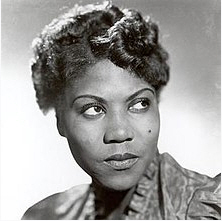
If you’ve been around for a while and/or like vintage gospel, jazz, and blues, you know who Rosetta Tharpe was as well as how influential she was. As Wikipedia notes, “Tharpe was a pioneer in her guitar technique; she was among the first popular recording artists to use heavy distortion on her electric guitar, presaging the rise of electric blues. Her guitar playing technique had a profound influence on the development of British blues in the 1960s; in particular a European tour with Muddy Waters in 1963 with a stop in Manchester is cited by prominent British guitarists such as Eric Clapton, Jeff Beck, and Keith Richards.”

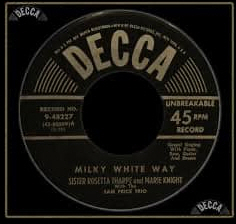
So, one would think that finding a picture of a 1951 Decca release of “His Eye is on the Sparrow” with Marie Knight would be easy to locate on the Internet. Perhaps, but I can’t find it and would really like to see what it looks like so I can mention it in a novel. I could fake that, I suppose, by assuming that it looks like the other Decca recordings of the era, but I don’t feel comfortable doing that.

I spent a couple of hours this morning looking for the image. So far, I’ve found everything but. Seriously, I’d rather be writing the novel that pulling teeth, research-wise, for every fact I use. I’ve mentioned Tharpe before in my “Florida Folk Magic Series” because my character Eulalie was a blues singer and knows who all the singers of her era were. In the novel in progress, the main character is named “Sparrow” so that’s why this recording is important. Plus, I like the song, one that everyone and their brother or sister has recorded. Since the book is set in 1954-1955, the 1951 recording is the most reasonable release to use.

If you’re thinking about becoming a writer, obsessions like this will often take over your days.

UPDATE:

And here it is, compliments of Sandy Daigler who picked the one method of searching Google’s images that didn’t occur to me:


Malcolm

Breaking point-of-view rules

Several days ago, I posted this comment on my Facebook profile and, as it turned out from the comments, I’m not the only one who thought the author was breaking point-of-view rules:

I’m reading an interesting mystery, filled with misdirection and clues that may or may not be true.

I won’t tell you what it is because I’m not here to bash the author but to mention point-of-view errors that mar the book. Like many novels, this one is told in alternating chapters about the major characters, each in a third-person restricted point of view.

This means that if the character doesn’t see it, hear it, think it, or intuit it, it (whatever) can’t be there.

What mars these chapters is the intrusion of the suddenly omniscient author who says things like:

“Bob did not see the man hiding in the shadows behind the steps.”

“Sally turned off the TV set just before a major story from her hometown aired. Had she seen it, she would have done things differently.”

You can do this if you’re writing from a consistently omniscient viewpoint. If you’re writing from inside a character’s head in first or third person, you’re playing games with the reader.

Most of those commenting thought the writer as sloppy and/or that the book needed a better editor. One person mentioned the distinction between “close” and “distant” third person. As Writer’s Digest puts it, “The advantage of middle-distance and far-distance third person is that instead of hearing the opinions and reactions of one person, the POV character, the reader can now hear those of two people: POV character and author. Distant third person lets the author put in his two-cents’ worth of interpretation of events.” Frankly, I think this is an abomination because the author has intruded himself or herself into the story.

So, what do you think?

Malcolm

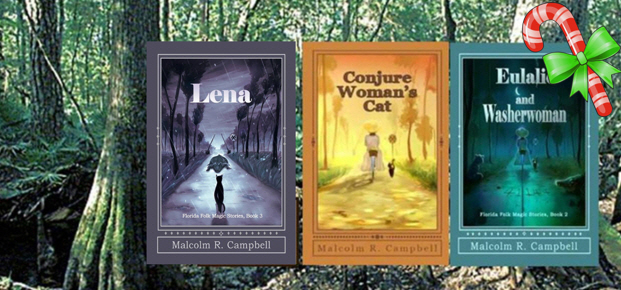
Malcolm R. Campbell is the author of “Eulalie and Washerwoman,” one of the three novels in the Florida Folk Magic Series in which the narrator is a cat. 

‘Let’s have some new clichés.’ – Samuel Goldwyn

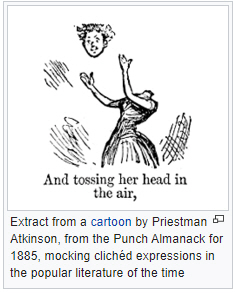
Have you noticed how quickly some words become clichés on social networks and light-weight news sites? Some are wonderful when they first appear. But they quickly spread like wildfire through memes and hashtags and fads. Soon enough, they become about as meaningless as the traditional “I’m fine” reply we give to those who say “How are you?” the first time they see us during the day.

Suddenly, those once wonderful words become little more than background noise and we no longer hear them.

Sometimes writers think up powerful phrases while writing a novel. Later they use them again, thinking they’re still fresh and new. Then, if they’re a good editor–or have hired a good editor–they’re shocked to learn that (without knowing it) they’ve used their unique phrase a hundred times in the novel. Readers notice this and become irritated; even if the readers don’t notice it, the phases have become meaningless clichés within the scope of the book.

Current words and phrases that are being turned into clichés are “Me, too,” “Be kind,” “Live a life of gratitude.” Some, like “Me, too” become part of a movement and help identify it and serve as signals to others that a person is writing or talking about an issue they find important to them.

Notions about living a life in thankfulness, gratefulness, and kindness have variously had transcendent spiritual and temporal connotations. The trouble is, everyone and their brother (talk about a cliché) is using them on Twitter, in Facebook memes, and elsewhere (armed with appropriate hashtag) so often that they’re becoming meaningless, not to mention sounding preachy.

When I see a celestial-looking photograph with the words, “If nothing else, be kind” a hundred times a week on Facebook, I’m frankly pretty damned tired of it. The idea has become so overused that its a horrid, preachy cliché even though it’s no less true today than it was the first time somebody said it.

I keep hoping for more online originality to keep things from getting trite and tiresome. I think the clichéd memes and tweets are doing more harm than good because nobody really sees them any more, and if they do see them, they’re no longer emotionally impacted by the sentiment.

Using the “same old, same old” (talk about another cliché) on Facebook and Twitter is easy. While it saves time, it’s also a waste of time. In fact, saying nothing would bring about a better result.

Malcolm

Your work, your distinctive voice

If there’s one thing that’s become more critical in traditional publishing, it’s a distinctive voice. A successful manuscript is one that you can spot from thousands after just the first line—you’d never confuse J. D. Salinger’s voice with Virginia Woolf’s (think Catcher in the Rye vs. A Room of One’s Own). Developing style in your writing captures the reader’s attention from the onset and builds a world that is fresh and unique. Plot is crucial, but only writers with both in their arsenals can achieve a manuscript that lives up to the reader’s expectations.

—Jeff Kleinman of Folio Literary Management

You are your fiction.

This doesn’t mean fictionalizing events in your life into short stories and novels. It means writing the way only you can write to tell stories only you can tell.

I’m often critical of MFA programs because they seem to teach people how to write stuff that matches the most popular stuff being written at the time. This may lead to short-term success, but no real satisfaction. If you’re young, most of the stuff that’s popular now will be old hat by the time you reach the peak years of your writing powers. So, if the fads perpetuated by some writing programs excite you, you’ll end up out of date and out of fashion before your time.

Like most potentially great writing, there’s a risk to using your own voice. People may not like it. They may want you to write in everyone else’s voice. I’d rather fail than sound like everyone else; but then, I’ve always been a rebel.

No doubt, there’s probably a greater chance of success writing in a safe, rather generic voice rather than a unique voice that scares some prospective publishers and readers. If you’re happy with this, that’s okay, and it could make for a successful writing career. Otherwise, you have a long row to hoe as soon as you try something new, something uniquely you.

When I say “you are your fiction,” I mean that the way you think and feel and naturally write is your real fiction as opposed to a sanitized version of the style you want to use. Your voice grows out of the way you see the world and the way that world interfaces with the stories you want to tell. Personally, I think it’s a shame to corrupt that perspective with a writing approach that sounds like the top twenty-five authors of the moment.

I see the location of a story as inseparable from the story and believe that the magic surrounding the story is real. I’ve never been able to camouflage that–not that I want to. So, I write the way I write because writing any other way wouldn’t be me.

We all have a choice, I think when we decide whether to be ourselves when we tell our stories or to be a carbon copy of the last book we read.

Malcolm


New Pages: a great resource

NewPages.com is news, information, and guides to literary magazines, independent publishers, creative writing programs, alternative periodicals, indie bookstores, writing contests, and more.New Pages

Literary magazines and writing contests have been a traditional training ground for aspiring writers for years. Some magazines pay. Some don’t. Contests usually pay, but sometimes offer publication and author’s copies. Either way, they give writers a way to practice their craft and potentially earn a few dollars and some writing references.

If you look at the website of a successful author, you will often see a long list of literary magazines where his/her work has appeared; so, too, grants and fellowships. Traditionally, mainstream/large press publishing has found these credentials more important than some of the newer small presses because the “resume material” helped show an aspiring writer had already received some validation elsewhere. While those who self publish don’t need a resume to publish a Kindle or CreateSpace book, magazine credits and awards still look nice on the website.

Many writers rely on the Poets & Writers database of upcoming writing competitions, grant opportunities, and fellowships. As a writer, I think more is more when it comes to keeping up with resources. So, I highly recommend New Pages. They offer multiple resources in addition to information about literary magazines, bookstores, competitions, as well as book reviews.  One unique feature is their publication of the titles of books received for review. This is kind of nice whether your book is reviewed there or not.

They also review literary magazines and keep readers up to date on news magazines. This feature helps authors choose where to submit as well as an easy way to learn more about the magazines before sending in an MS.

This is a writer-friendly site with multiple menu selections, options, and resources. It’s been around for a while and has a good handle on the subjects it presents.

Malcolm

Malcolm R. Campbell’s short story “Shock Treatment” appears in the Tulip Tree Publishing’s 2019 anthology “Stories That Need to be Told.”


Withhold judgement about your characters

With fiction [as opposed to writing a column], the process is different because I don’t know where the story is going. I’ll know that I want to write, say, a story about a young woman whose father dies. And I’ll know I want that story to explore grief. But I never exercise any moral judgment on the characters. To me, they are just characters. By withholding judgment, I can look at the world, through their eyes, with humility. I don’t judge them as “good” or “bad”; they are all flawed human beings. I would say this kind of writing uses a different muscle—it relies much more on the powers of empathy.  – Laila Lalami in an interview here.

Wikipedia Photo

I’ve been following this author’s works for ages, beginning years ago when she had a blog called Moorish Girl. The blog’s archives may still be out there, but she more or less stopped writing it when she published her debut novel Hope and Other Dangerous Pursuits in 2005.

Most of us cannot replicate the prose, much less the intelligent world view of this award-winning Moroccan-American novelist and college professor. Yet, when I read her ideas about literature and especially the writing of fiction, I see goals worth striving for. In general, I try not to judge my characters, that is to say, to give the reader an author’s view about which of them are good and which of them are bad.

To the extent that we can withhold judgement, we increase our ability to create a memorable story because we let the characters speak for themselves and form their own opinions without allowing our beliefs intrude into the story from the outside. I found this difficult to do when writing my Florida Folk Magic Series because my longtime hatred of the KKK made it almost impossible for me to treat them objectively.

Lailami believes that “the development of empathy is crucial to personal growth as a human being but also as a writer.” I agree though I’m not sure I can achieve it. Yet it seems to me that everything from world peace to family harmony depends on the empathy we have for others. That empathy makes us more real and accepting and does the same for our fiction.

–Malcolm


Giving yourself permission to quit

Sometimes short stories, novels, poems, and even science fair projects get tangled up like wet kite string and no matter what one does, the whole thing gets worse and one starts to doubt himself or herself about all projects. Nobody likes telling characters to get out of their lives when a story won’t come together, and yet, trying to force it to come together sort of guarantees that it will never come together.

So, we start avoiding the manuscript for weeks at a time. The next time we look at it, the thrill is gone. What we thought was going to be a joyous story looks more and more like raw sewage.
Have you been there?

If so, you know that the manuscript is sitting on your computer like an evil spirit. It knows you’ve been taught to push through the problems in a story, and fight your way to the end of it. Now, if you’ve signed a contract with the publisher to finish this manuscript, you may have no choice but to get drunk and just do it. Otherwise, it’s causing more trouble than its worth.

I think it’s better at some point to give yourself permission to quit. Set the MS aside and search for something new to write about. I just did that, and it feels like the weight of the world has been lifted off my shoulders. Until the moment I cried “uncle” on the story, I was becoming convinced I’d never write anything again. Now I’m free.

Every story, I think, begins as something with potential, yet it’s still an experiment of sorts. We’re not duty-bound to see it through if it isn’t working for us. Maybe it will work in a year or ten years, but today, it’s sapping our strength.

Let it go.

Malcolm

My short story “Shock Treatment” appears in this new anthology.


‘Elmer Gantry was drunk’

Here’s how you can make your eyes glaze over. Consider writing a post about the first lines of novels, go online and read through the 100000000 sites listing famous first lines, and then after you’ve absorbed a lot of icing and no cake, you won’t want to read another book for the rest of your life.

But you will. So will I. We can’t help it.

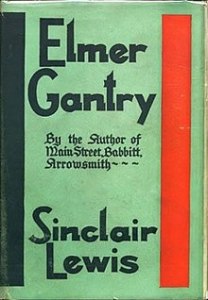
Just to get it out of the way, “Elmer Gantry was drunk.” is my favorite first line because it so aptly sets the stage for Sinclair Lewis’ 1926 satire. It’s likely there aren’t a lot of people reading that book these days, though there was probably an upsurge when the powerful 1960 film starring Burt Lancaster, Jean Simmons, and (in a role like no other in her filmography) (Shirley Jones. I enjoyed both the book and the movie even though they’re very different.

Before my eyes glazed over, I was going to talk about opening lines, why I liked some, why I didn’t like others, and then see what your favorite lines are.  But now I’m overwhelmed, and not in a good way, with all the choices. Sure, most lists include Lolita – Vladimir Nabokov, Anna Karenina – Leo Tolstoy, One Hundred Years of Solitude – Gabriel Garcia Marquez, and Slaughterhouse-Five – Kurt Vonnegut. I’ve read these books and all the first lines (except for Marquez’ line which I detest) might make an interesting discussion. But then, I had to look at longer and longer lists and discovered that not only were my eyes glazed over, but my consciousness as well: there was no way to limit the discussion and I felt like I’d just suffered through the punch lines of a hundred jokes.

I have similar feelings about lists or discussions about favorite songs, favorite movies, favorite poems, favorite paintings, and even favorite novels. It’s lame to put it this way, but all those favorites are like comparing apples to oranges–or possibly, apples to anchovies. My mood, and possibly who I was with, is often a big factor in my choice of a favorite anything. Sometimes I disappoint myself by re-reading a favorite novel and finding out that I don’t like it any more.

When I see a first line while reading a book for the first time, I might think, “Oh, that’s nice,” but when I see it in a list of first lines, it seems more like trickery. Unfair, I know. I guess I like the lines in context rather than pulled out of their novels like teeth.  When they’re glommed together, I feel like reaching for a drink or two or ten, and then writing, “Malcolm Campbell was drunk. He was eloquently drunk, lovingly and pugnaciously drunk. He leaned against the bar of the Old Home Sample Room, the most gilded and urbane saloon in Cato, Missouri, and requested the bartender to join him in ‘The Good Old Summer Time,’ the waltz of the day.”

Actually, I’d probably swap out “The Good Old Summer Time” with Ellington and Webster’s 1941 “I Got It Bad (and That Ain’t Good)” because it really is a cool song title. I’m sure there are other worthy titles I could have chosen, but I didn’t want to look.

Well.

If you have a favorite opening line, please add it in the comments list. If you have a hundred, don’t add them.

Malcolm