Are professional chefs nasty?

If you watch “Hell’s Kitchen” with Gordon Ramsay or “Chopped” hosted by Ted Allen, perhaps you’ve noticed that a fair number of the contestants on both shows present themselves as badass competitors who will wipe the floor with the scum they’re competing against.

Ramsay, of course, is well known for his volatile, profanity-filled approach to the show while the “Chopped” host and judges are unfailingly polite.

What my wife and I wonder is this: in “real life” away from the TV shows, are the chefs who appear nasty, or are they simply posturing like school-yard bullies on TV? For all I know, maybe the shows’ producers force them to act like people raised in a bad-neighborhood gang.

I know one thing for sure: If I go to a fine restaurant, I don’t want any of these chefs getting close to my food. As best I can tell, Gordon Ramsay and the judges on chopped really know how to cook, though they do like meat that’s too rare for me. Many of the contestants, who hold chefs’ jobs around the country, seem to know how to cook as well.

But the language, the arrogant posturing, and the excessive number of tattoos are a turnoff. Yes, I know, at my age I’m out of sync with everyone who’s 40 years younger.  But I do know how to cook without making what happens in the kitchen sound like a gangland activity.

Malcolm

Pat Conroy knew how to cook, and you can find evidence of that in his novels. I can’t cook at Conroy’s level, though I still hope you enjoy my books.

What if the blog gurus are nuts?

The gurus say that writers with blogs should not dedicate every post to a description of their latest books or pleas for people to buy it. Instead, they suggest that authors dedicate a fair number of their blogs to mini-articles about the locations and themes of their stories. This, they say, will draw the kinds of readers who want to read your novels.

When I started my four-novel Florida Folk Magic series, I focused some of my posts on the Florida Panhandle where the books are set, some on the environment created by the KKK in the 1950s, and some on the art of conjure.

This seemed to make more sense than displaying a static photo of my latest book cover.  As the gurus said, “If every post you write says buy my book, you’re pretty much posting SPAM.” Heaven forbid. So, I wrote about the subjects I thought prospective readers of the novels might find interesting.

The posts got a few hits when they were new. I have no idea whether anyone clicked on the links to my books. Months went by. Then years. Now suddenly I’m getting hundreds of hits on every post that has anything to do with conjure. Yes, I appreciate that, but the point is, I had no intention of setting myself up either as an expert on conjure or a clearinghouse for rootworker information.

Perhaps the gurus steered me wrong. My current posts are receiving a fraction of the visitors of posts written months or years ago. This is not good. Now I wonder if I should delete all the conjure techniques posts or just ignore them. If everyone asking Google search “what is goofer dust?” bought a copy of one or more of my novels, I could live with the skewed statistics toward conjure.

But they don’t. They learn how to cast a spell and move on.

The gurus never said this would happen, that all those posts related to your novels’ settings and backgrounds would take on a life of their own and create, say–a hoodoo resource blog. I don’t know enough to host such a thing. So, what say you? Should I delete all the old conjure posts that are getting all the hits? Or should I take a deep breath and ignore them?

Or, should I put a hex on all of them so they go away?

There are a lot of options, but I really need for this blog to get out of the conjure biz. Or else.

Malcolm

Malcolm R. Campbell is the author of the satirical comedy “Special Investigative Reporter.”

Chapter One Prize

The Chapter One Prize is open to writers over 18 who are working on an as-yet-unpublished novel. The prize has been established to support and celebrate novelists. This prize aims to find the best opening chapter of a novel-in-progress written in the English language. On March 15, 2021, the three prize winners and honorable mentions will be announced here on the website and via social media, and all entrants will be contacted via email about the results. Prize winners will have the option of showcasing their Chapter One Prize entries on this website.

Source: Chapter One Prize

If you have a novel in progress, this competition looks interesting. Submit your first chapter by the end of the month with an entry fee of $20 and you might win a prize and have your work featured on the Gutsy Great Novelist website.

A lot of people avoid competitions with entry fees. I don’t because the fees are a fair way of raising the prize money. If you win, you enhance your online presence. If you don’t, you’ll probably have a nicely polished first chapter.

I’m planning to send in the first chapter of my novel in progress even though my chapters are very short (Dan Brown length).

Make sure you check the formatting requirements carefully.

Malcolm

My novel in progress is a sequel to “The Sun Singer” and “Sarabande” called “Weeping Wall.”

It’s Monday: What are you reading?

Word of mouth is one of the best ways to learn about new books or old classics that a friend has re-discovered. I tend to stick with authors I like, such as John Hart, but if a friend or book blogger tells me about something else, I can easily be tempted to try a book or author I’m not familiar with.

This week, I started another novel by Lisa See, The Island of Sea Women. I’ve read an enjoyed most of her novels. The book was released in 2019 by Scribner.

From the Publisher

“A mesmerizing new historical novel” (O, The Oprah Magazine) from Lisa See, the bestselling author of The Tea Girl of Hummingbird Lane, about female friendship and devastating family secrets on a small Korean island.

Mi-ja and Young-sook, two girls living on the Korean island of Jeju, are best friends who come from very different backgrounds. When they are old enough, they begin working in the sea with their village’s all-female diving collective, led by Young-sook’s mother. As the girls take up their positions as baby divers, they know they are beginning a life of excitement and responsibility—but also danger.

Despite their love for each other, Mi-ja and Young-sook find it impossible to ignore their differences. The Island of Sea Women takes place over many decades, beginning during a period of Japanese colonialism in the 1930s and 1940s, followed by World War II, the Korean War, through the era of cell phones and wet suits for the women divers. Throughout this time, the residents of Jeju find themselves caught between warring empires. Mi-ja is the daughter of a Japanese collaborator. Young-sook was born into a long line of haenyeo and will inherit her mother’s position leading the divers in their village. Little do the two friends know that forces outside their control will push their friendship to the breaking point.

“This vivid…thoughtful and empathetic” novel (The New York Times Book Review) illuminates a world turned upside down, one where the women are in charge and the men take care of the children. “A wonderful ode to a truly singular group of women” (Publishers Weekly), The Island of Sea Women is a “beautiful story…about the endurance of friendship when it’s pushed to its limits, and you…will love it” (Cosmopolitan).

I’m enjoying the book. Younger readers may be surprised to learn that Japan occupied Korea for many years

What are you reading?

So, are you reading something wild and wonderful? If so, please share the title and author and what you think of it so far.

Malcolm

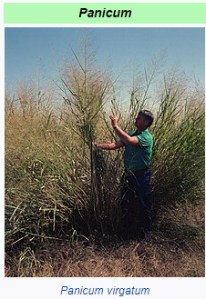
Panic Grass – a writer’s dream name

Wikipedia photo

I love double meanings. That’s why I like the name “panic grass.” It has nothing to do with panic–that comes from Panicum–but the use of the word when describing an environment where (in your story) things are going wrong is a nice subliminal trick.

The common or regional names of many plants will help you create the kind of ambiance you want. Perhaps that’s cheating.  But I don’t care as long as the name is factual and also likely to be used in the place where my story is set.

If you have a good plant or wildflower guide for your state or region, you’ll find a lot of “local color.” I have these guides for both Florida and Montana. They not only help me describe the location but support my addiction to puns and words with double meanings such as “spurned panic grass.”

The guidebooks also ensure that the flowers in your stories are blooming at the time of the year when they bloom in “real life.”

–Malcolm

Briefly Noted: ‘Race Against Time’ by Jerry Mitchell

He’s been called “a loose cannon,” a “pain in the ass” and a “white traitor.” For more than 15 years, Jerry Mitchell has unearthed documents, cajoled suspects and witnesses, and quietly pursued the evidence in unsolved murders of civil rights activists. Mitchell’s investigative reporting and sustained coverage for The Clarion-Ledger in Jackson, Mississippi, has brought to justice four Ku Klux Klan members, beginning with the conviction of Byron De La Beckwith for the 1963 assassination of Medgar Evers and, most recently, Edgar Ray Killen who was found guilty in June for orchestrating the murders of Andrew Goodman, James Chaney and Michael Schwerner in 1964. – Columbia School of Journalism, Chancellor Award Winner Bio of Jerry Mitchell

If you’re old enough to have been around during the 1960s violence led by the KKK (I am), then you know that fires, bombs,  clubs, knives, and bullets wielded by the KKK took a lot of lives but these events seldom led to arrests and convictions. I grew up in that world and I knew the reason why. Nobody saw nothin’.

However a reporter named Jerry Mitchell thought there had probably been much to see and that since there’s no statute of limitations on murder, those unsolved KKK murders needed another look. As John Grisham said, “For almost two decades, investigative journalist Jerry Mitchell doggedly pursued the Klansmen responsible for some of the most notorious murders of the civil rights movement. This book is his amazing story. Thanks to him, and to courageous prosecutors, witnesses, and FBI agents, justice finally prevailed.”

From the Publisher

On June 21, 1964, more than twenty Klansmen murdered three civil rights workers. The killings, in what would become known as the “Mississippi Burning” case, were among the most brazen acts of violence during the Civil Rights Movement. And even though the killers’ identities, including the sheriff’s deputy, were an open secret, no one was charged with murder in the months and years that followed.

It took forty-one years before the mastermind was brought to trial and finally convicted for the three innocent lives he took. If there is one man who helped pave the way for justice, it is investigative reporter Jerry Mitchell.

In Race Against Time, Mitchell takes readers on the twisting, pulse-racing road that led to the reopening of four of the most infamous killings from the days of the Civil Rights Movement, decades after the fact. His work played a central role in bringing killers to justice for the assassination of Medgar Evers, the firebombing of Vernon Dahmer, the 16th Street Church bombing in Birmingham and the Mississippi Burning case. Mitchell reveals how he unearthed secret documents, found long-lost suspects and witnesses, building up evidence strong enough to take on the Klan. He takes us into every harrowing scene along the way, as when Mitchell goes into the lion’s den, meeting one-on-one with the very murderers he is seeking to catch. His efforts have put four leading Klansmen behind bars, years after they thought they had gotten away with murder.

Race Against Time is an astonishing, courageous story capturing a historic race for justice, as the past is uncovered, clue by clue, and long-ignored evils are brought into the light. This is a landmark book and essential reading for all Americans.

In 1964, I didn’t think anyone would have the guts to find and publish the truth, the in-depth truth that names names and brings people to court. Jerry Mitchell did what all reporters should have been doing. This book came out a year ago: since then, I hope it has inspired other reporters to look deeper into their stories about racial violence stemming from hate groups.

Malcolm

Malcolm R. Campbell is the author of four anti-racism novels: “Conjure Woman’s Cat,” “Eulalie and Washerwoman,” “Lena,” and “Fate’s Arrows.” They are available in e-book, paperback, and hardcover through major online booksellers and via your local bookstore’s orders from its Ingram Catalog.,

Authors must learn how to conceal information

If you pick up what you hope will be a fabulous novel and discover the entire story is on the first page, you’ll feel cheated. You were expecting to be scared, puzzled, enchanted, inspired, or excited with a darn fine page-turner of a yarn.

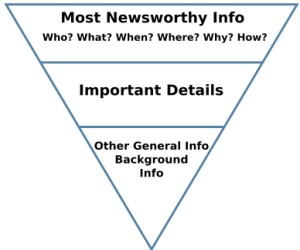
When you read the most important information first, what do you have? If you said “news story,” you’d be right. Between the headline and the lead (some people spell that “lede”) in the first paragraph or two, you will get the gist of what happened.

Wikipedia graphic

This is why news reporters use what’s called the inverted pyramid style of writing, that is to say, the important information comes first. The story’s position on the newspaper page, the size of the headline, and sometimes the accompanying photographs also tell you the relative importance–in the editor’s eyes–of that story in the news of the day.

Newspaper readers and TV news program viewers are generally expected to be like the 911 dispatcher: important information first. If there’s a dead guy on your front porch, you don’t tell the dispatcher about the dinner had and movie you saw on your way home before finding the dead guy.

The readers of novels and short stories expect teasers early on, but not the ending of the story. So, the author is concealing most of what s/he knows during the writing process. Writers must figure out how to do this early in their careers so that in spite of hiding nearly everything they appear not to be hiding anything.

So, while being careful of what s/he says, a writer is also careful of what s/he doesn’t say. That is, writers learn how to lie and conceal smoothly. The novel is a juggling game wherein the author is constantly thinking, “When should I say X?” Obviously, authors have to provide clues or the entire novel won’t seem believable when the reader gets to the end. But, if the clues are clumsy, the reader won’t bother to go to the last page because they figured everything out half-way through the book.

Many writing teachers advise starting the story as close to the ending as possible. One reason for this that it keeps superfluous material out of the book. Another reason is that it focuses the writer on moving the plot forward toward that ending with as few unnecessary  (and often boring) side trips into stuff that doesn’t matter.

While concealing information from the reader, the author has to play fair. S/he can’t have an otherwise smart detective fail to ask a witness or a suspect the most obvious question any detective would ask. And, if the author is writing from one character’s point of view, that character can’t selectively leave things out their narrative while in the process of planning to do them: that’s not natural.

Like all liars, a writer can’t get caught. Right, they never swore to tell the truth, just to give you a story that looks like the truth. The savvy reader knows, of course, that the author will be guilty of the continuous sin of omission beginning on page one.  But then, that’s what the reader wants.

Malcolm

If you have read my novel “Fate’s Arrows,” think back about the things that I did not say about my main character Pollyanna until the end of the book. 

I could’ve been a sheep rancher

When my wife and I moved to Atlanta from North Georgia in 1980, we were having trouble making ends meet. I suggested Montana.

What would I do there, she wondered. I said that I’d hire on at a sheep ranch and/or drive concessionaire busses trucks in Glacier National Park.

She didn’t think either of those jobs sounded like the real me. Plus, she had no intention of living in Montana.

As it turned out, I was writing a book about sheep ranching and had a folder filled with everything one needed to know to get started–or to stay solvent if one had already gotten started. Fortunately, I didn’t become a full-time sheep rancher: the Montana wool business has been in decline for years.

The more one looks into the ranching biz, the more one discovers there’s a lot of down-in-the-muck stuff going on that we never saw on “Fury” or “Bonanza.” I didn’t mention this to my wife.  Plus, Montana’s high range isn’t very hospitable to humans who grew up in the South. My wife already knew this so there was no way I could spin the weather situation.

She didn’t know that ewes, as Bill Stockton tells us, let gravity drop the new-born lambs out on the ground. Or, if that doesn’t work, they spin around and sling them out. This information was not in my wife’s “need to know” classification.

One thing I didn’t know at the beginning was that my wife’s allergic to wool. That much pretty scuttled the sheep rancher “dream.”

Malcolm

Several of my older novels are out of print, but my sheep rancher can still be found in “Mountain Song.” It is the tamest of my sheep books.

Writing about a high-speed chase on a mountain road

Since it’s cold and rainy here in north Georgia, I spent the day writing about a speeding Harley Davidson being chased by a ranger along Glacier National Park’s Going-to-the-Sun road. In “real life,” that highway is covered by many feel of snow in February that will take many weeks to plough before the summer season begins in June.

Fortunately, the Google Earth views and the Google Maps street views–as discussed here were taken in the summer. So, what I see looks like this photo:

My keyboard almost has no room on my desk due to the stack of paper maps, guidebooks, and place name guides cluttering up my space. If this were a fictional road or some random road in the middle of nowhere, I might get away with a little artistic license. But Glacier National Park has over three million visitors a year and most of them want to see this road from their cars, from a red bus, or from a park shuttle.

So, there’s no room for mistakes. That’s a bit daunting. On the other hand, I hope the fame and beauty of the setting will help draw people to the novel to be called “Weeping Wall.” Here’s what the real weeping wall looks like, compliments of Wikipedia:


If you’re westbound in one of the convertible red tour busses, you’re going to get wet. All of that water comes from snowmelt higher up on the Garden Wall. There’s less of a torrent here late in the summer. Weeping Wall will be the third in my “Mountain Journey’s Series,” following The Sun Singer and Sarabande.

The most difficult task hasn’t really been getting the landmarks right. It’s been getting the background from the earlier novels in the series correct–and then some of the characters also appear in my Kindle novels Mountain Song and At Sea. Co-ordinating all these stories was something I never wanted to face–until now. I think I’ve gone nuts.

But, it’s a fun kind of crazy.

Malcolm

I invite you to enjoy my two earlier novels in the series, “The Sun Singer” and “Sarabande.” Both of them are contemporary fantasies set in Glacier National Park, Montana.


Writing about a place that’s far away

Writers with a big advance from their publishers can often travel to faraway places, take pictures, and do research. Most of us can’t do that. Fortunately, Google Maps and Google Earth can help.

I live in Georgia and am writing about a speeding motorcycle on Glacier National Park’s Going-to-the-Sun Road. I’ve been there with family but wasn’t taking notes. I can’t afford to go back, even if there weren’t COVID restrictions. So, how do I learn more about the road from far away?

  1. I’ve picked a popular tourist destination. So, for almost every trail, a section of road, or mountain in the park, there are going to be “How to” guidebooks easily found via my search engine. The best of these give you plenty of information about hiking a trail, climbing a mountain, or sightseeing along a highway.
  2. Fortunately, Google Maps has “street view” activated for Going-to-the-Sun Road. Using that, I can see the road from a driver’s point of view, including points of interest visible from the highway such as trailheads and parking lots. In a sense, this allows me to “go there” and see what my characters will see.
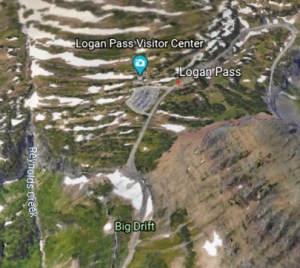
  3. Hovering over the visitors center at Logan Pass.
    Once I’ve done that, I can switch to Google Earth and set my search terms on Logan Pass and go straight there, first as though I’m seeing it from a satellite view, and then–better yet–as though I’m looking at the road and the visitors center and the nearby mountains from a helicopter. I can hover as close to the road or the mountains as I want or gain some altitude and see many miles of highway or trail at once.

It’s better to go there, of course, but using these tools, I can gather enough information to make the novel work.

Malcolm

My novel “Mountain Song,” set partly in Glacier Park, is free on Kindle February 8 through February 10.