Most writers I know have been trying to quit for years. But, they got themselves fooled into thinking they can tinker with a little writing here and there and then quit any time they want. Not going to happen.
Writing just leads to more writing. Case in point. I was safely going day to day happy to tell myself that my book was stalled and that I was going to spend me resulting idle years keeping bees. I decided to take a few minutes to prove to myself I was really stuck, so I wrote a few paragraphs without really caring how I did it, and suddenly the dam broke and the whole story came flooding through my house like a flash flood in a dry wash.
So now I have to keep writing because I can’t claim I’m stuck. Should have left the darned thing alone.
Throw this crap away along with all your pens and pencils and keyboards.
Writing a few words is like smoking just more cigarette, stopping at the old watering hole for one more drink, or shooting up a bit of heroin just once for the road–so to speak. None of these things help you quit any more than writing just one more word gets the writing addiction off your back.
Let’s call it what it is: an addiction. If you write, you’re addicted and cold turkey is the only way out.
Don’t even write a check or a Christmas letter or a note to the milkman, or a grocery list. Just stop. Think of this post as tough love. If you can’t stop, shoot yourself in the foot, have yourself committed to a home, or go to jail. It’s for the best.
Malcolm
Malcolm R. Campbell keeps writing novels because he thinks he can quit any time he wants.
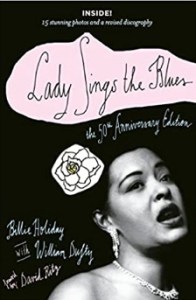
When the 1972 film “Lady Sings the Blues” aired the other night on one of the many DISH network channels, it was hard not to think of the original autobiography of Billie Holiday that was reissued in an anniversary edition in 2006. When you watch the movie, which I like, you’re seeing a bit of Diana Ross simmered and stirred into Holiday. I think you get closer to the real Billie When you read the book–though it’s hard to separate out the influences of those who helped her write it. I’ve heard all her songs and think they’re the best way to understand Holiday, especially if you have a version with analog sound instead of the always-slightly-false digital approach. (My bias.)
From the Publisher
“Perfect for fans of The United States vs. Billie Holiday, this is the fiercely honest, no-holds-barred memoir of the legendary jazz, swing, and standards singing sensation—a fiftieth-anniversary edition updated with stunning new photos, a revised discography, and an insightful foreword by music writer David Ritz “Taking the reader on a fast-moving journey from Billie Holiday’s rough-and-tumble Baltimore childhood (where she ran errands at a whorehouse in exchange for the chance to listen to Louis Armstrong and Bessie Smith albums), to her emergence on Harlem’s club scene, to sold-out performances with the Count Basie Orchestra and with Artie Shaw and his band, this revelatory memoir is notable for its trenchant observations on the racism that darkened Billie’s life and the heroin addiction that ended it too soon. “We are with her during the mesmerizing debut of “Strange Fruit”; with her as she rubs shoulders with the biggest movie stars and musicians of the day (Bob Hope, Lana Turner, Clark Gable, Benny Goodman, Lester Young, Coleman Hawkins, and more); and with her through the scrapes with Jim Crow, spats with Sarah Vaughan, ignominious jailings, and tragic decline. All of this is told in Holiday’s tart, streetwise style and hip patois that makes it read as if it were written yesterday.”
–
I’ve read conflicting claims about Holiday’s acceptance as an artist after she recorded her most powerful song, “Strange Fruit.” Some say she found it harder to work after that while others say her status when up. The song is a strong indictment of the lynchings of African Americans.
While writing yesterday’s post about the I Ching, I thought of that long-ago phrase that was once very popular: “One with the Universe.” Unfortunately, “everyone” used that phase so extensively that it became trite and that didn’t matter because most people weren’t really applying it, they were just saying it.
Those of us who have studied Huna (Hawai’ian mysticism) see no difference between the universe and the Creator. Some Huna scholars put it this way: “There is nothing that’s not God.”
Whether you see all that is as a Huna mystic or as a member of a group with another approach to the “Cosmic,” it seems clear that if we are all doing our best to synchronize our lives with the universe–perhaps via the I Ching–we would not have the spectre of climate change hanging over our heads like the sword of Damocles.
It’s a shame we have left the world in an apparently perilous condition for our children and our children’s children. This reminds me of those novels where a once proud family falls into ruin because the older generation didn’t manage the estate properly. We are not managing the World’s resources properly, evidence enough in my view that most of us are not one with the universe.
If you look up “one with the universe” in Google, for example, you’ll find multiple commentaries on how to synchronize your life, thinking, and work with the universe. The best of these tend to say that doing so will make a difference in ourselves and then in the state of the World. It’s easy to get discouraged and think, “okay, I’m doing my bit, but what difference can it possibly make?” the answer is always “More than you know.” When you think of the “six degrees of separation” concept, then it becomes clear that we aren’t all that far apart when we decide to act or change the way we think.
Many of us are fed up trying to get the “powers that be” to do something realistic about climate change. Not that we should stop trying. But we can increase the odds of success by synchronizing ourselves with the universe. Doing so is more powerful than all the letters we can write to government agencies.
I no longer remember what led me to the Book of Changes known as the I Ching. Most likely it was something Carl Jung wrote. He was a friend of sinologist Richard Wilhelm (1873-1930) who brought to the western mind the first translation of the I Ching, a work that so impressed Jung that he wrote a forward to it. I believe it was first translated into English in 1951 and, of all the translations, some say it is still the best.
According to Princeton University Press, “The I Ching, or Book of Changes, a common source for both Confucianist and Taoist philosophy, is one of the first efforts of the human mind to place itself within the universe. It has exerted a living influence in China for 3,000 years, and interest in it has been rapidly spreading in the West.”
The universe, we suspect, is always in a state of flux, sometimes favoring things we may consider doing and sometimes not. The I Ching when used as an oracle shows us whether or not conditions are right for our plans just as a weather report tells us whether today is a good day to put out to sea. Most sailors wouldn’t begin a sea voyage in a hurricane. Likewise, when considering conditions with the I Ching, those with a Taoist perspective wouldn’t begin a project on a day when doing so goes against the universal flow.
In his foreword to the Wilhem edition, Jung said, “For more than thirty years I have interested myself in this oracle technique, or method of exploring the unconscious, for it has seemed to me of uncommon significance. I was already fairly familiar with the I Ching when I first met Wilhelm in the early nineteen twenties; he confirmed for me then what I already knew, and taught me many things more.”
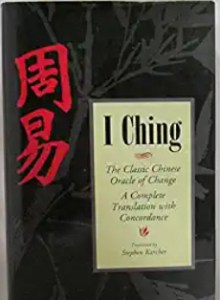
As an oracle, used for divination or for meditation, The I Ching is–so to speak–like a wise and all-knowing companion on one’s life’s journey. I probably started using the I Ching in high school and, basically, found that when I used it often, life just seemed to go more smoothly. I still have my original copy, though I’ve supplemented it with Rudolph Ritsema and Stephen Karcher’s I Ching: The Classic Chinese Oracle of Change [The First Complete Translation with Concordance].
The publisher’s description said, “We need the book when we stand at a crossroad of the soul.” I agree. The book’s answers to a flippant question are often like getting one’s hands slapped So, don’t ask it where you left your car keys or if you’re going to “get lucky” on your date tonight.
In this 1995 edition, the authors write, “The I Ching is a diviner’s manual or active sourcebook for what C. G. Jung called the archetypal forces. It organizes the play of these forces into images so that an individual reading becomes possible. . . These forces represent the flow of life and the experience of its meaning, its way or tao.”
Consistent use of the I Ching slowly changes an individual view of and approach to life. This benefit cannot be overstated.
I believe that most of our problems come from the arrogance of living outside the universe, a belief the I Ching would caution the seeker against.
Got a tip from a reasonably informed source: “The Christmas people are at it again.”
Even though it was March, I drove downtown in my 1950 A4 Checker (for you young people, that’s a car, not an Internet fact checker) in a cold wind that raged drunkenly beneath black clouds that looked like they’d been painted onto a frightening sky by Salvador Dalí during one of his less-lucid moments.
Arrived at the Max Value Department Store at high noon, heard a clock ticking, saw a used-up department store Santa singing “Do not forsake me oh my darling.” He waived as though we were the same kind of people even though we aren’t.
There was a line of Christman trees with bright burning candles in the store window (actually behind the window) hovering over a pile of brown pine needles, crumpled tinsel, last year’s gifts, and last year’s dreams.
I waited until September and drove downtown again, saw that Max Value had burnt to the ground, demonstrating the danger of placing candles on Christmas trees. Nearby stores that hadn’t burnt down yet due to the vicissitudes of mob looting that is no longer a crime in most cities, already had factory-fresh trees and garlands, ribbons and bows, stacks of toys I’d never heard of, and signs that proclaimed, “To Hell With Hallowe’en and Thanksgiving, we’re merrily geared up for Christmas.”
I felt lower than Jimmy Hoffa at the bottom of the river with concrete shoes.
Skipping Hallowe’en was fine with me because I think the holiday is meant for dead people. But Thanksgiving. Ignoring that day is a crime in enlighted cities that feature skies painted by Thomas Kinkade. My town was still stuck with Dalí skies, Piccasso streets, and Picasso people that had eyes in all the wrong places. It was obvious to me why nobody cared about Hallowe’en or Thanksgiving: the world was filled with people who can’t see straight or who are blind or who escaped from an asylum.
I walked up to a store manager and said, “It’s not even Black Friday yet.” He laughed like that evil doll in a movie I wish I’d never seen and said “Corporate Calls the shots. Next year, we’re putting up our Christmas displays during the dog days of August.” “I assume there’s a discount for the fleas,” I said. “Hardly. Folks give them to their cat-loving friends as gag gifts.”
I left before I got angry enough to kill him.
The clean-cut Santa standing outside the main door was so fat, I decided he was already eating turkey. When I got home, I heated up a roast turkey TV dinner, thankful that everyone who knows me won’t accept any cards or gifts from me because “I’m out of touch” and proud of it.
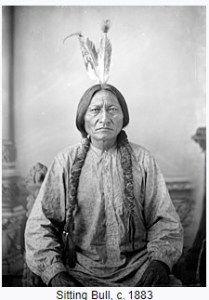
“True West” calls The Earth is All That Lasts “The most ambitious American history published in 2022. For the first time, a major scholar of the West has distilled the known primary and secondary sources equally with heretofore unused Sioux Indian oral history, correspondences, memoirs, and interviews to create the finest dual-biography ever written about Crazy Horse and Sitting Bull. … Through the final pages readers will have taken a literary and historical journey that will leave them with a greater understanding and perspective on one of the most heralded and written about cultural conflicts and wars in United States history.”
The book, by Mark Lee Gardner (Rough Riders) was released by Mariner Books (Harper Collins) in June 2022 and is featured in the Montana Historical Society bookstore, though the retail price is lower on Amazon.
From the Publisher
“A magisterial dual biography of Crazy Horse and Sitting Bull, the two most legendary and consequential American Indian leaders, who triumphed at the Battle of Little Bighorn and led Sioux resistance in the fierce final chapter of the “Indian Wars.”
“Crazy Horse and Sitting Bull: Their names are iconic, their significance in American history undeniable. Together, these two Lakota chiefs, one a fabled warrior and the other a revered holy man, crushed George Armstrong Custer’s vaunted Seventh Cavalry. Yet their legendary victory at the Little Big Horn has overshadowed the rest of their rich and complex lives. Now, based on years of research and drawing on a wealth of previously ignored primary sources, award-winning author Mark Lee Gardner delivers the definitive chronicle, thrillingly told, of these extraordinary Indigenous leaders.
Crazy Horse, 1877, Disputed Photo – Wikipedia
“Both Crazy Horse and Sitting Bull were born and grew to manhood on the High Plains of the American West, in an era when vast herds of buffalo covered the earth, and when their nomadic people could move freely, following the buffalo and lording their fighting prowess over rival Indian nations. But as idyllic as this life seemed to be, neither man had known a time without whites. Fur traders and government explorers were the first to penetrate Sioux lands, but they were soon followed by a flood of white intruders: Oregon-California Trail travelers, gold seekers, railroad men, settlers, town builders—and Bluecoats. The buffalo population plummeted, disease spread by the white man decimated villages, and conflicts with the interlopers increased.
“On June 25, 1876, in the valley of the Little Big Horn, Crazy Horse and Sitting Bull, and the warriors who were inspired to follow them, fought the last stand of the Sioux, a fierce and proud nation that had ruled the Great Plains for decades. It was their greatest victory, but it was also the beginning of the end for their treasured and sacred way of life. And in the years to come, both Crazy Horse and Sitting Bull, defiant to the end, would meet violent—and eerily similar—fates.
Wikipedia
“An essential new addition to the canon of Indigenous American history and literature of the West, The Earth Is All That Lasts is a grand saga, both triumphant and tragic, of two fascinating and heroic leaders struggling to maintain the freedom of their people against impossible odds.”
According to “American Heritage,” Gardner “An authority on the American West, Gardner has appeared on PBS’s American Experience, as well as on the History Channel, the Travel Channel, and on NPR. He has written for the Los Angeles Times, True West, Wild West, American Cowboy, and New Mexico Magazine. He lives with his family in Cascade, Colorado.”
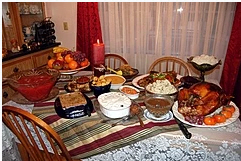
When mother served us something for dinner we didn’t like and scarcely touched, he always said there are people in country X who don’t have any food at all. I wasn’t sure how cleaning up my plate would help those people, so after years of hearing her pronouncement I said, “Let’s just mail it to them.” That comment didn’t go well.
Other than those days when mother got into the locoweed and served something strange, she was a great cook 24/7/365. Even though she managed meals on a tight budget, we always had plenty to eat. The older I got, the more I realized that more people than not didn’t have plenty to eat. It made me think we should be thankful for what we had.
If one feels thankful, that feeling changes his/her life. Gone are the feelings of entitlement of rich vs. poor, our country vs. a third-world country, or working people vs. those who don’t work. I don’t think many of us can imagine what it’s like to walk in another person’s shoes, much less find the empathy needed to truly understand those who don’t have what we have–so to speak.
Feeling thankful for what we have and how we live and how our friends and family are there for us doesn’t mandate our giving all of our money to worthy causes. I’ve written posts in the past about the fact many worthy causes suggest only $25 will help, but fail to consider that they are one of 50 charities that have approached us with the same rationale. I like Kiva because it lends money to people who are trying to help themselves. My donation by itself seems rather paltry but paired with hundreds of others, I believe it makes a difference.
I’m thankful for Kiva and the other groups who help those who need help. It gives us a way to reach out to thousands of people. Our lives are not perfect, but there is still much to be thankful for even though all of us meet up with the slings and arrows of outrageous fortune as a matter of course: as part of life itself. I’m sitting here typing this post in a warm office with dinner in the oven. If I weren’t thankful already, I could start with that.
“The students are at the start of their creative lives, and I remember well what those years felt like — when you think you know what art requires, and then the realization comes that you must go deeper and deeper still (if you’re serious at all) into the unknowable, uncomfortable, vulnerable place where the root of creativity lies…which is to say, you must go deeper and deeper into yourself, which can be daunting indeed. Even now, after all these years, I still have days of sharp (or anxious, or befuddled) resistance to this act of deep surrendering…but the joy of age is that I know my own process now, the daily habits, practices, and mindset that will carry me past each block and obstacle and back into the work.” Terry Windling in “When the Magic is working” from Myth And Moor.
This 2014 post from Windling’s blog shows you why I like her work and why I return to her Typepad blog so often for fresh inspiration. I might also note that I read Theoroda Goss’ novels and blogs for the same reason. And so, too the former Endicott studio journal, featuring the work of Windling, Jane Yolen, Midori Snyder, and others. To read their work is to re-discover anew a deep well hidden in a sacred copse where magic lives in the deep water. Drink, and you’re transformed and living within, as Windling wrote, that deep and “vulnerable place where the root of creativity lies.“
Life, as philosophers and comedians say, “ain’t easy.” The slings and arrows of daily life wound us again and again until the magic within our souls just about drains away. So we return to the well and drink again.
Every artist/writer/painter finds his/her own muse and his/her hidden well where s/he drinks and is refreshed. It might be an author (or group of authors) and their novels, essays, and poems; it might be the witch who lives down the street, or perhaps the “older generation” in one’s own family. We all must find the source of our magic and what makes it flow through our veins like holy fire.
–
You may not have anything in common with those who inspire you except for the inspiration they provide. None of the people associated with the blogs and studios listed above know me. We move in different circles. To great extent, they are interested in faerie and mythic worlds while I’m interested in contemporary fantasy and magical realism.
In time, the magic will live within you and you’ll find that you no longer have to return to that well (unless you’re sightseeing) to start your work. You will know what to see in your mind’s eye or how to adjust your breathing or your office or your desk because you will have done it so often that it will become, not second nature, but first nature. First nature for your art perhaps; or first nature for the way you live your life. The second approach works better for me: what I write on the page comes from how I live and what I believe rather than as a prop for making art.
I used to listen to music when I wrote. For one book it was “Nirvana Road.” For Another book, it was “Beneath The Raven Moon.” Music, I find, becomes associated with the work and with the magic behind it. Playing the music is like turning the ignition key in a car–or, these days, like holding down the brake while pushing the “start” button. Then things are purring at the right level and plain of existence, the writing flows because the magic is working.
Do high school teachers still require writing short essays in class? Beats me. And, if they do, how are they written: pen, pencil, computer?
During “my era” we used pencils. Then, when I got into college, the writing-related courses had typewriters: that seemed like a quantum leap, and probably easier for teachers who no longer had to decypher their students’ bad handwriting. Unlike a room filled with laptops, a room filled with Selectric typewriters going at once was rather noisy.
Wikipedia photo
While some students typed like they were trying to poke holes in a pile of clay in art class, I typed fairly fast. Most journalism students did because we all grew up with typewriters. But this isn’t the tapping I’m talking about.
In-class essays were typically about something we purportedly read as homework and were usually a minimum of 150-200 words on subjects like “What was yellow journalism?”
For most students, the word count was more important than the content. So, they’d write a sentence or two and then count the number of words they had. They counted the words by tapping on each word with the point of their pencil. So, it was write, then tap tap tap tap tap, followed sometimes by a sigh when the student realized s/he was lightyears away from the minimum word count.
Naturally, these essays didn’t have a lot of unity, coherence, and emphasis because they kept going until the word count was reached. Finally, after all that tapping and counting up the words, the essay just ended. Most of the essays came back with a lot of red ink that spoke to a lack of organization. I hope NaNoWriMo entries aren’t written this way.
I can’t help but smile when I think about all that pencil-point tapping as students counted and re-counted the words on the page.
On the other hand, some students got to the minimum word count with ease, but ruined the essay by saying “Yellow journalism was caused by a mistake at the ink factory that turned black ink into yellow ink.”
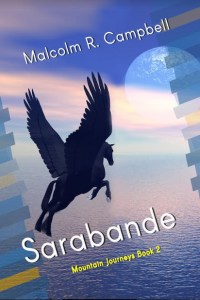
Malcolm R. Campbell is the author of the contemporary fantasy “Sarabande.” The sequel to “The Sun Singer,” “Sarabande is available on Kindle, paperback, hardcover, and audiobook.
‘The 2020 median pay for writers and authors was $67,230 per year, with the most common entry-level education being a bachelor’s degree. In 2019, there were 131,200 working novelists in the country, and the job outlook for 2019 to 2029 is 2 percent, a small decline. The staff at Indeed posts that the national average salary is $49,046 and ranges from $15,080 to $127,816. Many novelists are self-employed, so this salary will vary based on how many hours you’d like to work and how successful your works are.” – Chron
I’ve never seen money like that except on cops and robber shows where people walk around with suitcases of one-hundred-dollar bills. When I was a technical writer for computer companies, my salary wasn’t too bad. But when I retired from that rat race, my earnings didn’t soar into the James Patterson realm or even the realm of popular mid-list authors.
At my age, the gigolo business is no longer an option.
So, it (the writing) comes down to liking what we do and then guessing whether our royalties each month will be higher or lower than our expenses. Thank goodness for that Social Security check and my investments in diamond mines and oil wells.
We (authors) usually think what we’re writing is a lot more entertaining than the stuff going on around us in “real life.” I’m sure thinking that way is evidence of loco weed, bad whisky, or schizophrenia. According to the May Clinic, “Schizophrenia may result in some combination of hallucinations, delusions, and extremely disordered thinking and behavior that impairs daily functioning, and can be disabling. People with schizophrenia require lifelong treatment.” My lifelong treatment is writing novels (and meds).

 Malcolm R. Campbell keeps writing novels because he thinks he can quit any time he wants.
 When the 1972 film “Lady Sings the Blues” aired the other night on one of the many DISH network channels, it was hard not to think of the original autobiography of Billie Holiday that was reissued in an anniversary edition in 2006. When you watch the movie, which I like, you’re seeing a bit of Diana Ross simmered and stirred into Holiday. I think you get closer to the real Billie When you read the book–though it’s hard to separate out the influences of those who helped her write it. I’ve heard all her songs and think they’re the best way to understand Holiday, especially if you have a version with analog sound instead of the always-slightly-false digital approach. (My bias.)
 Malcolm R. Campbell is the author of the Florida Folk Magic Series of novels in which the blues have a strong presence.
 Whether you see all that is as a Huna mystic or as a member of a group with another approach to the “Cosmic,” it seems clear that if we are all doing our best to synchronize our lives with the universe–perhaps via the I Ching–we would not have the spectre of climate change hanging over our heads like the sword of Damocles.
 Even though it was March, I drove downtown in my 1950 A4 Checker (for you young people, that’s a car, not an Internet fact checker) in a cold wind that raged drunkenly beneath black clouds that looked like they’d been painted onto a frightening sky by Salvador Dalí during one of his less-lucid moments.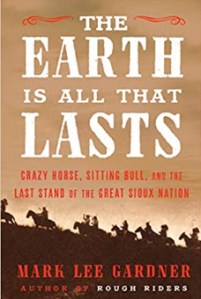
 When mother served us something for dinner we didn’t like and scarcely touched, he always said there are people in country X who don’t have any food at all. I wasn’t sure how cleaning up my plate would help those people, so after years of hearing her pronouncement I said, “Let’s just mail it to them.” That comment didn’t go well.



 I’ve never seen money like that except on cops and robber shows where people walk around with suitcases of one-hundred-dollar bills. When I was a technical writer for computer companies, my salary wasn’t too bad. But when I retired from that rat race, my earnings didn’t soar into the James Patterson realm or even the realm of popular mid-list authors.
 Malcolm's Round Table