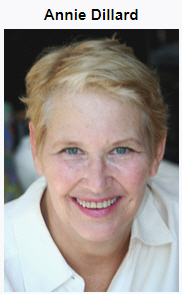
 “I can no longer travel, can’t meet with strangers, can’t sign books but will sign labels with SASE, can’t write by request, and can’t answer letters. I’ve got to read and concentrate. Why? Beats me.” – Annie Dillard, from her website
I was browsing through the Poets & Writers website today when I saw that a profile of Annie Dillard, by John Freeman, “Such Great Heights” from 2016 was displayed from the magazine’s archives. Freeman writes, “You can almost hear the pops and fizzes of combustion as the flue clears and Dillard’s mind gulps down the oxygen it has been feeding on for years—books. It’s something to behold. Here is the sensibility that emerged from a white-glove Pittsburgh background because she read a novel about Rimbaud and wanted her mind to be on fire too. Here is the writer who pulled it off, chiseling out Pilgrim at Tinker Creek (Harper’s Magazine Press, 1974), the Walden of our time, in nine months because she read a book on nature and felt she could do better. And thus Dillard wrote that great, elegant prayer to the seasons, largely at night, in the Hollins College library in Roanoke, Virginia, powered by chocolate milk, Vantage cigarettes, and Hasidic theology.”

If there were a website where readers who love a writer’s words and philosophy could sign up to become an official kindred spirit, I would have gone there in 1974 when the Pulitzer-Prize-winning Pilgrim at Tinker Creek emerged to sign my name on Dillard’s kindred spirit page. He work has influenced by thinking .
In Tinker Creek, she writes, “It is so self-conscious, so apparently moral, simply to step aside from the gaps where the creeks and winds pour down, saying, I never merited this grace, quite rightly, and then to sulk along the rest of your days on the edge of rage.
I won’t have it. The world is wilder than that in all directions, more dangerous and bitter, more extravagant and bright. We are making hay when we should be making whoopee; we are raising tomatoes when we should be raising Cain, or Lazarus. Go up into the gaps. If you can find them; they shift and vanish too. Stalk the gaps. Squeak into a gap in the soil, turn, and unlock-more than a maple- a universe. This is how you spend this afternoon, and tomorrow morning, and tomorrow afternoon. Spend the afternoon. You can’t take it with you.”
Yes to all that. And to her words in such books as Holy the Firm, Teaching a Stone to Talk, and Tickets for a Prayer Wheel. She taught for 21 years at Wesleyan University where I wish I’d been a student to audit her classes. If you read a lot, you will most likely find your Annie Dillard, the friendly author you wish lived next door with the porch light on..
We’re about the same age, she and I, and there’s much we could have talked about.
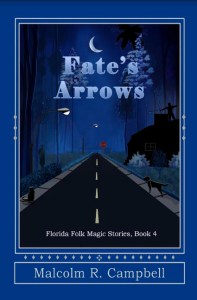 This time, it’s the novel in progress which, if I don’t get my teeth sharpened up, could turn into a real turkey and that would tick off my understanding publisher. So, my apologies for the length of time that’s passing by since the release of my last book, Fate’s Arrows in 2020. Like a turkey drumstick to a guy used to fried chicken, Cornish game hens, and squabs, this book was supposed to be essentially a short novel or a long novella. But once I got into it, I realized that–as a continuation of the story in Fate’s Arrows–it was a lot longer and more complex than I expected.
 If Ostrich really tastes sort of like venison, I would like it. So I hope that when I finally get enough spare room inside my mouth to chew what I ended up with, I’ll make better progress with this book. And, when it comes out, I hope you’ll like it even thought it will probably be darker and grittier than Fate’s Arrows. Let’s face it, there’s no good way to write a light-hearted book about the KKK because it’s members in Florida where my novels are set were more cruel than Shortfin Mako Sharks and quite likely lived next door. Your friendly sheriff was probably a member.
 Well, there are lots of ways, actually, but I’m thinking of “1883′ which ran initially in 2021 with great work by actors Tim McGraw, Faith Hill, Sam Elliott, and Isabel May. The series about a wagon train heading west was very gritty, but the dialogue and plot were exceptional. Okay, I’ll warn you that there are spoilers here.
 I just finished entering online comments into a Glacier National Park survey about how to do things better in managing the park. If you’ve visited Glacier recently, you know that all roads in the park are controlled by a reservation system that dictates when you can drive from one place to another. I can understand why the plan was tried, but I think it made everything worse.
 I was amused at the semantic chaos a character in a recent novel fell into while trying to explain the various pagan groups to an individual who (a) was a born-again Christian with Baptist-oriented beliefs, and (b) thought anything labelled “pagan” or “witchcraft” was pure and simple “devil worship.”
 Was it a lapse in my education or a personality defect that brought me into the theater in 2001 to see the Ron Howard-directed film “A Beautiful Mind” with absolutely no idea who John Forbes Nash (June 13, 1928 – May 23, 2015) was, much less the focus of his work? I suspect my lack of knowledge of Nash came out of the rather thin coverage of subject matter in my university’s general education courses. Since I’d never heard of Nash, I didn’t notice the publication of Sylvia Nasar’s 1998 biography A Beautiful Mind on which the feature film was based. The biography is well written and yet, I missed it until after the film came out
 The movie made quite a splash and won many awards, at the Oscars and elsewhere. Some people didn’t like the way schizophrenia, from which Nash recovered. Others thought Nash’s wife Jennifer Connelly was miscast as Alicia Nash who, in reality, came from El Salvador and spoke with an accent. And then, as Wikipedia reports, “According to Nash, the film A Beautiful Mind inaccurately implied he was taking atypical antipsychotics. He attributed the depiction to the screenwriter who was worried about the film encouraging people with mental illness to stop taking their medication.”
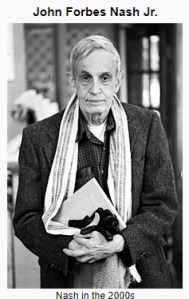 In the Oppenheimer biography American Prometheus, Oppenheimer is said to have a “forgiving instinct for the frailty of the human psyche, an awareness of the thin line between insanity and brilliance.” He worked with Nash and saw the issues behind the individual.
 Cox and Forshaw will tell you it’s a quantum mechanics idea in their book, as the subtitle suggests. I agree with them.
 Or maybe French mathematician Émile Borel thought up the idea in 1943. Or maybe it was in Morgan in 1866
 SNAFU is people drinking all night in a bar while climate change is causing the seas to rise up to the doorstep. Hell, maybe “if it can happen, it will happen” is pure cynicism as we see our politicians arguing about how many angels can dance of the head of a pin while ignoring what’s really important.
 One thing I do know is that the person who promised her Bitcoin (whatever that is) dealings had been so successful along with winning a suitcase of lottery money, that she could finally send me “a car for people who thought they would ultimately know everything.” Sadly, the car never arrived and her phone number has been changed to some communal phone at Sing Sing in Ossining, New York. Here’s the photo she sent me before entering the slammer. If you have to ask what it is and/or how much it costs, it’s not the car for you.
 I strongly suspect that–due to my belief in the Many Worlds Interpretation of Quantum Physics–that many of us don’t live in the universe where were started out. But I can never quite catch the change happening. The only clue is today’s history classes that no longer teach things I remember happening. In today’s universe, perhaps they didn’t, or else we’ve sanitized it out of existence. The chart shown here seems self-evident, so I won’t waste time going back to the work of folks like Niels Bohr and Max Planck. I’ll note that I really like
  I’m certain about one thing. When you’re my age, you don’t know everything such as the speed and location of an electron. I strongly suspect that this is the new way of the world, one (e.g.) when even Senators and Congressmen/Women don’t simultaneously know the location of their asses and the nearest hole in the ground. This has caused a lot of polarization between the two major parties.

 Malcolm's Round Table