I stand with Israel

While I think the creation of Israel by the British was bound to create a focus for fighting that would (apparently) last for all time and while I think Israeli treatment of Palestinian interests has been far from perfect, I stand by the country’s right to defend itself and for Jewish people worldwide to have the right to live in harmony without being targeted by rising antisemitism.

It’s intolerable that Jews, according to the FBI, faced more hate crimes in 2022 than any other religious group. This makes no sense to me any more than progressive college students supporting Hamas makes any sense to me.

According to a PBS story, “The rise in Jew-hatred in the U.S. is not limited to white supremacists. It said that “the antisemitism of the far-right and far-left are pushing into the mainstream of American culture and politics from both sides.” The intolerance is so old that it’s difficult to sort it out other than to say it often leads to spurious beliefs held by the Nazis during WWII.

The Anti-Defamation League exists “To stop the defamation of the Jewish people and to secure justice and fair treatment to all.” I don’t think that’s too much to ask. According to the ADL website, “Our values guide our internal culture and shape the approach we take to our programs and initiatives externally. Confronting antisemitism, our founders established ADL based on their Jewish values. We build on their legacy as we speak out on behalf of all marginalized communities across the country and around the globe.”

The recent attacks against Israel some from a terrorist organization supported by rogue states. Why do so many Americans support this? Apparently, they have been brainwashed by old myths and old fears.  I have no tolerance for that any more than I have any tolerance for those who said the 9/11 attacks were justified and proclaimed their support for Bin Laden. They are like those who support the KKK.

I’m a pacifist and cannot support violence against individuals or legal states of any kind and so I fear that those who openly support Hamas are creating a larger problem that ensures the violence against Israel will continue. And it will probably never end.

Malcolm

Jews in WWII: history’s defining moment

As I read Isabel Allende’s The Wind Knows My Name which begins when Samuel Adler’s father who disappears during Kristallnacht, I think that the plight of the Jews at the hands of the Germans and others is the primary event in recent history that defines the state of the world. There are, perhaps, some 70,000 books about the war. As for those directly related to Geman, Russian, and other countries’ crimes against the Jewish people, I cannot determine.

It’s hard to read such novels and nonfiction accounts without Xanax and/or Scotch to tame the horror in one’s mind and stomach at the unmitigated cruelty against one of the world’s major ethnic groups without rational purpose–unless you consider myths rational enough to justify it.

What bothers me is that the myths are illogical rationale for targeting the Jews are still with us, even within the U.S. where one would think we’ve outgrown such hatred. You can follow the fight against this evil by looking at the International Holocaust Remembrance Alliance.  According to its website, ” The IHRA identifies the practical needs of policymakers, scholars, educators, and museum professionals working in the Holocaust remembrance sector, and it produces materials to support the work of these stakeholders. Resources such as IHRA academic publications, educational guidelines, and reports are written by experts for the benefit of non-experts, helping to ensure that the IHRA’s expertise can serve a highly practical function throughout IHRA’s member countries and beyond.”

I believe we owe it to ourselves and to the Jewish people to stay informed about the ongoing problems rather than assuming that since we see nothing bad happening outside our windows, there are no issues to fight.

From the publisher, we read,  “The lives of a Jewish boy escaping Nazi-occupied Europe and a mother and daughter fleeing twenty-first-century El Salvador intersect in this ambitious, intricate novel about war and immigration” (People), from the New York Times bestselling author of A Long Petal of the Sea and Violeta. “Allende’s storytelling walks a lyrical romanticism on roads imposed by social and political turmoil.”

The danger, I think, is believing that such problems are gone with the wind. They are not. They live with more vitality than any of us would believe.

–Malcolm

Why I’m skipping ‘All Quiet on the Western Front’

This new film adaptation of the 1929 novel by Erich Maria Remarque is generally receiving positive reviews by viewers and critics. According to Rotten Tomatoes, 91% of 142 critics’ reviews are positive, with an average rating of 8.3/10. The consensus is that the film is, “Both timely and timeless, All Quiet on the Western Front retains the power of its classic source material by focusing on the futility of war.” Wikipedia notes that “Metacritic, which uses a weighted average, assigned the film a score of 76 out of 100, based on 36 critics, indicating “generally favorable reviews.”

From the trailers, the cinematography appears excellent and in your face, although some critics say the film missed “the essence” of the novel, and wondered if the filmmakers had read  Remarque’s book. Like the scenes of the D-Day landing in “Saving Private Ryan,” the horror of similarly realistic scenes in this movie will in some ways teach viewers just what war is. And, perhaps, move them to vote for people who don’t send our soldiers into that horror.

I’m skipping the movie because I read the book when I was too young for it–junior high school. I had PTSD nightmares for years afterward. I wish I could see the movie, but I’m not strong enough (I guess) to return to the venue of the novel. That book probably was one of the influences on my becoming a pacifist. Even so, I think we need such novels and feature films because they might turn more people away from the so-called honor of dying for one’s country or becoming a “hero” for going where nobody should ever have to go.

I think all the “honor and glory” the country lays at the feet of soldiers living and dead is bullshit. Movies like this remind us that death accomplishes nothing except grieving family members.

UPDATE-2/20/23:

‘All Quiet’ wins 7 BAFTAs, including best film, at U.K. film awards ceremony

–Malcolm

Malcolm R. Campbell is the author of anti-Klan ficition set in the Florida Panhandle in the 1950s, at present a four-book seires beginning with “Conjure Woman’s Cat.”


Today, 35K people are blogging for peace

“When your fight has purpose—to free you from something, to interfere on the behalf of an innocent—it has a hope of finality. When the fight is about unraveling—when it is about your name, the places to which your blood is anchored, the attachment of your name to some landmark or event—there is nothing but hate, and the long, slow progression of people who feed on it and are fed it, meticulously, by the ones who come before them. Then the fight is endless, and comes in waves and waves, but always retains its capacity to surprise those who hope against it.” – ― Téa Obreht, The Tiger’s Wife

(I’m not an official blogger for peace, check Mimi Writes if you want to be a member and use the official logos.)

The quote from Téa Obreht suggests one reason why war is so difficult to stamp out.

My introduction to the realities of war came from reading All Quiet on the Western Front when I was in high school. I found this novel to be so graphic, I could not comprehend how anyone who fought in a war, observed a war or read that book could possibly support any politician calling for war. I won’t read it again.
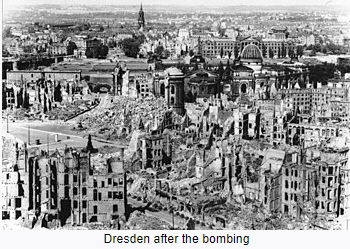
I felt the same way after reading the equally repellant Johnny Got His Gun. “Hawks,” I wanted to say, “this is what war does to people.” Along with many others, I learned about the unnecessary and immoral firebombing of Dresden when I read Slaughterhouse Five. Cynically, I wondered how many of those who raged at Sherman’s approach to war thought what we did to Dresden was somehow justifiable.

We don’t always hear the anguished stories of those who fight and return because they can’t or won’t talk about what happened over there. I’ve written elsewhere that I think the real casualties are those who survive so that they can go through the hell of the battle every night in their dreams. Perhaps we learn a little from war reporting, and later from historical novels and nonfiction accounts. Perhaps if we spent one day in Ukraine, we would become doves forever; but I doubt it.

Dresden, where 25,000 people were slaughtered.

Kurt Vonnegut, wrote in, Slaughterhouse-Five, “You know — we’ve had to imagine the war here, and we have imagined that it was being fought by aging men like ourselves. We had forgotten that wars were fought by babies. When I saw those freshly shaved faces, it was a shock. ‘My God, my God — ‘ I said to myself, ‘It’s the Children’s Crusade.'”

And so it usually is. We imagine there’s glory in it. There is not. The idea of glory is the sham that sends the babies off to fight and that celebrates their work if they return. They never return, actually, because they will never mentally escape the slaughterhouse of battlefields and the cities like Dresen that got in the way.

Perhaps if we listened to their nightmares and shared their PTSD, we could become doves forever and–as we used to say (and sing)–“give peace a chance.”

When it comes to a prospective war, your thoughts about the wrongness of it matter.

–Malcolm

Malcolm R. Campbell is the author of the Vietnam War novel At Sea.

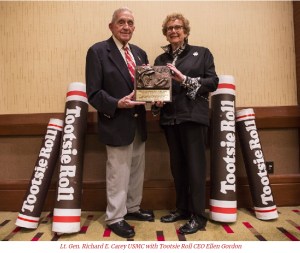
Tootsie Rolls, the “go-to” food for marines fighting in the Korean War.

If you read accounts of the badly outnumbered U.S. Marines fighting against the Chinese near Chosin Reservoir in 1950 in the Korean War, you’ll find the troops constantly eating Tootsie Rolls.

https://headstuff.org/culture/history/tootsie-rolls-korean-war/

The temperature was at least -25° and the wind and snow made conditions worse. Cans of C rations, “light” such as fruits and “heavy” such as meats were always frozen and took forever to thaw out in a pot of boiling water over a cooking fire.

“Tootsie Roll” was a code word for a 60mm mortar wound. Running out of ammo, the marines called for a parachute drop. The radio operator didn’t have a code sheet, so sent real Tootsie Rolls.

I don’t know the marines’ first reaction, but the candy (chocolate toffee) became a lifesaver. Unlike frozen cans of food, it would warm up in your mouth, staving off intense hunger and providing energy. It also turned out that a Toosie Roll would plug up a bullet wound in weather so cold that the blood from wounds tended to freeze. The candy, when warmed up in one’s mouth would also work like caulk and patch up leaking fuel lines.

I haven’t eaten a Tootsie Roll in years but had them often as a kid. I wish I’d been able to tell my folks that the candy was “Marine approved.” Of course, I wasn’t doing Korean War research for the novel in progress then, but it seems like the kind of fact that would be mentioned in history class.

Malcolm

Putin thinks he’ll win in Ukraine because the world will become bored with the war

In the United States, school shootings, gun control, and the potential of Roe v. Wade being overturned are occupying more and more space on news pages. So, I wonder if today’s CNN story After 100 days of war, Putin is counting on the world’s indifference by Nathan Hodge represents a plausible analysis of the future.  Meanwhile, Biden is sending more missiles. That will help, but will it be enough?

Some analysts say that Ukraine will ultimately cede the eastern regions of Luhansk and Donetsk to avoid a protracted war, more lost lives, and continued destruction throughout the rest of the country.  While I can understand why this result could happen, I hope it doesn’t. It would not only be a loss for Ukraine but a black mark for the rest of the world that could have done more.

The world did little when Putin stole Crimea. So it’s possible the world will slowly forget about the rest of Ukraine, or at least Luhansk and Donetsk because–short of risking a nuclear exchange with Russia, people will see there’s nothing more they can do short of adding Sweden and Finland to NATO. That won’t help Ukraine, though, will it?

If Russia is allowed to keep the Donbas region, will it be forced by a treaty agreement to pay reparations to Ukraine for the lives lost, infrastructure destroyed, homes and businesses lost, and people displaced? I suspect not–or perhaps a token amount that adds insult to injury.

I am by no means an expert on international policy, much less Ukraine. Yet I feel the need to say something here, fragile as it may be, to remind people that the war is still going on and that now is not the time for our indifference.

Malcolm

Reminder: “Winterkill,” a novel by Ukrainian Canadian author Marsha Forchuk Skrypuch, will be released on September 6 and is available now for pre-order. The novel tells a gripping story of how the Soviet Union starved the Ukrainian people in the 1930s — and of their determination to overcome. This genocide is known as the Holodomor.

Korean War – all but forgotten

If it weren’t for the insane antics of North Korea’s “Supreme Leader” Kim Jong-un, we would probably never remember that a war–that’s technically not over–divided up the country. I remember the war because it was in the news when I was a child. Little to nothing was said about the war in my history survey courses other than President Truman firing General MacArthur in April 1951.

Even now, I think most viewers of “M*A*S*H” reruns assume the TV show was set in Vietnam even though the co-authored novel by a M*A*S*H surgeon (under a pseudonym) was based on this wartime experiences in the Korean War.

I research the war from time to time because characters in my novel Fate’s Arrows and in my short story “The Smoky Hollow Blues” (in the recently released Thomas-Jacob anthology The Things We Write) served in Korea. The novel in progress has these same characters, so I find myself wanting to know more about the near-disaster for the U.S. Marines at Chosin Reservoir in 1950.

You can learn about this battle online on more sites than Wikipedia, and they give a decent overview of the battle. Yet I feel it’s through the lens of somebody watching it from outer space. I can’t afford to buy books about the war just to fill in background information about my characters. Fortunately, I have most of Jeff Shaara’s historical novels including The Frozen Hours about Korea. The novel brings me a close-in view of what it was like to be fighting a superior-in-size Chinese force in sub-zero temperatures where weapons malfunctioned and frostbite was a killer.

I bought the book before I knew I would ever use it as a reference. I like Shaara’s work and probably have most of his novels on my shelf. As an author, I go everywhere I can for background information, and sometimes historical fiction works out very well.

Malcolm

За Україну (for Ukraine)

Я читав, що американці не воювали б так, як ви воювали, якби на нас напали, як на вас.

Ви надихаєте нас і соромите нас, тому що ми не втручалися. Ми надіслали зброю та припаси, і ми чули, що вони були корисними. Якщо наша відправка допомогла, то ми можемо спати вночі.

Ми погано спимо. Образи з щоденних новин про смерть і руйнування в Україні переслідують наші мрії. Деякі з нас мріють, що ми бачимо жах на власні очі, тому що саме так ми повинні бачити його – а не на телебаченні, як ніби ваша боротьба – це фільм.
Можливо, ваша сміливість одного дня надихне нас знайти власну мужність, щоб врятувати себе, якщо до цього трапиться, і врятувати інших, які просять нашої допомоги. Сьогодні ми відпочиваємо в цілості й здоров’ї в наших домівках, далеко від звуків бомб, танків, ракет та останніх слів загиблих. Завтра, можливо, ми схаменуємося і відповімо на ваш дзвінок.

Поки не настане завтрашній день, ви перебуваєте в наших думках і на нашій совісті. Мені шкода, що ми не робимо більше, коли наші боги говорять нам, що ми повинні робити більше.

Ми любимо вас більше, ніж дозволяє наша влада.

Malcolm

Translation:

I have read that Americans would not fight as you have fought if we were attacked as you were attacked.

You inspire us and you shame us because we did not intervene. We sent weapons and supplies, and we hear that those were helpful. If our shipment helped, then we can sleep at night.

We are not sleeping well. Images from the daily news of death and destruction in Ukraine haunt our dreams. Some of us dream we are seeing the horror first hand because that is how we should be seeing it–not on television as though your struggles are a movie.

Perhaps your courage will one day inspire us to find our own courage to save ourselves if it should come to that, and to save others who ask for our help. Today we rest safe and sound in our homes that are far away from the sounds of bombs and tanks and missiles and the last words of the dead. Tomorrow, perhaps, we will come to our senses and answer your call.

Until that tomorrow arrives, you reside heavily within our thoughts and upon our consciences. I am sorry we are not doing more when our gods are telling us we should be doing more.

We love you more than our government will allow.

That long line of refugees

When Ernest Hemingway’s dispatches from the Greco-Turkish war of 1922 began appearing in a Toronto newspaper, readers discovered a new style of war reporting that read, in some ways, like a novel, telling a story that put readers in the story.

When I read these dispatches during my journalism school days, I was most taken  by his description of an endless line of refugees: “Minarets stuck up in the rain out of Andrianople across the mud flats. The carts were jammed for thirty miles along the Karagatch road. Water buffalo and cattle were hauling carts through the mud. No end and no beginning. Just carts with everything they owned. The old men and women, soaked through, walking along, keeping the cattle moving. The Maritza river was running yellow almost up to the bridge. It rained all through the evacuation.”

But what impacted me most strongly, was that in a dispatch sent several weeks later, he wrote: “No matter how long it takes this letter to get to Toronto, as you read this in the Star you may be sure that the same ghastly, shambling procession of people being driven from their homes is filing in unbroken line along the muddy road to Macedonia. A quarter of a million people take a long time to move.”

The power was not only the writing, but the fact that in between reports while the world went about its everyday business, this line of people was still on the road.

NewsClick photo

I think of these reports now as I watch or read reports of the long lines of refugees fleeing Ukraine, fleeing from a man who claims his army doesn’t target civilains, and that all the time when I’m not reading the news, those refugees–like the endless line of people from the Greco-Turkish war–have been on the road, cold and hungry while I was having dinner, being shalled while I was sleeping, walking endlesss steps while I was watching television.

The power of the scenes on TV and Internet news sites comes partly from the horrors described. It also comes from the fact that while we come and go, the tragedy in Ukraine is a 24/7 nightmare. While I’m sitting here typing this post and drinking a glass of red wine, another man is walking toward Poland carrying his dying child, one of many in an unending line of other such men and other such children.

Malcolm

Trying to be more like Papa Joe, are you Vladimir Vladimirovich?

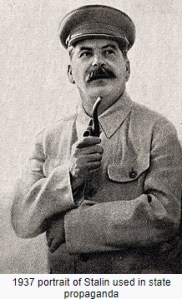
Let’s suppose Vladimir Vladimirovich Putin woke up a while back in his latest palace with a woe-is-me attitude and thought: “Проклятиеn, I’m getting old and my life has turned into nothing better than vodka, syphilis, and anonymity with reduced odds of catching up with the great deeds of Papa Joe.”

With nothing on his resume since Crimea, he was tired of oligarchs asking, “So Vladimir Vladimirovich, what have you done for us lately?”

In his heart of hearts, such as it was, he thought of the joy Papa Joe must have felt while he was deporting residents of the Baltic countries to Siberia for real or imagined anti-Soviet behavior in 1941. Since most people didn’t know anything about that, history could safely repeat itself with a “cleansing” of Ukraine, those неблагодарные ублюдки (ungrateful bastards) who dare to turn their backs on the former USSR.

Or, there’s another possibility: he’s nuts. Several days ago, the “Daily Beast” wondered if “Putin Will Throw Mother of All Hissy Fits if Kyiv Attack Fails.” Chances are, he’s already having it even though Ukraine’s survival is looking more and more grim.

Ukraine has surprised everyone with its tenacity. If Putin hadn’t threatened a nuclear attack against anyone who intervened, would we have intervened. Probably not, though in spite of its middle ground posture, Israel might have had the guts to do it.

Putin’s ego(maniac) trip is about to change Europe and NATO forever. Too bad the syphilis didn’t kill him first.

Malcolm