Camino Winds brings back many of the characters from Camino Island, a novel the New York Times aptly decribed as “a delightfully lighthearted caper.” Camino Winds begins with wind, the monster hurricane Leo that takes aim at the Florida Island with deadly intentions and mind-numbing accuracy. In her blurb, author Delia Owens (Where the Crawdads Sing) calls this second book in the series a “wild but smart caper.”
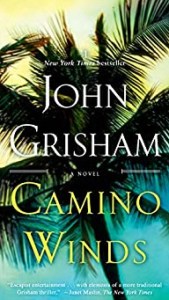 The novel is easy to read but the most exciting part of the caper is provided by the hurricane, and this is where we find the book’s most effective writing. A man is killed during the story, purportedly by falling tree limbs, but bookstore owner Bruce Cable of Bay Books doesn’t think so. The local police don’t seem interested, so the caper aspect of the novel begins when Bruce and his friends start trying to find out what really happened.
They begin by disturbing the crime scene, borrowing the dead man’s car, and appropriating the food and liquor in his kitchen that will dertainly go bad if left for any forensic techs who might one day show up. The dead man, an author named Nelson Kerr–among those who hung out at Bay Books–won’t miss the food and probably wouldn’t begrudge the amateur sleuths a great meal and all the high-priced drink they can handle, which turns out not to be a lot.
Kerr as apparently writing a novel about something that somebody didn’t like so, probably–the amateur sleuths speculate–the killer was mixed up in the pièce de ré·sis·tance crime Kerr plans to thinly diguise as fiction in his new thriller. If so, they no doubt wanted to stop him before (a) he finished the book, or (b) the book get to a publisher if he did finish it.
Bruce, et. al. have some good ideas, the kind that just might get them killed. If they (the sleuths) were black ops types, they dould take the next step and go after the bad guys with enough gear that woud make Tom Clancy and Clive Cussler exited. But they aren’t, so they can’t, and they don’t. For the reader, this means a lot of time is spent listening to the characters’ pondering which, fortunately, is punctuated with a few laughs, scares, and dicoveries along the way.
They mean well. They’re likeable. And they keep pushing on whoever they can influence until heavy hitters become involved and the crime is solved. Until then, nothing much happens. When the pros show up, a considerable amount of time is spent describing how the bad guys scammed the government out of a lot of money while hurting everyday people. Yes, we suspect this kind of thing is true. But how they (the bad guys) do what they do takes the focus of the story simultaneously closer to its climax and farther away from the main characters.
This is an unsatisfying plot solution. The characters who begin the caper really need to end the caper. If you read every Grisham novel, you’ll nonetheless have fun reading this one. If you don’t, you won’t.
–Malcolm
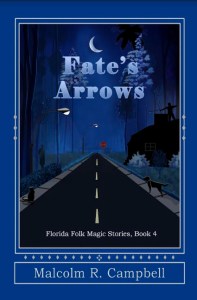 Malcolm R. Campbell
Publisher: Thomas-Jacob Publishing


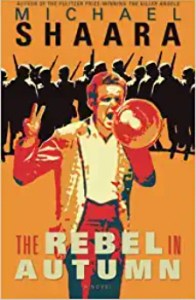 This gem of a novel is an accurate immersion into campus life in the 1960s, especially the protests and the discussions of university censorship of student materials. Inspired by an event at Florida State University (FSU) in which the president banned a short story from the college literary magazine due to the use of a few “dirty words,” the story begins with a grim sense of reality.
 When General Billy Mitchell wrote a report in 1924 that not only predicted the Japanese would attack Pearl Harbor but how they would do it, it was rejected out of hand.
Those who've seen documentaries and feature films such as "Tora! Tora! Tora!" know before they pick up Jeff Shaara's accurate and well written "To Wake the Giant: A Novel of Pearl Harbor" that military commanders and diplomats in the late 1930s and early 1940s continued to reject a Japanese attack out of hand.
Having read all of Jeff Shaara's historical novels, often about subjects I've studied, I'm accustomed to his impeccable research as well as the fact he makes history so human and readable that by the end of each novel, one feels like s/he was there. Unfortunately, some early Amazon reader reviews said Shaara's research on "To Wake the Giant" was sloppy. Subsequently, those reviews were shown to be inaccurate.
Unlike battles that last for days or weeks or months, the attack itself was short. So this book had to be a little different, focusing for many pages on the events leading up to 8 a.m. (25 minutes later than Mitchell's prediction) on the morning of December 7th, 1941. The events prior to the attack not only demonstrate the viewpoints of the major political and military players but show the attitudes of men serving onboard the Arizona and other ships in Pearl Harbor. Shaara shows the attitudes and emotions of those involved months in advance but while the attack is underway.
The human factor looms large in this novel and that's one of its major strengths. Once again, Shaara has put us into the action in a way we'll never forget.
When General Billy Mitchell wrote a report in 1924 that not only predicted the Japanese would attack Pearl Harbor but how they would do it, it was rejected out of hand.
Those who've seen documentaries and feature films such as "Tora! Tora! Tora!" know before they pick up Jeff Shaara's accurate and well written "To Wake the Giant: A Novel of Pearl Harbor" that military commanders and diplomats in the late 1930s and early 1940s continued to reject a Japanese attack out of hand.
Having read all of Jeff Shaara's historical novels, often about subjects I've studied, I'm accustomed to his impeccable research as well as the fact he makes history so human and readable that by the end of each novel, one feels like s/he was there. Unfortunately, some early Amazon reader reviews said Shaara's research on "To Wake the Giant" was sloppy. Subsequently, those reviews were shown to be inaccurate.
Unlike battles that last for days or weeks or months, the attack itself was short. So this book had to be a little different, focusing for many pages on the events leading up to 8 a.m. (25 minutes later than Mitchell's prediction) on the morning of December 7th, 1941. The events prior to the attack not only demonstrate the viewpoints of the major political and military players but show the attitudes of men serving onboard the Arizona and other ships in Pearl Harbor. Shaara shows the attitudes and emotions of those involved months in advance but while the attack is underway.
The human factor looms large in this novel and that's one of its major strengths. Once again, Shaara has put us into the action in a way we'll never forget.
 Lawyer and priest Cullen Post believes Quincy Miller’s 22 years in prison for a murder he did not commit represent not only a miscarriage of justice but brought additional power and financial gain to a small-town Florida sheriff and the criminals he sheltered, aided, and abetted. Proving Quincy Miller’s innocence is a tall order, perhaps impossible, especially when those who framed him want him to quietly rot in prison dead or alive.



 Malcolm's Round Table