Remembering Hoyt’s Cologne

hoytsWhile researching folk magic for a new book, I stumbled across numerous references to Hoyt’s Cologne, an old-style toilet water that was supposed to bring people good luck, especially when gambling.

Originally called Hoyt’s German Cologne (until World War I made the name less optimal), the cologne was developed in 1868 by apothecary Eli Waite Hoyt. Usually described as floral in scent–and very strong–the cologne became so successful that Hoyt sold his apothecary shop seven years later to devote his time to the product.

The product is still available today, including on Amazon. One reviewer stated that it’s definite not subtle. Another described it as “very manly.” Wisdom Products describes it this way:

Hoyt’s Cologne developed in 1868 is truly an old fashioned fragrance reminiscent of early American colognes.  A clean and refreshing scent with fragrance notes of citrus and floral.  Hoyt’s is widely believed to bring good luck.  Splash on your hands and body before playing games of chance.
HoyttradingcardOEDUSA suggests splashing it on before and after shaving, adding that:

Though the company will never reveal the full formula some of the essences used to create the scent are: bergamot and neroli to add a citrusy note; orange blossom for a warm floral undertone with an element of dry orange; and lavender for a hint of refreshing herbal. In our opinion this is a delightful cologne that will pleasantly surpirse the uninitiated.

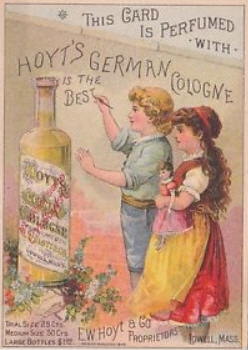
Today, E. F. Hoyt & Company’s beautiful advertising cards and signs are sought after by collectors of vintage designs. Developed by Freeman Ballard Shedd, the cards were originally soaked in the cologne when handing out sample bottles became too expensive.

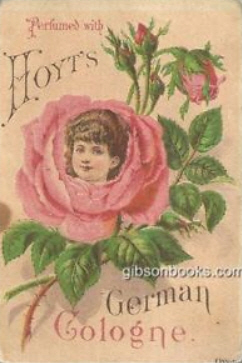
The “Girl in a Rose” series of trading cards was especially popular. You can see an assortment of these cards on Cliff & Linda Hoyt’s This Card Perfumed with “Hoyt’s German Cologne” website.
hoyts2Catherine Yronwode, who operates the Lucky Mojo Curio Company, with its extensive hoodoo information site, mentions interviewing a man who worked for many years for Lucky Heart, a company that featured African American cosmetics and spiritual supplies.

He told her that a lady once came into the drug store where he worked as a child, bought a bottle of Hoyt’s, emptied the contents on her hair, and left the bottle on the counter, and saying, “I’m gonna get lucky tonight!”

I don’t know yet whether I’ll mention Hoyt’s Cologne in the book, but with my love of magic as well as vintage advertising, discovering Hoyt’s Cologne was an interesting “research trip.”

The current owner of Hoyt’s and the Hoyt’s trademark is Indio Products.
Malcolm

Malcolm R. Campbell is the author of the Florida Folk Magic Series, including the newly released “Fate’s Arrows.” These “conjure and crime” novels are set in the Florida Panhandle of the 1950s.
 

Stories where we live

from the archives. . .

“One of the best things about folklore and fairy tales is that the best fantasy is what you find right around the corner, in this world. That’s where the old stuff came from.” — Terri Windling

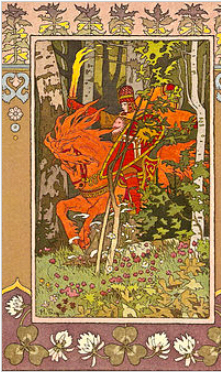
Ivan Bilibin's illustration of the Russian fairy tale about Vasilisa the Beautiful
Ivan Bilibin’s illustration of the Russian fairy tale about Vasilisa the Beautiful

For American audiences, the most famous fairy tales, including those brought to the screen by Disney and others, all came from somewhere else. Such is the power of books and film.

Of course, once upon a time, the more famous stories we know were once local yarns from real places. In fact, many places got their names from something that once happened there with people who were well known at the time. To those who knew the origin of the name, a river or forest or mountain pass was more than water, trees and rocks. It was all that, plus what happened–and, what might happen again.

Almost all places have stories associated with them. You can find some of the more notorious and/or most interesting by running Google searches with such phrases as “Florida ghost stories,” “Glacier Park legends,” and “Illinois haunted places.” The people who live in a town or county often grow up hearing multiple versions of these stories along with others that never get into books, newspapers or websites.

We tell stories to each other almost every day. Sometimes, this is pure gossip. At other times, it’s neighborhood news with a bit of opinion thrown into it.

Storytelling is a very natural pastime even without a front porch or a campfire. We share the good, the bad and the ugly with each other. When that which we’re sharing is larger than life, or stranger than normal, it begins turning into a legend associated with the place where we live.

When we camped pine forests, we told and re-told the tall tales about what happened there "years ago."
When we camped pine forests, we told and re-told the tall tales about what happened there “years ago.”

As a writer of contemporary fantasy, I always love weaving local ghost stories and legends into my work. For one thing, those stories are just as much a part of a place as are the rivers, mountains and towns. Also, they have a lot of flavor in them whether it’s pure local color or an amusing or frightening tale that could have happened anywhere.

Our stories are stronger, I think, when we consider the legends and tall tales connected to a place as part of our research. Almost every town has a haunted house, cemetery, or lover’s lane. If you live there, you know about it already. If you don’t, it’s not too hard to track down through ghost hunter and haunted websites.

Plus, for those of us who love blurring the line between fiction and reality, ghost stories about the places where we’ve set our short stories and novels add a nice touch of mystery.

Malcolm

99seeker

The e-book edition of “The Seeker” is also on sale at Smashwords and OminiLit

Books: Magic Between the Covers

“A well-composed book is a magic carpet on which we are wafted to a world that we cannot enter in any other way.” – Caroline Gordon

My parents orchestrated Christmas Eve and the following morning with skill, making it a time of magic and expectation even though the gifts beneath the gifts beneath the tree were saturated with love rather than money. More often that not, one or more of the carefully wrapped packages beneath the spruce tree contained a book.

More often than not, each book was inscribed with my name, the date, and the name of the person who found the book and thought I might like the story. Pirates, space ships, wild animals and detectives waited between the covers for me to turn the page and enter an alternate universe. I didn’t see stories as alternate universes at the time, but now when I think of books, I smile at the concept of being in two places at one time.

There I was following the Hardy Boys in their latest attempt to help their police detective father crack a dangerous case AND there I was sitting in a comfortable chair in the living room next to a lamp. According to reports, I often didn’t respond when my parents called me to dinner when I was more there than here within the pages of a book like The Twisted Claw.

Portals, Portkeys and Magic Carpets

Caroline Gordon saw books as magic carpets. Ever fascinated with portals, I see books as doorways to faraway lands like the famous wardrobe in C. S. Lewis Chronicles of Narnia. In today’s Harry Potter series terms, readers might well see a book as a portkey that whisks them away the minute they touch it.

While looking at the Amazon page for Mark Helprin’s upcoming novel In Sun Light and Shadow, I found the novel’s stunning 489-word prologue included there as part of the book’s description. The constraints of fair use don’t allow me to cut and paste the entire prologue into this blog as a shining example of an author’s invitation to his readers asking them to step through the door, touch the portkey or settle themselves onto a flying carpet. But, here’s a taste. . .

An Invitation

Helprin’s prologue begins with the line: If you were a spirit, and could fly and alight as you wished, and time did not bind you, and patience and love were all you knew, then you might rise to enter an open window high above the park, in the New York of almost a lifetime ago, early in November of 1947.

The prologue goes on to describe the view from that window, and then the room itself: full bookshelves, the Manet seascape above the fireplace, a telephone, a desk drawer containing a loaded pistol, and a “bracelet waiting for a wrist.” Then the prologue concludes with: And if you were a spirit, and time did not bind you, and patience and love were all you knew, then there you would wait for someone to return, and the story to unfold.

Even though I was, from the viewpoint of my three cats who were hovering around the den door waiting to be fed, sitting here at my desk, I had in fact stepped through a portal to an apartment in New York 65 years ago. I tell you this: I wasn’t ready to return when Katy, our large calico, rubbed against my leg with a no-nonsense purr because I was thoroughly enchanted by the magic between the covers.

Even though a small percentage of the books I read each year come into my hands as gifts, I approach every book with an interesting premise and a cover splashed with promises as a gift. Years ago, I watched a TV western called “Have Gun, Will Travel.” Today, I gravitate more toward Have Book, Will Travel. Each book is an invitation to adventure, lives hanging in the balance, twisted claws lurking in the dark, castles set high above green valleys, and frightened travelers walking down roads in sunlight and in shadow.

Books cast spells and carry us away and while we are gone, we are changed, writ larger by the experiences now living within our consciousness, and ready to see the word of here with the visions we had while we were there.

Malcolm

Travel to mountains and magic for $4.99. It’s cheaper than Amtrak and Delta Airlines.

What if Harry Potter Bought the House Next Door to You?

WHAT IF?

Few questions are more important to a writer. So, what if Harry Potter bought the house next door and wasn’t shy about who he was and what he could do? Really, Harry Potter himself, not Daniel Radcliffe.

Of course, the real Harry Potter—if there is one—is part of a secret world that “in real life” we would never know anything about. There’s a reason for that: people who are different are usually shunned, persecuted or worse.

The first traditional rule for the adept—alchemist, psychic, shaman, wizard—is KEEP SILENT. If he lived next door to any of us, the real Harry Potter would probably appear as unassuming as Clark Kent in the Superman stories.

But, as long as we’re playing WHAT IF?, let’s say Harry is sick and tired of staying in his figurative closet. (Actually, he did stay in a closet at his foster parents’ house—what a nice touch of symbolism on Rowling’s part).

Time for the Welcome Wagon

When a new family moves into a neighborhood, people are curious. They drop by with pies and casseroles partly as a way of starting things off with a friendly “hello” and partly as a way of getting a look at the new folks to assess how they’re going to fit in. Times might be changing, but even today there are many neighborhoods in which the “welcome committee” will be displeased if a Black, Jew, Muslim, or Gay answers the door. In other neighborhoods, Whites, Catholics, and Japanese “don’t belong.”

In scholarly literature, those who don’t belong are often referred to as The Other. They are outside the mainstream. In the Harry Potter books, witches, elves, wizards and giants are outside the mainstream of English society. Even within the magical world itself, there’s a hierarchy about who’s “in” and who’s “out.”

Fantasy offers readers unlimited opportunities to come to terms with what’s different, what goes against the mainstream scheme of things, and to consider whether the consensus reality of “real life” must be engraved in stone or not. Fantasy lets us safely question “what is.” While reading a Harry Potter book or watching a Harry Potter movie, it’s easy to feel simpatico with Harry, Ron, Hermione,  and Dumbledore, and perhaps even to feel a bit sorry for the everyday people in London who don’t know anything about the magic in their midst. Just think of all they’re missing!

But What Happens When We Get to the End of the Book and the Last Movie?

Here come Harry’s friends!

Picture this. The moving van has pulled away and the new family—who looked normal enough while carrying boxes into the house—has gone inside. So, you put together your best cherry pie or your favorite Hamburger Helper meal (depending on your skill in the kitchen), and you go next door and ring the bell.

A dark-haired guy comes to the door. He’s wearing well-aged dungarees and a polo shirt. He smiles and says “Hello.” But, before you can introduce yourself, his son—whom you can see down the entry hall in the living room—shouts Avis! and a flock of pigeons appears out of nowhere and flies past you en route to the wide open sky.

What happens now?

  • The guy who answered the door says, “Hi, I’m Harry,” and acts like the thing with the birds didn’t happen.
  • You ask, “How did he do that” and Harry says, “No big deal, it’s just James Sirius having a bit of fun.”

It’s not quite like seeing it in the movie, is it? As I play with this WHAT IF question, I like to think that the world has progressed a lot between the time when TV viewers were watching Rob and Laura Petrie at 148 Bonnie Meadow Road in the Dick Van Dyke Show and all the Wisteria Lane families on Desperate Housewives. We are more likely to welcome Harry today than we were in the 1960s, aren’t we?

What do you think happens if Harry Potter moves in to your neighborhood and, along with his wife Ginny, makes no secret of his skill with spell casting and potions? Will the neighbors accept him with open arms the way they did while reading Rowling’s books, or will they stay away?

This is not a WHAT IF question I plan to use for the plot of my next novel. If I were Dan Brown, I might show that Rowling’s books weren’t fiction at all and that the guy next door is probably attracting the wrong kind of attention from, say, Homeland Security, the mob, and various terrorist groups. If I were Katherine Neville, I might show that in spite of his skills, Harry needs the help of my protagonist, say, Bill Smith, who has to go on a search for the real Nicholas Flamel to save the neighborhood. Or, if I were Tom Clancy, I’d probably have a couple of CIA operatives show up to assess “which side” Harry was planning to help “win” with his most powerful spells.

Do We Want the Fantasy Characters to Just Stay in Their Books Where They Belong?

We love fantasy whether it’s epic, contemporary, urban, steampunk, heroic or another sub-genre. In the books, Harry Potter was viewed as the hero who saved the magical world and (by readers) as one of the most-loved characters in fiction.

But WHAT IF Harry, Ginny and the kids moved into your neighborhood. Would it all become one happy family with baseball games on Saturdays and Quidditch matches on Sundays? Or, would Harry, Ginny, and their friends from Hogwarts and Diagon Alley remain separate in their house and yard as The Other?

What I think would happen and what I would like to see happen don’t match up here. Even so, I like asking the question WHAT IF?

Malcolm

Malcolm R. Campbell is the author of contemporary fantasy, including the 2011 novel Sarabande from Vanilla Heart Publishing.

Versatile Blogger Award, OMG, ROFLMAO

Due to a questionable, though potentially humorous ripple in the space-time continuum yesterday, author Smoky Zeidel awarded me the Versatile Blogger Award. According to the usual half-informed sources, this award forces me to divulge seven facts about myself that most of you don’t know without the benefits of a get out of jail free card or an invitation to join the FBI witness protection program.

  1. I danced with a local mobster’s girl friend one night in Denver when he (the mobster) was out of town. The girl friend was also a stripper, though not while we were dancing to the celestial “Double Crossing Time” from the Blues Breakers with Eric Clapton album via the juke box.
  2. I once delivered singing telegrams for Western Union even though I can’t sing. (I delivered regular telegrams, too.) Fortunately, strip telegrams were banned in Florida due to the size of the palmetto bugs.
  3. My first byline came from Quill & Scroll Magazine when I was in high school. This occurred before I been introduced to the exciting world of mobsters’ girl friends and Eric Clapton.
  4. My college roommate and I introduced a Vietnamese exchange student to President Lyndon B. Johnson as he shook hands with the mob (not the Mob) watching his plane come into Denver in 1966, the same year I danced with the stripper. We did not bring the stripper with us, but our friend from Saigon still got a nice smile from the leader of the free world.
  5. After I got out of the Navy, my parents inadvertently asked during a Sunday afternoon dinner (moments after all of us got back from church) if “those stories” about Navy men going to bars in foreign ports frequented by strippers were true. When I said “yes,” they seemed pleasantly scandalized and said “that” was part of the price one paid for serving one’s country. I didn’t mention that I made a downpayment on that price several years earlier in Denver.
  6. I had a school-boy crush on actresses Millie Perkins, Natalie Wood, and Nancy Kwan. I “fell in love” with Wood when I saw her in person on an old Chicago radio program called Don McNeill’s Breakfast Club. She was there promoting a new movie called “The Burning Hills.” She didn’t notice me because she was there with Tab Hunter. Wood wouldn’t sing “Let me do a few tricks, Some old and then some new tricks, I’m very versatile” for a few years yet.
  7. En route to a Dutch shipbuilder where I did volunteer work one summer as part of an international youth group, we all swam in Amsterdam harbor after the captain of the barge we were using for transportation said the water was so dirty, nobody ever dared get in it. No strippers were present.

New Award Winners

According the the rules of the Versatile Blogger Award, I am supposed to pass along this award to 15 bloggers who currently have no idea I’m thinking of doing such a thing. Yet, they are writing blogs I enjoy reading:

  1. Chelle Cordero, “Welcome to Chelle’s World”
  2. Pamela Patchet, “A Novel Woman”
  3. Neil Vogler, “A Writer, He Muttered”
  4. Susanne Iles, “Bone Singer Studio”
  5. Seth Mullins, “Spirituality With an Edge”
  6. Shelly Bryant, “My Blog”
  7. Lee Libro, “Literary Magic”
  8. Floyd M. Orr, “POD Book Reviews & More”
  9. Terry (aka Montucky), “Montana Outdoors”
  10. Matt, “Just Wondering”

Well, I’m not as young as I was when I was dancing with strippers, swimming in Amsterdam harbor, talkin with President Johnson or singing “Happy Birthday” to the shocked residents of Tallahassee, Florida while wearing my Western Union badge. That means I’m out of steam and will stop at ten blogs on my list. Don’t bug me about this: I have Mob connections.

Malcolm

Malcolm R. Campbell is the author of the comedy/satire, “Jock Stewart and the Missing Sea of Fire,” the novel credited with adding a little nooke to the Nook.

Review: ‘The Uncertain Places’ by Lisa Goldstein

“A long time ago there lived a poor woodsman. One day he was walking in the forest when a man came out of the trees and hailed him. ‘Good day,’ the man said. ‘And how are you doing today?’

“‘Very poorly,’ the woodsman said. ‘My family and I have not eaten for three days, and if I do not find food for them soon I fear we will all die.’

“‘I can help you,’ the man said. ‘But you must promise to give me the first thing you see when you return home today.'”

All long-time readers of fairy tales are familiar with stories that begin like this, or similar to this, and they all involve people who are down on their luck who are mysteriously offered a great boon. The boon isn’t free because it involves a bargain that may change the lives of a family throughout time forever.

Just stories, of course, with morals in them about getting something for nothing, being too quick to give away something not clearly specified, and trusting anything that happens at crossroads, boundaries and other undertain places.

In Lisa Goldstein’s wonderful contemporary fantasy “The Uncertain Places,” protagonist Will Taylor looks back on the events that occurred after his college roommate Ben introduced him to Livvy Feierabend in 1971. Will is smitten with Livvy; Ben is smitten with Livvy’s sister Maddie. Livvy and Maddie live with their mother Sylvie and younger sister Rose in an odd and rambling house in the Napa Valley.

Will notices on his first trip to Napa that Sylvie is rather scattered. On subsequent visits, it becomes more and more obvious that the house and the family are, in ways that cannot be pinned down, also scattered as though they aren’t quite living in the here and now, or that if they are present in the here and now, that the line between the family’s house and vineyard on one hand and their secrets on the other hand is not altogether well defined.

Will and Ben slowly discover that stories they always believed were “just stories” might be more than that. How exactly did the Brothers Grimm come by old fairytales about woodsmen and witches in their famous books of “Children’s Tales” published in multiple editions beginning in 1812? Growing up, the Feierabend sisters were not allowed to read fairytales. How odd. But Will finds out why, and that “why” has to do with the kinds of fortune and fate that befall those who find themselves confronted by friendly helpers in the uncertain places.

The consequences of decisions made in such places are forever. There’s good fortune, to be sure. But it comes at a price, one that Will doesn’t want Livvy to pay. All of this happened in California during the rather abnormal times of the 1960s and early 1970s, and Will narrates the events that followed the weekend when he became smitten with Livvy Feierabend as though he’s telling a fairytale that contains fairy tales.

Will’s telling of the story is one of the novel’s greatest strengths, but also a lingering weakness. Looking back, as he is, Will places Ben, Livvy, Rose, Maddie and Sylvie into the world of “once upon a time,” and this adds to the ephemeral nature of “The Uncertain Places.” The Feierabend sisters’ world is vague in all the secret ways magic and boundary areas are vague, and that makes them all the more plausible and delightful.

The flasback structure of the novel also blurs the impact of the story because there periods of normal reality in between the odd events Will is telling us about. Readers who are more accustomed to constantly forward-moving plot might say, “get back to the story.” While these gaps filled with normacy are not large, they are somewhat distracting.

Nonetheless, the novel sparkles like stars and faerie lights in the woods and old secrets on the cusp of revelation, and is highly recommended for all lovers of fantasy whose ancestors didn’t make long-term bargains with those they met in uncertain places.

Update, August 2012: Novel wins 2012 Mythopoeic Fantasy Award for Adult Literature

Malcolm R. Campbell, author of contemporary fantasies. including the “Sarabande”

a young woman’s harrowing story in multiple worlds

Grandfathers: protectors and tricksters

The mini-golf ant is fake, or is it?

My mother’s father was a solid, responsible grandfather when it came to driving a nail straight, shooting a flawless game of pool, and finding where the fish were hiding in the river. He worked as a farmer, an auditor and a car salesman, so he knew a lot about the practical nuts and bolts of the world.  He also knew what was wrong with it and what was dangerous, so he was among my childhood protectors and instructors.

He also saw the humor in the unexpected, lurching out of dark shadows at night, playing practical jokes, and becoming a conspirator in the wild, imaginary tales my two brothers and I cooked up.

As a fan on tricksters in myths and legends, my first lessons in combining fact and fiction, the sacred and the profane and the practical and the ludicrous came from my Grandfather Gourley. As a child and a young adult, I simply saw that Grandpa liked making people laugh. Now, I wonder if he had somewhat of a trickster’s mindset: that is, creating the laugh as part of a learning experience?

In my novel The Sun Singer, my Grandfather Elliott character—who has as lot in common with my grandfather—is the one who stirs things up. Since my novel is an adventure story, Elliott’s grandson Robert gets into some dangerous situations because things got stirred up. Needless to say, Robert’s parents aren’t pleased when things get stirred up. After all, they expect grandfathers to serve as wise protectors.

My grandfather lived in Illinois. I lived in Florida. So, for many years I only saw in on vacations. Ultimately, he and grandmother moved to Florida, finding a house about four blocks away from us. My parents liked the arrangement for all the usual reasons about having family close rather than far away. I wonder, though, if my parents noticed that after grandfather came to town, things got stirred up more than  ever. My mother often told stories about the practical jokes her father played on her when she was a kid.

So, she had to know that having Grandfather Gourley in our neighborhood was somewhat like having a coyote or a fox in the hen house. When things went nuts, Grandfather acted innocent like he had no clue what could have possibly caused the latest hijinks. From him, I learned how to keep a straight face while household weirdness played itself out. While visiting my granddaughter last week, who is still very literal when it comes to the meanings of things said and done, I quite naturally felt a need to protect her from all possible harm and unpleasantness.

Yet, I also began my sacred task as a grandfather: working on getting her more acquainted with the figurative. (In small doeses, of course.)  My grandfather helped teach me about humor, magic, and the benefits of managed chaos. That’s a tradition I want to continue.

–Malcolm

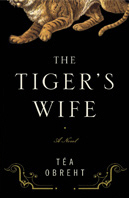
Review: ‘The Tiger’s Wife’ by Téa Obreht

The Tiger’s Wife by Téa Obreht
My rating: 5 of 5 stars

The tiger’s roar filled the cave with thunder. Mother Wolf shook herself clear of the cubs and sprang forward, her eyes, like two green moons in the darkness, facing the blazing eyes of Shere Khan. — Rudyard Kipling in “Mowgli’s Brothers” from “The Jungle Book” (1894)

Gather around, my friends, and I will tell you the story of the man who could never die, who, some say, still walks the streets of our village at night, and then—if most of you are still awake—I’ll tell you the story of the tiger Shere Khan whose eyes burn brightly in the night when he prowls near campfires like this looking for his wife.

Like all great storytellers, author Téa Obreht demonstrates beyond the shadow of a doubt in “The Tiger’s Wife” that memorable stories live at the crossroads of fact and fable. Doctor Natalia Stefanovic is treating children at an orphanage in an unspecified Balkan country when she learns that her beloved grandfather has died. The details are unclear. They provide no closure.

While seeking closure, Natalia remembers the times they spent together when she was young, their trips to the zoo to see the tigers, and the rather fantastic stories he told of his own youth. He told her the story of the deathless man and he told her the story of the tiger’s wife. Her grandfather experienced the events in these stories when he was a child, and like all memorable stories, they were somewhat true and somewhat pure potential and supposition, believed to varying degrees by those in the village who kept their children indoors at night when the tiger owned the streets.

Obreht tells us these stories in bits and pieces as Natalia juggles the real world of the orphanage and the superstitions of those in the village where the orphanage is located with the fables out of her grandfather’s past. To learn how and where he died, she will walk present-day roads laden with stories and she will walk into her memories of the tiger and the man who could never die, and when all is said and done, the truth of the matter will be a mix of everything she encounters at the crossroads.

“The Tiger’s Wife” is dark and deep and perfectly crafted, and if you allow yourself to be immersed in it, you will see the blazing eyes of Shere Khan.

View all my reviews

Malcolm R. Campbell is the author of Garden of Heaven: an Odyssey, a novel of magical realism where fact and fable mix.

The spookiness of written truth

Some people have a built in BS detector. They can see the flaws and scams in the world’s best publicity.

Writers have a spookiness truth detector.

In her excellent book for writers, The Sister from Below: When the Muse Gets Her Way, author Naomi Ruth Lowinsky begins with one of my favorite Robert Graves quotes:

“The test of a poet’s vision,” writes Graves, “is the accuracy of his portrayal of the White Goddess. The reason why hairs stand on end, the eyes water, when one writes or reads a true poem is that a true poem is necessarily an invocation to the White Goddess.”

The experience Graves describes is similar to that spooked feeling one gets while walking down a lonely road at night and pondering what might be watching him from the dark forest, or while walking through an old house at night and thinking of yarns about it being haunted or that people were killed there or that something lurks within that isn’t human.

When a writer reads or writes the truth, the bells and whistles of his spookiness truth detector go off. Now, this detector won’t help him decide whether Mobil or Valvoline is better for his car or even whether he can get the meal his body needs on any given night at Olive Garden or Outback.

No, the spookiness truth detector is usually reserved for matters of the heat and soul, gods and goddesses, sun and moon, and for thoughts and ideas that are only too happy to go bump in the night.

When I read, I want to be spooked either by thrills and chills and excitement or by the truth of important things. When I write, I know my revisions and edits are done when my eyes water and the hairs on my arms stand on end.

If you’re a writer who is in tune with his muse—or, say, with the universe—then you may feel spooked when you read Lowinsky’s book. Truth be told, my BS detector went off while reading certain sections of Robert Graves The White Goddess. But it didn’t go off when I read The Sister from Below: When the Muse Gets Her Way.

But, I’m not here to convince you to buy the book. I’ve been feeling spooked while researching and writing my novel Sarbande and while reading through a lucky haul of good novels lately.

I’m not frightened, mind you. I just wanted to spread out the chills a bit.

You may also like

I’ve started a new web log called Sarabande’s Journey to share some of the heroine’s journey resources I’ve found while working on my novel. If you are reading about, writing about, or on such a journey, I invite you to stop by and see if anything there spooks you.

Malcolm

Review: ‘Awakening of the Dream Riders’

Awakening of the Dream Riders Awakening of the Dream Riders by Lynda Louise Mangoro

My rating: 5 of 5 stars
Kyra has discovered how to fly.

As Lynda Louise Mangoro’s magical novel “Awakening of the Dream Riders” begins, fourteen-year-old Kyra is trying out her new talent: “Her favorite unicorn poster suddenly loomed directly ahead. Pulling back, she slowed just in time to avoid a collision with the wall and sent herself tumbling backward through the air, rolling head over heels in a clumsy display of aero-gymnastics.”

Before Kyra discovers what she’s doing, veteran readers of paranormal fiction will guess that her joyful and liberating flight is astral projection. But she’s too elated to concern herself about technical terms. She can’t wait to share her stunning discovery with her best friend at school.

This well-told story moves at light speed, as fast as a person flying in their “light body” can soar across town in the blink of a thought. Soon, Kyra and her friends, Ray, Lauren, Crystal, and even the science-minded Noah are talking about “dream riding.”

On the back cover of “Awakening of the Dream Riders,” Mangoro describes Kyra’s world as “a quiet street in a picturesque English seaside town.” As Kyra and her friends discover, that’s only one reality, and it’s heavy and dense when compared to dream riding.

But unknown shadows await them within the infinite scope of the bright reality that knowing how to fly has offered them. Kyra and her friends will discover their unique dream riding talents, talents they must develop quickly in order to survive a tragedy their freshly opened eyes do not yet see.

“Awakening of the Dream Riders” plunges the reader into an inventive paranormal adventure. The high-energy magic of the story arises out of the fact that Kyra’s world on the ground and in the air appears very real. And there’s more to come: Mangoro’s debut novel is the first in a projected series of open-your-mind fantasy adventures for young adults and adults.

View all my reviews >>

Malcolm R. Campbell is the author of two magical realism novels, “Garden of Heaven” and “The Sun Singer.”