Tarot: Step inside the cards

Sooner or later, most good cooks throw away their recipe books. What they know is not rote memorization, but an understanding of food, the impact of heat and cold, and the results of mixing one thing with another.

Knight of Swords – Thoth Deck. Other decks use the term “King.

Effective Tarot card readers throw away books that list the standard meanings of each card because they have discovered that the card is a prompt–or perhaps a spirit–that directs the reader to his/her own intuition and knowledge.

Personally, I don’t believe the future is fixed in place, so I’m going to see a reading (whether it comes from the I Ching, Tarot Cards, Bones, or some other system) as a story about what is now the case or is developing. How the reader sees this matter will also impact how they react to either the so-called standard meanings of the cards and/or to their intuitive glimpses into the question on their minds that is prompted by seeing the cards in a certain order.

In time, the reader no longer needs the cards. That’s much simpler, but perhaps a long time coming for many people who pick up a Tarot deck and wonder if it will speak to them.

I am influenced when I look at the cards by knowing that they are “ruled” by the elements Earth, Water, Fire, and Air. Fire and Air are considered active. The Swords suit (modern-day spades) is within the realm of Air. Knights are always considered the fiery/active part of each element. The active nature of a Knight is shown in the movement of the figure on the card. As described on Raven Tarot, “The element of Air is the pure mind, the thought and the intellect, synthesis and analysis, the proceeding of the amorphous spirit of Fire and the unconscious emotion of Water into definitions and concepts. Air is both structure and conscious realization, both formation and abstraction.” 

Other readers come to the Tarot with other basic ideas and they will be influenced by those and they will find the cards to be catalysts to their intuition in a somewhat different way, though they “should” more or less come to the same conclusions about a subject as I do.

The deck I use.

Some people “learn the cards” by meditating on each one and allowing ideas about each card to come to them without actively trying to “figure out the card.” Others do multiple readings about things they will know in the “future” and see how what they saw in the “spread” (the card’s layout on the table) coincides to the unfolding future. When one does this, it helps to do readings about others because if you do them about yourself, you can always change the way things unfold an invalidate the reading.

The Card as a Doorway

In my imagination, I visualize being in a nondescript room with a large doorway in it that’s painted like the card I want to learn more about. After I’ve relaxed and gotten rid of all the general chatter going on inside my head, I walk to the door and open it. What do I see outside? What do I hear? First impressions are important because they simply are and haven’t had time to get twisted into logical deductions about what’s going on. When I open the door painted like the Knight of Swords card, I see swirling fog, sometimes by day and sometimes by night, and hear the sound of the wind.

Sometimes my intuition leads me to sit on the doorstep there–as we’re supposed to do at a railroad crossing–and Stop, Look, and Listen. Sometimes my intuition leads me to step outside, and when I do that, I’m usually in the sky, swirling around like a leaf in the wind with no control of its own. There’s no fear in this, no sensation of falling, and no worry that I might be carried so far away from the door, I won’t know how to get back. Since this is “my card” in Tarot readings and as I see myself generally, floating, swirling, sailing, and tumbling in pure air is a basic, womb-like experience. I’m often content to do nothing and just soak of the nourishment of the moment.

I can exert control if I like, though it’s more intuitive than logical. Rather than, say, deciding to fly over a specific place, I simply wonder “what’s down there” or “what else is up here.” I might see cities and oceans the way I would seem them from a plane or stars the way I might see them through the lens of a telescope. Air carries me whither it wants to.

Doing this kind of meditation is not unique to me. Many intuitives have said that Tarot cards are, for them, like windows or doorways. I suppose, though, that I bring a shaman’s journey technique and, rather than seeing figurative worlds or literal places, I see what’s outside the door of each card.

And, in a sense, whenever we do a Tarot reading, we are looking at what’s outside the doorway of the present moment and our present time and current place.

Malcolm

Malcolm R. Campbell is the author of novels filled with magic.


Today’s Tarot Reading: Everything’s going to hell in a handbasket

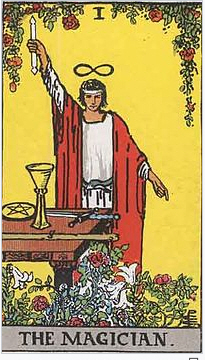
Wikipedia photo

I’ll confess, I didn’t do this reading myself. I went out to tarot.com which is kind of a fun site and checked to see what my three-card free reading would be. I learned that the world’s leadership has collapsed and that I should stay alert.

Okay, I can stay alert.

I’ve had decks of tarot cards in my desk since I was in high school. I enjoy the symbolism a lot. The 78 cards cover almost all of life’s situations. When the cards appear to fail, the problem is usually the person reading the cards.

Readers must always recognize that the future isn’t engraved in stone. The cards indicate what will happen based on current conditions. You’ll find the same thing to be true if you use the I Ching, the book of changes, to ask questions about current conditions or the so-called future.

I’ve gotten rusty using either oracle because I discovered a long time ago that I can see the situation better through meditation than on relying on either the Tarot cards or on the I Ching’s hexagrams. In either case, the probable future related to your question always comes from you. The cards and hexagrams are crutches, so to speak. Perhaps “guides” is a better world.

When I was in high school, the country was gripped by one of those recurring new age fads in which folks were reading cards and the I Ching and trying to become one with the universe. As I’ve gotten older, oracles have become less important to me because I realize that I am creating the future events that I will soon experience in everyday life.

While I think oracles can provide a lot of guidance, it’s been helpful to me to leave them behind for the most part. I feel confident that I am on the right path. So I don’t need to keep checking my Tarot deck or my copy of the I Ching to see if I’m right. At some point, constant checking translates into uncertainty and doubt, and once we’re preoccupied with those feelings, we are going to hell in a handbasket.

I find that I’m usually aware of signs, the cries of birds and the appearance of clouds and winds and blowing leaves. I see this as no different than an inner-city dweller being streetwise to possible dangers around the corner or a farmer being aware of changes that might affect the sowing of seeds or the harvesting of crops. Some would say I’m superstitious. Possibly so.

When we become attuned to our environment, whether it’s a mountain town or a big-city suburb, we certainly know better where it’s safe to walk and where it’s not safe to walk. Yes, the Tarot cards can tell me that. But my thoughts are faster.

The whole shebang–whether you call it “the future” or “the big picture” comes down to trusting oneself. Conjure women used to say that if you have to keep checking on how your latest spell is proceeding, you’re signifying doubt

In Frank Hebert’s novel Dune, we were told that fear is the mind killer. That resonated with me when I read it back in 1965. It still does. I also think doubt is a mind killer because it counteracts the positive thoughts we have about a specific project or the future in general.

Symbols tend to resonate with us. Some say that’s like hitting one tuning fork with a mallet and having a nearby tuning fork make the same sound. Art impacts us. Stories impact us. So do “chance” meetings with others or odd changes in the weather or the pictures we find on a Tarot card deck. All that is like computer input. Consciously or subconsciously those symbols alert us to probabilities and help us find our way through the ever-shifting maze of life.

–Malcolm

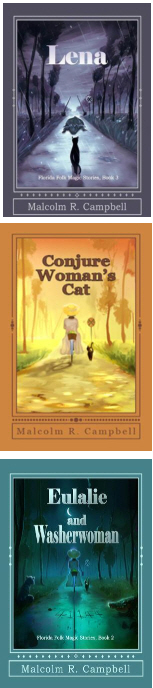
My novel “Lena” continues on sale for 99 cents through October 5th.


What Macbeth’s Witches Were Really Mixing Up

Wikipedia graphic

Fillet of a fenny snake, 
In the cauldron boil and bake; 
Eye of newt and toe of frog, 
Wool of bat and tongue of dog, 
Adder’s fork and blind-worm’s sting, 
Lizard’s leg and howlet’s wing, 
For a charm of powerful trouble, 
Like a hell-broth boil and bubble. 

Macbeth, Act 4, Scene 1

When you read Macbeth and hear the witches chanting about the eye of newt and tongue of dog, don’t worry. Most of those ingredients are the folk names of herbs, not critters’ body parts. Here are those added by the second witch.

  • Fenny Snake – Fenny refers to fens (swamps).
  • Eye of Newt – Seeds of Black or Brown Mustard (Brassica juncea), which–in hoodoo- are used to confuse enemies. They are often mixed with sulfur powder.
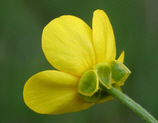
  • Buttercup: Steve Matson photo from Califlora

    Toe of Frog – Yellow Buttercup, including within the United States, the Western Buttercup (Ranunculus occidentalis Nutt), the seeds of which were ground up by Indians with other seeds for making a flour-like staple called pinole. The flowers themselves are considered poisonous.

  • Wool of Bat – Holly (Ilex aquifollium), meaning “holy,” used by Druids and other ancient Europeans. Holly symbolized male and female and Yule and is still considered in conjure as not only a blessing to the household and as protection for the home.
  • Tongue of Dog – Houndstongue (Cynoglossum officinale), also called dog’s tongue and gypsy flower. It was once considered a cure for madness and has been used by herbalists for a variety of ailments, including venereal disease and inflammations.
  • Dog-tooth Violet – Wikipedia photo.

    Adder’s Fork – Dog-Tooth Violet (Erythronium americanum) and related species. It’s also referred to as rattlesnake violet and serpent’s tongue. It’s not related to the violet. In conjure, it’s used to stop slander and gossip and those who are using it against you. It is placed on the doorsteps of enemies or when meddling inlaws are the problem, mixed with slippery elm into a body wash.

  • Blind Worm’s Sting – This is a lizard that looks like a worm. It’s sting is it’s bite. Perhaps they used the poison or tossed in the worm.
  • Lizard’s Leg – Ivy, genus (Hedera) and other creeping plants. Potentially, might include poison ivy and poison oak. Ivy is for binding things together as well as for ensnarring unwelcome desires (including drinking too much.) One can spend days trying to unravel the folklore and symbolism of ivy throughout the ages, including the use of the plant as a crown. Holly and ivy are among the evergreens used to decorate houses for Christmas and Yule as symbols of rebirth.
  • Howlet – That is to say, an owl.

–Malcolm

Florida Folk Magic Stories: Novels 1-4 by [Malcolm R. Campbell]Florida Folk Magic series of four conjure novels. Save money buying them together in this set.

Hope you enjoy the novels.

Magic: the ‘Catch-22’ of using it

Most magic is fairly easy if all you’re looking at is a set of directions. It can become more complex if it’s so-called high magic and requires a complex ritual. It can become challenging if multiple preparations are required, including herbs, candles, purifying oneself or one’s house, and other activities or ingredients that one may wish to hide from friends and family.

Regardless of the approach one takes, the one aspect that cannot be overlooked no matter how perfectly one follows the directions and prescriptions for an intended result is belief. Magic requires belief in order to function, or, as some might say, your beliefs create your reality. One point I emphasized in my three hoodoo novels is that when a conjure woman does a spell, she doesn’t look back–if she throws it into a stream or lake, for example–because looking back to check on the spell signifies doubt.

Those who don’t believe in magic think that the necessity of belief is “convenient” for those trying to convince you magic is real. That is, if you don’t believe, it won’t work. But how can you believe, if you’ve never seen it working?

I believe I’ve written here before that a lot of those who hoped The Secret and other books related to the “law of attraction” would change their lives for the better were disappointed with the results. Why? They didn’t seriously believe the process would work. Perhaps some of them wished for changes that seemed so logically impossible that even the enthusiasm they felt after reading a book like The Secret wasn’t strong enough to extinguish their doubt.

Most of us are “programmed” by society or our ever-hopeful (or partially cynical) belief systems that small changes are more likely to happen in our lives than huge changes. We believe it’s more likely that we’ll find a dollar bill on the street than win a Powerball lottery jackpot. This suggests how we should proceed with magic. Since small changes seem more logical to us, we can focus our magic on small changes. That is, rather than trying to use magic to become suddenly rich, we can use it to do better financially this month than last month. Instead of trying to heal ourselves or a loved one from a dread disease overnight, we can focus our intentions on feeling better than the day before.

We can accept this, so we’re less likely to doubt our first experimentations with magic. That’s what we build on. When those seem to work, we can focus on a result that’s slightly more challenging.

Of course, our overall belief system helps or hinders our magic. If we think that Murphy’s laws rule the universe, we will be less successful than if we are generally positive and tend to see the best in other people until proven wrong. Or, if we spend ten or fifteen minutes working on a spell intended to help a loved one feel better, but then spend the rest of the day worrying about them getting worse, we’re undoing our magic because our energy is more focused on something negative than something good.

When it comes down to it, magic is part of an individual’s approach to life. One has to be open to new experiences and systems of thought that are outside the everyday realm of logic to make magic work. If you want to make magic a part of your life, you need to make your life a part of magic; that is, begin with meditations and interpreting dreams and reading about those who’ve had transcendent experiences. No surgeon goes into an operating room thinking, “This procedure isn’t going to work.” S/he has many years of education and practice before stepping into that OR. Likewise, magic requires (usually) an equally time-consuming and diligent study of how the world works and how the self works before you can do what looks so easy in the Harry Potter books and movies.

Like any other discipline, magic and medication seem to work better when people learning about them are content with taking baby steps first. Nobody takes one piano lesson and then expects to play at Carnegie Hall the following week. Yes, if you truly believe, you can change your life in an instant. But we’re brought up in a science and technology world where logic is the prime mover of the universe, so large-scale belief on the first day one encounters magic is a hard row to hoe. Over time, and with patience and practice, we can prove to ourselves that magic works. We may never convince our friends, but then that’s not really important because seeing the universe in an alternative way is our path, lonely as it may be.

We can all conquer that “catch-22” about magic and belief if we devote time and effort and faith to our studies. It’s not an easy path, yet I think it’s a wonderful path.

–Malcolm

My hoodoo novel “Lena” is currently on sale on Amazon for 99₵.


A wee bit o’ cantraip

This is one of my favourite words for magic. I like it because it’s old and it’s a Scots word. The English say “cantrip” and use the word to refer to ‘scam.”

The English need to get their minds right about this.
My ancestry is Scots, with a strong dash of Irish from my mother’s side of the family. That means I was born with an affinity for cantraip whether it was the spell of a witch or the mischief out of the faerie world.

In The Life of Robert Burns, which you can find in Project Guttenberg, he says:  “I owed much to an old woman (Jenny Wilson) who resided in the family, remarkable for her credulity and superstition. She had, I suppose, the largest collection in the country of tales and songs, concerning devils, ghosts, fairies, brownies, witches, warlocks, spunkies, kelpies, elf-candles, dead-lights, wraiths, apparitions, cantraips, giants, enchanted towers, dragons, and other trumpery. This cultivated the latent seeds of poesie; but had so strong an effect upon my imagination that to this hour, in my nocturnal rambles, I sometimes keep a look-out on suspicious places.”

I grew up reading Bobby Burns’s lowland Scots poems and perhaps that influenced me as much as my DNA to always be seeking a fair bit o’ cantraip in every dark wood and every dark woman.

Truth be told, I expect that the many worlds interpretation of quantum mechanics and panpsychism will ultimately explain many things that are best-considered cantraip at present.  Quantum physics is science and panpsychism is superstition (or so some say), but they have a lot more in common than the followers of either viewpoint are willing to acknowledge yet. I’m enchanted by both–call it a Scots Irish thing.

Cantraip is never sleight of hand, the kind of “magic” you see during most magic shows on TV or conventions. I did like Erin Morgenstern’s novel The Night Circus wherein the magicians were using real magic while pretending it was sleight of hand. Whenever I see purported sleights of hand, I wonder, “hmm, is that real magic or practices misdirection?”

Sleight of hand, it seems, is much easier for audiences to believe in. Audiences want to be fooled, and they are. The great sucess of Penn and Teller is evidence of that. If you saw Tony Randal in the 1964 movie 7 Faces of Dr. Lao, you may remember that the audience was far more excited over the splashy sleight of hand than Merlin’s real magic.

You fools, I thought.

The world might be better if we could buy faerie dust at Walmart. We need a wee bit o’ cantraip to give us hope, make us smile, and prove that Washington’s politicians don’t know everything.

Malcolm


Florida Folk Magic Series: a journey into the past

In 1954, the year in which most of my Florida Folk Magic Series is set, Dwight D. Eisenhower was President, Richard M. Nixon was Vice President, Earl Warren was the Chief Justice of the Supreme Court, and  Elvis Presley issued his first single, “That’s All Right”, on Sun Records. It was the era of an unconstitutional Communist witch hunt conducted by Senator Joseph McCarthy. It was the era of Jim Crow and the so-called “separate but equal” doctrine.

It seemed natural to me then, even in grade school, that people were still talking about World War II and that when kids played army in their backyards, they were fighting the Japanese and the Germans. What seemed unnatural to me then was that people were still, one way or another, fighting and re-fighting the U. S. Civil War.

The words “terrorism” and “terrorist organization” weren’t part of national security debates in those days, but if they had been, the KKK should have born that label; permitting the group to march in parades was, as saw it then, as ludicrous as allowing the Mafia to march in parades and, as I see it now, made as much sense as allowing ISIS to march in a U. S. parade today.

My own childhood years were good ones, but Klan violence–which was heavy in Florida–and the mistreatment of African Americans as a group were, to me, an intolerable smear on our nation’s intentions and mission as written down in the Declaration of Independence and the Constitution.

The vestiges of that smear are still part of a polarized national debate today. We still have more problems to solve and attitudes to change in 2018 than we should. White supremacists, neo-Nazis, bigots, and misogynists, as I still see it, are people with an Attila the Hun mentality and, frankly, we’d be better off if we put them on a giant ice-flow and set them adrift during hurricane season.

Yes, I have strong feelings about these issues.

But in spite of those feelings, the three books in this series are not intended as a political statement. They are history. They are the culture of another era. And they are the everyday magic of another era, one that still has many devotees today. It has been said that in the South, Whites didn’t like Blacks as a race but liked many of them personally as individuals. From what I saw, there was at least some truth in this, for our moderate and liberal White friends did have Black friends and colleagues. Even so, the KKK prescribed how far we could go.

If a White went “too far,” s/he would run into trouble that could be fatal. If we broke one of the rules–such as allowing a Black to sit in the front seat of our car or walk through the front door of our house–the Blacks would say, “this isn’t done” because they were even more at risk should anyone see the infraction than we were.

Oddly enough, Scouting brought conjure to my attention. That is, we learned to respect the out of doors and how to live safely in forests and swamps. This led to discussions with Black friends who had additional ideas about what was out there and how to safely approach it. Needless to say, I didn’t take any hoodoo practices back to the Scout troop or overtly use them on our monthly camping trips. But those practices taught me a lot about humankind’s potential relationships with the environment, one that in later years ecopsychology would explore without deriding these relationships as superstition.

The bottom line for a novelist is telling stories set in specific time periods with characters with points of view that aren’t always mainstream. Yes, as a writer I also needed to make sense of what I saw as a child, but not in a political treatise. I’m drawn, as I was then, to the people themselves and how they fought against the dangers that came into their lives. Have I put tall my demons to rest? Probably not.

Nonetheless, writing these stories has brought me a sense of closure to the time when First Lady Mamie Eisenhower christened the Nautilus, our first nuclear-powered submarine, Vice President Richard Nixon said we might send troops Indochina (as we called it then) even if the allies didn’t like it, the United States Supreme Court ruled that segregated schools were unconstitutional, and Blacks weren’t allowed at lunch counters where I had the blue plate special or in the front of the city bus I rode into town.

–Malcolm


Sample Hoodoo Spell: Opportunity, Life Change and Good Luck

“Let’s face it, sometimes the basic dressed candle spell just doesn’t cut it. When I needed some serious road opening, I devised this extra powerful Road Opener spellcast. It uses some additional products, not just Road Opener/Abre Camino formulas, in order to provide some much needed oompf.”

Source: The Spellcaster’s Source Hoodoo and Voodoo Witchcraft Blog

If you ever wondered what the directions for a hoodoo spell look like, this post is a good example, one that tells you the spell’s purpose, the ingredients you need, and provides a how-to-do-it narrative. While researching the novels in my Florida Folk Magic Series, I relied strongly on sites like this, comparing and contrasting the ideas I found to see which ones had the best fit to traditional Southern conjure.

Malcolm

Magic: Who Are You and Why Are You Here?

Twelve years ago, Rhonda Byrne’s book The Secret was in the news. The description on the home page of the book’s website says of Byrne, in part, “In The Secret, she explains with simplicity the law that is governing all lives, and offers the knowledge of how to create – intentionally and effortlessly – a joyful life.” People bought the book and sought out other books and websites that spoke of the law of attraction and how to make it work in our lives. Some people have called the book a placebo while others claim it changed their lives.

Long-time students of magic claimed that most of the information in the book had been around for a long time, but that Byrne had repackaged the information in a new way for today’s audience. In a way, she did for our time what James Allen did for his time with the publication in 1903 of his now-famous book As a Man Thinketh. (Allen’s book is available on Amazon and can also be found in various free versions.) I read As a Man Thinketh when I was in high school because my father had an early edition of the book on the living room shelf.

The purpose of this post is not to critique The Secret or even Allen’s book. Nor do I have access to any statistics that show what percentage of those who bought either book found within their pages the route to a joyful life. As I read The Secret and a related books, it seemed to me that many people were focusing on the law of attraction for health and wealth. I’m not surprised. Needless to say, if a person is physically ill and living in a slum, health and wealth sound like reasonable goals as long as one isn’t greedy and wants to become a superman or superwoman and have a billion dollars in his or her checking account.

Magic, whether it comes from the ancient crafts, hoodoo, the mystery schools, or self-help books like The Secret can, I think, change us, especially when our approach includes a reverence for the Earth and the spiritual mysteries of all life. Yet, any study of it begins with who we are and why we’re here (on Earth in this time period) before we begin our study. Some say it takes a lifetime to understand just who we are–consciously, unconsciously, and at the soul level–so before one begins to study magic, s/he must learn that “his or her lot in life” prior to magic was of his or her own making, consciously or otherwise.

As one looks inward to discover who they are, they might also learn why they’re here. That is to say, are they here to work on personal issues of long standing, impact the lives of specific people, or add their voice to those fighting against one form of injustice or another? Self-help magic books tend to ignore the fact that those who buy them have a lot of skills and/or baggage before they begin to read. Some readers will recognize ideas they have pondered already; some readers will become very enthusiastic as the words in such books “strike a chord” and their eyes are opened again; others will become lost because the self-help magic books are about as effective as handing an award winning cookbook to a person who has no idea what a kitchen is.

I’m not convinced that the first goal of magic and/or a spiritual outlook is a joyful life. Yes, joy is very nice depending on how we define it. But I think our joy is a result of of who we are and whether or not we’ve discovered why we’re here. Yes, we can be healthy. Yes, we can attract enough income (however it’s defined) to live without worrying how we’re going to pay the rent. But I do not see either of those situations as the primary goals of magic and, in fact, believe we sabotage ourselves by looking at external gratifications before looking at and understanding our inner lives.

We can change our lives in an instant if we believe we can change our lives in an instant. To fully believe this, we have a lot of, shall we say, brainwashing to get around that has given us reasons for the way the world is as it is. As a long-time fan of Erice Berne (Games People Play) and Thomas Harris (I’m OK, You’re OK), I see hundreds of ways how parents and other authority figures sent their children down roads to ruin. Some call this “negative programming,” that is, a psychological rationale for why you think you’re behind the eight ball or think that you’re not behind it.

So, I don’t think a magic recipe book is going to be a quick fix, though it can inspire us to the possibilities of self-discovery and a journey toward self-actualization (as Abraham Maslow called being fully alive). You are who you are with or without magic. I suspect you’re here right now for a reason that may or may not include magic. I’ve chosen magic because that is how I see the world. I would feel empty without it and so would my books.

Malcolm


Review: ‘Doña Barbara’ by Rómulo Gallegos

Doña BarbaraDoña Barbara by Rómulo Gallegos
My rating: 5 of 5 stars

Perhaps the greatest testimony to Rómulo Gallegos is the very rich literary prize named after him in honor of his work and influence. The prize has been awarded to Mario Vargas Llosa, Gabriel García Márquez, Roberto Bolaño and other masterful authors whose powerful books are said to be the cornerstones of magical realism and South American literature.

Sadly, we seldom hear Gallegos’ 1929 novel “Doña Barbara” mentioned in the same company as the well-known books that have received the Gallegos prize. In his forward to the 2012 edition, Larry McMurtry writes that the novel “is in its way a paean to the Venezuelan Llano” a vast grassy plain that, in the novel, “is steamy, tumescent, lust driven.”

In “Doña Barbara,” the characters often say that the land does not relent. In fact, its horrible and fated barbarism and its magical and conscious beauty are as intertwined as surely as the destinies of the powerful female rancher Doña Barbara and the college educated and idealistic protagonist Santos Luzardos. When Luzardos returns to the Llano ranch, Altamira, of his distant youth, he finds that it has been depleted and nearly forsaken by incompetent, greedy overseers who couldn’t resist their complicity in Doña’s schemes. Through magic, sex, paid-off judges, and raw power, she has enlarged–at her neighbors’ expense–her adjoining ranch El Miedo (fear) into a sprawling country unto itself that expands outward through manifest destiny.

Readers may well be reminded of Luis Alberto Urrea’s “The Hummingbird’s Daughter” as they immerse their souls in “Doña Barbara,” because both novels view the land in epic proportions, beautifully described and inseparable from the lives of its people. The land is essentially the main character or, at the very least, an infinite circle of hell where the well-drawn, multi-dimensional characters are driven to kill or be killed as fate decrees.

Like two gladiators who have been chained together, Doña Barbara and Santos Luzardos cannot both survive in an enchanting, sadistic world where every action appears pre-ordained even when it isn’t. The novel ends the only way it can, but the story’s characters and readers won’t realize this until they reach the last chapter.

View all my reviews

Adder’s Tongue

“Erythronium americanum (trout lily, yellow trout lily, yellow dogtooth violet) is a species of perennial, colony forming, spring ephemeral flower native to North America and dwelling in woodland habitats. Within its range it is a very common and widespread species, especially in eastern North America. The common name ‘trout lily’ refers to the appearance of its gray-green leaves mottled with brown or gray, which allegedly resemble the coloring of brook trout.” – Wikipedia

Wikipedia photo

The perennial forb/herb, which can be found in the eastern United States and Canada, but typically not in Florida, is also called Adder’s Tongue. While some people call it a dogtooth violet, it’s not related to violets. Even  though this is a native plant, you can purchase the seeds commercially. My focus here is folk magic usage, but I’m noting traditional edible/medical uses for reference only.

While the plant has a strong emetic impact on some people, the petals have been used in tossed salads. WebMD has the following caution: “People apply English adder’s tongue directly to the skin to treat ulcers. Don’t confuse English adder’s tongue (Ophioglossum vulgatum) with American adder’s tongue (Erythronium americanum).” Other sites say that the plant can be made into a poultice and applied to wounds that aren’t healing. Check with your doctor before using any part of the plant as a poultice or a tea even though those have been traditional folk medicine uses

Hoodoo

Traditionally used to stop people from slandering you, including nasty relatives. Dry the leaves and grind them into a powder and then sprinkle them around the front door the home of those who are slandering you, or gossiping about you in ways that border on slander.

Or, you can combine the leaves with ground-up Slippery Elm bark, brew it, cool it and strain it and then pour it over yourself from your shoulders to your toes. Some suggest reciting the 23rd Psalm while doing this. If the people who have been slandering you are visitors to your house–such as relatives or neighbors–collect this mixture from your bathtub, add one teaspoon of ammonia, and you’ll have a wash you can use for scrubbing our doorstep and front walk. If your entry hall can be cleaned with liquids, use the wash there as well.

As for the name, potentially it was inspired the shape if the spore-bearing spike and, for usage, by Psalm 140:5, “They have sharpened their tongues like a serpent; adders’ poison is under their lips.”

Voodoo practitioners would keep meddlesome people way with powdered dried beef tongue for use, sometimes in combinations with herbs, in mojo bags or as a sachet powder. Witches (traditional natural religion practitioners) have been known to use the drug for healing, divination, and magical spells involving dreams.

Some curio suppliers provide adder’s tongue in small packets for you to use with your own spells. This is rather expensive when contrasted with finding colonies in of the plant yourself in places with plenty of spring sunlight.

–Malcolm