When I was a kid, people often asked what I’d wish for if a genie said he’d grant three wishes

If wishes were horses, beggars would ride.

Even as children, we knew being and/or appearing greedy was unseemly. This meant that the first of those three wishes had to be:

I wish for world peace.

Next, we’d add something everyone else in the neighborhood had gotten for Christmas or a birthday. Like:

I wish for a new Schwinn Sting-Ray bike in flamboyant lime

Since the powers that be said it was illegal to use the third wish to ask for three more wishes, a lot of us tacked on something to help the family:

I wish Grandpa would get off the sauce.

Those of us who read fantasy fiction were careful about the kind of genie we’d ask to meet our wants and needs. Otherwise, even the most carefully worded wish would contain a hideous catch. Hence the pastime of making up and spreading genie jokes.

Here are several from James Martin’s page:

  • During a first date a man and a woman were telling each other about their pasts. The man said “A genie once gave me the option of becoming more attractive to women, or having an exceptional memory.” “Which one did you choose?” the woman asked. He replied, “I don’t remember.”
  • A representative said, “I wish I was on an island surrounded by beautiful women.” Poof. He was on an island with gorgeous women fawning all over him. “This is the life,” the congressman sighed. “I wish I would never have to work again.” And poof, he was back in his government office.
  • A man was walking down the beach and picked up a very old bottle. As he rubbed it to remove the sand a genie popped out and said, “You can have one wish.” The man thought for a minute and said, “Make it so all women will love me.” Poof, in an instant the man was changed into a bar of chocolate.

And those are the sanitized examples.

We usually heard the beggars would ride quote when parents, ministers, stand-up comics, and other authority figures hear us wishing for things they thought we should work for: (e.g., I wish I had good grades). Work for it? How lame is that?

Long before “The Secret” was published, I read a bunch of magic books that said I could manifest stuff with my thoughts. There there are two catches. (1) You have to truly believe the mainfestation will happen. (2) If you manifested  $10000000 into your bank account or a new Rolls Royce into your garage, you’d have to explain to the IRS where you got it.

Working for it is easier than wishing for it, or so it seems.

–Malcolm
The new year never seems to live up to the Times Square excitement

People are still shooting each other, having sex, drinking too much wine, getting married, watching bad TV, dying of old age (so long  Glynis Johns at 100), and eating too much fast food. When will it end?

I’m more concerned about the mass shootings than the wine and the sex and the marriage–like the senseless attack at Iowa’s Perry High School. Shooters kill a bunch of people and then kill themselves. Why don’t they kill themselves first? That would reduce the amount of grief and paperwork.

We expect too much magic, it seems, with the changing of the year.  Or maybe we don’t expect enough. Or, worse yet, we expect the same old, same old. Speeding tickets, DUIs, getting fired, getting hired, texting too much, running into a tree while texting, being shot by the cops while breaking into a store, finding the Oak Island Treasure. Yes, when will it end?
I have high hopes for the human race, but low expectations. Perhaps you feel that way, too.

I don’t think “it” will end because it’s easier for all of us to sit back and watch “it” happen on TV without worrying about “it” (all the bad stuff) than figuring out how to fix “it.” Okay, most of us don’t know how to fix it, though one would think that by working on the problem as a group we could make progress with the changing of the years.

Then, New Year’s Eve would mean something.

–Malcolm

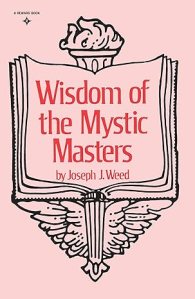
‘Wisdom of the Mystic Masters’ by Joseph Weed

Once upon a time, when I was starting to take my curiosity about esoteric subjects seriously, I read Wisdom of the Mystic Masters and other books by Rosicrucian author Joseph Weed. As a Rosicrucian, Weed was no doubt aware of the fact that the road to mastery is a long road. So, in looking back on these books, I’m surprised at how they were so blatantly oversold (this reminds me of The Secret) in that they implied all you had to do was read a popular account of ancient lore and soon thereafter you would become all-powerful and quasi-divine. Like The Secret, these books came and went quickly because–while there was truth in them–it could not be learned and perfected during the halftime show of the football game that had taken over the living room’s TV set.

From the Publisher

“This book contains the most awesome secrets ever known to man—ready to be used by you to attain the riches, influence, and joy you’ve always wanted! By using the staggering power of these age-old secrets—jealously guarded by the wealthiest and most influential people in history—you’ll quickly discover how to release a flood of riches into your life… how to gain influence and control over others… bring new romance into your marriage or social life… gain the instant respect of everyone you meet… overcome any threat that faces you now!

“Here is the ancient might of the Mystic Masters immediately ready to help you to the pinnacle of money, fame, and power!”

One thing I noticed with these descriptions right away is that many of them focus on obtaining wealth and power, the very opposite of what hermetic studies are all about.  Obviously, the publishers don’t think “the masses” will read such books to become more spiritual, more aware of the “big picture,” or to improve themselves.  So they promise fame and fortune.

If you look closely at what these hyped books offer, it’s very similar to what James Allen wrote years ago in his wonderful 1903 book As a Man Thinketh.  My father had this book on the family’s shelves and I read it long before I’d ever heard of Weed. From the book of Proverbs. Chapter 23, it is written,  “As a man thinketh in his heart, so is he.” In my view, this is all we need to know. No hype is needed.
You can read Allen’s book, now in the public domain, on Project Guttenberg here.

The paradox here is that the wisdom itself is simple, but its development is complex. And that’s what makes the hype work so well on prospective readers. Read “this” and you will know “all.” Perhaps so. Then what?

Malcolm

Those ubiquitous Templars

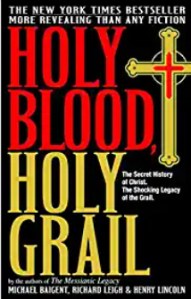
I’m re-reading for the second or third time Holy Blood, Holy Grail by Baigent, Leigh, and Lincoln because the subject matter is fascinating. I’ve lost track of all the Templar-related books I’ve read, not counting Dan Brown’s The Da Vinci Code.

When I was twelve, I joined the DeMolay  Club affiliated with my school because I liked its values which are related to the values of the Masons. Unfortunately, I had to leave when their chosen meeting day conflicted with the meeting day of my Scout group. Jacques de Molay was the last grandmaster of the Knights Templar before the group was virtually destroyed by the French king and the Pope in 1307.

Prior to that, when visiting my grandparents in Illinois, I first heard those values from my grandfather who was the commander of the local Masons which were affiliated with The Knights Templar of North America. The commandery, the building of the local Ilinois chapter, was a wonderous place and I was tempted to become a Mason after hearing about the values of the group. I chose instead to join the Rosicrucian Order because of its strong commitment to esoteric teachings. I did not think I should also become a Mason, though they have my support.

History Channel Photo

Now as I watch the ongoing coverage of the treasure hunters on Oak Island, I find it interesting that the team doing the work there is excited about the possible Templar connection to the treasure that might have been hidden there. I have zero interest in treasure, but I’m drawn to this show because I’m curious about the potential connection between the Knights Templar and what, if anything, is ultimately found on this privately-owned island off the coast of Nova Scotia.

Re-reading this book brings back many memories of the research I did in the past into such subjects as the work of artist Nicolas Poussin (1594–1665), especially his two paintings labelled Et in Arcadia ego which are also mentioned in the books of the Francis Bacon Research Trust. Arcadia represents, is it said, heaven on earth and yet the coffin in the painting suggests the presence of a darker side. The prospective bloood line of Christ, notably in the French Merovingan dynasty and the Plantard family is also interesting.

How many of these mysteries are real and how many are pure fiction. I may never know. But I like delving into real or imagined secrets.

–Malcolm

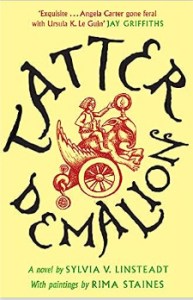
‘Tatterdemalion,’ by Sylvia Linsteadt

Oops, I meant to say something about this wonderful book when it came out two years ago. The book is well-written and beautifully illustrated by the widely-known faerie world artist Rima Staines.

From the Publisher

“In a ruined world, what survives are the stories we tell Poppy, who speaks the languages of wild things, travels east to the mountains with the wheeled and elephantine beast Lyoobov. He’s seeking answers to the mysteries of his birth, and the origins of the fallen world in which he lives. Up in the glacial peaks, among a strange, mountainous people, a Juniper Tree takes Poppy deep into her roots and shows him the true stories of the people who made his world, people he thought were only myths. Their tales span centuries, from three hundred years in the future all the way back to our present day. It is through this feral but redemptive folklore that Poppy begins to understand the story of his own past and his place in the present. Tatterdemalion is a stunning collaboration between writer Sylvia V. Linsteadt and artist Rima Staines, featuring the fourteen original paintings that inspired the narrative.”

From the Author’s Website

Sylvia Victor Linsteadt is an author, scholar of ancient history, and certified wildlife tracker. She studied Literary Arts at Brown University, graduating with Honors in 2011. 

“Her work—both fiction and non-fiction—is rooted in myth, ecology, feminism & bioregionalism, and is devoted to broadening our human stories to include the voices of the living land.”

“She is the author of the short story collection Our  Lady of the Dark Country, two novels for young readers, The Wild Folk (Nominated for the CILIP Carnegie Medal in 2019) and The Wild Folk Rising, and the post-apocalyptic folktale cycle Tatterdemalion with painter Rima Staines.”

To learn more about folklore/fae authors, artists, and illustrators, I recommend the blog Myth and Moor. While the blog has been on hiatus (but becoming active again), you will find faerie resources and authors in the right-hand column.

Malcolm

Malcolm R. Campbell is the author of the upside-down faerie tale, “Waking Plain.”

The Amazing Schlock on the Doorstep

No, it’s not a box from Amazon, though that’s possible when I post orders while drunk. In reality, the schlock is no longer on the doorstep because  (a) fewer people have doorsteps these days, (b) postal rates make schlock promotions expensive, and (c) e-mail is simply easier even though SPAM filters toss most of it into a virtual bent shitcan (a navy phase for stuff that’s seriously FUBAR).

My in-basket is constantly filled with psychic schlock. I’m not sure why because, like you, when I see it I use my vast psychic powers to “see” that it (the schlock) is a grain of truth at best and something that will cost a lot of money at worst. The e-mail begins with a personal story that supposedly tells me about an amazing secret that, in just a few minutes, will be given to me and that once I have it all the abundance, money, good health, free passes to brothels, influence, love, and influence I have ever wanted will be mine.

“Dear Malcolm,” the pitch begins, “years ago when I was as drunk and sick as you probably are today, I sat next to the statue of an angel of grief in a dark cemetery in Paris’ 20th arrondissement on All Saints Day smoking my way through a pack of Gauloises–a patriotic pastime in France in those days–pondering how to return my life to the holy promise it had been when I was born. My vision–or perhaps it was reality–showed me how to fix all the broken places of my life and I was surprised then beneath a light rain how easy it was to do that. I will show you how my life became defined by unlimited joy, health, and wealth if you will subscribe to my daily e-mail letter ‘Bonne Chance’ for a mere pittance.”

Everything I’ve always wanted. What an addictive temptation that might be. But then I read that even though the seller has $100000000 in his checking account, he wants to charge me $29 per month to learn the secret. I wonder, if he’s rich, who does he need my $29? I wonder, if the secret was revealed to him on All Saint’s Day, is it really his to sell and does it really take many many months to explain what he learnt in moments?

So, I say “no.” Sometimes the sellers of psychic schlock reply by saying something like, “Malcolm, how can you pass up our wonderful offer?”

I say I already know the secret (like I care) and don’t need to pay a monthly fee to hear about it. I don’t hear from them again after that.

But I wonder how many thousands of people are on the psychic schlock e-mail list and how many start dutifully sending in their $29 every month to learn what boils down to a few generalities about positive thinking, biorhythms, quantum theory, and meditation. Sooner or later people cancel their subscriptions without achieving any of the promised abundance.

Such promises are hard to ignore even though the secrets behind them are not secrets at all, but well-known principles that go back centuries before James Allen published As a Man Thinketh (now free online) in 1903.

It’s all quite simple and doesn’t cost $29 a month. The difficulty, as always, is believing that such easy concepts really work.

–Malcolm

Friday the Thirteenth: What Can Possibly Go Wrong?

Actually, nothing. . . unless you want it to. It’s a day of spiritual feminine energy that men took over and turned into a day of ominous superstitions.

A bit of online research brings you information such as this:

“Before patriarchal times, Friday the 13th was considered the day of the Goddess. It was considered a day to honor the Divine Feminine that lives in us all and to honor the cycles of creation and death and rebirth.

“Friday the 13th was considered a very powerful day to manifest, honor creativity, and to celebrate beauty, wisdom, and nourishment of the soul.” – “The Spiritual Significance of Friday the 13th”

And this: “Friday is also named after Freya, the goddess, and is represented by Venus. Venus is the epitome of feminine energy. Her energy joins us as we approach the weekend to remind us that it is important to rest, relax and play.” – “Friday 13th – A Powerfully Feminine Energy Day”

And yet, most people appear to accept the fact that there’s something “wrong” with Friday the Thirteenth.” The darned movie strengthened people’s fears but didn’t cause them. The movie’s plot reads like the scary stories we used to tell around the campfire on Boy Scout camping trips. The movie, I think, is best viewed on a dark and stormy Friday the Thirteenth when, if the force is against you, the power will go off and you’ll hear the serial killer in the basement waking up from his/her nap.

Apparently, “13” as an unlucky number comes out of a Norse myth and continues on via the number of people at The Last Supper. We compound the nonsense by having no floor 13 in high-rise buildings, and similar “precautions.”  Wikipedia informs us that “According to the Stress Management Center and Phobia Institute in Asheville, North Carolina, an estimated 17–21 million people in the United States are affected by a fear of this day, making it the most feared day and date in history. Some people are so paralyzed by fear that they avoid their normal routines in doing business, taking flights or even getting out of bed.”

Those who know me (poor dears) know that I believe we create our own reality. So, if you don’t want anything “bad” to happen, then it won’t. Others who know me do not like my “number’s up theory,” which is that if your number isn’t up, nothing untimely will happen on the 13th. If it is up, well, you’re not safe in your own house.

I think that’s a bunch of hooey (more or less), though I stayed in my house today because on the 13th a lot of people drive drunk in hopes that zoning out will save them. Or maybe, somebody left the door open at the asylum.

I’d much rather celebrate this day for its pre-patriarchy meanings. I’m pretty sure my opinion isn’t influenced by the fact my granddaughter is named “Freya.” 

–Malcolm

Malcolm R. Campbell is the author of the four books in the Florida Folk Magic Series that begins with “Conjure Woman’s Cat.”


Aligning oneself with change with the ‘I Ching’

I  no longer remember what led me to the Book of Changes known as the I Ching. Most likely it was something Carl Jung wrote. He was a friend of sinologist Richard Wilhelm (1873-1930) who brought to the western mind the first translation of the I Ching, a work that so impressed Jung that he wrote a forward to it. I believe it was first translated into English in 1951 and, of all the translations, some say it is still the best. 

According to Princeton University Press, “The I Ching, or Book of Changes, a common source for both Confucianist and Taoist philosophy, is one of the first efforts of the human mind to place itself within the universe. It has exerted a living influence in China for 3,000 years, and interest in it has been rapidly spreading in the West.”

The universe, we suspect, is always in a state of flux, sometimes favoring things we may consider doing and sometimes not. The I Ching when used as an oracle shows us whether or not conditions are right for our plans just as a weather report tells us whether today is a good day to put out to sea. Most sailors wouldn’t begin a sea voyage in a hurricane. Likewise, when considering conditions with the I Ching, those with a Taoist perspective wouldn’t begin a project on a day when doing so goes against the universal flow.

In his foreword to the Wilhem edition, Jung said, “For more than thirty years I have interested myself in this oracle technique, or method of exploring the unconscious, for it has seemed to me of uncommon significance. I was already fairly familiar with the I Ching when I first met Wilhelm in the early nineteen twenties; he confirmed for me then what I already knew, and taught me many things more.”

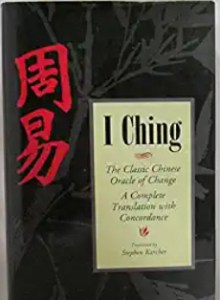
As an oracle, used for divination or for meditation, The I Ching is–so to speak–like a wise and all-knowing companion on one’s life’s journey. I probably started using the I Ching in high school and, basically, found that when I used it often, life just seemed to go more smoothly. I still have my original copy, though I’ve supplemented it with Rudolph Ritsema and Stephen Karcher’s I Ching: The Classic Chinese Oracle of Change [The First Complete Translation with Concordance].

The publisher’s description said, “We need the book when we stand at a crossroad of the soul.” I agree. The book’s answers to a flippant question are often like getting one’s hands slapped So, don’t ask it where you left your car keys or if you’re going to “get lucky” on your date tonight.

In this 1995 edition, the authors write, “The I Ching is a diviner’s manual or active sourcebook for what C. G. Jung called the archetypal forces. It organizes the play of these forces into images so that an individual reading becomes possible. . . These forces represent the flow of life and the experience of its meaning, its way or tao.”

Consistent use of the I Ching slowly changes an individual view of and approach to life. This benefit cannot be overstated.

I believe that most of our problems come from the arrogance of living outside the universe, a belief the I Ching would caution the seeker against.

–Malcolm


Has anyone tried this new age experiment?

Systems of new age and/or old wisdom often include exercises designed to enhance one’s imagination, “see” things at a distance and determine diseases and other problems others may be suffering.

These experiments always represent a practical application of the day’s lesson inasmuch as true understanding and mastery require more than reading about a technique or method.

I’ve seen a lot of these experiments over the years and have enjoyed both the successes and failures of following the recipes. However, I balked at one of them, one in a book I read in junior high school with a title I no longer remember. I started out several times and always stopped, not because I thought it wouldn’t work, but because I thought it would. I’ve never had the courage to go back to it.

Basically, you’re supposed to sit in a chair in a room at one end of your house, calm yourself, and then get up and walk to the other end of your house, turn around, and go back to the chair.

Next, you imagine doing that, thinking of everything–doors, shelves, furniture–you see en route. Pretend to walk from one end of the house to the other and return to the chair.

Then do it physically. Then do it in your imagination. If you do this long enough, you will supposedly return to the chair and find yourself already sitting there.

It’s a good experiment, I think, but I never could face the possibility that it might work. Something just bothered me about that. What about you? Have you seen this experiment? If so, have you tried it.

I’ll be curious to hear your results.

Malcolm

The ubiquitous fascination of the Knights Templar

“As late as the medieval era and beyond, social groups claiming to hold secret wisdom– such as the Gnostics, the Cathars or the Knights Templar, sought to establish their pedigree by linking themselves explicitly to the deep wisdom held by the ancient mystery religions; and scholars have demonstrated, in fact, that such linkages do exist.

“Fast forward to modern times. With the Enlightenment, a more secular, scientific, and overtly political outlook permeated Western society, and these elements were reflected in the secret societies that arose at the time, such as the Freemasons and the Carbonari.” – Paul Witcover

In the years after the crusaders captured Jerusalem in 1099 many Christians wanted to visit sites in the Holy Land free from interference by robbers and others in Muslim-controlled areas. Out of this need grew the Knights Templar, an organization of religious knights that ultimately became so large and wealthy, that its existence and prospective control of holy artifacts became a huge threat to Rome by the 1300s.

From time to time somebody writes a new novel or nonfiction book and the Knights appear on the bestseller lists and our fascination with the power and magic and treasure they might have controlled is reborn. Public interest was especially strong when Dan Brown’s The Da Vinci Code was released in 2006. Currently, there is speculation amongst the treasure hunters on the History Channel’s “The Curse of Oak Island” series that the Canadian island might contain the lost treasure of the Templars.

A lot of people tend to see the Templars, the Freemasons, the Illuminati, the Rosicrucians, and other mystery-school-styled groups (If they exist at all) as wholly evil and secretly in control of the world or as groups interested in the mystical side of the Christian religion and its predecessors. So much fiction (some with a lot of farfetched straying from the facts) and nonfiction about these organizations has been written that it’s often hard to sort out the real from the absurd. The “mysteries” refer to the Eleusinian Mysteries, the Dionysian Mysteries, and the Orphic Mysteries.

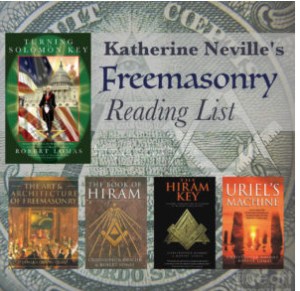
The author Katherine Neville, who was writing Dan-Brown-style novels before Dan Brown was writing them has a nice list of secret society references on her website that help separate the wheat from the chaff when it comes to the Templars, the Masons, and other groups. If you’re trying to find a starting point in Templar lore–after exhausting Wikipedia–may I suggest her list of references?

I’ve read many of the books on the list and yes, they are fascinating.

For information about the Knights Templar as they exist today in the United States, see the Grand Encampment of Knights Templar of the USA website.

My grandfather was a member of this organization and as such the commander of the Illinois Commandery where I spent many hours as a child.

–Malcolm