Beach bums say
(from birds’ first cries at break of day
to sweet whispers of sunsets and red sails)
that I better watch out
or I’ll be fetched far from the happy shore
along with childhoods, daisies, favorite books,
meaningful looks, old fishermen’s shoes and folktales,
and hauled downward below the continental shelf
where everything that ever happened
is stored for safekeeping
in Davy Jones’ locker.
Titanic is there,
with Lusitania, Edmund Fitzgerald, Empress of Ireland,
assorted sea monsters, sirens and songs, silenced now,
except in dream remnants flying like prayer flags
while their dreamers ceaselessly seek their future.
Yesterday caresses my feet like undertow
and the lifeguards say
I better watch out
or I’ll be ripped from an uncertain littoral
strewn with shells where long-gone creatures once lived
downward below the surface of known thought
where everything that ever happened
is locked away with ghost stories.
Yesterday whispers to me
like undertow
and the philosophers say
that I better watch out
or I’ll be come and gone with fleeting gestalts,
sunny afternoon dust motes, twilight inklings,
eye-blink gods and lives without faults
left out of history’s footnotes
that are kissed and missed forever
by all that has been borne
into the sleep of the deep.
Ceaselessly,
beach bums, life guards and philosophers
warn me with each red sky of morning
and every menacing grey twilight of gales
that yesterday is made of mirrors and smoke,
merely a mirage of dreams and lights across the bay.
Nonetheless, tomorrow or sooner than tomorrow,
I will ignore those fading cries of reason
because I’m watching less out than in,
aging upon the new season like spirits in oak.
Tomorrow, then, when yesterday calls me
with the words of wondrous once-upon-a-times,
turtle doves and lonely lost loves,
she will promise me many worlds, quantum leaps,
vision quests, and cave shadows in perfect pantomimes,
and like all I lack,
I’ll be borne back.
Domestic house cats are like often water, opting for slow and silent pressure rather than overt fire and brimstone approach of other pets when food time is approaching (and possibly forgotten by the two-leggeds in the house).
Our three house cats noticeably become more friendly as regular mealtimes approach. They lean against our legs when we walk through the house. They make little murping noises and rub against doorjambs and table legs in our presence.
But mostly, I can tell how close it is to their next meal by how close they are to my desk. When mealtime is 45 minutes away, they’re in the hallways. When it’s 20 minutes away, they’re outside my den door–or just inside it. When mealtime is imminent (or late) they’re right next to my desk. Sometimes I say, “Why are y’all going around in a pack” and they look at me with a variety of expressions of pity and disdain–their way of saying, “the old duffer doesn’t know how to tell time any more” and “Sure, when he wants something to eat, he just goes out to the refrigerator and gets it, but we have to wait because the Creator screwed up and didn’t give us the thumbs we need to open stuff.”
If cats could speak English, I’m sure they’d say, “Raccoons got thumbs and we didn’t. What kind of sense does that make?”
My answer would be, “They wash their food and you don’t. You don’t need thumbs.”
“If we had thumbs, we’d wash our food.”
Far be it from me to question why cats don’t have thumbs. If they did, food time for them would probably be 24/7 because (unlike what some cat books say), cats do overeat if the food is available.
But since it isn’t, I can set my watch by how close they are to my desk. Since they just got fed 25 minutes ago, they’re nowhere to be seen. Once they have their food, they have no use for me any more until 11 p.m. approaches. Then, I’m suddenly their best friend, the best thing since slice bread, or even a minor god (though not a smart god due to their lack of thumbs).
The cats who–as we know–move around on little cat feet like fog know how to use silence to exert pressure. Like the water that slowly erodes rock over time, they erode my concentration over time. I could be in the middle of writing the last line of the great American novel. But I can’t, because I can’t come up with the right words due to the sound of silence all around my desk.
Malcolm R. Campbell is the author of contemporary fantasy, paranormal short stories, and the three folktales about animals in “The Land Between the Rivers.”
Ever cautious, I was the last to arrive on MySpace. “What is Facebook all about?” I used to wonder. I’m “on” Twitter, but there are days when I don’t know how to keep up with the tweets. True to form, I didn’t show up on Pinterest’s doorstep the day they opened for business.
In fact, I stayed away until this past weekend. All my colleagues at Vanilla Heart Publishing were all already creating boards and pins (whatever that meant) and wondered why I wasn’t.
This weekend, I was too tired to do anything else after mowing the yard, so I looked at Pinterest. Hmm, not too bad. I set up boards called Joy of Travel, Books for Fantasy Lovers, This and That from My Blogs, and Resources for Writers. Things went smoothly. It was fun. Here’s the link.
–
Coming up Next: Author Dianne Marenco Salerni (“We Hear the Dead,” “The Caged Graves”) will be here in several days with a great guest post. With today’s zombie fad, we usually hear about protecting the living from the dead. However, there have been times when the dead needed to be protected from the living.
This morning’s bowl of grits reminded me of many Happy Thanksgivings in the Stewart family where Ma and I sat on the front porch watching traffic on County Road 777, happy that my dear old Daddy was in the barn sleeping off a week’s worth of extra partying. We were grateful for moments of silence punctuated by the sounds of our spoons clattering against the sides of our heaping bowls of grits and homemade butter.
“It takes true grits to live in a family like ours,” Ma always said.
“You’re right as rain, Ma.”
“Yep,” she would say. “Of course, if Pa were awake, we wouldn’t have heart-to-heart moments like this.”
“We still love him though.”
“Mostly.”
“Well then, I’m grateful for ‘mostly.'”
Good times, a lot of memories, grits and a fair amount of ‘mostly.’
One night in 1967, I picked up a white candle on the campus of Syracuse University and joined a long line of students that moved like a ribbon of continuous light across the dark campus. We did not use the words Dona nobis Pacem (Grant us Peace) as many bloggers are saying across the world on this November 4th day in which we blog for peace. We were, of course, protesting the Vietnam War in those days when many of us sang “Where have all the flowers gone.”
Since that night of candles and songs, at least 10,960,000 have been killed by wars. “Gone to graveyards every one,” the old Pete Seeger folk song tells us. “When will they ever learn?”
My Scots ancestors once sang—and often still sing—an old song called “The Flowers of the Forest,” a lament about the grief of the women and children after James IV and his 10,000 men died at the Battle of Flodden Field in northern England in 1513. I wonder if Pete Seeger ever heard the words: “The Flooers o’ the Forest, that fought aye the foremost, The pride o’ oor land lie cauld in the clay.”
Perhaps There’s Hope
Since 1967, we have had many occasions to ask “When will they ever learn?” Even in these days of terrorists and unstable governments and territorial disputes that seem to have no solutions, there may be hope. In his October 2011 article in Foreign Policy“Think Again: War,” Joshua S. Goldstein writes that even though 60% of Americans responding to a recent survey thought a third world war was likely, fewer people per year have been dying in wars in years between 2000 and 2011 than in the 1950s through the 1990s.
One reason for the decline is the smaller scale and scope of the conflicts after World War II, Korea and Vietnam. According to Goldstein, “Armed conflict has declined in large part because armed conflict has fundamentally changed. Wars between big national armies all but disappeared along with the Cold War, taking with them the most horrific kinds of mass destruction. Today’s asymmetrical guerrilla wars may be intractable and nasty, but they will never produce anything like the siege of Leningrad.”
Is there reason for hope in such an analysis? Goldstein suggests that the world seems more violent now than it ever did in part because information is more accessible and pervasive. Whether it’s via 24-hour news channels, online news sources, or social networks like Twitter and Facebook, we hear one way or the other about every car bomb, every attack and every atrocity. On such days, I’m still tempted to ask, “When will they ever learn?”
Higher Standards
We still have work to do, and this isn’t it. – Wikipedia Photo
The world, writes Goldstein, also seems more violent because society’s standards have risen. A day’s worth of fighting in Iraq or Afghanistan brought news of battle deaths that were a tiny fraction of the numbers killed per day in World War II. Yet our anger about every five soldiers or civilians killed in recent these conflicts was, it always seemed, much higher than for every 5,000 killed in the 1940s.
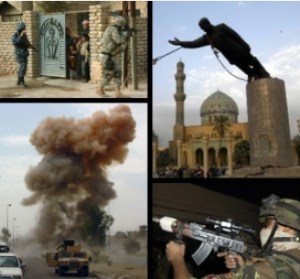
We’re less tolerant of violence now. The in-your-face nature of TV war reporting that began during the Vietnam War is showing us in ways we cannot accept where the flowers are going and how they got there. The images out of Iraq showed us more of what we didn’t want to see.
Perhaps we are learning. Perhaps our flowers of the forest will remain in the forest and the day will come when laments and folk songs about war and grief can be left on dusty shelves and slowly forgotten. Until then, we still say Dona Nobis Pacem and hope people are listening.
“Suddenly thanks to Google Books, JS-TOR and the like, all the great thinkers of all the civilizations past and present are one or two clicks away. The great library of Alexandria, nexus of all the learning of the ancient world that burned to the ground, has risen from the ashes online. And yet—here is the paradox—the wisdom of the ages is in some ways more distant and difficult to find than ever, buried like lost treasure beneath a fathomless ocean of online ignorance and trivia that makes what is worthy and timeless more inaccessible than ever.” – Ron Rosenbaum, “The Last Renaissance Man,” a feature in “Smithsonian Magazine” about Lewis Lapham of “Lapham’s Quarterly”
Search Engine
Men my age are often called curmudgeons because we decry the best of the past that often is, or appears to be, lost to us.
As a journalist and writer, I wonder what happened to objective news. (Yahoo even cites personal opinion blogs as news sources.) As a grocery shopper, I wonder why I can no longer buy Winesap apples at the grocery store. As a movie viewer, I wonder why–after all the years when movie screens and TVs were getting larger and easier to see, the “in” thing now is to watch movies on screens the size of a postage stamp on one’s cell phone. And, as an author, I wonder why rants on Amazon are considered “reviews.”
Nonetheless, I think Lewis Lapham might well be right when he suggests that the Internet is “decapitating our culture, trading the ideas of some 3,000 years of civilization for…BuzzFeed.”
On any given day, the Yahoo “news” main story is more likely to be about either the jaw-dropping dress or the hideous fashion blunder of an actress than a news story about anything that remotely matters.
Why is this?
There are a lot of usual suspects…parents “rearing children” to believe they are entitled to everything free or almost free…the whole “teach the test” approach to education…liberal arts colleges giving way to colleges that offer direct training for one industry or another…Twitter and other nasty sites that champion having a short attention span…something in the drinking water…deadly rays from cell phones…and, perhaps, various forms of self-centered greed.
Take your pick.
Half Empty or Half Full
When asked whether a glass is half empty or half full, positive people supposedly say it’s half full. That beats empty. On the other hand, perhaps the correct answer is the glass is larger than necessary, rather like using a gallon jar for a task requiring a thimble.
We can see the drivel all too easily. On the other hand, we can tune it out. The Internet is far too large to contain only what each of us wants. Whether we see the amount of drivel as information democracy or an unlimited smorgasbord, the challenge is finding better ways to tell the drivel sites from the trash sites, and to discover new ways of finding the hidden gems.
For every one hundred people who appear on Leno’s “Jay Walking” bits in which he asks everyday people simple questions about history, geography and culture who can’t tell us the capital of their own state, there are (hopefully) five people who knew all the answers but didn’t make the show because correct answers aren’t funny. (I wonder why the incorrect answers are funny.) I’m not sure the amount of drivel in the world is increasing but rather that it’s more visible with the Internet, more TV channels, 14-hour news, and the social media.
On its “about us” page, Lapham’s Quarterly says it, “embodies the belief that history is the root of all education, scientific and literary as well as political and economic. Each issue addresses a topic of current interest and concern—War, Religion, Money, Medicine, Nature, Crime—by bringing up to the microphone of the present the advice and counsel of the past. Valuable observations of the human character and predicament don’t become obsolete.”
I find many treasures on the Internet. Finding them is, at times, like going to a garage sale and looking through somebody else’s trash for something I will treasure. Finding one’s treasure has never been easy. Even before Gutenberg made the dissemination of the written word easier to do when he introduced movable type about 1439, there was a lot of drivel in the world. It didn’t take long for people to decry books they thought were either hopeless or heretical.
When Newton Minnow told the National Association of Broadcasters in 1961 that television was a “vast wasteland,” the notion that the drivel outweighed the most wonderful programs being produced wasn’t new. Minnow suggested more government involvement in fixing the problem than I liked. It’s really difficult to force people to read only the best books and watch only the best movies and TV shows. It’s utterly impossible to say which books/films/shows those are.
In the half-full/half-empty glass puzzle, one can always begin with too small a glass, meaning that some of the water isn’t going to fit. Even though the too-large glass has a lot of air in it, there’s space available for whatever we want to add. Perhaps it’s more water. Perhaps it’s rocks. I like seeing empty space in a glass or on the Internet because that means there’s always room for more. If only 5% or 10% of that more is any good, we still end up with a greater number of tasty sips of water (or, perhaps, Scotch) than before.
There used to be a joke site or two claiming that “you have reached the end of the Internet,” meaning the last possible URL that was out there. Scary thought. In some ways, an online facility with more drivel also has more treasures. Each of us can decide which are which and how to tell the difference.
There was a lot of pure country music on the radio when I was young, especially on the powerful clear channel AM stations that could be heard throughout large areas of the country after dark. I heard Ford a lot on the radio, along with everyone else who recorded a version of “Sixteen Tons.” I don’t hear the song much any more, but the words still resonate with me during these difficult economic times. One doesn’t have to be a coal miner stuck in the old country store and truck system (payment in goods rather than cash) to understand the feeling of “I owe my soul to the company store.”
These days, the company store is the mortgage company, the credit card company, the IRS, the county property taxes, and a host of other payments that keep a lot of people behind the 8 ball. As for the load sixteen tons, we could substitute “write sixteen novels” or “drive 1600 miles” or “work sixteen years” or whatever fits.
Oddly enough, though, I only think of that “another day older” line and start hearing Tennessee Ernie Ford’s voice on my birthdays. That’s good, I think, for it keeps industrial-strength worrying about finances to a minimum. That was yesterday. Today, I’m blogging about it and then moving on. As Smoky Zeidel said in today’s post, “I’m a True Writer: a writer who not only can write, but must write.”
Sometimes must write = curse. But most of the time, writing is a creative way to stop oneself from worrying about being deeper in debt or how long the drought’s going to last or why political campaigns bring so many clowns out of the woodwork. It seems a bit audacious to say that writers create worlds, so I’ll just suggest we’re creating cities, lakes and mountains. If I don’t like what I see, the backspace key comes in very handy. It won’t erase actual debt, but it will erase scenes in my short stories that aren’t turning out quite right.
On my birthday yesterday, I wrote a fair number of words of a new short story, saw a friend of mine stop by unannounced and mow my lawn with his riding mower, ate a plateful of spaghetti, talked to my brothers on the phone, had a glass of Biltmore Pinot Noir, got some reading done, and felt pretty good about things in spite of hearing “I picked up my shovel and I walked to the mine, I loaded sixteen tons of number nine coal.”
I also heard Ford’s radio/TV sign-off catch phrase: “Bless your pea-pickin’ heart!” and found it hard not to smile.
As I sit here in the sunny kitchen of my father-in-law’s farmhouse, I’m going through withdrawal because the Internet does not exist here. On a typical morning, I would have checked e-mail (pot), looked at several news screens (cocaine) and read everything in my Facebook (meth) news feed.
My Facebook status would be a no-brainer: blitzed, spaced out, and higher than the summit of Mount Everest. I recall those old, fried-egg-in-a-skillet public service announcements: This is your brain. This is your brain on drugs. Any questions?
Ever addictive, the Internet provides 24/7 instant gratification. Everything is now and now we can trip out anywhere we want from the illusions of You Tube right now to the mirages of web cams. On celestial days, the endless supply of self-evident platitudes on Twitter (hash) empowers us. On tense days, we can discuss causes on Linked-In (ether) or play free-base flame wars in the comments sections of news pages and friends’ profile pages and hope the experience doesn’t turn into the bad trip of being unfriended or banned.
Here on the farm, life is also now, but it’s a slower, less ubiquitous now. I cannot move at light speed from the kitchen table to the creek. There’s no creek icon on the window. While I can randomly hear the sounds of birds and horses and tractors, they are farther away than MP3 files and have no volume controls. Time was, contentment was easy to find in a farm or old forest because when I arrived at such places, my perception synchronized itself with the rhythms of the real world.
Today, the worlds of beach, river and mountain top begin as cold-turkey experiences away from the lovable and addictive noise of radios, televisions, cell phones and WiFi. Real-world taste, touch, hearing, seeing, smell and intuition have become dulled from lack of use. I can’t wrinkle my nose and download a new sight program nor stick out my tongue and update my tastes.
Daily, it takes more and more effort to see and hear the real world, especially the more subtle voices of trees and snakes and flowers. In fact, when I’m high on Facebook, I have my doubts about the existence of pastures outside my father-in-law’s sunny kitchen, much less the cries of gulls along the gulf coast or the songs of wolves in the Montana high country. The Internet will give me a semblance of all that. Truth be told, that semblance is faster and cheaper than walking out my front door and driving six hours south to Alligator Point, Florida, much less three days north by northwest to East Glacier, Montana on the edge of the shining mountains.
If the Internet existed here on the farm, I could experience, semblance-wise, the mountains and the sea right here, right now. I do see flowers blooming in the garden out past the kitchen sink. I remember once knowing what they were and what they smelled like but, without the Internet, I can’t “touch” the flowers’ images and see alt-text tags with that instant information.
The real world has become difficult to navigate and harder to imagine. I’ll be okay when I get back home and smoke a little e-mail and do a little Facebook. I’ll be fine because my brain will once again become part of the Internet and I won’t have any questions.
Every sixteen minutes, someone in the United States dies by suicide, according to the American Foundation for Suicide Prevention (AFSP).
The AFSP conducts Out of the Darkness walks to increase national awareness and to help raise funds for education and research for suicide prevention.
I am pleased that my brother, Barry, will be participating in the upcoming Orlando, Florida Annual Community Walk on February 5th. He will be walking for TEAM STRAT in honor of the late rap artist and poet David Campbell (STRAT).
“Although we have lost him in life, he will always live on through his son Taylor, his poetry, his music, and many wonderful memories.”
The Orlando walk will be held February 5, 2011 at Baldwin Park: 2420 Lakemont Ave.
“If I had influence with the good fairy who is supposed to preside over the christening of all children, I should ask that her gift to each child in the world be a sense of wonder so indestructible that it would last throughout life.” — Rachel Carson
After the basic needs are met, I can think of little that is more important in the upbringing of a child than cultivating a sense of wonder.
When I see adults who have bright and twinkling eyes, who are forever learning new things, who are inquisitive and gentle about the natural world, who have the grit and spirit to take risks, who are not afraid to cry, who take responsibility for their own actions, who believe one way or another in magic and worlds they cannot see, then I know they were loved as children.
Where there is creativity and an infinite ability to dream, there is hope. As a father, I could do no better than teach the joy of an open mind; as a writer I could do no less than write it and live it.
BOOK REVIEW COMING SOON
I’m currently reading a wonderful and well written novel by Fairlee Winfield called “Buffaloed.” In a word: it’s a hoot. It shows the West like it was rather than like it was idealized to be. And, one of the main characters is none other than Montana’s best artist: Charlie Russell.
 Yesterday tugs at me







 Malcolm's Round Table