My wife and I have discussed the reality that we own the dirtiest car in the neighborhood. If it were a Jeep covered with mud from our latest off-road adventure, we could feel proud of our badass look. But, alas, it’s an ageing Buick LaCrosse.
The car had collected several years of road dirt, unknown scum, pollen, and bird shit. I finally got tired of it.
So I washed it. My wife will be shocked. Normally, I rely on rain to wash the cars. But today, I used Armorall, a hose, a sponge, and a drying cloth. Most of the appalling dirt came off. I was surprised.
But then, two hours later, some damn bird and landed on the side mirror and used the thing as a toilet. We never had this problem before moving to the country. City birds know better, I guess. So, I trudged back out with the sponge and washed it off. Maybe a shotgun will solve the problem. Or a grenade.
When we had problems at a former house with woodpeckers hammering on the gutters, we got rid of them by tying a helium balloon to the corner of the house. I really don’t want to get that started with the car’s mirror because I’ll have to untie the thing every time I leave the house.
If you know how to keep birds off your car’s side mirrors, let me know.
O frabjous day! Callooh! Callay! Another flood watch is heading our way.
My friend Jock Stewart was supposed to write this post, but he’s pre-drinking for the weekend.
However, he scribbled a note on the back of a bar napkin: “Malcolm, 99% of the people in the world can be divided into two groups, cynics and fools.The other 1% know the power of bribery and magic.”
What this means for Northwest Georgia tomorrow is this: If you’re planning an outdoor wedding reception complete with flower bowers and booze that cost you 20 grand, the thing’s going to be rained out. You should have bought “rain insurance” (I think Lloyd’s of London sells that) or paid off Mother Nature or asked the conjure woman down the road to do a weather spell. These spells are similar to Patton’s Weather Prayer except for the fact you’re planning for a marriage rather than a battle.
Of course, those are often the same thing.
Without doing your home work, the wedding will have to be moved into the garage or the attic, and neither place is likely to have the ambiance of your back yard garden.
It goes without saying, that cynics are more likely to expect rain, but to also expect bad luck no matter how many alternate venues are prepared. Fools hope for the best, and while they are the good people that bad things happen to, there’s less stress involved if things work out fine.
Since my wife and I are planning a short road trip tomorrow, we expected rain. So, we’re leaving the surrey with the fringe on top in the garage and taking the Buick. (Don’t make jokes about our Buick.) The Buick has a roof, windows that close, and a heater, along with the other necessary parts. I gassed it up at Mr, C’s Shell Station this morning, so it’s ready to go when the black clouds roll across the county in the morning.
My mother was the eternal optimist. She’d plan an outdoor even event if all the weathermen in the state were forecasting storms, and the thing would come off perfectly with nary a drop of rain. She believed in the law of attraction before anyone knew what it was or she knew more magic than I suspected.
Since I’m more of a Murphy’s Law kind of person, my wife and I will be driving in the rain tomorrow. As for you, I hope you weren’t planning to get married in the garden Saturday afternoon.
According to statistics–which I don’t feel like looking up right now–Americans are generally heavier than they should be. And, we don’t get enough exercise (which is probably one reason we’re heavier than we should be).
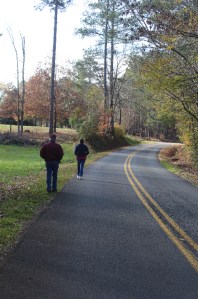
I live in the country with an office on the front of the house, giving me a front row seat on the road where a lot of people walk, ride bikes, ride horses, and sometimes walk their dogs while they (the dog owners) ride horses while holding onto long leashes connected to the dogs. We have an old house sitting on the far end of the property and it still has a separate mailbox. I made a vow two years ago to walk down there to check the mail a couple of times a week. I’ve done that once or twice, preferring to use the riding mower to save time. It’s a good thing that vow wasn’t a formal resolution or a promise to Santa Claus.
My brother and his wife take walks several times a week. Fortunately, they do this in central Florida so that I don’t get trapped into participating in their bad habits. They walk (who knows where) away from the house for 25 minutes. Then they walk home for 25 more minutes. During that time I can eat an entire box of Kispy Kreme doughnuts. Trouble is, when they visit us for Thanksgiving, they continue this notorious walking hobby and want me to go with them. This past week, they walked four times, conning me into going on two of them.
Talk about tired. I suppose I could claim it was “a good tired” and that I should feel virtuous. On the the plus side, it (the walk) burnt off calories. According to my brother and this wife, calories are bad. I tried to point out to them (my brother and his wife) that I’ve been slowly losing weight for the past year using a mind control/positive thinking program that didn’t require walking along country roads where everyone’s dog barks at you and speeding pickup trucks almost knock people into the ditch.
We’re lucky to be alive.
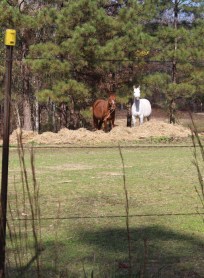
They (my brother and his wife) set a fast pace. Even the trucks have to go into overdrive to get around us. If you’re paranoid while walking in the country, you’ll get worse because every cow and horse along the route is going to be staring at you. I’m not sure just why four, puny little humans should be a threat to an entire herd of heavy black Angus cattle, but all those eyes focus on us until we’re out of sight and out of mind. Those eyes watch us again on our way home. And the same dogs come racing out to the highway thinking, “WTF, I thought I chased those clowns away 25 minutes ago.”
One dog chased us for 15 minutes, disappearing into the woods again and again and then lunging out at new spots to take us by surprise. His owner was chasing him, ticked off–by the expression on her face–that we dared walk by her place and disturb the 200 dogs they have there keeping watch on things.
We had plenty of Thanksgiving food to eat along with some Scuppernong wine, but I’m in the clear because I walked it off. I’m seeing a lot of whining on Facebook from people who suddenly gained 25 pounds last Thursday afternoon. They’re on treadmills when they’re not heading off (in their cars) to the gym. Poor bastards.
Tallahassee Florida’s Leon High School – Florida Memory Photo
I probably sound like my grandfather telling a when-we-were-kids story when I say that my brothers and I walked to school from grade school through high school–or rode our bikes. School buses didn’t serve in-town neighborhoods and parents didn’t serve as chauffeurs unless a hard rain was about to fall.
High school seems to far away now, it’s possible I’ve forgotten most of it. One student drove his Model T to school. That got a lot of positive attention except when he was out starting it (with a crank, of course) on rainy days.
Heck, even the early Volkswagens could be started with a crank and were light-weight enough for football players to carry them up the steps while the owners weren’t around and leave them in a high school hallway. As you can see, there are a few steps to navigate en route to the front door.
When I was a senior, I drove a car to school once in a while. It was a 1954 Chevy that wasn’t very dependable. It used more oil than gasoline and the driver’s side window wouldn’t roll up. Even though Florida winters weren’t all that extreme, we had to put a blanket over the front end on cold nights or it wouldn’t start in the morning. My bike was more dependable, though the older I got, the more embarrassing it became to arrive on a bike and be seen putting it in the “losers’ bike rack.”
Leon High “Redcoats” band at the state capitol. Somewhere, I have a photo of us at the U.S. capitol from the year we marched in the Cherry Blossom Festival parade.
It took me about 30 minutes to walk to school; fifteen if I rode my bike. Sometimes my car would make it half way and I could talk the rest of the way in five minutes if I was lucky and 25 minutes if I wasn’t.
After all these years, I remember the names of more of the girls I had crushes on than the names of my teachers; except for the teachers who were memorable for good or bad reasons. I think I got a good education in this school, played clarinet in the band, and was in the chess club.
Leon High was large and old: the school was founded in 1871 and is considered Florida’s oldest, continually accredited high school. The “new” building in the photograph was built by the Works Progress Administration in 1936. When I was there, we had almost 2,000 students in grades 9-12, though in years after that, the school board couldn’t decide whether the freshman belonged in the high school or the junior high school (now called a middle school <yawn>).
Getting to school progressed from not very far to farther since the grade school was the closest to my house, the junior high was right next door to the grade school, and the high school was just down the street. My brothers and I knew all these streets well since our paper routes covered a swath of neighborhoods from the high school to the north edge of town past our house. We knew every possible way of walking home.
When you were in school, did you ride a bus (school bus or city bus), walk, ride a bike, or get there in a revolving car pool of neighborhood parents?
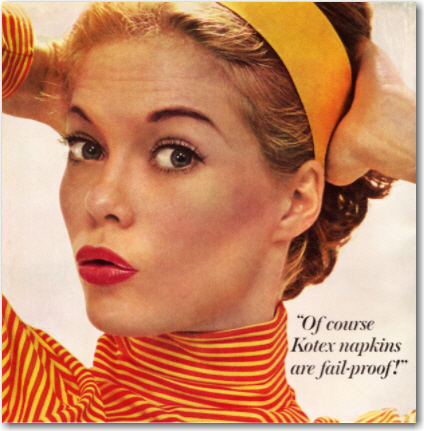
When I was in junior high school, I saw an ad in one of Mother’s women’s magazines for Kotex and was curious why ads for sanitary napkins always showed young women out playing sports instead of sitting around the dinner table.
Mother was washing pans in the sink when I walked into the kitchen and said, “Mom, why would anybody ever buy an unsanitary napkin?” She dropped the pan, turned around as white as a ghost and shouted “What?”
“I saw a Kotex ad for sanitary napkins and wondered if they thought other brands were unsanitary.”
“These are special napkins for women,” she said.
“Is that what y’all use when you go to a tea or have cakes while playing bridge?”
Mom was swaying a bit, possibly remembering it was just a week earlier when I asked her what the word “shit” meant. I learned that she apparently didn’t know but that it was a curse word we didn’t use in our family.
“Absolutely not.”
“They’re for rich people, then?”
“Rich and poor, I’d say.”
“Does grandma use them?”
“Listen, under no circumstances are you to ask your grandmother about sanitary napkins,” she snapped.
“So, saying sanitary napkin is sort of like saying “shit”?
“If you treat the words that way, I will be eternally grateful. Suffice it say, sanitary napkins are especially packaged like Band-Aids so that folks will know they’re germ free.”
“The ad said they’re fail proof. Is that what you need if you’re really messy and keep spilling gravy on the table cloth?”
Mother sat down and put her head in her hands, inadvertently putting her elbows in a spot of grease that hadn’t been wiped off the table yet.
“Now, look what I’ve done to my best blouse.”
“If there are any Kotex in the pantry, I can bring you one and we’ll see just how good they are.”
“No, but thanks for asking,” she said with an unexpected trace of a smile. “Now go do your homework and don’t use the words ‘sanitary napkin” in front of your father or brothers.”
“It’s like shit, right, but a more powerful curse?”
“Someday you’ll be a father and when one of your sons asks you what the words ‘sanitary napkin’ mean, I hope you’ll remember this conversation and what you put me through.”
“I will, Mom,” I said, realizing that I felt less informed after asking the question.
“Memory is fiction. We select the brightest and the darkest, ignoring what we are ashamed of, and so embroider the broad tapestry of our lives.” ― Isabel Allende,Portrait in Sepia
I first read Portrait in Sepia when it was released in 2000. As I re-read it for the first time this past week, I thought “how ironic this is that this is a novel about memories and I’ve forgotten most of it.”
The storylines of books tend to run together for me because I read a book per week. However, Allende is one of my favorite authors so, logically, I ought to remember more of each novel’s details. Except for high energy action books, I tend to read novels closely; I don’t scan sections or skip descriptions or conversations to get to the so-called “good parts” (as some people call the pivotal scenes).
Several weeks ago, I re-read The House of Spirits, a novel I read in 1982 when it came out and one other time before this year. Again, the details were so hazy it was almost like reading the story for the first time. I can understand why high school and college literature teachers tell us they re-read the books they teach every semester that they reach them.
Even though I forget so many details of novels, I discover new things every time I re-read them. So, in addition to the surprise at how much I’d forgotten, there’s the excitement of seeing a character or an even in a new way.
When people ask me about my childhood, obviously I know most of it. Or, maybe I don’t. If I can’t remember a book in any detail several years after reading it, how reliable is my memory about anything in my past or the country’s past? Sketchy, at best. Though family Christmas letters have long been mocked as falsified (or carefully told) versions of what a family did during every past year, the only way I could be sure when I did something thirty years ago was looking in a binder of old Christmas letters to see what year something happened.
Things get worse when I realize that after using fictionalized bits and pieces of things I saw or did in some of my own novels, I begin to see that the line between what I really did and what a character did in my novel has gotten a little blurry.
We’ve heard often that those who witness traffic accidents and other events are often unreliable. They think they have a clear picture of the event when, in fact, they don’t. They think their view of an event was like that of a stationary security camera. In reality, they glanced away at noises, movements of other people, etc. What they didn’t see, they think they did see because the mind fills in the gaps with what it thinks probably happened. They don’t know they’ve done this, and experts say that a lie detector test won’t pinpoint discrepancies in their versions of events.
An article in the current “Writer’s Chronicle” deals with this issue for the authors of memoirs and historical novels. It’s called “The True Story? How to Deal with Evidential Gaps While Writing a Biography,” by Viola van de Sandt. What really happened during such gaps often comes down to circumstantial evidence. Sometimes, important events can only be sketched in and presumed through fragments of diaries, articles, letters, etc.
I have often wished I’d kept a diary, a cut-and-dried account of daily events. I tried multiple times, but could never stick with it. So I have a lot of gaps in my own personal history. As Allende’s protagonist in Portrait in Sepia said, “I try desperately to conquer the transitory nature of my existence, to trap moments before they evenesce, to untangle the confusion of my past. Every instant disappears in a breath and immediately becomes the past; reality is ephemeral and changing, pure longing.”
I assume my memory is faulty. It’s been proven to be that way many times. Who I am and what I think I saw of daily events is more of an approximation than anything else. If you have a foolproof method of keeping track of your past, I’d sure like to know how you do it.
A Google search on the question “what do people care about” returned 636 million hits. How do you answer that question if you have to list cares in order of preference? It’s not easy, is it? Some people will be pragmatic and say “good health.” Others will be assume money can buy everything, and say “wealth.” And then there are those who want to make sure their “good health” and their “wealth” aren’t occurring under some miserable circumstances in a horrible environment, and they’ll say “power.”
Then there are those who want to be shockingly honest who will say “myself” and those who want to be flip rather than thinking seriously about it, and they’ll say “sex” or “drugs” or “rock and roll.”
Maslow said we have to satisfy needs at the base of this triangle before we can move to the needs at the top. If so, where we are determines what we care about.
In a world where the daily news suggests that the opposite is true, I’m not sure whether I’m a hopeless romantic or just plain naive when I say that I hope this list is the reality behind all the storm and stress in our political and personal lives.
Business Insider surveyed people around the world based on the importance potential concerns were in people’s lives, finding that family, work, friends, and leisure time outweighed concerns about politics and religion. Where you are and what you lack might well play a role in what you think is important. For some people, the answer is “survival” followed by “meeting basic needs.”
I saw multiple approaches across the Internet to answering this question. Many of them focused on people who could probably be construed as middle class who were probably employed and who more or less had their daily lives under control. For example, the three top answers on Thought Catalog about things “worth caring about” were:
Keeping in touch with friends when one or both of you move away, even if that means reserving time to talk to them even when it isn’t convenient.
Listening to someone when they’re going through a breakup and need someone to vent to.
Paying attention to what your body needs in terms of nutrition and exercise, and not denying it things or overloading it with unhealthy stuff.
It’s hard to fault these answers as long as we presume they represent a mainstream, relatively affluent response that excludes people in third-world countries, surviving hand-to-mouth in a card board box on a city street, prison, gang-controlled neighborhoods, war-torn countries and other abusive-no-apparent-exit conditions. I can’t speak for them because I don’t know them and I’m not where they are. I wouldn’t fault them for saying “keep on living” or “stop hurting” or “get the hell out of this place.” (Maslow’s hierarchy of needs might determine our core cares.) Yet, the romantic in me wants to say that in their dreams and short moments of respite from the harsh realities of living moment to moment, they think about Love, Family, Friends, Inspiration, Tolerance, Animals, Laughter, Music, Happiness.
Inside or outside a mainstream religion, I can’t help but think there’s a larger order of reality behind what we care about as well as what we do to help others increase their opportunities for achieving lives filled with what they care about. Yet, as flight attendants say when warning about aircraft disasters, you have to save yourself before you can possibly do anything to save those around you. That’s probably mostly true. But how far do we carry it?
Do we need $100,000 in the bank before our survival is certain enough to allow us to reach out to others? Must our health be perfect before we can act? Some people seem to think so. But I think they miss a truth that may not be obvious: helping others helps us all. I didn’t see “helping others” as the number one concern on any lists, but then I didn’t read all 636 million search engine responses. Some nuns, monks, doctors, nurses, first responders and others might put that answer first. I hope so because it’s nice to know somebody finds it important and perhaps that makes me feel a little less guilty for not listing “helping others” anywhere in my top five responses to “what do you care about?”
Perhaps we’re all brainwashed to see something of a genie joke in answering the question, fearing that no matter what we wish for, the genie will give it to us under the worst possible circumstances. So, whether we’re afraid to put all of our eggs in one basket or we want to hedge our bets or we are simply human enough to care about a lot of things, we avoid the flaw of selecting one thing to top our list–or even making a list at all.
I’m not sure we can rank cares the way we list the year’s top ten movies, most popular books, or richest celebrities. Sure, we love lists showing us the top ten or the top one hundred of one thing or another, but real life isn’t a list. It’s more of a complex tangle that requires a lot of juggling, and the naive romantic part of me hopes that most people know themselves well enough to do what’s important more often than not.
As you might have noticed, there’s been a fair amount of political talk going around this year.
A lot of it illustrates my hypothesis that politicians–especially career politicians who don’t believe in term limits–are people who were consigned to hell who’ve been let out on parole because hell is full and/or because Satan thinks they’ve been rehabilitated and/or because having them running loose in the temporal world is the result of another one those “learning experiences” both God and the Devil want humanity to wallow through, albeit for different reasons.
Looking at the results of this learning experience so far, it appears we have failed. No, this isn’t a comment about who won and lost, but about how we’ve played the game.
Badly, I would suggest.
Will Rogers, who wasn’t a fan of government, once said, “I don’t make jokes. I just watch the government and report the facts.” Assuming he’s in a grave, he would be turning over in it now because the facts no longer matter. They’re not even funny.
We live in a world of fake news and selective-reporting-by-corporate agenda. People are arguing on Facebook, citing “the fake news I believe” vs. “the fake news you believe.” The gist of this approach is that people listen to “news” reports and editorials based on the fake news that best coincides with their view of the world as they think it ought to be. Any sane person steps into these debates at their peril usually to be slammed by people on both sides of the aisle as an ignorant troll.
So where are we now? Some say we’re in a hell of a mess. It’s so bad that most of our comedians have gone from being funny to being strident. It’s so bad that 75% of people’s prayers these days are that the people believing the wrong set of lies will perish in a flood or volcano. It’s so bad that hell itself looks like a paradise.
So, what’s to be done?
Some say, if you can’t beat them, join them. That sounds unseemly, like a sell out, like the fastest way to hell in a hand basket. Some say, “sue the bastards,” though the trouble is, we can’t seem to agree on which bastards need to be sued. Some say, “make love, not war,” and while that’s not a bad idea, it probably won’t send the nasty politicians back where they came from. Others are running around like chickens with their heads cut off and, as we all know, that doesn’t accomplish a whole hell of a lot.
My advice–which isn’t worth a damn–is to keep silent until the extremists on both sides of the political spectrum run out out of ammo. That may take a while, but better safe than dead.
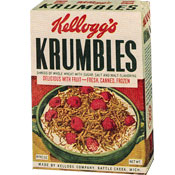
Researching a novel set in the 1950s–during my childhood–brought me many memories as I looked at the political issues, the fads and the products. While I didn’t mention Kellogg’s Krumbles cereal in the book, seeing the familiar box again was definitely a trip down memory lane.
Krumbles was my favorite cereal because I liked the taste and the fact that it didn’t get soggy in milk. Supposedly, Kellogg’s was trying to make a shredded wheat like product, but it ended up crumbling in the box. So, they crumbled it on purpose and it made a fine, high-fiber cereal that was on the market between the 1920s and the 1960s.
According to Murphy’s Laws, if you like a product, that’s the one the grocery store and/or the manufacturer discontinues. Losing Krumbles wasn’t a loss of innocence, it was a lost of a tasty breakfast.
–Malcolm
Malcolm R. Campbell’s 1950s novel is called “Eulalie and Washerwoman.” It’s the story of a conjure woman who uses folk magic to fight a corrupt businessman in her small Florida Panhandle town.


 It goes without saying, that cynics are more likely to expect rain, but to also expect bad luck no matter how many alternate venues are prepared. Fools hope for the best, and while they are the good people that bad things happen to, there’s less stress involved if things work out fine.
 I live in the country with an office on the front of the house, giving me a front row seat on the road where a lot of people walk, ride bikes, ride horses, and sometimes walk their dogs while they (the dog owners) ride horses while holding onto long leashes connected to the dogs. We have an old house sitting on the far end of the property and it still has a separate mailbox. I made a vow two years ago to walk down there to check the mail a couple of times a week. I’ve done that once or twice, preferring to use the riding mower to save time. It’s a good thing that vow wasn’t a formal resolution or a promise to Santa Claus.
 We’re lucky to be alive.

 “I saw a Kotex ad for sanitary napkins and wondered if they thought other brands were unsanitary.”

 As you might have noticed, there’s been a fair amount of political talk going around this year.
 Researching a novel set in the 1950s–during my childhood–brought me many memories as I looked at the political issues, the fads and the products. While I didn’t mention Kellogg’s Krumbles cereal in the book, seeing the familiar box again was definitely a trip down memory lane.
 Malcolm's Round Table