The program offers professional artists the opportunity to pursue their artistic discipline while being surrounded by the park’s inspiring landscape. The program seeks professional artists whose work is related to the park’s interpretative themes and supports the mission of the National Park Service.
The program provides an artist with uninterrupted time to pursue their work and the opportunity to engage and inspire the public through outreach programs. Park housing is provided for a four-week session during the summer or fall season.
The artist is required to present several public programs during their residency. The programs must be related to their experience as the artist-in-residence and can be demonstrations, talks, exploratory walks, or performances. Digital images of selected work produced as a part of the residency may be used in park publications, websites and presentations for education and outreach.
Artists of all disciplines are encouraged to apply. Applications are available online at https://www.callforentry.org. The deadline to apply is January 30, 2014. For more information contact the park at 406-888-7800.
–
Click here for a list of Glacier’s past artists in residence.
People often say they need time to recuperate from their vacations before going back to work. Yeah, my knees and ankles hurt after walking miles and miles between airport gates in order to travel from Georgia to Montana and back. But really, it’s mental relaxation I’m needing. (My brain doesn’t have a automatic transmission, so I have to manually shift from vacation mode to work mode.)
Oh, so we can’t get meals delivered to our table without going to a grocery store first?
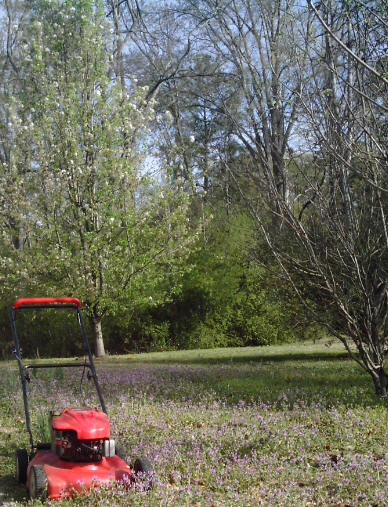
Oh, are you telling me there’s no yard crew keeping the flowers happy and the grass green and well-mowed like there was at Glacier Park Lodge?
But, without missing a beat, the credit card bill arrived a few moments after we got home. Naturally, there was nothing in the mail from Hollywood telling me they want to pay me 100 grand to make The Seeker into a blockbuster movie. But the credit card people didn’t waste any time telling me it’s time to fill their collection plate.
As a contemporary fantasy author, I try to keep reality to a minimum, but so far, I haven’t found the right magic formula for limiting the amount of reality in real life.
Oh, so those prescription meds don’t jump into the bottles automatically unless I call them in first and then drive down to the pharmacy and pick them up?
There’s a plus side to work mode reality. Even though work mode includes chores, it’s cheaper than vacation mode. And really, work mode food is gentler on our digestive systems.
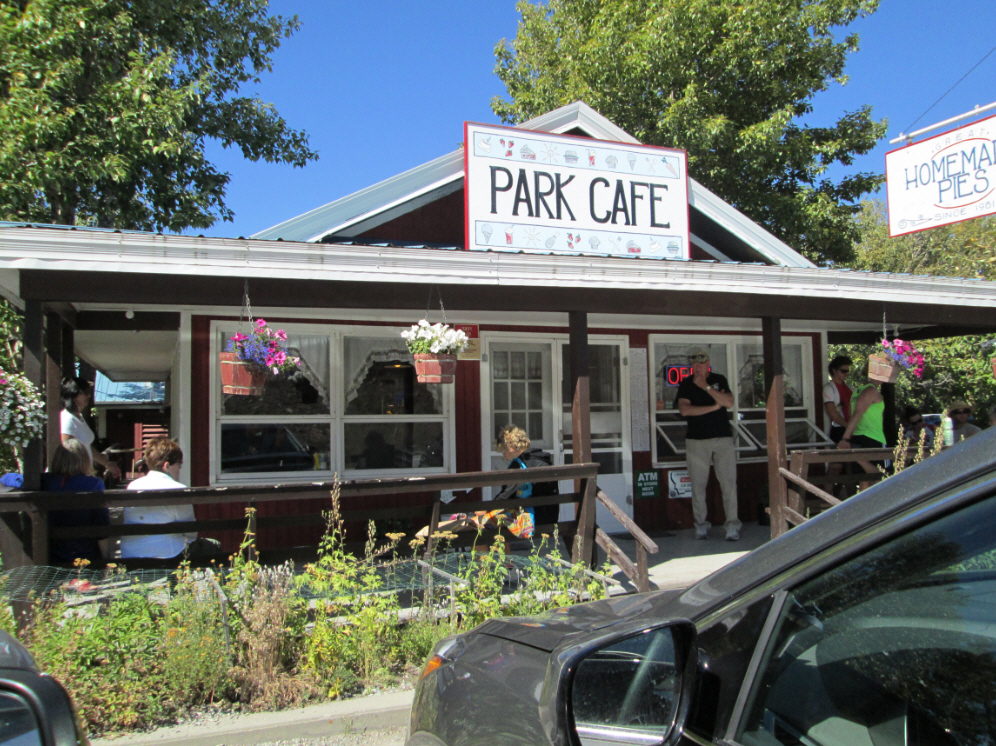
I’m glad we could catch a few Montana meals at the Park Cafe, Bison Creek Ranch, Luna’s, and the Whistle Stop cafe because the chefs at both Many Glacier Hotel and Glacier Park Lodge have a preoccupation with overly spicy food. Can’t you put a few plain dinners on the menu to give our stomachs a break?
Since I’m writing this post instead of working, you can tell I’m not completely out of vacation mode. Shifting gears is a work in progress.
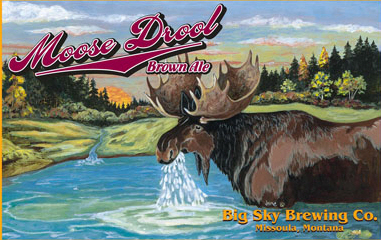
The closest my wife and I came to a moose during a ten-day trip to Glacier National Park with my brother Barry and his wife Mary was an ice cold can of Moose Drool brown ale. For the most part, the critters were absent.
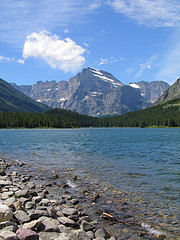
We discussed photo shopping this picture and saying, “Hey, guys, we saw this moose in Lake Josephine, but frankly the scenery doesn’t look much like Lake Josephine.
We did see several grizzly bears, ground squirrels, a coyote, a flash of brown that was purportedly a wolverine, and an osprey.
We were assured by the bartender at Many Glacier Hotel that Moose Drool isn’t made with actual drool. Most of the drool during the vacation was caused by various renditions of huckleberries: huckleberry water, huckleberry ice cream, huckleberry margarita, and huckleberry pie.
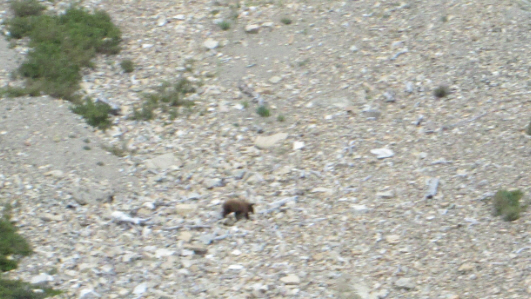
Grizzly bear near Many Glacier – Photo by Barry Campbell
One of the grizzly bears was on the talus high above the road between Many Glacier and Babb. We saw it several times and began to wonder if the National Park Service was paying it in huckleberries to pose there for tourists.
Seeing the cars and buses stopped for this bear–with everyone pointing–reminded me of similar scenes with black bears in the Smoky Mountains.
In spite of the lack of wildlife, we had a good trip. Well, we could have done without the cold rain and the hail storm we got into on during a hike near Hidden Falls. So far, four of my novels are partially set in Glacier. With another novel on the drawing board, it was nice to see many of the settings I plan to use.
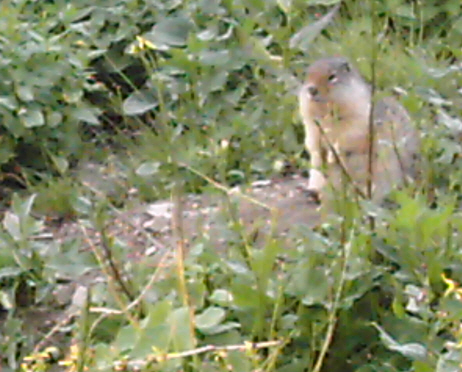
Ground Squirrel at Logan Pass – Photo by Lesa Campbell
I have a lot of location choices. Plenty of places for action, battles, people sneaking up on other people, and the other kinds of things that happen in contemporary fantasy novels.
Coming soon, The Betrayed, the third novel in my “Garden of Heaven” series named after a Glacier Park Valley near Hidden Falls.
Next year, Aeon will complete the trilogy that includes The Sun Singer and Sarabande, both of which are partly set in Glacier Park’s Swiftcurrent Valley.
So far, I haven’t thought of a way to include Moose Drool in one of my books other than to suggest that an ice cold glass of it goes very well with the stories.
Although my novels (The Sun Singer, Sarabande, and The Seeker) are set in Glacier National Park, I haven’t set foot in the park for many years. (I worked there as a seasonal employee in the 1960s and visited in the 1970s and 1980s.)
Later this summer, I’m looking forward to seeing the place I have always thought was the most beautiful place on Earth. All my photographs and slides are old and faded, so I hope to capture some new memories along with some new pictures.
And yes, I plan to take a red bus ride up to Logan Pass and back, have a nice meal in the now-renovated Many Glacier Hotel dining room, and walk around Josephine and Swiftcurrent Lakes on a trail I once knew like the back of my hand.
I’ll be there with my wife and my brother and his wife. We travel well together and pretty much take a casual approach to sightseeing, dining and hanging out in scenic locations with a variety of activities.
But, like anyone going back anywhere, I worry about it being anticlimactic or that it will be changed more than I want to know.
The worst of the here and now
I already know that there are fracking operations on the Blackfeet Reservation a stone’s throw from the park’s eastern boundary. I want to say, “I told you so” about such problems because after Glacier was called the most threatened park in the system in the 1980s, I campaigned strongly for legislation that would keep certain kinds of development farther away from pristine wilderness areas. This is worse than having a tar factory go up in city subdivision.
The response was, “we can only protect the park itself.” My reply was, “if you don’t restrict development outside the park, you’re not protecting the park.” And so it went.
Also, I already know there are 300 miles fewer trails than there were when I worked in the park. Inadequate funding is the main cause. On the plus side, Many Glacier and other park structures have been seeing some renovation work through various campaigns and grants. That makes our historic, National Register structures last longer so more people can enjoy them.
I can tell I’m out of touch. When I called reservations at Many Glacier Hotel, I asked for the Alpine Suite. That was the hotel’s best suite when I worked there. Nobody had ever heard of it. I described where the two Alpine Suites were, and learned they’d been converted into regular rooms.
The lure
The first few times I went back, the bellmen would always show me that the wall of names in the bellman room was still there. My name was there along with many other familiar names from past years. I already know this space has long-since been converted into a restroom.
If we stay on an upper floor in the main section of the hotel, we’ll appreciate the standard elevator that took the place of the old manually operated, cage-style elevator that guests were seldom allowed to ride. It was a great old elevator, one that probably would fail most building codes in the country if it were still there.
The last time I was in the Swiftcurrent Valley, my knee went out on a hike up to Grinnell Glacier. I was astounded. Those of us who worked at the hotel used to stroll up there dozens of times during the summer. Since then, my knees and ankles have grown weaker, so I wonder how much hobbling around I’ll be able to do.
In the past, I’ve always seen people there that I know. This time I won’t. It was fun having the manager, fishing guide, houskeeper, wranglers and others remember me on past return trips. This time, it will be rather like going back to your old high school long after the teachers, coaches, bus drivers, and administrative staff have all retired.
So, how will it go? I think we’ll all come home with some genuine new memories, memories of Glacier and ourselves in the here and now rather than Glacier as it was or might have been. And if that means our pictures show a bunch of weak-kneed, out-of-shape people sitting on the balcony watching the boats on the lake and the ospreys flying high over the nearby peaks, so be it. Maybe a young couple will talk by and ask, “have you folks ever been here before.”
Maybe I’ll say, “Sure, I used to jog up to the glacier and back after dinner and climb with the mountain goats.”
The merger between the Glacier National Park Fund and the Glacier Association has been completed, creating the Glacier National Park Conservancy. If you’re a fan of Glacier National Park, you can read about the organization’s current projects here.
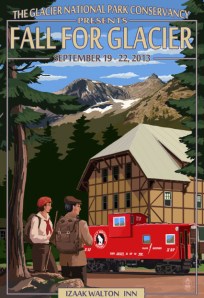
The traditional Fall for Glacier event will remain an annual part of the Conservancy’s program. Fall for Glacier is scheduled for September 19-22, 2013 at the Izaak Walton Inn at Essex, Montana on the south end of the park.
Activities include lectures, a photography session, red bus tour, a float trip on the Middle Fork of the Flathead River and hikes. Click here for a list of featured speakers.
The popular Backpacker’s Ball ends Fall for Glacier with dinner, dancing and an auction.
Make reservations soon before Fall for Glacier is sold out.
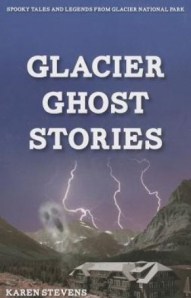
Karen Stevens (“Haunted Montana,” “More Haunted Montana”) has been collecting Montana ghost stories for thirty years and has been visiting Glacier National Park for forty years. Glacier Ghost Stories brings her passions together in a slim, but informative volume that follows her search for strange and inexplicable events at the park’s historic hotels.
Steven’s book is, in one sense, a reporter’s travelogue: she talks about her investigative trips, the weather, the accommodations, and her interviews with hotel personnel. In the process, she includes a fair amount of park history with details for each hotel: Apgar Village Inn, Belton Chalet, Glacier Park Lodge, Lake McDonald Lodge, Many Glacier Hotel, Prince of Wales Hotel and Sperry Chalet.
Glacier Park Lodge celebrated its 100th anniversary this summer. The other hotels are elders in the lodging business as well. The hotels are busy during their short summer seasons. They’re isolated from the world throughout the rest of the year. The schedule and the wild country are, it seems, the perfect recipe for legends, yarns and a long list of things that defy logical explanation.
While they don’t advertise ghosts in travel brochures, hotel managers and long-time employees had a lot to day about things that go bump in the night: people who suddenly disappear, objects that move when nobody’s looking, doors that lock by themselves, music and other sounds from unoccupied rooms, footsteps in the dark. Stevens includes the room numbers where things seem to happen. Take note of these before your next visit.
Glacier Ghost Stories includes legends about Marias Pass, Going-to-the-Sun Road, Two Medicine Valley and the Belly River. In the book’s postscript, Stevens writes that visitors to Glacier and Waterton parks “follow in the footsteps o those who came before us: Native Americans, trappers, hunters, explorers and others whose spirits even today may roam the land they loved so much in life.”
Stevens does not hear about or witness the over-the-top paranormal happenings we associate with Edgar Allan Poe and Stephen King. She did uncover enough to make us wonder and to look over our shoulders the next time we visit any of the park’s hotels. The book is an engaging portrait from a ghostly point of view.
“From the eastern boundary of Glacier National Park in Montana, visitors can throw a stone and hit any of 16 exploratory wells and associated holding tanks, pump jacks, and machinery used to force millions of gallons of pressurized water, sand, and chemicals into shale rock formations thousands of feet beneath the surface.” – James D. Nations, Ph.D., Vice President for NPCA’s Center for Park Research
Center for Park Research
The existence of wells and the infrastructure of fracking within a stone’s throw of Glacier National Park is unacceptable. Some have said we are powerless to prevent it because those wells are within the sovereign Blackfeet Nation. To that, I ask, does sovereignty extend outside a nation’s borders?
Some years ago, the proposed Cabin Creek mine in British Columbia was stopped, in part, because it was likely to pollute rivers flowing from Canada into the U.S. The same is likely to be true of groundwater outside the immediate proximity of those wells on Blackfeet land.
James D. Nations writes in “Fracking and National Park Wildlife” that a third of the nation’s national parks are within twenty-five miles of shale basins. This means that a great number of wildlife habitats are potentially at risk. These risks come primarily in the areas of habitat fragmentation, water quality and quantity, and noise and air pollution.
There’s an old fashioned Libertarian principle that may finally be taken seriously as we realize more and more that the Earth is one community. The principle is that you cannot do anything on your land that harms your neighbor or your neighbor’s land.
The dangers of fracking and other forms of pollution are not restricted to the property where the industrial development occurs. Air and water carry the negative impacts many miles away. This is not acceptable.
While we may not be able to quickly wean ourselves away from older coal fired power plants where no alternatives are quickly available, fracking is relatively new. The complete nature of its threats and risks are not yet known. We don’t need it any more than we need new coal fired power plants.
We need, I think, to look not only at the threats to Glacier and other national parks, but to the places where we live and work. If we take life seriously, we can no longer permit one company or one nation or one developer to do as he wishes on the land he owns or leases when his actions affect people, habitats and wildlife many miles away.
Glacier Park Lodge: Celebrating 100 Years, byChristine Barnes, photography by Fred Pflughoft, David Morris, and Douglass Dye, Farcountry Press (May 2013), 64 pages.
The Swiss-style Glacier Park Lodge on the eastern side of Montana’s Glacier National Park was built by the Great Northern Railway (now BNSF) one hundred years ago as a tourist destination for railroad passengers. While the railroad sold its lodging facilities in 1957 and ended its passenger service in 1971, the rustic hotel with its central roof supported by massive Douglas firs has endured through the years as the “Gateway to Glacier.”
Christine Barnes has captured the spirit of the historic hotel with an accurate overview of “Big Tree Lodge” accompanied by an extravagant collection of archival and color photographs in GlacierPark Lodge: Celebrating 100 Years.
If the Great Northern Railway’s transcontinental route from Minnesota to Washington was the grand dream of tycoon James J. Hill in the late 1800s, the hotels and chalets built by the railroad at the dawn of the new century were the great vision and legacy of Hill’s son Louis W. Hill.
“Louis had taken over from his father, James J. Hill, in 1907, but temporarily stepped down in December 1911 to devote his time to railway-financed projects in and around Glacier National Park,” writes Barnes. “‘The work is so important I am loath to [entrust] the development to anybody but myself,’ he explained to the press.”
As a book of memories, GlacierPark Lodge: Celebrating 100 Years describes the establishment of the park in 1910, the building of the hotel in 1912 and 1913, the railroad’s back-country chalets, and the area’s mountains and wildlife. The book includes a bibliography of standard Glacier references, recipes from the hotel dining room and travel information.
With the help of three talented photographers, Barnes’ experience as a veteran chronicler of old hotels allows her to distil salient facts and images into this small-format book in an accessible style. Her other books include Great Lodges of the West, Old Faithful Inn at Yellowstone National Park and Great Lodges of the Canadian Rockies. She was the senior consultant and historian on the PBS series Great Lodges in the National Parks which included two companion books.
GlacierPark Lodge: Celebrating 100 Years is a perfect introduction to the hotel for first time visitors and a keepsake for long-time hikers, climbers and other enthusiasts of the Crown of the Continent.
–
In addition to three novels partially set in the park, Malcolm R. Campbell is the author of Bears; Where they fought: Life in Glacier Park’s Swiftcurrent Valley and “High Water in 1964” in the National Park Service’s Glacier centennial volume A View inside Glacier National Park: 100 years, 100 Stories.
The Best of Glacier National Park, by Alan Leftridge, Farcountry Press (April 30, 2013), 136 pages, photographs, maps, resources
“We’re here! What should we do, what is there to see?” In the preface to his practical and well-illustrated Glacier National Park guidebook, Alan Leftridge writes that as a park ranger, he often heard those questions from excited visitors who “wanted to start making memories.”
Many of Glacier’s two million annual visitors travel a long way to reach northwestern Montana, and when they arrive, they are not only in awe of the scenery but of the scope of the prospective activities that await them in a 1,012,837-acre preserve with 762 lakes and 745.6 miles of trails. While Glacier is best experienced without hurry or stress, the economics of vacation travel make it necessary for visitors to maximize their time in the park.
The Best of Glacier National Park highlights, as Leftridge puts it, the park’s “iconic features.” The book begins with an overview of park facts, geology, and cultural history. This is followed by twenty-six “best of” chapters describing everything from scenic drives, picnic areas and nature trails to wild flowers, birds and photography opportunities.
Each chapter includes a map, color photographs and clearly marked headings and subheadings that make the information easy to find. This book is meant to be used as a quick and easy reference whether you are stopped at an overlook on the Going-to-the-Sun Road or standing in a subalpine fir forest on the Swiftcurrent Nature Trail. The hiking sections, which are broken down into nature trails, day hikes and backpack trips, include directions and special features you’ll want to see and photograph.
Glacier’s rangers, naturalists, boat crews and saddle tour operators are probably asked more questions about the park’s flora and fauna than anything else. The “Best Wildlife” chapter includes a mammal checklist and tells you where to find marmots, deer, elk, bighorn sheep, moose and bears. The book includes appropriate warnings about Grizzly bears, suggesting that they be observed at a distance. “Best Birds” highlights ospreys, eagles and ptarmigans, among others.
Naturally, “Best Wildflowers” begins with beargrass. Leftridge notes that “It is a myth that bears rely on this lily to satisfy their diet. If you see beargrass’ tall stalks with missing flower heads, know that other animals, including rodents, elk and bighorn sheep, nibbled here.”
According to the National Park Service, there are 1,400 plant species in Glacier. While “best” is a subjective term, this guidebook focuses on such popular and showy wildflowers as the Glacier Lily, Indian Paintbrush, Lupine and other visitor favorites.
Naturalist John Muir said Glacier National Park includes the “the best care-killing scenery on the continent” and suggested that visitors “Give a month at least to this precious reserve. The time will not be taken from the sum of your life. Instead…it will make you truly immortal.”
Whether you have a month, a week or a only few days for the high country known as the Crown of the Continent, The Best of Glacier National Park is an excellent all-purpose, general guidebook for discovering everything to do and see when faced with thirty-seven named glaciers, 175 mountains, and 151 maintained trails of waiting memories.
A former Many Glacier Hotel summer employee, Malcolm R. Campbell is the author of nonfiction and fiction with a Glacier Park focus, including Bears; Where They Fought: Life in Glacier Park’s Swiftcurrent Valley and three contemporary fantasy novels set in the park, “Sarabande,” “The Seeker” and “The Sun Singer.”
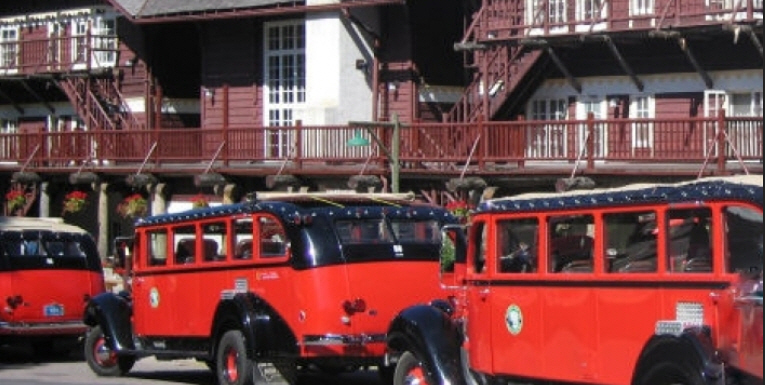
WEST GLACIER, MT. – The National Park Service announced today that it was modifying the terms of a prospectus for the concessions operations at Glacier National Park to reinforce the park’s intention to retain the operation of the entire fleet of red buses while providing safe, informative and memorable experiences for Glacier National Park visitors.
These modifications supersede original plans to retire half of the red bus fleet, replacing them with modern equipment.
Acting Glacier National Park Superintendent Kym Hall said, “We love the red buses and our intent has been to retain this iconic symbol of the park.”
Changes to the prospectus clarify how maintenance and rehabilitation of the bus fleet will occur. The newly selected concessioner will be responsible for the management and upkeep of the red buses. The National Park Service owns all
NPS Photo
the existing 33 historic red buses in the fleet. Through the terms of the pending concessions contract, the National Park Service intends to monitor the condition of the red buses and rehabilitate the buses as needed over the course of the 16-year contract. Hall said that modifications of the prospectus for the new concessions contract are being developed to clarify those requirements. The modifications to the prospectus will be posted on the agency’s commercial services website at http://www.concessions.nps.gov/prospectuses.htm in mid-February.
Hall said, “We appreciate the advocacy for the red buses by the Glacier Park Foundation and others, and their dedication to preserving the fleet of 33 iconic and historic buses.”
As the historic buses age, rehabilitation work is required to keep the fleet safe and operational. The buses have 1930s–era bodies adapted to modern chassis. It is recognized that the required custom rehabilitation work on the buses will be very expensive.
A complete and custom restoration of the buses was last completed in 2002 with the generous assistance of the Ford Motor Company through the National Park Foundation. At that time the cost for the rehabilitation of the buses was more than $6 million dollars.
Hall said, “We want to maintain and continue the tradition of the iconic red buses on the road in Glacier National Park.”
–
–Malcolm
Malcolm R. Campbell is the author of paranormal short stories and contemporary fantasy adventure novels, including “The Seeker” and “The Sun Singer,” both of which are set in Glacier National Park.








 Malcolm's Round Table