 I have legal moonshine in the house and think it’s darned good. What amuses me is the fact that some of today’s legal distillers advertise that they’re using the same recipe they used when the family made moonshine illegally. Midnight Moon Moonshine says on its website, for example, that “Midnight Moon is inspired by Junior Johnson’s family moonshine recipe and – true to the roots of moonshine – it is made from 100% American corn and handcrafted in small batches.”
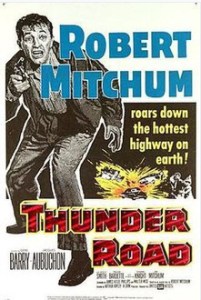 In movies like “Thunder Road,” I always support the moonshiners because I think messing with them is an example of government overreach that began with the Whiskey Rebellion of 1791 when the new federal government taxed booze to pay for the war. My question then, and now, always was how is it fair to tax one product rather than levying a tax on all projects? Not that I would like that any better.
Made in 1958, “Thunder Road” became a cult favorite, especially in parts of the county with a moonshine tradition. When one of my brothers bought some mountain property in North Carolina years ago, he was told that there were probably stills there; just don’t go looking for them.
My wife and I watch the movie from time to time. I like it, except for the ending which I consider as an example of illegal federal force. (Like the ending of “Bonnie and Clyde.”) But aside from that, it’s a bit of nostalgia with Mitchum’s typical natural style of acting and the added benefit of having jazz singer Keely Smith in the cast and singing the theme song “The Whippoorwill.” Mitchum co-wrote the song. Smith is probably best remembered for her song–sung with her husband Louis Prima–“That Old Black Magic.”
In 2012, there was a Thunder Road Festival in Roane County, Tennessee, but I can’t find any mention of it in subsequent years: “One of Tennessee’s fastest growing festivals, Rockwood’s Thunder Road Festival is held each April in downtown Rockwood, TN. The day-long festival captures the element of Rockwood’s past as a location on the notorious Thunder Road.”
And then, of course, there’s NASCAR, but that’s another story.

 “The Film Noir Foundation is a registered 501(c)(3) non-profit public benefit corporation created as an educational resource regarding the cultural, historical, and artistic significance of film noir as an international cinematic movement.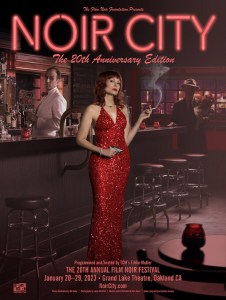
 Noir films are on my mind today since my wife and I just watched the 1946 “murder-in-a-locked-room film called “The Verdict” starring Sydney Greenstreet and Peter Lorre in one of their nine film pairings. The film is dark and filled with shadows and a plot that leaves you guessing until the end. What’s not to like?
 Even so, years after those days, few people know what to make of the 1960s, the era of flower children, anti-war protests, and distrust of “the establishment.” Nancy Kwan, who appeared in the public eye with the release of “The World of Suzie Wong” in 1960, was a welcome distraction to the forces wreaking havoc on the United States and its institutions.
 “Flower Drum Song ” (1961) definitely kept Nancy Kwan on our minds while we were advocating “Make Love Not War.” Wikipedia notes that “”Flower Drum Song became the first major Hollywood feature film to have a majority Asian-American cast in a contemporary Asian-American story. It would be the last film to do so for more than 30 years, until The Joy Luck Club (1993). In 2008, Flower Drum Song was selected for preservation in the United States National Film Registry by the Library of Congress as being “culturally, historically, or aesthetically significant”
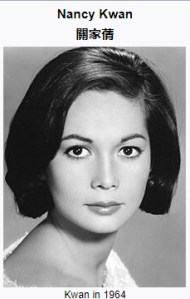 I’m happy that Nancy Kwan is still around, some years older than me, because her presence on this earth reminds me of Hong Kong, the war, Japan, the draft, and all the other good and bad things of those days when most of us lost our innocence and thought absolution would come through hopes we could never attain.
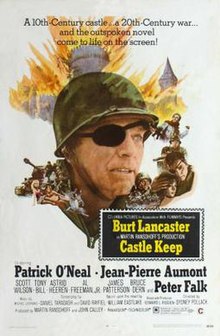 In “Castle Keep,” a rag-tag group of American soldiers is assigned to a remote Belgium castle during World War II ostensibly to protect the artwork there. With little to do, the soldiers develop their own hobbies and relationships with townspeople as though they’re all on extended leave. According to Wikipedia, “The American soldiers are happy to enjoy a respite from combat while being surrounded by unimaginable antique luxury, however, their days of leisure and peace almost undermine the very reality and the ugliness of the war itself. There is also a recurring theme of eternal recurrence, as one soldier drunkenly ponders out loud that maybe he’s “been here before”. And, although the men are eager to sit out the war that they feel will soon end, there is a sense of foreboding, a feeling of inevitability of what will eventually transpire.”
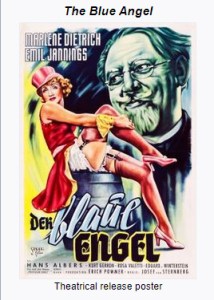 “The Blue Angel” directed by Josef von Sternberg was released in 1930 and, as Wikipedia describes it, ” presents the tragic transformation of a respectable professor to a cabaret clown and his descent into madness.” It’s often called a comedy-drama, but that seems based on short moments of humor in a film that shows how easy it is for a man to walk into a cabaret for innocent reasons and end up being corrupted by the predators there. Two versions of the film were made, one in German with English subtitles and one in English. The English version is an inferior production in part because speaking in fractured English completely destroys the atmosphere of the film.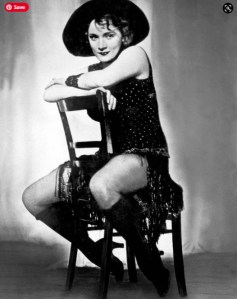

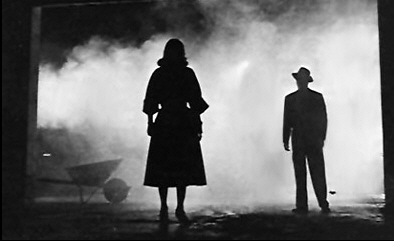
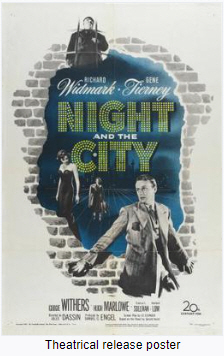 Wikipedia describes Night and the City as “a 1950 film noir directed by Jules Dassin and starring Richard Widmark, Gene Tierney and Googie Withers. It is based on the novel of the same name by Gerald Kersh. Shot on location in London and at Shepperton Studios, the plot revolves around an ambitious hustler who meets continuous failures.” One can’t help but notice: This is like the Greyhound station for DEATH!
 I stopped watching years ago because the show was: (a) too long, and, (b) filled with snarky, politically correct preaching. Talk about movies and the arts and stay away from politics, I want to say. But–I think you can guess this–nobody asked me.
 Today’s films attract attention. I think every generation has probably felt this way. So, when I mention on Facebook that my wife and I watched such and such, the general reaction is “say what?” or “who is Burt Lancaster?”

 Malcolm's Round Table