Review: ‘Alexander’s Lighthouse’ by Don Westenhaver

Author Don Westenhaver (Nero’s Concert) returns to the ancient world with a historical thriller set in Alexandria Egypt at a time when the Roman Empire’s rule was being challenged by a group known as “The Mob.” Set in 92 AD, Alexander’s Lighthouse is a smooth mix of fictional characters and events in a thoroughly researched historical setting.

Marco, a young Greek doctor arrives in Alexandria to study for a year at the city’s Museum and Library with something most visiting students do not have: a famous Gladiator father remembered fondly by the Empire. He secures a meeting with the Roman Prefect Titus Cornelius which leads to a position with a museum department tasked with the discovery of new weapons and other practical equipment. Marco’s access to the royal palace, his courtship of the prefect’s daughter, and his work on secret projects soon bring him to the attention of the mob.

The historical detail in this well-written novel provides readers with three-dimensional characters living, working and fighting within the scope of the long-ago politics and culture of Egypt in the city founded by Alexander the Great after it came under Roman rule. While Alexandria is an advanced, shining city with more than the usual amount of tolerance for its mix of Roman, Greek, Egyptian, Christian and Jewish citizens, there are conflict areas ready to be exploited by Free Egypt, the latest incarnation of the mob.

The inventive plot features a weapon under development by Marco and three colleagues in the museum’s special projects group that both the Roman rulers and the Free Egypt rebels desperately want to have. Spies are everywhere. It’s difficult to know whom to trust. And the friction between those who relish the laws and order of Roman rule and those who want the return of an independent Egypt lurks beneath the surface. The story builds through one intrigue after another toward the inevitable open rebellion. Marco, his co-workers, the prefect’s daughter, Paula, and a rich and alluring widow named Nebit are simultaneously players and pawns in a very deadly game.

While the novel’s historical detail intrudes at times, the story moves at a rapid and believable pace in Westenhaver’s re-created Alexandria with a powerful what-if premise: what-if the weapon in the book had been created at the famous museum? No, it isn’t historical. But as Westenhaver says in the Author’s Note, “My only defense is that the weapon should have been invented much earlier than it was.”  (It contained well-known and commonly used materials.)

Like Nero’s Concert (2009), Alexander’s Lighthouse has great depth along with the kind of action that keeps readers turning pages. The novel is available in trade paperback and on Kindle.

Malcolm

Malcolm R. Campbell is the author of four novels, including the contemporary fantasy “Sarabande.” His “Book Bits” writers’ links appear several times a week on his blog The Sun Singer’s Travels.

Contemporary fantasy for your Kindle.

Book Review: ‘Goatsong’ by Patricia Damery

Each chapter heading of Patricia Damery’s beautifully written novel Goatsong begins with the words “tell me about.” Sophie’s daughter Stacey is asking her mother to tell her the old and ever-changing family stories about the days she spent as a ten-year-old child with the three Goat Women on Huckleberry Mountain and was reborn into the fullness of the world.

Young Sophie’s single mother works as a waitress at an all-night diner and sleeps all day, sometimes alone and sometimes with the man she brings home: “Ma didn’t want me making noise during the day while she slept, so I left the house and did all kinds of things most kids would not have the opportunity to indulge in, you might say.”

That summer, Sophie meets Nelda, Dee and Ester on the mountain above the Russian River in northern California, and in the process of learning about herding goats, “logging in” garbage dumped alongside the roads, and dancing naked in the meadow, she discovers love and acceptance from her ad hoc surrogate family. Among other things, Sophie learns to see and acknowledge that which others often miss, roadside trash included.

Wise, practical and nurturing, Nelda knows the Goatsong. Strong, persistent and dependable, Dee takes exception to those who dump garbage on the mountain as well as those who won’t lift a hand to stop it. Forever taking notes as the women do their daily errands, the relatively silent Ester is a witness, logging in the garbage. She finds, for example:

“1 beer bottle, label torn and unreadable, green.
1 plastic freezer bag, Safeway, good condition.
1 16 oz. paper cup, 7-11, good condition.”

The three Goat Women, who know they are “undesirables” from the townspeople’s point of view, accept Sophie as one of their own during their daily adventures on a mountain that Damery describes with the prose of a poet. The novel is a hymn to nature and natural living as well as an eternal and memorable story. Original, unorthodox and wise, the Goat Women provide Sophie with an unfettered, practical and loving worldview that is absent at her home and school.

In their own way, the goats (Natalie, Boris and Hornsby) are also Sophie’s teachers. The author, who has run a biodynamic farm in the Napa Valley for the past twelve years with her husband, said on her blog this past summer that “Walking the goats is truly an art.” Damery brings her knowledge of that art into her novel, creating goat characters who are as three dimensional and essential to the story as the women.

In the introduction, Damery writes that “Goatsong is the mysterious combination of humility and that essential ability to climb above, like a goat, or a song. To know the Goatsong of tragedy, Nelda told me, is to be reborn.”

When you read Goatsong, you are breathing in fresh air off the Pacific ocean, smelling the sweet scent of the bay laurel, and cooling your tired feet in sacred streams flowing through old redwoods in the company of wise women who, without agenda, may well change you as they changed the ten-year-old Sophie in those old family stories about the town of Huckleberry on the Russian River.

Malcolm

a young woman’s difficult journey

Allowing a story to happen

Some writers begin with an outline while others just start writing. Either way, the story is likely to have a mind of its own. Characters will do and say unexpected things. Research will turn up new ideas that alter the original ideas for a scene. Regardless of the overall plan, or lack of a plan, the story will need a bit of space in which to grow.

You’ll know when it’s better to wait patiently than to press on with your typing. This often happens at the end of a scene. Now it’s time for the characters to do something else. But what? Or, it may be time for for the writer to check in on another character. But who? Or, perhaps you’ve written up to the edge of A BIG SCENE and you’re not exactly sure how that big scene ought to get underway.

At times like this, I find it better to stop writing for 15 minutes, an hour, or perhaps for the rest of the afternoon and do something unrelated to the novel or short story I’m working on. If the next scene of the story seems close, but isn’t quite resolving into my thoughts, I’ll do something relatively mindless like playing a game of Freecell, hearts or Angry Birds. If I think the scene needs more time to come to mind, I’ll go do errands or mow the lawn.

When I distract myself, the next scene in the story always occurs to me out of nowhere.

I suppose there are many theories about this. I really don’t want to know them. If I did know them, the whole process might simply stop working. Anyhow, I have my own theory about it.

If you think about some of the methods people use to relax, especially those who do psychic readings or are using biofeedback to get rid of a headache or a sore back, the process begins with visualizing a relaxing place, slowing the breath, and then follows through various self-hypnotic methods that will slow one’s brainwaves and heart beat.

Now, I’m not suggesting Tarot card readers ought to begin with a game of hearts on their computers before spreading out the cards or that Freecell will send energy up and down your chakra system to improve your well being. Perhaps. At any rate, my mindless activities tend to produce the same results as structured or unstructured meditation. The result? I’ve stepped away from the story, relaxed, and allowed it to happen.

My won/lost percentage for Freecell, hearts, chess and other games on my computer isn’t good because once I begin playing them, the next scene of my story is likely to occur at any moment and to be so compelling that I can’t wait to get back to my Word file and start typing again. At that point, I’m ready to quit the game in a second and get back to the larger-order of fun: writing.

I suppose we all have our little tricks and superstitions. One way or another, they seem to be in our writer’s tool kits as the magic behind the curtain that allows our stories to happen.

Malcolm

a heroine’s journey adventure for your Kindle

Creating Magical Animals in Fiction – Part 2

“The Twa Corbies”, Illustration by Arthur Rackham to Some British Ballads – Wikipedia

In Part 1, I suggested that magical animals in fantasy, magical realism and folktales should start out on your imaginary drawing board as factually accurate as possible. Real-world facts make your animal believable.

Whether your animal can perform overt acts of magic, such as my flying horse Sikimi in The Sun Singer and Sarabande, or mysteriously appears on the scene when important things happen to the characters, such as the crows in Verlyn Flieger’s The Inn at Corbies’ Caw, you can add great depth by linking it to traditional myths and superstitions, American Indian creation myths and real or imaginary local stories and beliefs. When you do this, you are building either on what the reader already believes (ravens hang out in grave yards and bring bad luck) or you are layering the story with information that, while probably new to the reader, helps  make your magical animal three dimensional.

In a recent short story about the rare Florida panther, I noted that according to Seminole myth, the creator placed all the animals into a birthing shell from which they emerged when the time was right. The first animal to come into the world was the panther, and she had certain qualities that made her special. Since my story is set in a long-ago time period before humans arrived, the animals view the birthing shell as real. They mention it in an off hand way because my short story is not retelling the myth; the mythic backstory gives my panther a larger than life ambiance.

Many writers turn to Nature-Speak and/or to Animal-Speak: The Spiritual and Magical Powers of Creatures Great and Small by Ted Andrews for a comprehensive introduction to a large number of animals as they are seen in myth and folklore. The books are especially valid for stories set in the United States since they have an American Indian flavor. I prefer to find out about my prospective magical animals before I start writing so I can build their characterizations and actions around the myths and superstitions rather than pasting a “surface-level” set of qualities on top of an otherwise realistic creature.

The Internet is an amazing resource as long as one double checks everything from multiple sources to: (a) insure the myth or legend is widely known rather than being one writer’s imaginary story or religious belief, (b) locate enough detail to keep your account (including the adjectives and phrases you use) from sounding too much like the one source you located. When setting a story in a real location, a you can start with such online searches as creation myths of the Seminoles (insert appropriate tribe for the region) , panther (insert appropriate animal) myths and legends, and Florida (insert state, city, park, forest or resort) animal legends.

How Magic Do You Want Your Animal to Be?

Magic has to be used carefully, for if you make your main character (human or animal) all powerful, then you won’t have a way to build an exciting story. When your animal is all powerful, then you can build in understood “rules” that keep it from solving all the challenges in the story the minute it arrives. My flying horse, for example, is on the scene to transport my human characters from place to place. But he allows them to decide where they’re going and what they’re going to do when they get there. While he occasionally takes strong action, he generally doesn’t interfere in the fate, destiny or logical plan of the humans.

You can, of  course, make all of the magic indirect. That is, if an character’s totem animal is the raven, the raven need not have Superman-like powers to play a role. He can appear in dreams and visions with cryptic messages, can be seen flying in a certain direction as a hint to the characters to go that way, and can be placed in trees or in flight overhead when things are beginning to get frightening. This approach works well in contemporary fantasy and magical realism where your magical animals generally don’t have the capabilities of science fiction and fantasy animals in other worlds where the rules are different.

In “real life,” an overtly magical animal would attract attention. Of course, if that attention and how the human and animal deal with it, is important to your story, then hiding the animal’s abilities wouldn’t be an issue. Otherwise, magical animals tend to be more overt when they appear in parallel worlds, spooky uncertain regions, and deserted places. You can also blur the level of reality by opening up the possibility that the magical things a character saw and/or took part in, might have been the stuff of his imagination and dreams. You will see when you do your research into animal superstitions and tales, that magic tends to happen in places where the whole world cannot see it. This not only makes the magic potentially more frightening (it happens at midnight where two roads cross, for example), but keeps it from getting out of control in your story.

If your protagonist is a human, the rules of storytelling (depending on the genre) generally call for him or her to have more control over the direction of the plot than the animal. When placed within a dangerous situation, you character—knowing or not knowing the magic that’s “available”— will make choices to run, to hide, to fight, to be heroic, to find hidden strengths, or perhaps to fail. The magical animal cannot run in out of nowhere and “fix” all of the character’s problems. If so, the story become very anticlimactic.

In most fantasy, there are various “rules in place” in the parallel universe and in adjoining or overlay worlds that contain or restrict all the magic. This also makes stories more suspenseful and mysterious and keeps them from ending on the first page. Even Superman can’t do everything and be everywhere at once: the fact that he can’t, is what makes the story a story. The same is true for your magical animals.

Malcolm

Author Melinda Clayton returns to Appalachia for her new novel

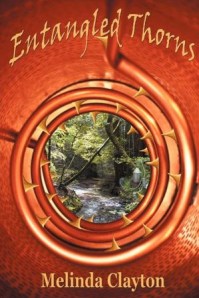
I’m pleased to welcome author Melinda Clayton (Appalachian Justice and Return to Crutcher Mountain) to the Round Table today to talk about her new novel Entangled Thorns. Once again, Clayton heads back to Appalachia for a compelling story about hard times and hard memories. Entangled Thorns, which tells the story of Beth Sloan and the “infamous Pritchett family of Cedar Hollow, West Virginia,” was released by Vanilla Heart Publishing June 27, 2012.

Malcolm: Like Appalachian Justice and Return to Crutcher Mountain, your new novel Entangled Thorns has an Appalachian setting. What draws a Florida author away from the orange groves and sunny beaches into the hills of West Virginia for her storytelling?

Melinda:  My mother’s family is from West Virginia, around the Charleston area.  My grandfather was retired from the mines.  Both of my maternal grandparents passed away when I was a teen, but up until that time we visited every summer.  I loved everything about it:  the people, the mountains, the wildlife.  My mother was born in a tiny place called Big Ugly Holler, which served as the inspiration for Cedar Hollow.  It doesn’t exist now, but we once hiked into the mountains to see what was left of it.  There was no road; by that time, there wasn’t even a trail.  When we finally reached our destination all that remained of Big Ugly Holler were a few foundations and chimneys covered in vines.

Malcolm: In Entangled Thorns, your protagonist Beth Sloan has been running from and/or repressing her troubled childhood until circumstances force her to confront it. Your protagonists in Appalachian Justice and Return to Crutcher Mountain were also wounded as children. Does this overarching theme of your work come out of your experience as a psychotherapist or the kinds of stories you’re drawn to on the nightly news?
Melinda:  I love this question, and the answer is, “both.”  I read a book when I was very young – I’d give anything to remember the title of it – but it was about a social worker who worked with troubled kids.  Ever since then I knew I wanted to work with troubled children and families in some capacity.  I’ve also always been drawn to true crime stories, as morbid as that might seem.  There is something about the workings of the human mind that absolutely fascinates me, particularly when it goes off-kilter in some way.

Malcolm: You recently completed a Ed.D. in Special Education Administration program which required a dissertation. How did you manage to jump back and forth between academic writing with its reliance on sources and a formal style to fiction with its emphasis on people, adventure and an accessible style?

Melinda:  That was a little challenging at times.  The act of writing fiction was a great stress reliever, but I had to work to keep the informal language (contractions, slang, etc.) from entering my academic writing.  It was tempting at times to put in something like, “This research will show that there ain’t no correlation…” for the pure fun of seeing my committees’ reaction.

Malcolm: How does the doctoral work fit into your professional goals?

Melinda:  My ultimate goal is to teach at a college level.  My doctorate sort of combined two fields of study, since my M.S. is in Community Agency Counseling, and my doctorate is in Special Education Administration.  I’d love to contribute to the field by demonstrating how the two fields often go hand-in-hand and should support each other and work together, instead of arguing over funding streams and services as so often happens.

Malcolm: For the general public, Appalachia conjures up such themes as isolated, subsistence living, hard-working and persevering people, coal mining and other environmental excesses, and pure, raw music unlike that from any other part of the country. How do your characters and plots mesh with or run counterpoint to these stereotypes? Does the lure of Appalachia for your storytelling ever translate into other areas, say, in tempting you to move there as a teacher or psychotherapist?

Melinda:  It’s a delicate line to walk.  I know from my own family that the manner in which Appalachia is often portrayed can be a sore point.  At the same time, I want the story to reflect what is, in some areas, true to life.  I relied heavily on not only my research, but also my own memories as well as my mother’s experiences.

I also know from my experiences that the poverty associated with Appalachia exists elsewhere.  There’s no need to travel to Appalachia to encounter it.  In the late 1980s, when I was fresh out of college with a B.A. in social work, my first job was as the coordinator of case management services for a rural mental health center in Tennessee.  My case workers and I were responsible for a three county area, working with the most impoverished of families. Many of our clients were without electricity or running water.  Many also lived in the most basic of housing structures, without floors or internal walls.  I think it’s difficult to believe there are still families living in such poverty in the U.S., but there are.

Malcolm: Thomas Wolfe brought the phrase “You Can’t Go Home Again” into general use. “Going home” can be awkward, embarrassing or frightening on so many levels even for those of us who had relatively normal childhoods. But your characters had strong reasons for avoiding home, yet all of them find that they must go home again. Does this theme grow out of the psychologist’s seemingly favorite “well me about your childhood” question or is it more that home is the only place where the issues of home can be fixed?

Melinda:  Again I have to smile, because it’s both.  My writing of home is a very transparent attempt to create the home I miss.  Until I was about twelve, we lived in my father’s hometown in TN surrounded by aunts, uncles, cousins, and grandparents.  We had fried chicken at Mawmaw’s house every Sunday after church, then spread blankets on the lawn under the pecan tree and visited well into the evening.  A rough couple of years ended all that.  One aunt died tragically in a car accident, another divorced, my grandparents lost their home to a fire, and my family moved away.  I’m sure it wasn’t as idyllic as I remember, but it’s pulled at me ever since.

But I also think it’s necessary to revisit the places that have scarred us, either symbolically (often for safety’s sake only symbolically) or physically.  We have to face our issues before we can resolve them.  Burying them doesn’t work; we have to excise them, examine them, and then choose to heal and move on.

Malcolm: Thank you, Melinda.

Where to Find Melinda on the Internet

Blogs on Xanga and WordPress

Facebook

Twitter

Amazon Author’s Page

and now a word from our fantasy sponsor

My book reviews, interviews and posts on Malcolm’s Round Table, Magic Moments and Literary Aficionado are brought to you by, er, me.

Speaking of myself now in the third person, Malcolm R. Campbell is the author of magical realism, contemporary fantasy and satire published by Vanilla Heart Publishing of Washington State. While my noir satire, Jock Stewart and the Missing Sea of Fire, is set in a fictional Texas town with a really screwed up fictional newspaper, my three other novels are set in Glacier National Park, Montana and other places where I have lived or visited.

Last summer brought the release of Sarabande, a harrowing heroine’s journey and contemporary fantasy about a young woman who is haunted by the ghost of her sister. Sarabande seeks the help of a young man who has, on one previous occasion, bent time to “raise the dead.” The solution to the problem is not without its nasty down side.

Satire for your Nook

In 2004, I came out with the first edition of my novel The Sun Singer, the story of a young man whose psychic dreams ultimately lead him into a dangerous mountain world where it will take all of his skills to survive. First things first: he had to figure out who the good guys are and who the bad guys are and, as it turns out, who exactly he is. The second edition of The Sun Singer was released in 2010. College students at Lone Star College, Texas, read and discussed the novel this past Spring as part of a Wayfaring Heroes course.

Garden of Heaven: an Odyssey (also released in 2010) is magical realism about a man who grows up on a Montana ranch who loses his way when a failed love affair sends him down dangerous roads along which is is betrayed multiple times by those he cares about the most. The book is also available as an $4.99 e-book from OmniLit.

Where To Find Malcolm R. Campbell on the Internet

Excerpt from Sarabande

Only $4.99 on Kindle

Gem pulled her hands away and stood up so quickly she knocked over her spinning wheel. She didn’t appear to notice. She walked to the window and leaned out as though making sure no one else would hear her words.

“I was shamed by the king.” Gem pulled up her left sleeve to reveal the letters SJ in a bold pink scar that contrasted with her walnut-colored skin.

“Your strike brand!”

“I bore Justine’s mark as well as his child. Both were conceived in pain in a dark cell covered with urine and rat droppings.” Sarabande went to her, but Gem rolled down the sleeve, covering the ugly mark that signified Sovereign Justine. “No, my friend, I cannot abide your seeing it close at hand. My daughter, though, this doting mother will speak of her at great length if allowed to do so.”

“Cinnabar has shown me her brand,” said Sarabande.

“Discretion is a lesson I was never able to teach her. But listen: on your journey to Osprey’s house, you won’t walk through the domains of kings.”

Sarabande gasped and sat down, suddenly lightheaded when she understood why Gem showed her the scar.

“If there are no kings, what dangers have you seen?”

Gem put her hands on Sarabande’s shoulders and kneaded out the growing knots. Her touch always felt like a touch of power, and she wondered if she shared Osprey’s way with healing magic.

“I have seen a dark creek beneath a bridge on a foggy night. I have heard screams and howls outside my comprehension. I don’t understand it,” said Gem, holding their eye contact as though she understood more than she would say. “Sarabande, you know without my lecturing at great length about the ways of the world. A a woman on a lonely road can be a target. Travel with a sharp knife.”

The impromptu massage felt good. The unclear warning did not. Vague predictions were worse than silence. They stirred up what did not need to be stirred up.

“Yes, I know that, Gem. I will carry a knife and take care to have it handy.”

“With due care, you can avoid your fate, but destiny is the way you’ve already written your life’s story.”

“I wanted to walk the sixteen hundred and fifty miles to Osprey’s house long before it occurred to me I would ever do so. If there is to be shame in it, then I will live or die with whatever I find on that lonely road.”

Thank you for stopping my Malcolm’s Round Table today!

–Malcolm

Smoky Zeidel and ‘The Storyteller’s Bracelet’

Smoky and Tufa

Today I’m happy to welcome back author Smoky Trudeau Zeidel (On the Choptank Shores, The Cabin). Her new novel, The Storyteller’s Bracelet (out this month from Vanilla Heart Publishing) is a historical romance set in the late 1800s during the period when the U. S. Government forced Indian youths into boarding schools where they would learn the “American way of life.” (See my preview of the book here.)

Malcolm: What is a storyteller’s bracelet, and what gave you the idea of using one as the centerpiece in your story about two young Indians from the southwest?

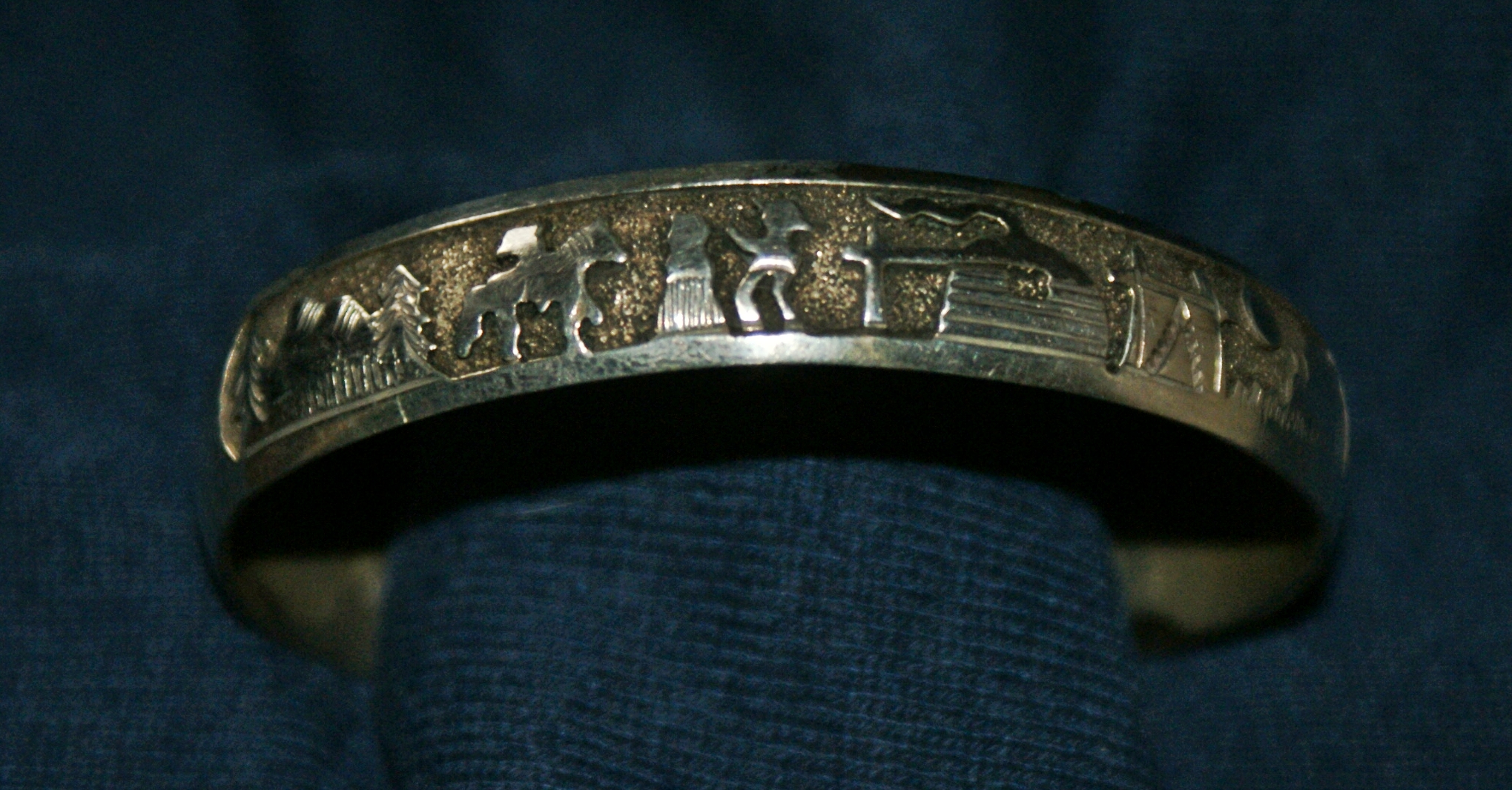
Smoky: A storyteller’s bracelet is a silver bracelet engraved with pictographs that tell some sort of story. My sister Bonnie gave me one as a gift about five years ago. I knew immediately I wanted to create a story about such a bracelet.

Malcolm: While the culture of Otter and Sun Song appears to influenced by the ways of the Tewa and Diné, your protagonists’ tribe isn’t identified in the novel. What led to your decision not to use a specific Indian nation for their background?

Smoky: You’re right about the Tewa and Diné/Navajo, but there also are Hopi influences in the story. I decided not to identify a specific tribe because I’m not Indian, and I didn’t want readers to presume that I am. I did not want to presume to know how a member of a specific tribe would act in any particular situation. Plus, I wanted to be able to pull aspects of different tribal lore into my story, especially when it came to telling the creation stories, because the different stories are beautiful. Also, by not identifying a particular tribe, I was able to bend the stories just a bit to fit the novel. I wouldn’t have felt right doing that if I had identified a particular tribe.

Malcolm: Like many young Indians, Otter and Sun Song were sent away to a white-run Indian school where the intent was to remove the students’ Indian language, beliefs, and culture and replace English, Christianity, and white clothing styles and laborer skills. Most of us didn’t hear about this in our high school history classes. It must have been difficult to place your characters into such an environment. How did you cope with this during the writing process?

Smoky’s Bracelet

Smoky: No, we didn’t hear about the Indian Schools in our history classes, just as we didn’t hear about the Japanese Interment camps. History often has overlooked the ugly things our culture has done, and these are just two examples of that. It was hard to place Sun Song and Otter in the school, but it was crucial to the plot. I also wanted to bring some awareness of what our government did to all the Indian Nations by ripping children and young people away from their tribes, their families, their culture. It was a shameful thing to do. Most of the time, when I was writing particularly tense scenes at the school, I raged at my computer. I felt really angry, even ashamed to have white skin. I guess, in a way, The Storyteller’s Bracelet is an apology to indigenous people everywhere for the way my birth tribe–white people of European descent–treated them.

Malcolm: The Storyteller’s Bracelet has a touch of magical realism in it, as does your earlier novel The Cabin. In both novels, the magic is a natural outgrowth of the places and the characters’ beliefs. Do you often wonder if such magic exists in “real life,” or do you approach it more as a viable storytelling technique?

Smoky: It is, of course, a viable storytelling technique, and is an integral part of the plot of The Storyteller’s Bracelet, as it was in my earlier novel, The Cabin. But yes, I do believe such magic exists in real life, at least for those of us who know how to tap into it. I’ve experienced it firsthand on several occasions. Does my body physically move from one plane to another in a different place and time, like in my books? No–at least, I don’t think so. But I have traveled to a cave in a faraway mountain range to converse with a Spirit Bear, and I have found myself transported to an island on a raft that is pushed by a great gray whale, with whom I also converse. Is it magic? Or is it imagination? I’m not sure there’s a difference.

Malcolm: Otter and Sun Song are in touch with their environment and treat wild creatures and special places there with respect.  This reminded me of your own approach to nature as you wrote about it in Observations of an Earth Mage. Did your own view of the natural world help you tell Otter’s and Sun Song’s story or did you have to “step away” from your own views to allow your characters’ views to be truly their own?

Smoky: No, I didn’t have to step away. Sun Song and Otter are like my own children–I created them, gave birth to them. It was critical to me that they shared my belief that we are all one with nature, neither above nor below every living creature, whether it be the smallest of insects or the powerful mountain lion or brown bear. We are nature. All of us. Intentionally harming any living thing is like harming a family member, for we are all the same, we are all one, to Mother Nature.

Malcolm: As a historical romance, The Storyteller’s Bracelet focuses on the feelings between Otter and Sun Song as well as the forbidden and dangerous feelings between Otter and the white girl Wendy whom he meets in the town where the Indian school is located. However, since these relationships unfold on a much broader canvas than the classic love triangle, were the two women a planned part of the plot from the outset or were you simply “following your characters” as you wrote when Wendy appeared on the scene?

Smoky: The two women were always in the planned plot, but they ended up being much feistier that I ever imagined. Sun Song, for example, in my initial story idea had a much smaller role than she ended up with. I ended up following her, because she made it clear this was to be her story as much as Otter’s. My planned original ending is nothing like how the actual novel turned out. Following Sun Song’s lead, I was able to work my way to these characters’ true story. And both I and the publisher, Kimberlee Williams of Vanilla Heart Publishing, think this story is much, much better than the one I originally planned.

Malcolm: Thank you, Smoky.

Where to find Smoky on the Internet

Website and Blogs

Author fan page on Facebook

Twitter

Amazon book listing

Inanna’s Heroine’s Journey – a drama for authors and seekers

“The world’s first love story, two thousand years older than the Bible—tender, erotic, shocking, and compassionate—is more than a momentary entertainment. It is a sacred story that has the intention of bringing its audience to a new spiritual place. With Inanna, we enter the place of exploration: the place where not all energies have been tamed or ordered.” – Diane Volkstein in “Inanna, the Queen of Heaven and Earth: her Stories and Hymns from Sumer”

Inanna, as envisioned by nikkirtw123 on Photobucket is strikingly close to my vision of Sarabande

As an author, I view my characters through a high-powered microscope and present the results of what I see as part of my stories. I will put you into the characters’ shoes if I can because—as Diana Volkstein writes—this is where the energies haven’t been tamed or ordered.

In my hero’s journey adventure Garden of Heaven: an Odyssey, I describe that place like this: “He knew him at the binary level where the line between matter and energy is barely discernible and often non-existent: Where urges pull at their chains, where drives push dumbly and drip sweat, where instincts race unchecked, where a horrifying sadness lies buried, where a raw pulse drums a cadence for the primitive rites of changing seasons, where white-hot impulses leap synapses in a shower of elemental fire.”

I wanted a similar, up-close focus in my heroine’s journey novel Sarabande. So, for the story of a woman seeking wisdom and wholeness, I could think of no better model than the myth of Inanna, a graphic dramatization of a woman’s inner journey to find herself outside the traps and trappings of a masculine world that has–as Sylvia Brinton Perera (“Descent to the Goddess”) wrote–forced the binary level of feminine power into dormancy for 5,000 years.

Or, as the late Adrienne Rich said, “The woman I needed to call my mother was silenced before I was born.”

Sarabande’s Heroine’s Journey

The journey in “real life”

In today’s terms, Sarabande was a tomboy. She was an expert with a knife, bow and arrow, a fishing pole, and everything she needed to know to survive in the wilderness. She learned all this from her father because her her mother believed women should only learn to keep a good home and not question society’s norms for women. However, Sarabande will never truly become herself as long as she is a disciple of either her late warrior father or her misguided, preachy mother. She is being taunted by a ghost that she must approach face to face in the ghost’s world.

Early on in her quest to rid herself of the ghost of her dead sister Dryad, Sarabande learns to see the world at a binary level: The lake, surrounding mountains and the cloud-draped sky broke apart into millions of colored specks. Sarabande leaned against Sikimí, even though he was no longer solid, and saw that her own light-pink hand was not solid either. In spite of her sudden dizziness, she did not fall. In fact, when her fingertips touched Sikimí’s side, a swarm of pink specks flew, like bees, into the permeable yellow gold of the horse, and when they did, their color changed to match the specks in their new environment.

But she doesn’t know what it means. So it is, that her quest to find and confront her sister follows the pattern of Inanna’s Heroine’s journey to confront her sister Eriskigal, Goddess of the Underworld. The underworld, in this case, is not the world of mobs and crime or “hell” in the Christian view, but the more dangerous world of the unconscious. Like Inanna, Sarabande will be broken, shamed and close to death before she learns who she is.

This is the heroine’s journey, to be buried in mother earth like a seed where she will be reborn with the spring into a new creation that finally has the freedom to follow the original injunctions of her destiny and her gender.

Malcolm

Review: ‘Cathead Crazy’ by Rhett Devane

“All she wanted in this life was a small slice of peace. Maybe add in some attention from her husband. Respect from her kids. A clean house. But she’d settle for peace.” – Rhett DeVane in “Cathead Crazy.”

Hannah Olsen wears multiple hats, and their combined weight is well-known to any woman who has done a portion of her life as a member of the sandwich generation stuck like thin cheese between an aging parent and demanding children. She has a full-time job, a household with a husband and kids to look after, and an ever-changeable mother called Ma-Mae at a nearby nursing home who needs and expects her dutiful daughter to be present around the clock.

In “Cathead Crazy,” Rhett DeVane tells Hannah’s story with grace, sweet-and-sour reality, humor during hard times, and a heaping helping of the down-home Florida Panhandle lifestyle. Immensely readable, this novel is about a family caught in the crosshairs of the difficult choices everyone with aging parents will ultimately face. Even so, there are still good days, laughter and memories that will serve well for a lifetime.

Rhett DeVane knows the territory, and she has made of it a moving story with realistic, multidimensional characters with universal cares and needs who try their best to navigate life without going “cathead crazy.”

The eight recipes, including “Ma-Mae’s Buttermilk Cathead Biscuits,” are a mouthwatering extra treat. Would you like sweet tea with your lunch, hon?

Malcolm

Author of four novels, Malcolm R. Campbell grew up in the Florida Panhandle where this novel is set, and thoroughly enjoyed seeing it again through Rhett DeVane’s wide-angle lens even though he never learned to like sugar in his iced tea. His novel, “Garden of Heaven: an Odyssey” is partially set in Tallahassee, Carrabelle, Tate’s Hell and other areas very close to Hannah Olsen’s neck of the piney woods.

Review: ‘The Comrades’ by Lynne Sears Williams

Lynne Sears Williams’ beautifully told historical romance “The Comrades,” carries readers back into Medieval Wales when the post-Roman Kingdoms of Powys and Gwynedd were at odds with each other while contending with ongoing threats from the English and the Norse.

In Williams’ 9th century tale, Evan, King of Powys, responds to a nasty cross-border raid from Gwynedd by ordering his commanders to kidnap Gwynedd’s princess Morleyna to use as leverage in negotiations with the neighboring kingdom. Carefully planned and boldly implemented, the successful abduction brings consequences the king and his warbrothers aren’t prepared for: a shrewd, highly intelligent “guest” at the castle who is also blessed with The Sight.

“The Comrades” is a stirring romance, graced with memorable characters, historically accurate place settings and customs, a first-rate writing style, and a rousing good plot. The interplay between Evan and his men, his aunt, his concubine and the princess is believable and flows easily between humor, statecraft and crisis. The story unfolds as the kingdom waits for a response from Morleyna’s brothers. Will they bring an army, a ransom or both?

Williams’ decision to tell the story from multiple points of view was a wise one. Readers see castle life and the world of Powys from the from the perspectives of Evan, Morlenya and other principal characters. While that world is long ago and far away, it shines clearly and brightly in “The Comrades.”

The story is supported by a helpful map and glossary.

–Malcolm