‘Mountain Song’ is a story about love that might be too broke to fix

As far as I know, we all experience “first love” and ultimately we all “come of age,” yet these subjects have become so cliched, that they are very difficult for writers to tackle with any hope of getting it right. We know in spades what it’s like to experience what our elders in a other era used to call “puppy love,” telling us it was immature, part of growing up (like falling off a bike), and ultimately wouldn’t matter.
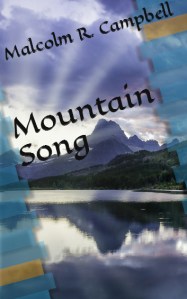
mountainsongcover4We all know the territory, don’t we: the love that seems both fresh and infinite that for reasons unknown collapses without warning as thought it never happened. But we never forget and we could easily bore young people with our stories about it, but just in telling old secrets about long-gone moments, we would appear to be discounting what people in high school and college are feeling right now.

There’s always something heroic about the risks of first love, yet when it comes to fiction, we can hardly turn a boy-meets-girl story in a college geography class into and epic of star-crossed lovers such as Romeo and Juliette. It strikes me odd that such a common occurrence as first love boils down to something each of us must suffer alone when we experience its collapsing.

The world seems to end for us and while it’s ending, we’re mostly silent. From time to time, I read a short story or a novel where the author gets it right. I’ve tried to get it right–but the words never seem to match the experience. Perhaps they can’t because we’ve all been there and have our own stories to tell (should we ever dare) about what it was like.

Based on a true story (kind of)

That said, Mountain Song has kernels of truth in it. I’ve obscured them because the real life characters, one of whom was me, were two people who had a summer romance while working at a resort hotel. By itself, that doesn’t make for a compelling novel because we took long walks in the moonlight and stole guarded kisses while on duty, and there’s just so much that can be said about that.

Plus, the characters had to be very different than their real-life counterparts. Otherwise, one has to worry about libel and invasion of privacy. So, in Mountain Song, the characters’ diverse backgrounds provided the framework for the story. Bottom line, as was true in real life, the two main characters were poles apart in terms of upbringing, home towns, and lifetime goals. But neither of us had the bizarre, flawed upbringings of the characters representing us in the novel.

The people who knew me then, said the true story ruined me. It did for a while. Then I recovered (mostly). If you’ve read everything I’ve ever written about Glacier National Park (and heaven help you if you have), then you’ll know I’ve tried twice before to tell this story. The first time was in an experimental novel that made Finnegans Wake look like an easy read. The second time, I had a publisher who wanted the book turned into commercial fiction. That didn’t work.

I’m not sure whether I’ve gotten it right yet because, truth be told–and it can’t be–I’m not a fan of sentimentality, worse yet novels where the protagonist comes across as a whiner with a “poor me” attitude because, well, nobody likes reading that schlock and one way or another we’ve all had a wedding ring ready and waiting in our pocket for the right moment when things fell apart.

–Malcolm


Review: ‘The Paper Magician’

The Paper Magician (The Paper Magician Trilogy, #1)The Paper Magician by Charlie N. Holmberg
My rating: 3 of 5 stars

This book just doesn’t work, though it has an interesting (and brave) main character as well as an inventive premise. A young woman graduates at the top of her class at magic school, is apprenticed against her hopes and dreams to a magician named Emory Thane who does magic with sheets of paper, and before she can learn more than a few basics is suddenly thrust into a battle with a master magician who hates her new mentor.

The problem is simply this: a vast portion of the book is taken up with a very lengthy vision sequence in which most of the elements are symbolic, old memories, wishes and dreams which the reader has no way of understanding or relating to. This is rather like reading a long drug trip experience with characters one doesn’t yet know well enough to understand most of the imaginary stuff, much less how (or if) it connects to the plot.

Secondly, since the protagonist, Creony Twill, has only learned a few minor paper folding techniques, the idea she can defeat the master magician who dislikes Thane is about as believable as, say, Harry Potter going up against Voldemort after who days at Hogwarts while on LSD.

The characters and story have a lot of promise, but the vision/imagination trip is not well anchored and just seems to float out there in space where nothing is real and nothing seems to matter. Even fantasies must be plausible.

Malcolm

View all my reviews

Writers, who’s your fashion icon?

Flavorwire has a regular feature called “Sweetest Debut” in which they interview emerging authors to “find out about their pop culture diets, their writing habits, and their fan-fiction fantasies.”

On February 15, they featured Teresa Messineo (“The Fire By Night”), on February 14, the column’s author, Sarah Seltzer, talked to Ethel Rohan (“The Weight of Him”), and on February 9, the focus was Kathleen Kent (“The Dime”).  The interviews begin with the question: What is your elevator pitch to folks in the industry describing your book?

fashionOkay, fair enough, “elevator pitch” is today’s jargon for a short, logline kind of statement that quickly explains a novel without getting boring. The point is, you’re in an elevator and have just moments to speak. If the whole “elevator pitch” thing has value, it teaches authors to get to the point, whether they’re trying to sway an editor, movie producer, or a reader.

I’ll stipulate that Flavorwire is a pop culture magazine. The column is, no doubt, supposed to make writers human, to dredge up fun facts about them that everyday folks (e.g., non writers) will find absolutely fascinating. That said, I stumbled when I saw that the column’s guests were being asked to name their fashion icon as well as the name of the TV show they “binge watch” when they’re not writing.

Since these are emerging authors, they’re a lot closer to being everyday folks than, say, the Hollywood celebrities who try to pretend like they’re regular people even though they own two or three houses with a combined value of $50 million. After all, most debut authors haven’t had a chance to get filthy rich and start acting, well, uppity.

Perhaps it’s just me, but I’m not really drawn to an author who has a fashion icon. I don’t even like the term “binge watching,” because it sounds like a slovenly thing to do. Worse yet, since the authors being interviewed are younger than I am, they’re listening to music and watching television shows I’ve never heard of. One of them did say The Great Gatsby is overrated, and so I crossed her off my list immediately, though I was pleased she mentioned a book that wasn’t about the rise and fall of the little black dress.

I don’t know how long “The Sweetest Debut” has been running because, the columns I saw didn’t interest me enough to drag me back to past months. I did hope to see a man interviewed to find out if he would get a different set of questions, I dunno, something stereo-typically masculine like “What fashion model do you wish you were having sex with?” or “Who’s the most famous NFL quarterback you beat up back in a high school PE class?”

I’m not saying the column is asking “women’s questions,” but I’m suspicious.

Could be, I’m just out of touch. If they interview me (fat chance), I’ll tell them my fashion icon is Levi Strauss and that I binge watch old episodes of “Walker Texas Ranger.” Actually, I watch Masterpiece Theater, but I have a feeling that answer might get edited out for lack of, well, popular flavor.

As for fan-fiction fantasies, Flavorwire, you’ve got to be kidding.

–Malcolm


Briefly Noted: ‘Hoodoo Food!’ with conjure cook-off winners

Some of the best recipes often come out of special cookbooks published by church groups, friends of the library committees, clubs, and historical societies. The recipes in Hoodoo Food! The Best of the Conjure Cook-Off and Rootwork Recipe Round-Up are no exception.

hoodoofoodNot only are the book’s recipes solid and well-thought-out by traditional cooking standards, they’re grouped by type, that is to say, the conjure category where they’ll provide extra blessings and benefits:

  • New Year’s Luck
  • Money Matters
  • Affairs of the Heart
  • Enemy Tricks
  • Dreams and Divination

The book was published in 2014 by the Ladies Auxiliary of California’s Missionary Independent Spiritual Church and includes the first-, second- and third-place winners of  conjure cook-offs held between 2010 and 2013.

In addition to the handy categories, the recipes’ ingredients include parenthetical notations showing their conjure benefits. As a fan of Hoppin’ John, I see that the New Year’s Luck recipe notes that the beans, diced bacon, spicy sausage, and red onion are great for luck, that the rice helps with prosperity and fertility, and that the spices help with protection.

Under Money Matters, who can resist “Valentina’s Hot Money-Draw Texas Chili” even if they already have plenty of money? The recipe is filled with ingredients for protection, pleasure, gold, blessings, and love luck. If you want more love luck, then feast your taste-buds on the treats listed under Affairs of the Heart, including “Love Honey” and “Ashta Special For Romance and Seduction.” This is the book’s largest category.

When you’re ready for more than a good night’s sleep, I like the “Astral Travel Tea” in Dreams and Divination, and suspect that the roasted dandelion root is a key ingredient here. Of course, good food is good food, and that applies to recipes like “Haters Be Gone Hot Wings” even if everybody loves you, and “Red Eye Gravy to Keep Your Man Working” even if he’s already busy.

You’ll notice as you read the book, you’ll find words of wisdom in the header at the top of every page. My favorites are “Men may come and men may go … but pie goes on for ever” and “The most dangerous food is a wedding cake.”

With this 96-page cookbook, you’ll eat well, live long, and prosper. Of course I can’t guarantee any of that, but it’s worth a try if you like having fun in the kitchen.

–Malcolm

Malcolm R. Campbell is the author of Conjure Woman’s Cat.


Kindle 99-cent sale today on four books

On Sale January 20th from Thomas-Jacob Publishing


historyof
Few of the eccentric inhabitants of her father’s Main Line, Philadelphia estate have much time for Fleur Robins, an awkward child with a devotion to her ailing grandfather, a penchant for flapping and whirling, and a preoccupation with God and the void. While her mother spends much of her time with her hand curled around a wine glass and her abusive father congratulates himself for rescuing babies from “the devil abortionists,” Fleur mourns the fallen petals of a rose and savors the patterns of light rippling across the pool. When she fails to save a baby bird abandoned in her garden, a series of events unfold that change everything.

appalachianjustice

Billy May Platte is a half Irish, half Cherokee Appalachian woman who learned the hard way that 1940s West Virginia was no place to be different. As Billy May explains, “We was sheltered in them hills. We didn’t know much of nothin’ about life outside of them mountains. I did not know the word lesbian; to us, gay meant havin’ fun and queer meant somethin’ strange.”


cwc

Lena, a shamanistic cat, and her conjure woman Eulalie live in a small town near the Apalachicola River in Florida’s lightly populated Liberty County, where longleaf pines own the world. In Eulalie’s time, women of color look after white children in the homes of white families and are respected, even loved, but distrusted and kept separated as a group. A palpable gloss, sweeter than the state’s prized tupelo honey, holds their worlds firmly apart. When that gloss fails, the Klan restores its own brand of order.


bloodonroses


In 1955, at the height of alarm over the Emmett Till murder in Mississippi and after the Supreme Court ruling against school segregation, Associated Press reporter Rachel Feigen travels from Baltimore to Tennessee to report on a missing person case. Guy Saillot’s last contact with his family was a postcard from the Tennessee Bend Motel, a seedy establishment situated on beautiful Cherokee Lake. But they have no record he was ever a guest.


Spotlight: Can the evil conjure man really turn into an alligator?

Today’s spotlight focuses on my recent novel Eulalie and Washerwoman and announces a Kindle freebie for one of my short stories.

Eulalie and Washerwoman

ewkindlecoverThis 1950s story about dueling conjurers features an antagonist named Washerwoman who brags that his famous mentor, Uncle Monday, knew how to turn into an alligator. But can Washerwoman do it as well?

Eulalie, who first appeared in Conjure Woman’s Cat, knows all there is to know about conjure. She will definitely need her skills to stop blacks from losing their homes and then going missing themselves.

I hope you like the magic and the mystery of the Florida Panhandle piney woods where the activities of a strong KKK seldom got mentioned in the sunshine state’s tourism brochures.

Free Kindle Book

willingspiritskindlecoverMy Kindle short story “Willing Spirits” will be free on Amazon January 18-20. The story features the purported St. Louis spirit named Patience Worth who spoke via medium Pearl Curran between 1883 and 1937. Patience was so prolific that she actually wrote critically acclaimed books.

Now, a young high school student has waited until the last minute to read one of those books and write a book report. She considers contacting its deceased author. What can possibly go wrong?

Amazon Giveaway

Later today (1-14-17) I’ll be running an Amazon giveaway for my contemporary fantasy novel Sarabande. It features a very determined young woman from the Montana mountains who fights against more troubles than anyone can shake a stick at to find the avatar who she hopes will stop the spirit who’s been haunting her for three years.

Watch Twitter for the giveaway. They come and go so fast, there’s never time to post about them here once they go live.

UPDATE: Giveaway went live about 12:10 eastern time and within the next 10-15 minutes, the three books available were snapped up. Thank you to everyone who entered.

–Malcolm


Storytelling and the Tarot

chrissyToday’s guest post is by C. LaVielle, author of the new fantasy novel Forging the Blade. As Chrissy mentions in the kind words of her introduction, we share common interests in both the hero’s journey as formulated by Joseph Campbell, and in the seeker’s journey to transformation through the Tarot trumps.

While both represent potential life paths, they also represent interesting structures for novels and short stories.

Storytelling and the Tarot

I first “met” Malcolm in August of 2010. I’d just finished (or thought I’d finished) FORGING THE BLADE and decided to do a blog about the process of getting it published. Because the book’s story arc follows the order of the tarot major arcana from The

We are all Fools.
We are all Fools.

Fool (Chapter 0) to The World (Chapter 21), I also decided to write posts about the tarot and The Hero’s Journey. Malcolm was one of the very first people to comment on my posts because Word Press saw that we were both writing about the Hero’s Journey and we were both interested in the tarot and referred us to each other. His on-line name at the time was The Knight of Swords—a most apt handle because he is both an author (knights and swords deal with communication) and a knight in shining armor to me. He was, and still is, always there with a word of encouragement when I need it most. And as a newbie writer I need all the encouragement I can get. I have decided to write about the tarot and stories—topics of great interest to both Malcolm and me.

Our stories are some of our most valuable possessions. We tell them not only to our friends and family, but also to ourselves because they define us and give our lives meaning and purpose.

The Tarot Deck

The Magician teaches us how to gain control of our own stories.

A typical tarot deck is exquisitely designed to generate an infinite number of stories. When a reader lays down a spread, each card she lays down is a piece of a story which she reads to her clients. It is a satisfying and healing experience to have a small part of our own story repeated to us from a new, non-judgmental perspective. It validates us and helps us understand things and see things we might have missed.

The major arcana cards, such as The Fool, The Empress, Death, etc., represent the archetypal events that occur in our life stories. These are the biggies. Events that are destined to happen. Turning points and major plot points. Events that the Multiverse is sending us because:

  • They are what we must accomplish at this particular point in our lives.
  • They are who we must be or who we must encounter at this particular point in our lives.
  • We have single-handedly fought our way into this situation and there is no other way out.

The minor arcana are, essentially, a modern deck of playing cards with the pip cards (aces through tens); and four instead of three court cards (pages, knights, queens, and kings).

The Four Suits

The Chariot: Where there's a will, there's a way.
The Chariot: Where there’s a will, there’s a way.

In both the tarot and a deck of playing cards, there are four suits, each one symbolizing one of the four magical elements.

  • Diamonds and pentacles: earth: money, business, health
  • Spades and swords: air: communication, logical thought
  • Hearts and cups: water: feelings, intuition, relationships
  • Clubs and wands: fire: motivation, inspiration, passion

When a tarot reader deals a spread for us she is looking at a sub-plot of our life story. The pip cards indicate what is happening on a mundane level and what part of our life is involved—money, love, health, passion, art, etc. The court cards indicate who the main characters are and, depending on their suit and placement, how they are dealing with the situation. The major arcana cards are wild cards dealt by the Multiverse, or, if you will, the Divine. These are the things that we, at this point, cannot control.

The Devil is master of the material realm. Don't let him ruin your story by convincing you that money and stuff are the things that are really important.
The Devil is master of the material realm. Don’t let him ruin your story by convincing you that money and stuff are the things that are really important.

Tarot as Story

A tarot reading is a story, complete with plot points, characters, and divine intervention.

  • Our lives are made up of hundreds of stories.
  • During busy or confusing times, we may be living two or more of these stories at once.
  • Plot-lines tend to repeat in our lives, but with different characters and settings, until we figure out how to make them have happy or at least appropriate endings.
  • These stories can happen in a moment or they may take years to tell.

The pictures are from “The Fool’s Journey Through the Tarot Major Arcana,” a ritual I wrote for last Summer Solstice.

More information about her novel:


forgingthebladeForging the Blade
An Adventure Through the Tarot Major Arcana Sixteen-year-old Molly Adair would love to spend all her time in WarCraft Universe. On-line she is Darkfire, a sexy wizard who fights dragons and saves kingdoms. In real life, she’s a chubby nerd with cut scars tracking up her arm, a knot in her stomach that won’t go away, and a nightmare of plunging through screaming blackness that slams her awake every night. Her life totally sucks and Molly is sure it can’t get any worse… Until her parents die in a plane crash and a terrifying shadow begins to haunt her.

A mysterious grandmother appears and whisks her away to Portland, Oregon, where a bizarre young man materializes in her bedroom, clicks a button on his smart phone, and sends her screaming into the land of Damia. The kingdom is at war, a rogue dragon is terrorizing the countryside, and the shadow continues to stalk close at her heels. A magical black cat and a gypsy’s promise are Molly’s only guides back to her grandmother’s house. On her journey Molly travels through each of the tarot major arcana cards, beginning with The Fool, Chapter 0, and ending with The World, Chapter 21.

A new poll says people are still reading

A new Gallup poll summarized by Art Swift and Steve Ander shows the following:

  • 35% say they read more than 11 books in the past year
  • 53% of young adults read between one and 10 books in the past year
  • 73% prefer printed books to e-readers or audio books

According to Swift and Ander, “Despite the abundance of digital diversions vying for their time and attention, most Americans are still reading books. In fact, they are consuming books at nearly the same rate that they were when Gallup last asked this question in 2002.”

Writers’ magazines love including essays with titles like “Death of the Novel.” While it’s true that most commercial magazines no longer carry serialized novels or short fiction, bricks and mortar stores and online booksellers are still moving books into people’s hands and hearts. And just type the words “book blog” into a search engine and look at the number of hits. A lot of people are talking about books.

galluppollSome say the business is easier for authors these days because we’re not shackled to BIG PUBLISHERS, some of whom won’t even consider a book unless it can sell 50,000 copies. So we self-publish and bring out our books through smaller publishers. Unfortunately, our main sources of editorial reviews have declined so there are fewer ways for new and so-called “midlist” authors to reach the public’s consciousness. It wasn’t too many years ago that solid newspaper review sections were written by local editors and staff writers, and–in addition to mainstream authors–covered local and regional authors as well as metro bookstore readings and signings.
In spite of that, readers are finding books. It’s a pity so many of them rely on Amazon and that so many of them think books ought to be free or nearly free. I often argue in this blog that while it’s true that a Kindle file doesn’t have the physical costs behind it that a hardcover book has, it still represents (possibly) a year or so of the author’s life in addition to the expense of editors, cover designers, proofreaders and publicists. As authors, we’re not selling the file: we’re selling what’s in it.

I still prefer printed books because I like the art and craft of them and find them easier to read in bed, in a car, on a bus, on the beach. Plus, I stare at a screen all day, so the last thing I want to do when I relax with a good book is stare at another screen. But that’s me. Reading from a screen is better than not reading. And, as we’re hearing, audiobooks are doing a lot better than most of us would have guessed if we’d been asked about their future ten years ago.

One positive note in this year’s survey over the one done in 2002 comes from the fact older Americans are reading more books than they used to. The poll doesn’t say why, but I like the increase in the numbers. Another thing I can’t tell from the poll is whether (or if) avid readers skew the numbers, making the averages look better than they are. Comparing notes at the end of 2016, another writer and I figured we read almost one book a week. So, do my 52 books per year counteract the answers from 51 people who didn’t read at all? In changing McCoy’s of Star Trek line, my response to that is, “Jim, I’m not a mathematician, I’m just a country storyteller.”

Yes, arts/humanities education is suffering

Every year, I read that one school system or another has further diluted the classroom hours devoted to the arts, what we used to get in courses labeled “Art” and “English” and, sometimes, “Humanities.” This introduction to books and other arts seems indispensable if we want a nation of informed readers, so it’s a pity we’re losing it. I wish those who have national platforms (talk show hosts, actors, singers) would talk about the value of reading. When Oprah’s show was going strong, she did a lot for the country’s authors because she had a popular platform. We need more of that, I think, before diminished exposure to the arts in school finally impacts a future Gallup poll.

Like the long-time literacy-based organization says, Reading is Fundamental. It’s sobering to see on their website that 93 million Americans can’t read well enough “to contribute successful in society.” For people who can’t negotiate all the forms, signs, jobs, news sources and other writing they require for day to day for basic needs, books aren’t even on the radar. I think we need to understand why this is the case before we understand why reading ten or eleven books per year is a pitifully low number for our national average even though the poll says things haven’t gotten worse.

When I served as a literacy volunteer between college and military service, I thought the need was incomprehensibly large and that progress seemed so slow at times, it was like trying to empty the ocean with a thimble. Yet, we can’t stop, can we? I’d like to see a Gallup poll that shows more people not only know how to read, but are reading more books and magazines as well.

–Malcolm

Malcolm R. Campbell is the author of magical, paranormal, contemporary fantasy and satire novels and and short stories. You can learn more about them on his website here.

Review: ‘The Magic Strings of Frankie Presto’

The Magic Strings of Frankie PrestoThe Magic Strings of Frankie Presto by Mitch Albom
My rating: 5 of 5 stars

Mitch Albom’s words and the songs they play in “The Magic Strings of Frankie Presto” comprise a “Pure Perfect Fifth,” a term related to an ancient system of musical tuning that has been linked to alchemy and the transformation of souls. Narrated by Music himself, this tale about an orphan from Villareal, Spain who becomes the best guitar player in existence is the quintessence of a well-told tale accompanied by the music of the spheres and the wisdom of many players.

Frankie’s mentor, known as El Maestro, reveres composer and guitarist Francisco Tárrega, teaches the classics, demands constant practice, and tells his young student to respect his left hand by keeping the nails trimmed so that the sensitive fingertips feel the pain of every note. They begin with Tárrega’s “Lágrima” (teardrop), and that song becomes a fitting leitmotiv throughout the novel.

Frankie can play it all, from the free strokes and rest strokes of Spanish guitar, to every standard rock and roll chord progression, to the worried notes of the twelve-bar blues. Though Frankie Presto plays a guitar with magic strings, his life is almost pure blues, pure “Lágrima.”

He is forever haunted by the violent unknowns of his childhood, people who suddenly go missing, the comings and goings of fame and not fame, his lover Aurora’s long absences, injuries and penances, and the on-going conflict between a beautiful voice that makes him rich and a guitar technique that nourishes his soul. Once, when he told El Maestro he wanted to be perfect as both a singer and a guitar player, Le Maestro said that both was the same as neither.

Frankie is forever running and forever searching. Through it all, his music leads him while he feels the pain of every note. Near the beginning of Albom’s novel, we learn that Frankie is dead, that we are standing around before the funeral talking with Music about Frankie’s life through a Chroma-filled remembrance that includes all his sharps and flats and rests. His story is filled with mystery, too, the unexpected riffs that come out of nowhere like the here-and-gone notes of a jam session, moments that fall together that had seemed separate, and a hidden continuity Frankie doesn’t know about until late in life. The unexpected arises again and again in different keys from the walking base line that drives the story measure by exceptional measure. And he wonders, is this gig destined synchronicity or perfectly orchestrated manipulation. He will have to decide that before the plays his last song.

By the end of the novel, with the help of an all-wise narrator and the testimonies of those who knew him in ages past, Frankie knows everything about himself and his magic strings, why things happened as they did, and the blessings of music as his song resolves into a coda of joy with a lasting counterpoint of “Lágrima.”

–Malcolm

View all my reviews

Gifting a book to a good home

What do you do when it’s time to downsize your personal library? I suppose you can sell some of the books on eBay or Amazon, but most  buyers at these outlets won’t pay more than a few pennies over shipping costs. That’s certainly not the fate most of us want for the older editions of niche books and classics.

Click on the graphic to see a newer edition on Amazon

A Facebook friend of mine used her intuition plus a healthy dose of reality based on the subjects I’ve discussed on my blogs about the research I’d been doing for two folk magic novels. She sent me a message telling me she was thinning out her library and thought she had a book that needed to be in mine. Would I take it in. It was an adoption, I thought even though I’d have to wait and see what it was.

Of course, when it comes to adopting pets, we seldom say we’ll adopt a pet without knowing what it is; nobody wants to be contemplating a regal cat or a playful puppy and have a tiger snake or an alligator show up. But, knowing S___, I didn’t think I’d end up with anything like those living books in the Harry Potter series that have teeth and are always angry when the wrong person tries to read them.

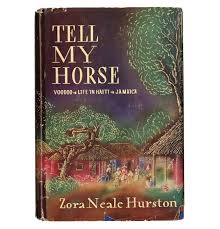
Her intuition was spot on. She sent me the 1938 original edition of Zora Neale Hurston’s Tell My Horse, an anthropological study of Voodoo in Haiti and Jamaica blurbed by Carl Sandburg, no less, with words like “bold,” “beautiful,” “priceless,” and “unforgettable.” The New York Times said of it, “Strikingly dramatic, yet simple and unrestrained…an unusual and intensely interesting book richly packed with strange information.”

I’ve read a lot of Hurston’s work from her novel Their Eyes We Watching God to her news coverage of the unfairly conducted 1952 Florida murder trial of Ruby McCollum to stories and books like Mules and Men collected while she was gathering hoodoo and other Florida folklore for the Works Progress Administration’s (1935-1943) Federal Writers Project. But Tell My Horse wasn’t in my library until yesterday afternoon at 4 p.m. when the mail arrived.

I know little about Voodoo (a religion), having mostly researched hoodoo (folk magic) except when I’ve stumbled across accounts out of New Orleans about notables such as Marie Laveau. So, I will enjoy reading this study about a related subject from one of my favorite authors; I’ll treasure the book and my highly intuitive Facebook friend who gifted it to me. I don’t know how long she had the book. When I told her Tell My Horse arrived, she said, “I knew you’d give it a good home. It languished with a friend of mine who was an antiquarian bookseller, until I found it in a dusty corner. I came to her through the experimental film of Maya Daren who was allowed to film and participate in voodoo rituals as Hurston did in her medium. It is a great relief to find her a place to thrive.”

S___, the book won’t languish in a dusty corner and, if you happen to stumble across this blog, I love you for your spirit of adventure, your kindness and your wonderful gift.

Now I know a good way to send my old books off into the world before they take over the house (my wife says they already have). Like Tell My Horse, many of my books are older than I am and will need loving homes rather than moldy basements and dusty attics.

–Malcolm

Malcolm R. Campbell is the author of two, Florida folk magic novels “Conjure Woman’s Cat” and “Eulalie and Washerwoman.”