On Connectedness: Music of Sacred Lakes, A Redemptive Ghost Story

Cowan
Cowan

Today’s guest post is by Laura K. Cowan (“The Little Seer“) whose new novel Music of Sacred Lakes was released this month. (See my review of Music of Sacred Lakes on Literary Aficionado.) Last year, Laura appeared here with her article “Speculative Supernatural Novels and the Growing Fantasy Genre”.

On Connectedness: Music of Sacred Lakes, A Redemptive Ghost Story

“I don’t belong anywhere.”

musicofsacredlakesFor some people, especially in the western world today, this is a common and nagging feeling, sometimes even with catastrophic results for a life. And this is the problem that, even while striking him as trivial and self-centered, is wrecking the life of Peter Sanskevicz, the young protagonist of. He can’t accept the sixth-generation family farm from his parents, can’t continue serving “fudgies,” tourists in Northern Michigan who feel more at home than he does–and then, Peter accidentally kills a girl. Seeing his life is at risk, Peter’s friend takes him to his uncle, a pipe carrier of the Odawa tribe, who tells him he has lost his connection with the land and must live by the shores of Lake Michigan until the lake speaks to him.

But what does that mean? How does a lake speak? What is this connection Peter, and many people in the modern world today, have lost? Why does it matter?

Connectedness & Belonging

When I started researching Music of Sacred Lakes, I had just come through a very difficult time in my life, in which religion still seemed very important but I was realizing the shortcomings of the faith of my upbringing. There was a big disconnect between what the people who raised me in church had said and what they did to help the world. There was an even bigger disconnect between what they said God thought of them and how they seemed to really feel about their place in the world.

Novel's Lake Michigan Setting
Novel’s Lake Michigan Setting

I set out to find out if I could live a life that honored God’s good creation and that left a place for me in that world. Surely people couldn’t really believe that the world was a beautiful creation of God and then fill it with trash and let it be destroyed by greedy corporations.

Surely I could find a way to live my faith that didn’t leave me miserable and condemned, being told simultaneously that I was saved by grace and that I had to have the exact right ideas about God in order to get to heaven (Pope Francis has a few things to say about that, I’ve discovered since). And even more importantly, I was discovering that this 20th-century idea of man being separate from the world–standing outside it and looking in—didn’t make any sense.
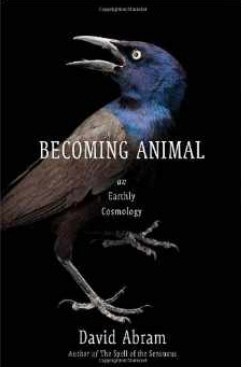
becominganimalI was seeing statements everywhere as I researched this novel of belonging that really hooked me. To paraphrase from the book Becoming Animal, I stand in the earth, not on top of it. I am within the biosphere, the atmosphere, and am breathing this air in and out. How then can I say I am set apart from this creation? If this atmosphere disappears, I die instantly. As I breathe in and out, exchanging matter with this world around me, I am a part of it, and it is a part of me.

That, and all the wisdom texts and physics books I was reading on the nature of matter and energy and the universe, which stated that matter is best understood as notes on a scale that vibrate at different frequencies to manifest as different kinds of substance (superstring theory) and that all these strings are connected across a vast network through the universe so that everything is connected to everything else (M Field Theory)—really clinched it for me. This modernist idea of man being separate, objective, different from the rest of the universe–it wasn’t true at all. And that had big implications–HUGE–for my faith, for the way I viewed the world, for the way I approached my faith.

To top it off, the mystics all agreed. The Oglala Lakota Sioux chief Black Elk once said that he had a vision of the mountain (The Black Hills) and the mountain was the center of the world, and the mountain was everywhere. This kind of statement has a way of cropping up in multiple religions, throughout the history of spiritual thought. It’s in Buddhism. It’s in Christianity, too, believe it or not. It even pops up in the Sufi streams of Islam.

Odawa Website
Odawa Website

I followed the rabbit hole down to postmodernism, to the wisdom traditions of the past that never lost connection with the world, to spiritual paths that honored the earth, and discovered that my own western modern iteration of faith had simply lost this important piece of wisdom, but that there were other cultures, Odawa and Ojibwe Native American being one in my own back yard, that had held on to this wisdom to bring it back to my generation. To say I was humbled, and in awe, and blessed by this, would be an understatement. And all this without ever leaving my own religion, Christianity. Mind boggling.

So what is it to discover that you can be a Christian and honor the wisdom of other people, without blending anyone’s faiths? What is it to discover that you belong in the world, and that, to finally quote a Christian mystic for once, “All will be well and all will be well and all manner of things will be well”? If you want to know what it is to discover that this question of belonging and the way we treat the earth are connected, read this story. I think if any of this post resonates with you, that ache that says there must me something more to life that you’re missing, something to your life that makes more sense than the daily grind, you will like Music of Sacred Lakes a great deal. You will discover connectedness, and as usual in life, this can come through the most unexpected of places: a story, a ghost, and a boy reconnecting with his faith through Lake Michigan.

In addition to her website, you can connect with Laura K. Cowan,  The Dreaming Novelist, on Twitter or on Facebook.


Merry Chrismas, Yuletide Greetings, Happy Hanukkah, Joyous Kwanzaa!

seasonsgreetingsIn the mystery school tradition, when members gather for solar festivals and fellowship, they often use the phrase “the god of your heart” when referring to the Creator or the Supreme Being because the term embraces all religions and practices for those variously might be celebrating Christmas, Yule, Hanukkah, Kwanzaa and other holy days and year-end reflections.

In that spirit, seasons greetings to you within the spirit of the god of your heart.

At this time of year, I enjoy reading how people from different faiths and traditions celebrate or commemorate the days between the Winter Solstice and Twelfth Night.  For some of us, this is the Festival of Rebirth often symbolized by seeds in the ground waiting for spring while memories of sunshine and growing things are symbolized by candles, Yule logs, and evergreens.

Best wishes for the season and thank you for stopping by Malcolm’s Round Table throughout the year.

Malcolm

Do I Dare Disturb the Universe?

And indeed there will be time
To wonder, “Do I dare?” and, “Do I dare?”
Time to turn back and descend the stair,
With a bald spot in the middle of my hair –
(They will say: “How his hair is growing thin!”)
My morning coat, my collar mounting firmly to the chin,
My necktie rich and modest, but asserted by a simple pin –
(They will say: “But how his arms and legs are thin!”)
Do I dare
Disturb the universe?
In a minute there is time
For decisions and revisions which a minute will reverse.

— T. S. Eliot in “The Love Song of J Alfred Prufrock”

What’s Your Tree

Julia “Butterfly” Hill disturbed the universe for 738 days by sitting in a 1,500 redwood tree from December 1997 to December 1999 to keep the 180-foot tree from being cut down. Her efforts saved the tree. Though many people, including those who agreed with her, said she was carrying her protest to an extreme level, the very nature of what she did attracted attention, garnered support, and that resulted in an agreement that saved the tree. In spite of one attack by morons with a chainsaw, the tree is carrying on its long life.

Most of us wouldn’t have done that because when all was said and done, the practical ramifications of sitting in a tree for two years would have probably made us unemployable, not to mention the loss of income that would have bankrupted us.  There is so much noise in the world, that it’s hard to know what any of us can do or say to disturb the universe enough to make a difference.  Today, authors hear that “it” is all about “platform.” One has to have a “platform” filled with Facebook and Twitter and blogs and Pinterest and LinkedIn to have any hope of seeling books. The trouble is, everyone else is out there in the same social media trying to sell their books. It’s hard not to get lost in the crowd.

Anyone who wants to follow his or her beliefs and passions and work for meaningful change is likely to feel just like the writers who are trying to sell their books: what must I say or do to be heard? Fortunately, there are many organizations we can associate with that will help us be heard as part of a group. If you want to fight to save redwoods, for example, you can join the Nature Conservancy, the Sierra Club, the National Parks and Conservation Association and many other groups. Many of them want hands-on help as well as your donations and your help in letter-writing campaigns.

In 1967, I came within several breaths of going to Sweden to avoid being drafted and forced to participate in a war I did not support. I had the means and the opportunity. The reasons why I didn’t are both complex and unclear, but within the context of this blog, my leaving the U.S. (and being banned from coming home for many years) would not have changed U.S. policy in Vietnam. If I had been famous, perhaps living in Göteborg might have either changed a few people’s minds or convinced everyone who knew me that I was nuts.

It’s a hard call, I think, to figure out the difference between running away and leaving because you cannot accept what your country, town, company or organization is doing. I absolutely cannot accept the United States’ policy of using drones to kill people it doesn’t like in foreign countries. In my view, that is unconstitutional and in violation of international law. This practice hasn’t been discussed very much in the Presidential race because few people are upset enough about it to disturb the universe. And, like those of us who have considered sitting in trees or moving to Sweden, we’re more likely to scuttle our own universes rather than impacting the national debate.

I would like to disturb the universe when it comes to the use of drones in sovereign foreign countries, the spying on Americans done with little uproar based on so-called “security reasons,” the mistreatment of the environment, the intrusion by governments and religious groups into a woman’s personal rights, and a dozen or so other issues. But I never quite know how.

The Quiet Approach

Whenever my frustrations about issues get too strong, I use every relaxation technique I know to pull myself back into what I believe is an essential truth: as Joseph Campbell said “We’re not on our journey to save the world but to save ourselves. But in doing that you save the world. The influence of a vital person vitalizes.”

Seriously, we’re not burying our heads in the sand when we admit that we cannot save the world. While some people will make very noticeable positive impacts, most of us will have to take a quieter approach. Perhaps we’ll donate some money to Planned Parenthood or we’ll add our name to a petition about oil pipelines through sacred Indian lands or we’ll spend the weekend with a volunteer group that’s clearing brush and deadfalls off a national forest or national park trail.

And who knows, there the ripples from such quiet actions influence. The universe we must dare to disturb, I think, is ourselves. Are we following our beliefs? Good, then doing so may impact a friend and then a neighborhood and after that, who knows who will step aside from their busy day-to-day life to help. We’ll probably never meet the people we influence,  but that doesn’t matter. We won’t have a page in wikipedia that tells the world who we are and what we did. That doesn’t matter either.

The hardest thing is, perhaps, that first step. Are we following our beliefs? If not, we need to disturb ourselves greatly. Once that happens, the universe that matters will never be the same again.

Malcolm

Promises to keep

The woods are lovely, dark and deep.
But I have promises to keep,
And miles to go before I sleep,
And miles to go before I sleep.

–Robert Frost in “Stopping By Woods on a Snowy Evening.”

Cattle behind the house watching me watching them

As snow fell across central and north Georgia on Christmas Day, weathermen told us this was Atlanta’s first white Christmas in over a century. In contrast with northern states where snow, salted roads and blizzards occur multiple times during the winter, Georgia snow is a big deal. Our one-to-six-inch snowfall (depending on where you were) caught the attention of local TV stations and the Weather Channel for many hours.

My wife and I were spending Christmas with her father on his farm in NW Georgia. The quiet of an evening of wood smoke and moonlight carried a hint of magic, a reminder, perhaps, of the way we felt during the best of our Christmas eves and Christmas mornings as children.

In the cycle of changing seasons, we often say that the period between the Winter Solstice and Ground Hog Day is not only the best time for planting trees, but the best time for planting figurative seeds. Our plans, goals and intentions germinate in the safe darkness of the soil beneath a fine winter snow, awaiting the sunny days when first shoots will appear, followed by leaves. The enchantment of a cold winter night in a snowy field or along the fence line margin where the world of cows ends and the dark of the woods begins, it’s easier to see one’s hopes for the future more clearly. The smoke from the chimney carries them into the heavens like prayers.

While New Year’s resolutions, at whatever level of seriousness we make them, present our public face, promises made in the quiet of the woods on a snowy evening represent our most sacred intentions. These are the promises that matter. They define who we are, why we are here, and the very best of our goals for the future.

Made in secret, they are the easiest promises to break for we suffer no public shame in failing to accomplish what nobody knew we planned to accomplish.

Made in secret, these promises are the best ones to keep. They are promises to ourselves that touch the soul. Yes, “the woods are lovely, dark and deep,” but there is work to be done, the most sacred of all work.

For now, the woods must wait.

Malcolm

The e-book is only $5.99 on OmniLit

Whispers of Forever

We are immortal, and do not forget;
We are eternal; and to us the past
Is, as the future, present.
— Lord Byron, in “Manfred”

When one of the seven spirits makes this comment to Manfred in Byron’s dramatic poem composed in 1817, Manfred replies “Ye mock me.”

While most people are not tortured by unexplained guilt to the point of calling spirits (supernatural rather than liquid) to help them forget, I wonder if they believe in an eternal now. Looking at immortality, we can say that which we see confirms it or denies it.

I see it confirmed everywhere I look, from nature to myths to science to intuition. Perhaps I’m a “glass is half full” rather than a “glass is half empty person.” If I have a bias in my writing, it’s in favor of forever. In “The Sun Singer” and “Garden of Heaven,” the eternal now is a constant whisper deep within these adventures.

While earth ties us down to the concepts of space and time, the eternal now presupposes no time and no space. Seeing this possibility beyond the illusion of physical reality is, I think, part of the human quest. Fortunately, in writing fiction, I do not have to prove that immortality is real or even that it’s real for those who think it’s real. My imagination is my guide, so I am content to whisper about the probabilities on the pathways my characters are walking.

My challenge as a writer is casting a strong enough spell with my words to keep the listener from saying “ye mock me” when he hears my characters whispering about forever. I don’t expect to change minds, for I am a storyteller with entertaining yarns. However, when a reader considers that there truly is something else on the other side of the illusion, I am well pleased.

–Malcolm

Available in multiple e-book formats

Book Review: ‘The Last Templar’

The Last TemplarThe Last Templar by Raymond Khoury
My rating: 3 of 5 stars

Raymond Khoury’s “The Last Templar” (2006) is part of a deluge of novels and nonfiction to step outside mainstream history to explore the real, prospective and imagined secrets about alchemy, the Knights Templar, and the origins of Christianity.

One cannot help but think of Katherine Neville’s “The Eight” (1997) which focused on present-day people fighting over and/or guarding the secrets of the Philosopher’s Stone and Dan Brown’s “The Da Vinci Code” (2003) which speculated about the true meaning of the Holy Grail and the bloodline of Christ. Many of Neville’s, Brown’s and Khoury’s fans were also attracted to such nonfiction as “Holy Blood, Holy Grail” (Baigent, Leigh and Lincoln, 1982) and Lynn Picknett’s “The Templar Revelation” (1997).

It is difficult to read, much less discuss, Neville, Brown and Khoury without acknowledging the fact that fact that they are part of a rather unique genre of spiritual conspiracy fiction that seemed to fill a need in the public psyche for truths thought to be missing from the tenets of Catholic and Protestant theology.

Neville’s “The Eight” was, perhaps, the first to popularize this “genre’s” style and focus: hidden wisdom, long-time conspiracies, compelling present-day mystery/thriller action, and numerous (and lengthy) history lessons. Since her focus was alchemy, Neville’s “The Eight” didn’t ignite the kind of controversy generated by Brown’s “The Da Vinci Code” which, some might say, hit us where we lived if not where we worshipped.

Like Neville, Khoury tells his story with a modern-day and a historical timeline. “The Last Templar” begins with what Booklist called “one of the most gripping opening scenes among recent thrillers.” Four horsemen dressed in Knights Templar regalia steal artifacts from a Metropolitan Museum of Art show of Vatican treasures, including a “decoder.” The other story line focuses on the last days of the Knights Templar as the Holy Land is “lost” with the fall of Acre in 1291 and the subsequent pilgrimage of a few surviving knights to safeguard the Templars’ treasure.

Publisher’s Weekly was less kind than Booklist, saying that the “war between the Catholic Church and the Gnostic insurgency drags on in this ponderous ‘Da Vinci Code’ knockoff.” Many readers criticized Dan Brown in “The Da Vinci Code” for constantly stopping the otherwise full-speed action of the book while one character filled in another character about the secrets of Mary Magdalene, the Grail, the actions of the Catholic Church, and Jesus’ bloodline.

In my view, “The Last Templar” carries such backstory diversions to an extreme. Picture, if you will, whether it’s plausible that FBI operatives investigating the raid on the museum, the stolen treasurers, and the continuing deaths would spend hours discussing Templar history in great detail.

The greatest fault with “The Eight,” “The Da Vinci Code,” and “The Last Templar,” is the fact that some characters must provide other characters with long-winded and unrealistic diversions into history, philosophy and theology because general readers are not likely to know the facts and the latest theories involved. The authors have felt that without these history lessons, the plots wouldn’t make sense.

I liked “The Last Templar” better than Publisher’s Weekly, but not as much as Booklist. The history was interesting, though I’d seen it all before. The plot was imaginative and included some page-turner action scenes involving the church, the thieves, the FBI and protagonist Tess Chaykin, an archeologist who witnesses the raid. The ending, while not wholly unreasonable was, I think, unsatisfactory, especially for those readers who not only want to know what the Templars’ secret but are angry that a real or a fictionalized church would deem it necessary to suppress the truth at all costs.

The romantic feelings between Tess and the head FBI agent add a variety of complications to the story, some of which lead into exciting action scenes even though the relationship within the book is rather forced and tedious.

For readers who have enjoyed the fiction and nonfiction in this wave of spiritual conspiracy books, “The Last Templar” is interesting escapist reading even though those who have seen it all before may speed-read through some of the Templar history.

View all my reviews

Your perfect world

“Our Fortunes and Lives seem Chaotic when they are looked at as facts. There is order and meaning only in the great truths believed by everybody in that older and wiser time of the world when things were less well known but better understood.” — Roderick MacLeish

The psychiatrist Eric Berne (“Games People Play”) wrote in one of his books that when confronted with a troubled patient, he would ask himself what one would have to do to a person while they were a child to make them turn out the way they did, needing the help of an analyst. Answering that question was often the beginning of treatment.

Berne’s statement had a great impact on me, especially while I was working at state facility for the developmentally disabled. We could see, in many of the residents’ histories, the effects of abusive, inept and often criminal events in their “upbringing.”

When we compared our residents’ current behaviors to their case histories, we knew the answer to Berne’s question.

Unfortunately, asking Berne’s question outside the world of psychology and mental health has led us all down some bad roads. They are roads of blame and excuses. Ask anyone why his dreams for his own perfect world never materialized, and more often than not, he will have a list of people and events from his past that “created” the world he is now experiencing.

He may have, filed away inside his mind, a mental dossier complete with facts, eye witnesses and the testimony of experts that proves he would be happy/rich today, if his parents hadn’t thrown his bike in the trash when he was 15…or if his former spouse had let him finish college…or if his boss hadn’t fired him at a financially precarious moment.

We take great comfort in such blame and in the fact we are using pure reason when we gather the facts that prove we are totally innocent when it comes to the slings and arrows that comprise our current lot in life. However, these facts seem to obscure the real truths, those we’re afraid to consider.

How odd that the very truth that presumably should empower us to fix everything that we claim is broken in what could have been our perfect worlds, is the one truth left off the table. If we could walk into a courtroom and sue everyone on our list of nasty people responsible for how we ended up, a wise judge might explain to us the meaning of such terms as contributory negligence, co-conspirator, and accessory.

Hearing such explanations might show us how to fix what we don’t like. Yet, ask anyone if he played a role in the way he’s ended up. Ask if he believes he created his present reality in any way, shape or form, and he will laugh off such ideas. It’s less personally devastating that way.

It’s far past time, I think, to stop asking Eric Berne’s question. While it’s a helpful question to ask, it’s skewed our thinking away from essential truths about why things are as they are. These days, I’m more inclined to ask questions based on James Allen (“As a Man Thinketh”) approach:

The aphorism, “As a man thinketh in his heart so is he,” not only embraces the whole of a man’s being, but is so comprehensive as to reach out to every condition and circumstance of his life. A man is literally what he thinks, his character being the complete sum of all his thoughts.

That leads to a far different question: “What have I done with my life so far to end up in the place I am now?”

Malcolm

Malcolm R. Campbell is the author of the Florida Folk Magic Series.

Flying with Ravens – Friday afternoon magic

from Jupiter Images
“Robert, Maistó (Raven) has reminded me that you must not confuse him with common crows. They are greedy, self-serving birds that eat too fast. According to Maistó, the ‘caw’ sound we associate with crows is more of a belch than a call.” — David Ward in “The Sun Singer”

“I have fled in the shape of a raven of prophetic speech.” — Taliesin

“They slept until the black raven, the blithe hearted proclaimed the joy of heaven.” –Beowulf


When you fly with Raven and/or imagine flying with Raven you must have a sense of humor. Prepare to be mocked, mimicked and satirized in every possible way. Accept this, for it shifts your consciousness rather like getting hit in the face with a feather pillow and refocuses your attention on your inner journey. When you pretend to be flying with Raven, you are flying with Raven.

Synchronize your flight with Raven’s flight and you will go within, dying to the exterior world so that dreams and magic are paramount. Alchemists call this stage of the great work “blackening” and often represent it in a variety of morbid death’s head and graveyard drawings. While flying with tricksters, you will in time see the humor in this.

To synchronize your flying with Raven, resist the urge to fly like a common crow and shout “caw caw” at the people in the world below. Observe and you will see that crows soar with bent wings and that ravens fly like hawks, flapping and then soaring on horizontal wings. Keep your hands straight and, if you must say anything, shout “crrrruck crrrruck.”

Ravens are keepers of secrets and they will escort you into the void where the mysteries are contained or they will bring you messages from the spirits of darkness with knowledge to impart. Sometimes, to emphasize your re-focused attention, Ravens will change into something else and expect you to follow suit.

While your encounter with Ravens stops the world as you know, it can be confusing. In terms of mythology and animal totems, Ravens are fun loving and fast moving and it’s best to be adaptable. However, flattery will get you everywhere. Inform them that you know that even mainstream science believes Ravens have more intelligence and insight than crows or, for heaven’s sakes, magpies. Figuratively speaking, the diverse Corvidae family has its share of black sheep.

When you see Raven in your dreams, magic is afoot–or, actually, awing–and it’s best to fly wherever it takes you. Whether you are a garden-variety author, a seeker, or a shaman, an open-ended, nonjudgemental experience with Raven is the key to power and mystery from (depending on your belief system) the astral, inner, or spirit world.

Meditations and magical flights with Raven can turn into a carnival of colors and changing seasons and laughter out of which–when you fear all is lost in the great chaos of the moment–meanings begin to appear clear and cold as black ice. Smile, laugh, and go with the flow; otherwise insanity is a risk–and that’s no joking matter.

Truth be told, Ravens have done their best to drive me crazy. They see it as a benefit–part of the initiation, so to speak–and a prelude to greater mysteries. I’ve told them they are quite full of themselves and their only defense is to laugh and tell me I fly like a baboon in heat. (I really don’t know what that means and haven’t wanted to ask.)

Malcolm

Each purchase benefits Glacier National Park

Disappointed in Jerry and Bobby

I don’t know how I would react to fame, the ever-prying lenses of cameras, the crush of people’s expectations, the constant roar of the crowd. Fame kills, I think, and it does so without remorse.

When I was young and in need of heroes, I saw chess champion Bobby Fischer as a viable candidate. I played chess badly, and so it was that I admired a guy about my age who played better chess at 13 than most chess players will ever play in their prime.

As a writer in training, I grew up with the canon of literature as it was preached during the 1950s; I rebelled against it, and so it was that I admired a guy of my mother’s generation who brought the Caulfield and Glass families to life outside the scope of what my teachers taught.

No one likes to see their heroes rusting away with age and crumbling into apparently flawed and strange creatures. Perhaps neither man expected the fame he achieved or understood its dangers. Bobby Fischer became eccentric and mean spirited and J. D. Salinger hid away from the public eye with what, at times, was an admirable persistence and what, at other times, seemed more like a self-righteous disdain for the rest of the world.

Rightly or wrongly, I am disappointed in both men because each of them threw his talent away. If Bobby’s mission was chess and if Jerry’s mission was short stories and novels, then let the vicissitudes of fame be damned and find a way to stay on course.

Bobby’s chess, including his innovations for the game, will continue to influence prospective masters who might benefit from his contributions to openings and end games. Jerry’s “The Catcher in the Rye” may well fade with time as its focus becomes more and more dated, but his writing brought us more than that in his sparse, but strong collected works. And perhaps there’s more, novels and stories sequestered for years in a safe that may one day find a friendly light of day.

Bottom line, though, I disappointed in Jerry and Bobby because they both quit, perhaps for cause, but that’s ultimately the weakest of rationale.

Malcolm

December 24 Fun, Family and Faith

While I’m happy to hear that some merchants are experiencing a late rush of shoppers today, I’m much happier when I hear stories about people celebrating Winter Solstice, Chanukah, or Christmas traditions and the transcendent magic of the season.

Whatever your traditions, I hope you have time to step away from the day-to-day tasks of earning a living and tending to the household for some quality time and old fashioned fun with your family and the god of your heart.

–Malcolm