“Indigenous nations and peoples believe in the spiritual powers of the universe. We believe in the ultimate power and authority of a limitless energy beyond our comprehension. We believe in the order of the universe. We believe in the laws of creation and that all life is bound by these same natural laws. We call this essence the spirit of life. This is what gives the world the energy to create and procreate, and becomes the ponderous and powerful law of regeneration—the law of the seed.” – Oren Lyons.

View outside my living room window.
When I look out the window and see the land, it’s much easier for me to believe in a sacred earth and the kinds of spiritual journeys that occur there than it is when I look at the Internet, the television set or a traffic jam on a city street.
I’ve had the same feelings in Apalachicola National Forest, Great Smoky Mountain National Park, along the Blue Ridge Parkway, in Glacier Park’s Swiftcurrent Valley and along the California coast at Pt. Reyes.
As the author of fantasy and magical realism novels and short stories, I can “get away with” suggesting that the land is sentient and that the animals one meets on the trail or sees above the mountain tops are wise and have lessons to teach us. Why? Because readers within my genre aren’t surprised by that view.
With most of the U.S. population living in cities, I wonder if those who live there long for the land as it’s shown them in spiritual ecology books and fantasy novels; or is there such a big disconnect between the land and daily life in the city, that environmental issues, spiritual journeys, and all the “Earth in peril” causes we hear about on the news or see on Facebook don’t seem real at all–outside of the novel on the nightstand.

Lake McDonald – NPS Glacier Park photo
I have no trouble writing fantasy that shows the Earth as alive because, whether it’s old childhood superstitions that grew out of so many days and nights spend camping, fishing and hiking or whether it’s wishful thinking, I see the land the way I write about it in my fiction.
I think it helps an author to not only have a passion for the themes in his/her storytelling, but to literally believe they’re true. When one believes, one tends to see a lot of things in nature (and elsewhere) that others do not see. Perhaps it’s an illusion or a tired hiker’s hallucination; I can’t say for sure. But it seems real, real enough to believe in.
Perhaps you have other passions. If you write stories and poems, create art, compose or sing songs, or work as a photographer, those passions and beliefs probably impact your work, making it more vibrant, believable and transcendent to those who see it or hear it. They may ask you where you get your ideas and you may tell them that within your belief system and your own journey, the ideas behind your work are quite natural.
“Where do you get your ideas” is such a standard question authors hear, we’re often flippant about it and make up absurd answers because, frankly, we’re tired of the question and tired of trying to concretely say where those ideas come from. When we’re not being flippant, we say those ideas are part of our lives and so they’re echoed in everything we do.
For me, it’s a sacred Earth and a spiritual journey. Whatever your life and your passions are about, your art is going to reflect that if it’s honest art.
–Malcolm
This post originally appeared on “The Sun Singer’s Travels” in 2015.
 Readers don’t like good even though many of them claim them have to have read “the good book” and that they adore every novel that features people who helps the homeless or who starve their families while donating time and money to the Salvation Army.
 Writers with platforms sell books. If you threw your mama from a train, you have a much better chance of writing salable books than a hapless MFA-graduate whose “platform” is (a) writing good, (b) An MFA, and (c) A resume filled with angst-ridden poems and short stories set in an unbelievable universe where angst-ridden stuff actually gets onto bestseller lists.
 If you’re a movie star or a famous Hollywood personality who looks like a slut or a stud on the red carpet, you can become a bestselling author even if you’re illiterate. How? Ghostwriters, darling. A sure way to get a publisher’s attention is by “writing” a memoir or novel based on a true story that dishes out plenty of scandal about your co-stars, lovers, and agents. The public adores stories that tell them their favorite stars aren’t really as pure as the driven snow. A bonus for movie stars is writing a book about an issue even if an expert writes it for you. Do this, and you’ll soon be testifying at Congressional hearings even though you probably know less about the issue than the average man or woman on the street.
 Create a novel with a compelling plot, multidimensional characters, and a jaw-dropping title that, under normal conditions, will probably sell only one hundred copies. Not to worry. This novel will have a secret weapon, and the big payoff comes when the secret is discovered: you’ve stolen thousands of its words from famous novels. When people find out, you’ll deny it, of course. Your readers will hate you. As your crime becomes harder to deny, you’ll claim “fair use.” That won’t work, but it may keep the wolves from your door for a while.
 On the other hand, unless a writer is well known and can fill his or her blog with news about upcoming book signings, conventions and other appearances, or–perhaps–the progress of a feature fill that’s being made from one of his/her books, the rest of us don’t have bookish information to provide in a weekly blog.
 Authors have been asked this question for years. Some are considered arrogant, egotistical, and vain, filled with self-importance as though they are kings and queens who must be served by millions of little readers. Some write that they write and hope the readers who like their plots and characters find their books.
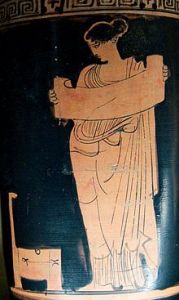 Many of us learned the classical definition of muses in school. We had to memorize their names along with those of all the other Greek and Roman gods, goddesses, heroes, heroines, and ill-defined entities.
 The taboos of childhood come in all shapes, sizes, colors and strengths. Some are merely household rules which seem odd, unfair or simply different than the household rules of one’s friends. They twist into the more grotesque shapes of poverty and abuse and every sacred truth that becomes a lie through the epiphanies of growing up. They are the political and social injustices we see through young eyes and the corruptions we feel to the marrow of young bones.
 A reporter at a small-town newspaper learns that a dogshit truck tipped over at the corner of Fifth and Main. When he arrives, the truck driver screams, “It’s a Commie plot” before a one-armed man pushes him into a porta-potty that mysteriously slides down hill into the river. When the reporter tells the police what happened, they laugh, and say he’s acting like a fugitive. Possible title: IN A WORLD OF IT
 Malcolm's Round Table