Siobhan, cá bhfuil tú?

I’m searching for my muse. She’s a Scot, so I’m saying in Gaelic, “where are you?” If you’re not Scottish, I should tell you that that name “Siobhan” is pronounced “Shihvon,” not “See ohb han.”

Having gotten that out of the way, if you see a potentially drunk muse wandering through your neighborhood, tell her to come home and help me get started with a new story. Ever since sending the last short story out to a magazine, I haven’t come up with anything.

One reason I need a new story is because I need money. Siobhan taught me to drink the most expensive brands of single malt Scotch out there, but when I’m broke, all I can afford is swill. That’s like being stuck with Bourbon which I don’t like at all unless it’s hidden in a mixed drink.

Frankly, if a writer doesn’t have a badass muse, he’s pretty much out of business, a hopeless drunk who wakes up in bordellos and/or jail cells and wonders how he got there. Writing is more dangerous than most people think. Not writing is either more dangerous. Trust me on this because without Siobhan’s help, I have no way to explain it.

Siobhan lives in Hawai’i and sends me story ideas via telepathy because (obviously) I don’t have enough dough to travel to Oahu. Plus, if I told my wife I was traveling to Oahu to meet a woman, her reaction probably wouldn’t me all that great. “Wouldn’t a sat phone be cheaper than a plane ticket?” she would ask. “But it’s for literature,” I would protest.

“Hah!”

So there it is.

If you see Siobhan on the beach at Kailua, tell her to give me a call. My fans are calling me every day screaming for new stories and they’re turning to James Patterson and Tom Clancy (even though he’s dead) in desperation.

–Malcolm


Allowing the story to go where it wills

“Trot your horse wherever he wants to go, putting pressure on with your legs when he goes away from the scary spot, and releasing pressure when he goes towards it. Resist the almost overpowering urge to steer your horse. Trust him! Hold on to the saddle with one hand if he is ‘ducking and diving.’ Keep trotting, he is looking for an answer, let him find it. When he finally goes to a spot in the arena he hasn’t been to yet – let him stop and rest. Just hang out with him there, or get off if it’s time to end your session.” – Logan Darrow

I haven’t ridden a horse in years, but when I did ride, I enjoyed dropping the reins to see where he would go. Logan Darrow’s exercise, posted on The Mindful Horse Woman four years ago, is wise advice for everyone with a horse. I enjoyed trusting the horse and I think he enjoyed the fact I wasn’t controlling what he was doing. In the same fashion, I enjoyed driving my old car aimlessly to see where I would end up. It wasn’t quite the same since I really couldn’t let go of the steering wheel.

But the concept was similar, somewhat like following winds, currents, and tides in a boat: giving up control and enjoying the ride. More often than not, whether it was by horse or car or sailboat, such rides took me where I needed to go even though I didn’t consciously know it. What I saw changed me. Where I ended up the was a person I needed to meet or something I needed to witness.

I feel the same way about poems, short stories, and novels. While we may have a theme, a set of characters, and a general plan for the action, the work ends up better if we trust ourselves and the material enough to drop the reins. No, I’m not advocating typing gibberish or writing while drunk. Yet stories seem to flow in a natural direction once you get them started. Like trying to force water to flow uphill, forcing a story away from its natural direction is not only a lot of hassle, the result looks unnatural.

I was reminded of this several days ago while working on a short story about a man in a rest home. Unusual for me, I intuited how it was going to end. I seldom know that. This time I did know it and I didn’t like it. So, like gently neck-reining your horse one direction or another, I “encouraged” the story to go down a path that didn’t lead to that ending.

A fight ensued. Clearly, like a horse who wanted to head for the barn, the story refused to go anywhere that didn’t lead to that ending. Yes, I know, if you can’t stop your horse from racing to the barn, you’re a poor rider. So, there always needs to be a meeting of the minds between you and your horse about what it is you’re doing. The same is true for a story. So, my story knew we weren’t going to gallop toward that ending on page one. And I learned that no matter what else happened in the story, its natural ending was a destiny the characters couldn’t avoid.

We can’t always drop the reins when we’re riding or writing, but we probably don’t drop them enough. The story’s almost finished now. The ending the story wanted makes sense. It also coincides with what I wanted to say better than ending the story some other way. I have no idea why this process works the way it does. We could speculate, I suppose, but even if we found the answer it wouldn’t change the process for the better.

If you don’t like the story you end up with, you can hide it at the bottom of your sock drawer and move onto something new.

Malcolm

Coming soon, a collection of nine short stories that more or less did what they wanted.


What It Felt Like When ‘Cat Person’ Went Viral

“So what was it like to have a story go viral? For a few hours, before I came to my senses and shut down my computer, I got to live the dream and the nightmare of knowing exactly what people thought when they read what I’d written, as well as what they thought about me. A torrent of unvarnished, unpolished opinion was delivered directly to my eyes and my brain. That thousands—and, eventually, millions—of readers had liked the story, identified with it, been affected by it, exhorted others to read it, didn’t make this any easier to take. The story was not autobiographical, but it was, nonetheless, personal—everything I write is personal—and here were all these strangers dissecting it, dismissing it, judging it, fighting about it, joking about it, and moving on.”

Source: What It Felt Like When “Cat Person” Went Viral | The New Yorker

Most authors hope this will happen to one of their articles, short stories, or blog posts because they have been working for years as a virtual unknown writing what reviewers and friends tell them is good stuff even though none of that good stuff sells well on Kindle or anywhere else.

We don’t think about the flip side. Do we really want the world peering through our online windows asking who the hell we are, why the hell we wrote what we wrote, and what exactly was the whole point of it?

When a writer’s novel suddenly becomes a bestseller, the old joke is that s/he is an overnight sensation that was years in the making. That his to say, the public discovered the writer today even though s/he has a resume full of books written over a decade or more that few people noticed.

The dangers of things going viral are, I think, greater with a magazine article or a short story because even if the primary version appears in print, the online version will have a link that makes it easy to access and read quickly in its entirety–as opposed to a 400-page novel. Suddenly, everything about the author and his/her piece is all over the Internet and people are saying this sucks or this is great. Yes, writers dream about becoming known, seeing their work sell, and actually earning a living off their efforts.

I’m not sure going viral as Kristen Roupenian describes in her article is the way I’d want to go. How about you? If you write a short story that does viral, you’ll probably be able to get an agent and a publisher for your book. Yet, are you sure the intrusion of the universe into your writing room is worth it?

Malcolm

This is a great time for writing by women – so why are we still considered second-rate?

“Do men learn from women? Often. Do they admit it publicly? Rarely, even today. Let’s stick to literature. No matter how hard I try, I can’t think of many male writers who have said that they were in any way indebted to the work of a woman writer.”

Source: This is a great time for writing by women – so why are we still considered second-rate? | Life and style | The Guardian

This essay by Elena Ferrante asks timely questions: are male writers ever influenced by female writers? When a male writer likes a female writer’s book, does he think it’s “good for a female writer” or good with the arena of all books?

Personally, I don’t see fiction or nonfiction written by women as second-class work. Apparently, a lot of people do–and perhaps some publishers and bookstores as well. What a shame.

–Malcolm

P.S. Click here to enter my GoodReads giveaway for a paperback of “Lena,” the third novel in the Florida Folk Magic trilogy.


What are authors doing when they’re not writing?

Here’s your multiple guess response:

  1. Drinking
  2. Researching something that may or may not help with the next book
  3. Considering a job in the real estate business–or, basically anything other than writing
  4. Reading another author’s books as an excuse for not writing
  5. Studying potential marketing plans in hopes of competing with James Patterson and Catherine Coulter (haha)
  6. Spending more money on a new website that costs more than his or her books are likely to earn
  7. We’re always writing even if we’re not actually writing

I guess all of the above are true. Yesterday afternnoon, my wife and I went down to Duluth, Georgia to the Southeastern Railway Museum’s celebration of its move to a new site some twenty years ago. We had fun seeing a museum we hadn’t been do in a very long time. We moved away (twice) and volunteering there was no longer possible.

Funny thing is, we wandered into the museum because I was doing research on railways for a book. We got trapped. We became volunteers. We worked our butts off for about ten years there. It’s easy to become derailed when you’re doing research.

Yes, I did write the book.

But for quite a few years, the museum was a passion because both my wife and I loved history.

As you may have heard, everything a writer experiences might end up in the next book. (I usually change the names to protect the guilty.)  If you think one of the characters in one of my books, you’re right, it might be you. But here’s the thing: everything we see when we’re not sitting at a keyboard might become part of the next story. Figuratively speaking, we’re always writing.

We see our lives as a series of stories, Sometimes I write them down and they become novels. Like most authors, I don’t make any money doing that because very few authors in the U.S. actually make any money. But, we’re addicted to writing when we aren’t drinking.

–Malcolm

My latest novel is called “Lena” and takes place in north Florida when the KKK was still a real problem. 


When did you first know you wanted to be a writer?

Interviewers, especially those who aren’t very creative, inevitably ask emerging writers that question. I don’t think readers care.

Since I don’t like the question, my flip answer is, “When I got too old for the gigolo business.”

My wife and I have seen so many 1940s movies where the characters, when asked why they did something stupid, said, “Well, there was a war on,” that that has become our standard rationale for just about everything.

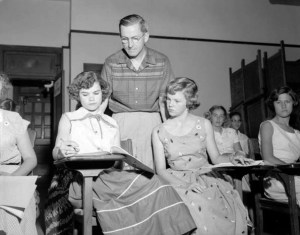
My father, Laurence, teaching journalism at Florida State University – (State Archives of Florida/Kerce)

I guess that’s my real excuse. Those were desperate times and people did desperate things, blew their savings in a poker game, married somebody in Vegas whom they’d known for twenty minutes, wrote the words “once upon a time” on a scrap of paper grabbed from the clutches of an ill wind on a dark street corner.

Truthfully, I could say that both of my parents were teachers and writers and that they passed the curse down to me. I’m sure a sophisticated DNA test would prove that. They both read a lot of books, and passed that mixed blessing down to me. It’s mixed because it leads to a house full of books.

My folks, who didn’t know anything about the gigolo business or the fact that my life’s work started because there was a war on, were a bit pushy about my writing. When I called home, Mother asked, “Have you been keeping up with your writing?” before she asked how I was or if this was just another call for bail money.

Maybe she knew my distrust of straight answers made me unsuitable for other careers such as the ministry, police work, or counseling. Years before the movie “Fargo” was released, she worried that I’d throw my principles into a wood chipper and become a used car salesman.

She had good reason to worry: I made my worst grades in school in English classes. That never went over well when report cards came out. “My teachers hate me because they think I think I know more than they do.” Mother acknowledged that I might, but said, “I think those teachers are like dogs. They can smell fear.”

She was right about that.

My teachers also smelled lack of interest. I told them I was already fluent in English and shouldn’t have to take it.

Chances are, I have a negative attitude about all this.

Malcolm


Thanks for trying out the free copies

I appreciate everyone who grabbed up a free copy of my Kindle short story “Waking Plain.” There used to be a TV bit called “Fractured Fairy Tales;” I suspect I got brainwashed by that so that I take sweet old stories and turn them upside down.

Meanwhile, my soon-to-be released novel Lena has made it past the editor. One always worries about hearing something like, “Malcolm, you know that guy who dies on page 23? How did he come back to life on page 97?” Oops.

Lena is the third and final book (you can quote me on that) in the Florida Folk Magic Series published by Thomas-Jacob. With luck, we’ll be able to show you the cover soon and then announce a release date.

Meanwhile, we have another late afternoon thunderstorm roaring through northwest Georgia. This is getting tedious because the low barometric pressure impacts both our (my wife and I) sinus conditions while all that water makes the grass grow faster than we can keep it mowed.

Fortunately, I have beef stew to warm up in the Dutch oven for supper, so no cooking required tonight. And, the cats have been fed; that means they’ve stopped hovering around my desk and bothering me.

My brother and his wife and grandson will be stopping here briefly next week. Oh hell, that means we have to clean up the house. We’ll have fun while they’re here, though.

Malcolm

About waiting for inspiration

“As writers, we don’t wait for inspiration. Inspiration waits for us.” – Simon Van Booy in his Publishers & Writers essay “Craft Capsule: A Bird in the Sky.”

Long-time professional writers scoff at the notion of beginning writers sitting around waiting for inspiration. Generally, they (the professionals) say they go to the office and write every day because that’s their job; they don’t sit around waiting for inspiration.

Nothing beats a wonderful story idea that appears out of “nowhere.” But can we count on this approach to be financially successful as novelists or freelance creative nonfiction writers? My answer is no.

Louis Pasteur once said that “chance favors the prepared mind.” I think writers who think that way find more inspiration than those who don’t.

In one of my posts about magic, I said that many psychic occurrences begin when an individual relaxes and imagines that something is happening–and then, suddenly, it is happening. That is, your imagination transforms into a link that shows you the location, person, or situation you wanted to view in a so-called paranormal way.

For me, inspiration works the same way. If I find myself without any story ideas, the best thing for me to do is search the Internet (or my bookshelf) for books about subjects I love writing about. If I do this casually–without putting pressure on myself to discover an idea–and just read or poke about for the fun of it, that is when I start thinking of prospective story ideas.

Usually, the half-born idea leads to reading through more of the books or websites that made me think of my potential story until more ideas come together and then I start wondering such things as “what if a person went to this place and did ABC?” or “what if people found a way to twist this kind of information into a evil business?”

Then I set the ideas aside for an hour or so while doing something relatively mindless, from mowing the yard to playing a video game–and while I’m doing that and not worrying about the story ideas, my mind is somehow open to additional thoughts that help the story take form.

I have no idea how or why this works, but it seems better than staring at the wall and waiting for the great American novel to show up out of nowhere.

Malcolm


Do You Want to Write a Series?

“A series can be great for authors because it can draw in readers and keep them. If they like your first book and its characters, they’re likely to forge ahead and buy more books in the series. This is why there are so many series out there.”

Source: So, You Want to Write a Series? – Indies Unlimited

Very helpful post for authors, beginning with whether there’s one plot that continues throughout all the books or whether a character or a setting remains the same while the plots change.

When done well, a series will make for a continuing use of a great plot or a great protagonist and engage readers for (possibly) many years.

There’s a lot to consider, and R. J. Crayton does a great job with this thorough post.

–Malcolm

Starting your blog

“I love blogging and blogging has loved me back. I’ve been offered paid freelance writing gigs and paid speaking engagements because of my blogs and I’ve used the See Jane Write blog to grow a small women’s writing group into an award-winning business. A blog can also be a great way to build an audience for the book you want to write.

“Make 2018 the year you finally launch (or relaunch) your website and blog. Here’s a guide to get you started.”

via How to Start a Blog – See Jane Write

blogCLIPartFrom time to time, people see that I’ve been blogging for many years and ask me how to start a blog. Seriously, folks, I’m not the one to ask because I break too many of the rules and/or some aspects of blogging don’t interest me.

However, Javacia Harris Bowser does know how to blog and offers one of the best overviews about getting started. She begins with domain name and theme considerations and works her way through the steps to having consistent content. (I’m inconsistent, but I see that consistency is better for most bloggers.

If you’re serious about writing a blog, See Jane Write before you do anything else.

Malcolm