‘The Long March Home’ by Tosca Lee and Marcus Brotherton 

Recent winner of the International Book Award in Historical Fiction, The Long March Home was released in May of 2023. The paperback edition came out in October.

From the Publisher

Jimmy Propfield joined the army for two reasons: to get out of Mobile, Alabama, with his best friends Hank and Billy and to forget his high school sweetheart, Claire.
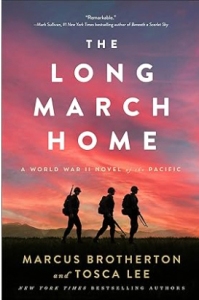
Life in the Philippines seems like paradise–until the morning of December 8, 1941, when news comes from Manila: Imperial Japan has bombed Pearl Harbor. Within hours, the teenage friends are plunged into war as enemy warplanes attack Luzon, beginning a battle for control of the Pacific Theater that will culminate with a last stand on the Bataan Peninsula and end with the largest surrender of American troops in history.

What follows will become known as one of the worst atrocities in modern warfare: the Bataan Death March. With no hope of rescue, the three friends vow to make it back home together. But the ordeal is only the beginning of their nearly four-year fight to survive.

Inspired by true stories, The Long March Home is a gripping coming-of-age tale of friendship, sacrifice, and the power of unrelenting hope.

From Publishers Weekly

“Brotherton and Lee masterfully capture what it was like for soldiers to face war’s atrocities, as well as the heartbreak of those waiting for them back home. This is a winner. ”

–Malcolm
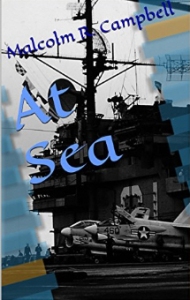
Malcolm R.  Campbell is the author of the Vietnam War novel “At Sea.”
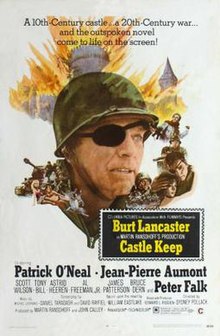
‘Castle Keep’ is a strange satirical movie

I’m drawn to strange movies such as this 1969 Sidney Pollack satirical film that ends up being simultaneously pro- and anti-war. The reviews were not outstanding, but that doesn’t bother me. William Eastlake, who wrote the novel, was wounded in the  Battle of the Bulge and was probably best known for his Checkerboard Trilogy.

Castle Keep poster.jpgIn “Castle Keep,” a rag-tag group of American soldiers is assigned to a remote Belgium castle during World War II ostensibly to protect the artwork there.  With little to do, the soldiers develop their own hobbies and relationships with townspeople as though they’re all on extended leave. According to Wikipedia, “The American soldiers are happy to enjoy a respite from combat while being surrounded by unimaginable antique luxury, however, their days of leisure and peace almost undermine the very reality and the ugliness of the war itself. There is also a recurring theme of eternal recurrence, as one soldier drunkenly ponders out loud that maybe he’s “been here before”. And, although the men are eager to sit out the war that they feel will soon end, there is a sense of foreboding, a feeling of inevitability of what will eventually transpire.”

The New York Times summed up its review by saying, “‘Castle Keep,’ however, is never as impressive as its various, very expensive parts, including its extraordinarily handsome castle, built to order, I’m told, in Yugoslavia. Like the castle itself, the film’s occasionally provocative thoughts are wiped out, destroyed, in the orgy of the climactic battle, the kind of complicated, realistic moviemaking that reduces all problems to confrontations between pieces of mechanical equipment, tanks, mortars, grenades and machine guns. The movie, which has aspired to higher station is, after all, very conventional.”

I know, I know, but I still liked the movie with its character studies (so to speak) of the individual soldiers as they react to the madness of their situation.

–Malcolm

My novel Conjure Woman’s Cat is on sale today on Kindle for only 99¢. This is the first book in my Florida Folk Magic Series set in the Florida Panhandle in the 1950s when Jim Crow and the Klan defined the state. 

Briefly noted: ‘A Delayed Life: The true story of the Librarian of Auschwitz’ by Dita Kraus

After reading Antonio Iturbe’s The Librarian of Auschwitz, the well-researched and agonizing novel based on the true story of Dita Kraus, I was happy to discover that Dita Kraus is still with us, apparently as sharp and feisty as ever at 92.

She has her own website here where she sells her delicate paintings of flowers, a few of the books mentioned in Iturbe’s novel, and provides a link to her own memoir A Delayed Life: The true story of the Librarian of Auschwitz which was published in 2020.

Look at the book with Amazon’s look inside feature, and you’ll find some amazing writing, pragmatic, incisive, and bluntly honest, as this excerpt shows:

From the Publisher

The powerful, heart-breaking memoir of Dita Kraus, THE LIBRARIAN OF AUSCHWITZ

Dita Kraus was born in Prague in 1929 – in her powerful new memoir she writes about her childhood before the war and then during the Nazi-occupation that saw her and her family sent to the Jewish ghetto at Terezín and from there to Auschwitz and then Bergen-Belsen.

Dita writes powerfully and unflinchingly about the harsh conditions of the camps and her role as librarian of the precious books the prisoners had managed to smuggle past the guards. She also writes about the liberation of the camps and her chance meeting with fellow survivor Otto B Kraus after the war.

Part of Dita’s story was told in fictional form in the Sunday Times bestseller THE LIBRARIAN OF AUSCHWITZ by Antonio Iturbe.

I am so impressed with this fine lady, that I ordered the book immediately. Perhaps it will fill in some of the gaps in my knowledge about her. If I had her persistence and bravery and dedication, I could move mountains–that’s pretty much what she did in the family unit school at Auschwitz-Birkenau when she was fourteen years old in this unholy place:

Malcolm

If the U.S. were overrun by a repressive regime, would we resist and hide targeted groups?

As I read Alice Hoffman’s The World That We Knew and Kirstin Hannah’s The Nightingale, I was impressed by the risks taken by people who hid Jews and others and/or led them across borders and/or blew up bridges, death trains, and other Nazi facilities.

Naturally, these novels are inspired by a minority of the people living in occupied countries. Even so, the dedication of those “fighting” or fighting against the Nazis is impressive. I couldn’t help but wonder if the U.S. would have such dedicated resistance fighters if it were overrun.

Yes and no, I suppose.

Our gun ownership levels are the highest per capita in the world, so we would have the weapons necessary for resistance. Our dedication–as a nation–for helping minority races has not been very good and is definately under debate now with, I think, a potential for positive change. Yet, if we were conquered by a Nazi Germany-style invader, would we shield, say, Jews, African Americans, American Indians, and other groups?

The brutality of the situation might inspire us to oppose it even though under peacetime, we aren’t doing a lot to help those groups now. When we turned away Jews fleeing occupied Europe during World War II, we didn’t know how bad conditions were becoming. But we did know they were bad. We were not unaware of vandalism against Jews or evem about Kristallnacht in 1938.

Many people are saying that while the Internet connects lots of people, it allows them to stay at arms’s length from each other. (The typical cartoon shows groups of people at dinner tables with no communication amongst them because everyone is texting.) So, would we keep ourselves at arm’s length from those groups an invader might repress?

I hope not, but I suspect we would react like the people who inspired The World That We Knew and The Nightengale. Those actively fighting the invader (one way or another) would be in the minority just as they were in occupied WWII countries.

So many people think that if they keep quiet, things will get better. If we’re conquered and believe keeping quiet works best, we haven’t learned anything from history.

Malcolm

Click on my name to find my website and my novels.

Might and Fog

Neither my wife nor I remember ever hearing the German phrase “Nacht und Nebel” (“Night and Fog”) in our World War II history classes. And yet, this directive from Hitler was brought up at the Nuremberg Trials, so it was certainly no secret at the end of the war, nor by the time our history classes were put together some twenty to thirty years later.

Basically, Nacht und Nebel was a policty of Hitler’s that broke the rules of the Geneva Convention in which those working against the Reich, most often in occupied countries, were arrested and subsequently put in camps or executed without any information about their fate sent to family or others. It was as though they never existed–they had been, as some novels put it–“disappeared.” Often the letters NN would be shown on any paperwork.

The phrase been around for a long time before Hitler, and especially Himmler used it and made it a part of the German war machine’s policy. NN not only stood for Nacht und Nebel but also for “nullus nomen” (without name) which indicates that such people were removed from the face of the earth physically and in every other way possible.

As I re-read Pam Jenoff’s novel The Lost Girls of Paris, about British agents sent to occupied France to cause trouble and send information back to Britain via wireless, I am noticing this phrase more than I did the first time through the book. I find it haunting and so unfortunately apt considering the fears and dangers of night and fog.

I generally do not like the tactics of the FBI, NSA, and CIA because we keep seeing evidence and innuendo about their spying in all the wrong places. Before all that was known, I’d always thought I’d make a reasonably good CIA agent. And yet I wonder if I ever would have had the grit and courage to do what the SOE (Special Operations Executive) agents did during World War II. Most of them didn’t last very long before they were caught.

I wonder about that, so perhaps that’s why NN bothers me in addition to the fact it “broke the rules of war.” Before I was conscious of the Night and Fog directives, I liked fog, probably because I saw so much of it as a child in San Francisco. Fog was part of the romance of San Francisco (as Tony Bennett sang in his famous song, The morning fog may chill the air, I don’t care). But now, I cannot get the Nazi practice of torturing and killing agents–or suspected agents–out of my mind.

Partly, that’s because I think it still happens in unexpected places. And from neo-Nazi regimes and groups what still prescribe the old ways.

Malcolm

What does “Save Your Cans” mean?

When I saw this 1940 poster drawn by McClelland Barclay in support of the war effort, my first thought was “Why did they want people to save toilets? Were they re-used in barracks?”

The cans rolling out of a machine gun like spent shell casings, while probably not an accurate portrayal of how the cans were used, pretty much dimisses the toilet idea.
I’m a fan of old posters, partly due to their art work and partly due to their protrayal of the culture of another era.

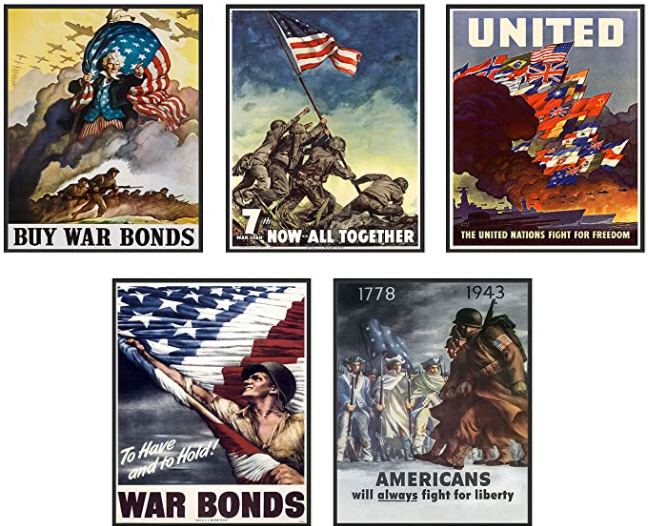
According to The Price of Freedom: Americans at War website, “Posters during World War II were designed to instill in the people a positive outlook, a sense of patriotism and confidence. They linked the war in trenches with the war at home. From a practical point, they were used to encourage all Americans to help with the war effort. The posters called upon every man, woman, and child to endure the personal sacrifice and domestic adjustments to further the national agenda. They encouraged rationing, conservation and sacrifice.”

These posters, available on Amazon, show that we were a very different nation in the days following the Japanese attack on Pearl Harbor:

If I were a history teacher, I would show these in class, not as propaganda, but as a window into the past that would–I would think–help start some great discussions.

Malcolm

At Sea by [Malcolm R. Campbell]I had the look and feel of such posters in mind when I created the cover art for my Vietnam War novel “At Sea.” I took the cover photograph with a 35mm camera while stationed on the USS Ranger (CVA-61) inthe Gulf of Tonkin. I wanted to show a typical flightdeck scene.

Briefly Noted: ‘The World That We Knew’ by Alice Hoffman

I reviewed The Dovekeepers which was extraordinary. The World That We Knew is also extraordinary, but it’s well beyond my poor powers to review.

It’s a breath of fresh air at a time when for reasons I cannot comprehend anti-Semitism is rearing its polluted self around the world along with the equally bankrupt white supremacists. And then, my generation was born in the shadow of World War II and that’s had a life-long effect on us.
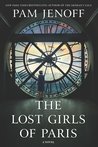
Among other things, the sins of the world–from Nazi Germany to the U.S. and other countries who wouldn’t accept Jewish refugees–are still strongly on my mind. So, this novel stops the world of today and takes me back into the horrors suffered by the Jews in Germany, France and elsewhere. Hoffman’s novel is tantamount to an immersion in a history we cannot bear.

So, I’m too biased about the subject matter to speak objectively about The World That We Knew.  I think it is perfect, complete (as is typical of Hoffman in The Dovekeepers) with a blend of brutal facts, magical realism, and characters we care too much about before they are gone. There was love here, too, in spite of the atrocities surrounding the characters.

Perhaps that love was enough, a brief flash of divine light above misbegotten times, places, and unspeakble crimes.

Malcolm

Review: ‘ The Lost Girls of Paris’ by Pam Jenoff

The Lost Girls of ParisThe Lost Girls of Paris by Pam Jenoff
My rating: 4 of 5 stars

Jenoff has written a compelling novel about female British agents serving in occupied France during World War II. In many ways, it’s a heartbreaking novel since we learn early on that the odds are against many of the agents lasting long in the field before they’re captured and executed.

The novel is easy to follow since it focuses three characters, albeit with a good supporting cast: Eleanor, who works for the British SOE (Special Operations Executive) and champions and then trains and manages female agents in the field; Marie, whom Eleanor recruits due her flawless French; and Grace, who finds an abandoned suitcase in a New York train station after the war and becomes interested in a packet of the agents’ pictures.

The novel moves well, giving readers a sense of what it might have been like for these women to suddenly leave the country without telling anyone where they were going and, after arduous training, finding themselves in harm’s way. Fans of black ops novels might wish that more of the novel concentrated on the field work itself rather than the worries and intrigues at SOE headquarters. However, the girls’ work in the field is well researched and authentic.

The problematic character in the novel is Grace. After stumbling upon the pictures, she feels compelled to learn more about the SOE, Eleanor, and the girls in the packet of photographs. While Grace is a realistic character, inserting her life and her problems into this story takes away from the primary focus of the novel. She is more or less a device the author has used to help convey the story to the readers. While Grace “works” as a character, the novel might well have been stronger if she hadn’t been included.

Taking the story as it is with Grace in the mix, the material is well presented and interesting. Goodness knows the story in “real life” could have happened this way with an unconnected person stumbling upon it and trying to learn more. That said, the novel is well worth the reader’s time.

View all my reviews

Review: ‘Making Bombs for Hitler’ by Marsha Forchuk Skrypuch

Making Bombs for HitlerMaking Bombs for Hitler by Marsha Forchuk Skrypuch
My rating: 5 of 5 stars

Ukrainian Canadian author Marsha Skrypuch writes–as one interview said–“War Fiction: Writing the stories that haven’t been told.” She writes about genocide and displaced persons with an eye toward well-researched historical detail often given a personal touch through interviews with survivors who lived through the very stories her fiction brings to readers who often begin each book with little or no knowledge about the stories that have been covered up, overlooked, or allowed to fall through the cracks of our baseline knowledge about man’s inhumanity to man because fictional and historical accounts often focus on politics and battles rather than on those who suffered.

In “Making Bombs for Hitler,” Skrypuch–author of twenty books for young people–focuses on the Nazi practice of rounding up Polish, Ukrainian and other children and using them as slave labor in work camps on behalf of the Reich. Those who were too young or too infirm to be productive were eliminated. Some were drained of blood that was sent to the front for use by wounded German soldiers. Others, like the novel’s protagonist, Lida, were forced into camp jobs, rented out to local farmers and others, or pressed into factory work.

While Lida is a strong character, she is a child as are the others in her cold barracks room. So, young readers will be able to identify with her fears and concerns, including her worry about the fate of her younger sister who was taken somewhere else. Those sent to the bomb making factory are caught between their will to survive and the morality of making weapons for the Nazi war machine. It’s difficult to read this without wondering “As a twelve-year-old child, what would I do under similar circumstances?”

One strength of the book is the way in which Skrypuch portrays the bonding on the characters under deplorable conditions. They come together out of an inner strength much stronger than a simple will to survive, but out of a heartfelt and very human need to help each other. This is a heroic story that will stay with its readers long after the last page has been turned.

I have read most, if not all of Skrypuch’s novels because all of them are strong, well written and dear.

View all my reviews