Holodomor is а genocide of Ukrainian nation committed in 1932–1933. It was committed by leadership of the Soviet Union in order to suppress Ukrainians obedient and the ultimate elimination of Ukrainian opposition regime including efforts to build an independent from Moscow Ukrainian State. In 2006 by the Law of Ukraine “About the Holodomor of 1932-1933 in Ukraine” Holodomor was recognized as genocide against Ukrainian people. In 2010, by the resolution of Court of Appeal in Kyiv region was proved the genocidal nature of Holodomor, the intention of Stalin, Molotov, Kaganovich, Postyshev, Chubar, Khatayevych, Kosior to destroy a part of the Ukrainian nation. In 1932–1933 were killed more than 7 million people in the Ukrainian SSR and 3 million of Ukrainians abroad in the regions which were historically populated by Ukrainian: Kuban, the North Caucasus, Lower Volga and Kazakhstan. – National Museum of the Holodomor-Genocide
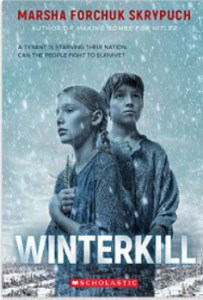
Winterkill, by Marsha Forchuk Skrypuch, Scholastic (September 6, 2022) Middle-Grade Fiction
 Winterkill will break your heart.
Once again award-winning Ukrainian Canadian author Marsha Forchuck Skrypuch (Making Bombs for Hitler, Traitors Among Us) gifts readers with a pitch-perfect, well-written, extensively researched novel that shows the human side up close and personal of those trapped within the clutches of an atrocity of history that many still say never happened, was a quirk of nature, Eastern European weather patterns, or bad luck.
Joseph Stalin engineered a blatant genocide against the Ukrainian people by the Soviet Union, especially the farmers. He stole their crops and the food in their pantries and gardens and took their personal possessions, farms, and their lives. Whether through fate or coincidence, history is repeating itself with this novel’s release as the Russian Federation has invaded Ukraine while it once again steals the country’s grain.
Nyl lives on a small family farm and, like many of his neighbors, is puzzled when the Russians increase crop quotas while sabotaging the farmers’ ability to meet those quotas. He meets Alice, an idealistic Canadian who comes to Ukraine with her father purportedly to help modernize the country’s farming methods, introduce the promised efficiencies of collectivization, and advocate for the acceptance of mechanization–especially tractors.
Skrypuch’s genius comes, in part, from making all of her characters three-dimensional, from those who hope to get by and those who turn on their neighbors as informers for personal gain. There are many points of view amongst these friends and neighbors and we see them clearly rather than as statistics delineating those who deny, who hide seeds and provisions, who try to escape, and who die without lifting a finger.
Alice appears at Nyl’s house with her father to take an inventory of everything in the house and on the property. Soon, it’s obvious that this inventory is helping the Russians dispossess the farmers and characterize them as an affluent, lazy drain on society. Alice doesn’t see the connection between her innocent task and the growing number of lost farms and deaths. By the end of the novel, Alice and Nyl are working together to survive and escape. The dead are everywhere. Food is nowhere.
The people in this novel make it work. We know them. We see them fight. And we see them perish under conditions that remind us of the Nazi terrors and the lack of a piece of bread.
–Malcolm
 Malcolm's Round Table